
DESCARTES (Cartesius), RENÉ. — Philosopher and scientist, b. at La Haye, in Touraine, on 31 March 1596, d. at Stockholm on 11 February 1650. He completed his studies (1604–12) at the renowned college of La Flèche, conducted by the Jesuits, where he received a thorough literary and scientific education: even when his thought led him in another direction, he always retained gratitude toward his first instructors and educators. His exceptionally gifted intellect revealed itself at once; his avidity for knowledge was great. After taking a degree in law at the University of Poitiers, following several journeys he entered, in 1618, as a volunteer gentleman, first into the Dutch army of Prince Maurice of Orange, and then into the army of Duke Maximilian of Bavaria. Around this time his vocation for the speculative sciences took shape, especially for mathematical physics and geometry. At the beginning of the winter of 1619 he was in Neuburg, a Bavarian city on the Danube, to spend those months of military service there: here, as he recounts, he had ample leisure to «remain with his thoughts». And here he first conceived the idea of a general method for acquiring knowledge, which he later developed and expounded. It seems that the idea flashed upon him in a dream on 10 November, which he interpreted as a heavenly sign of a task to which he had been called; consequently, in thanksgiving, he vowed to make a pilgrimage to the Holy House of Loreto: perhaps he fulfilled this vow some years later, when he came to Italy, going as far as Rome (1623–25). On his return, he is often found in Paris, where he probably strengthened his friendship with Fr. Marino Mersenne, of the Minims, who had also come from the college of La Flèche and was likewise deeply involved in the scientific movement, while at the same time being a zealous defender of the religious faith against the atheists and «libertines» of the rationalist current that was already spreading in this century. Mersenne would later become D.’s most assiduous correspondent and would often serve as the intermediary in his relations with the scholars, physicists, mathematicians, philosophers, and theologians of the time. In 1628 D. met Cardinal de Bérulle, founder of the Oratory, to whom, it seems, he presented the program of work he was planning to undertake, receiving from him encouragement and almost confirmation of the idea of a mission entrusted to him by God. He already felt mature for the undertaking; therefore, in order to distance himself from distractions and devote himself to it entirely, he decided to establish his residence in Holland, then a peaceful country, where he could live «as solitary and tranquil as in the most remote deserts».
The composition of his Regulae ad directionem ingenii most probably dates from 1628–29; he later left them unfinished (they were published posthumously only in 1701): here his new method was already set forth in full, inspired by the process of construction of the new experimental science, then represented by Galilei, while accentuating its epistemological aspect, with a predominance, nevertheless, of the purely mathematical part. Here, too, there was already the reform of the geometry and algebra then in use: the former, in his view, was too subservient to the figure, while the latter was hampered by complicated signs and too intent on practical results (to him is owed the introduction of the signs
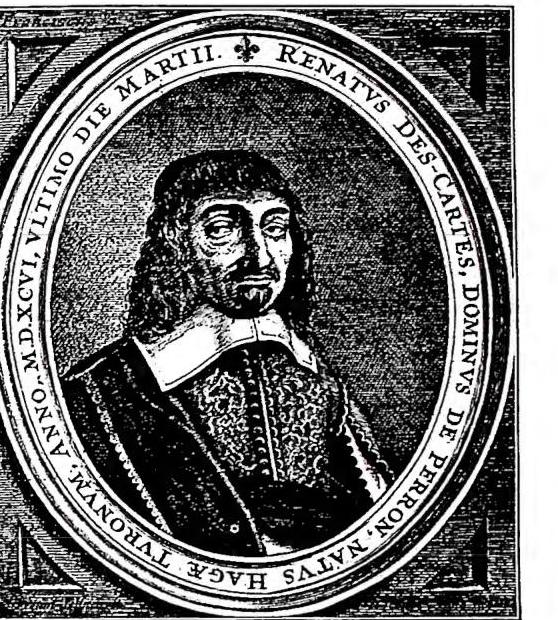
By now, however, D.’s name and the fame of his innovative genius had spread among learned men, and he finally decided to publish something. This was the historical origin of the much-celebrated Discours de la méthode (Leiden 1637), commonly regarded as the first clear announcement or manifesto of modern philosophy. In reality, he published it simply as an introductory essay to justify his method in scientific questions, and therefore placed it at the beginning of a volume containing three essays on physics and mathematics (at that time “natural philosophy” also included these subjects): La dioptrique, Les météores, La géométrie. When it appeared, the latter was the most widely read and discussed part, and only later, when D.’s philosophical thought began to be considered independently of his scientific thought, did people begin to publish the Discourse without the essays that followed II. It had, in fact, a very personal, autobiographical tone, and presented itself (being written in the vernacular, that is, in French) as a discourse addressed to a much wider public than that of professional scholars and philosophers: a kind of philosophy of “common sense,” which anyone outside scholastic jargon could understand. It is enough to recall Part 4, in which the famous principle Cogito, ergo sum is formulated, namely, the principle of the prior certainty and existence (in contrast with the existence of the external world) of the very person who, by thinking, makes existence a problem and is therefore conscious of himself (self-consciousness). This principle is followed by another, that of the existence of God, for which D. proposes a new demonstration, in his view irrefutable and more certain than even mathematical demonstrations, because it does not begin from the world (as was customary in scholastic philosophy), but from the self, that is, from the very existence of the being conscious of himself, who perceives his own limits and imperfections and therefore necessarily postulates, in the very act of recognizing those limits and imperfections, an infinite and perfect Being, from whom he derives.
This was followed by the Meditationes de prima philosophia (Paris 1641; the French version, revised by D., appeared in 1647; on the Index, decree of 10 October 1663 and 22 May 1720). Before publication, he circulated the text among several philosophers and theologians through Mersenne, so that they might raise objections to it, to which he would then respond. The text did, in fact, appear accompanied by these Objections and Replies. Most of them concern those points in which the break with traditional scholastic philosophy was evident. But philosophers already outside that tradition, such as Hobbes and Gassendi, also mounted vigorous opposition. A. Arnauld, who was already under the spell of this new philosophy, immediately brought to light one of its most obscure and difficult points: the doctrine of the union of soul and body in man, which for D. was a relation between two wholly heterogeneous substances, one conscious of itself (thinking), the other devoid of all consciousness and entirely material (possessing only the attribute, ultimately, of extension, to which D. reduced the essence of all matter). This dualism of thinking substance and extended substance did indeed have the advantage of purifying the concept of the soul’s spirituality of every corporeal, material image (and thus of more securely establishing its immortality); but, on the other hand, it also made the actual union of those two substances in the concrete unity that is the human person more obscure and difficult to explain. This is, in fact, the weakest point of Cartesian philosophy, which, on the one hand, seemed to raise the proper nature of the human soul almost to that of the angelic; while, on the other, it lowered animal nature to mere automatism: for, according to D., the animal too is like a machine constructed by nature, explicable solely through the elements of matter and motion, even if infinitely subtler and more complicated than the mechanisms that man himself can construct. As the best justification D. was able to offer for his dualism, one should recall Les passions de l’âme (Paris 1649; on the Index, donec corrigatur, decree of 20 November 1663), in which he demonstrated that the moral life of man could be explained equally well by his corporeal automatism (which, in his view, did not impair but rather made spiritual freedom more evident).
As regards religion, it may be said that Catholic theologians, although generally divided and often uncertain in their assessment of this new philosophy, respected the author’s undeniably orthodox intentions. He always openly professed his Catholicism, although he was careful not to enter into disputes concerning dogmas (only once did he attempt to explain transubstantiation in the Eucharist through his principles). Moreover, this philosophy took up again the theme of interiority that had been proper to s. Augustine, and reconstructed upon it the ontological argument proper to s. Anselm. The fact that it departed from scholastic philosophy, especially that of s. Thomas, did not seem sufficient reason to condemn it, if in the end it reached the same result in questions concerning reason no less than faith. Some Dutch Protestant theologians, however, did not think so, among them Gisberto Voëtius, rector of the University of Utrecht, who accused D. of atheism, had his doctrines condemned by the academic senate, and even obtained a decree from the civic authorities by which D. was to be expelled and his writings publicly burned. But the Prince of Orange and the French ambassador protected the philosopher, and the sentence was not carried out. Meanwhile, he was well aware that he could not win over Catholic circles unless he convinced them of the superiority of his philosophy over scholastic philosophy (to which, moreover, he remained far more attached than he supposed). At first, therefore, he thought of writing a work in which, for this purpose, his doctrines would be compared with traditional ones; then he changed his mind and decided to restate his own doctrine in a more systematic form and, as far as possible, in one closer to that customary in the schools, secretly hoping that his treatment might gain entry into them. Thus appeared the Principia philosophiae (Amsterdam 1644), in 4 books, translated into French by Abbé Picot in 1647; the first was devoted exclusively to philosophical principles, while the other three comprised the fundamental whole of Cartesian physics.
Meanwhile, the Protestant theologians of Holland did not leave him in peace, and he then decided to accept the invitation extended to him by Queen Christina of Sweden to go to her court in Stockholm. But he could not endure the severity of that climate and, having fallen ill with pneumonia, brought his life serenely and Christianly to its close.
Cartesian philosophy powerfully stimulated the speculative vein of the great metaphysicians who came shortly afterward—Spinoza, Malebranche, and Leibniz—while it also exerted considerable influence on the contemporaries and opponents Hobbes and Gassendi, already mentioned, and on Locke. But since it has become customary to regard the doctrines of those early thinkers almost as an inevitable logical development of that of D., it is appropriate to define more precisely the problem proper to D. in his works, which differed from that undertaken by the aforementioned successors.
D. is, first and foremost, a scientist, a mathematical physicist who, nevertheless, made science, and specifically mathematical physics, a philosophical problem as well, insofar as he asked what its metaphysical presuppositions were and ought to be (here too lies the difference between him and Galilei, apart from the other difference already noted, namely, their respective mentalities: one predominantly mathematical, the other more that of an experimental physicist). It is probable that these presuppositions had appeared to D.’s mind as early as 1628–29 with sufficient clarity; but their exposition was in fact formulated in three successive stages: in the Regulae, the Discours, and the Meditationes.
The Regulae ad directionem ingenii contain, in a much fuller and more reasoned form, the guiding criteria of scientific research, which are subsequently summarized in the four famous rules of the Discours (part 2). Here, by contrast, the rules number 21, and there would have been still more had D. continued along this path. But that is not important, for the essential point is already contained in the first part of the work (up to Rule 12). What matters more is that here the foundation is explored in a much more critically logical-epistemological direction. First of all, the superiority of the pure intellect over the faculties of the senses, imagination, and memory is asserted, and their relations are studied, whereby the latter may harm the pure intellect but may also assist it: everything depends on the clarity and distinctness of ideas, which are obtained precisely by purifying them of the influence of corporeal, external things, to which these faculties are subject. Ideas are the immediate object of the intellect, which is called intuition when their relation is grasped immediately, and deduction when it is grasped through a series of relations that ultimately connect one idea with another that is distant from II. Hence the necessity of memory, and the advice to repeat the chain of the process until, in a certain sense abolishing dependence on memory, deduction proceeds, so to speak, within the intuitive act itself. This is the new intuitive logic that D. wishes to substitute for the conceptual, syllogistic logic of scholasticism. But what is the origin and foundation of these ideas? Here D. sets forth his doctrine—no longer found in his later works—of simple natures, that is, the fundamental constitutive ideas for knowledge of things. Yet it seems to remain implicit that it is left to the scientist’s ingenuity to establish, case by case, which ideas are to be determined as fundamental in relation to others and in their reciprocal relations, given that this logic wishes to be above all not merely an art of reasoning, but an ars inveniendi. The same confidence, widespread at the time, that the question was one of method—of substituting a new “organon” (Bacone) for the one of Aristotelian origin, that is, a set of rules and precepts more closely corresponding to the procedures of the new experimental science—is balanced in D. by the explicitly declared conviction that constant practice in scientific inquiry is worth more than rules and precepts, together with “perspicacity” in intuiting and “sagacity” in deducing.
The Discours de la méthode, by contrast, despite its title, has a different tone and content: the question of method is addressed only in the first two parts, and is interwoven with autobiographical narrative, judgments on various kinds of learning, reflections on differences of ideas and customs among individuals and among peoples, and so forth. The rules are reduced to the four famous ones: never to accept anything that is not evident, that is, so clear and distinct to the intellect as to exclude every doubt; to reduce problems to their simple constituent elements; to proceed by gradual synthesis toward more complex forms of knowledge; and to undertake enumeration and final review. While awaiting the possibility of reducing morality as well to philosophically grounded principles, and since life allows no delay, D. offers in part 3 a so-called “provisional” morality, consisting of a few maxims: to conform to the ideas and customs of social life while always preserving one’s freedom of judgment; to be constant and resolute in action; to master one’s desires and seek happiness within oneself; and to devote oneself to a profession useful both to oneself and to others. Part 4 is central, and will provide the fundamental theme of the Meditations. In it he proposes the famous “methodical doubt,” from which there ultimately emerges the irrefutable evidence and certainty of the cogito against every form of skepticism. Hence the reduction of the soul to pure self-consciousness. There follow the proofs of God’s existence: a) from the idea of perfection, which cannot come to us from anywhere but God himself; b) from our own imperfection, which presupposes a cause of our existence other than ourselves; c) from the coincidence in God of essence and existence. Finally: we seek Truth and Good; but what meaning would “truth” and “good” have if God did not exist?
Subsequently, many reproached Cartesio for falling, in this demonstration of God’s existence, into a “vicious circle,” and the matter is still widely debated today: it seems, in fact, that he bases his demonstration, in accordance with his methodological principle, on the clarity and distinctness of ideas, while then making use of God’s existence, posited as the guarantee of the truth of our thought, to assure the truth of that principle. Cartesio defended himself against this accusation from the outset, but ineffectively: he did not clearly perceive that here there is what Rosmini would later call a “solid circle,” and that, moreover, if the criterion of clarity and distinctness could have its validity in the logical-epistemological sphere, here, in the case of God’s existence, there was a deeper reason, according to his own doctrine, in the need—indicated by his cogito—for a value transcending that of merely human thought. Part 5 first sets out the architectural outlines of his cosmology, then dwells at greater length on the movement of the heart, taken as an illustrative example of his universal mechanical conception. Here D. discusses the theory of the circulation of the blood, then recently discovered by Harvey, and proposes a different explanation, an unsuccessful one but more consistent with his “automatism.” Part 6 emphasizes the practical and utilitarian aspect of science, as well as the necessity of experience and collaboration for scientific progress.
This Discourse, varied and panoramic, is enlivened and sustained by the appeal of an elegant and lively style, and by a fine, open, and acute intelligence that became the model of the French spirit. The Meditations, on the other hand, while retaining the fluency and liveliness of thought, are more collected, confined to the central problem of Cartesian philosophy, namely that of the cogito, and pervaded throughout by an inner dramatic impulse, by a sense of problematicity (as it is said today). Hence the distinctive fascination of this work, brief in itself, in the text, but subsequently developed at length in the appended discussion of the Objections and Replies, which is more technical but no less instructive and attractive for the scholar, since it reveals the difficulties of the exposition. The first two meditations elaborate in breadth and depth the reasons for the initial doubt, carried to the point of paradox, where dream can no longer be distinguished from waking, and where it may even be supposed that an evil genius is deforming the reality of everything within our understanding; and they clarify further the meaning of the cogito, posited as the principle of the new philosophy. D., at first, had announced in the title of the Meditations that they demonstrated the existence of God and “the immortality of the soul.” Later, he realized that a true demonstration of the latter could not be provided by philosophy alone, and therefore restricted his thesis, in the title, to the “real distinction between the soul and the body in man.” Hence the insistence here on this distinction, from which it must follow that the soul is not, in itself, subject to perishing like the body. The III meditation deals with the existence of God. Here is presented the celebrated distinction of ideas into innate (which we find in ourselves through pure reflection upon ourselves), adventitious (which come to us from external things), and factitious (of which we ourselves are the authors). The idea of God is undoubtedly innate: from where else could it come to us? God is the supremely perfect Being and pure spirituality. The very idea that is in our soul demonstrates his existence, and it is like a sign imprinted upon our soul of its divine origin.
But here a possible objection arises: are we not subject to error even in reasoning that seems to us most firmly grounded? And might it not therefore happen that, although we clearly and distinctly see that this idea of God entails his existence, we are mistaken? The problem is discussed in the IV meditation, where the other celebrated Cartesian theory is expounded: the dependence of error not upon the intellect but upon the will, which, insofar as it is free, has a wider scope than the intellect alone and can therefore lead us to make judgments even when we do not conceive clearly and distinctly. In the V meditation the discussion moves to the problem of the external world, clarifying first of all the proper essence of material things (extension); but this provides an opportunity for a further proof of the existence of God, since, whereas for all other things essence does not entail existence, only in God are essence and existence found to coincide (a revival of the ontological argument). Finally, in the VI meditation, the question of the existence—not simply of the essence—of the external world is discussed. It is not that D. wishes, or ever truly wished, to doubt this existence: it is immediately given in sensation; but since, for D., sensations are obscure and confused forms of knowledge, which acquire the value of knowledge only when their content has been elaborated, distinguished, and clarified by the intellect, he now asks how we can “know” that existence, and what value and significance it has for us. It should not be forgotten that the essence of things had previously been clarified as purely mathematical; hence here “things” become that complex of sensations which were later called “subjective,” that is, not corresponding to the reality of the object considered scientifically. For D., these sensations have a practical, utilitarian, biological character: nature gives us the inclination to regard them as real in order to warn us of the benefit or harm that may come to us from things. In conclusion, these Meditations present the first attempt, in the modern era, at a critically and philosophically grounded spiritualism, although this attempt is made on the basis of the problem of science and knowledge and therefore appears one-sided, without an adequate development of that principle of interiority which we sense in Agostino as so full of moral and religious life. In this respect, one cannot but acknowledge the justice of the accusation directed against this philosophy: that it contributed powerfully, even against its intentions, to the spread of rationalism.
The Principia philosophica were then, and for a long time, regarded as the most mature expression of Cartesian thought, and even today this remains the most widespread judgment, especially among those who see in Spinoza its continuation and logical conclusion. But the deviation from the original spirit of the Meditationes is apparent simply from the importance accorded here, in book I, to the concept of substance, and from the univocity with which body and soul are placed in relation to II. This equality itself invites one to overcome dualism in Spinozist monism. This I is a hybrid book, composed in order to make the books that follow more readily acceptable; those books comprise the Fisica, which was here the subject closest to his heart.
Cartesian physics, insofar as it recognizes no valid concepts other than those of matter and motion, is characterized by the mechanistic ideal that inspires it throughout and that would become the fundamental characteristic of modern physics (so-called classical physics, now that physics seems to have taken another direction). But it must be added that this mechanism retains in D. a predominantly mathematical character, insofar as, distancing itself from democratic atomism and instead inclining toward “corpuscularism,” it posits the infinite divisibility of matter, denies the void and weight. The first law, here enunciated for the first time, is that of the so-called principle of inertia: “Everything remains in the state in which it is until something changes it.” But one must bear in mind the Cartesian concept of motion, which is “the transport of a body, that is, of a part of matter, from the vicinity of those bodies that immediately touch it, and which we consider to be at rest, to the vicinity of certain others.” Motion and rest, therefore, are merely relative terms. The second law states that “every moving body tends to continue moving in a straight line, which is the simplest of all,” without, naturally, excluding the possibility that, in concrete cases, this too may result from an infinity of other motions, as in the case, for example, of a diagonal resulting from motions in the two directions of the sides. The third concerns the alteration of the quantity of motion in two bodies that collide. This is the part that, neglecting concrete elements and factors of the mechanics of bodies, such as elasticity, mass, potential energy, etc., best revealed the abstractness of the purely Cartesian geometrical and kinematic approach, for which force itself is reduced to the concept of the pressure of one surface against another. This lack of dynamic principles subsequently marked his decline before the new Newtonian physics. Meanwhile, since for D. the quantity of motion is constant (for, he says, God created it as it is, and divine perfection also requires its immutability, so that the ordinary concurrence of God suffices for the world’s preservation), a vortical motion (tourbillon) arises in the absence of the void; this then breaks up into various systems corresponding to those of the stars and planets. Hence, too, his theory of the fundamental elements, the subtlest of which is light, which, according to D., propagates itself instantaneously, like motion in a stick. We shall not pursue an examination of his other doctrines. But it must be recalled that the predominant mathematical character of this physics, while at times inducing it to posit hypotheses or assumptions that still bear the mark of the apriorism of late Scholasticism (and against which experimental physics, from Newton onward, would direct its arrows: hypothesis non fingo), on the other hand gives this physics a more vivid sense of construction, indeed of reconstruction, as is in fact the work of science, which, in this respect, presents itself almost as an interpretation of God’s original creative work.
Cartesian physiology, too, as was mentioned in connection with animal automatism, has a strictly mechanical character. Already in the Discours, in place of Harvey’s principle of contractility, which to him smacked of an “occult power,” he substitutes “one of those fires without light,” similar to the fire that warms hay or that which makes new wine boil. He explains the circulation of the blood as follows. The more fluid parts of the blood, rarefied by heat and distributed throughout the entire organism, form the animal spirits, especially in the brain, indeed in the pineal gland; moving from there rapidly, like the particles of a burning flame, they move the nerves and muscles. The soul has its proper seat in the pineal gland.
Voltaire, disseminating Locke’s empiricism and Newtonian physics in France, called Cartesian physics and metaphysics “a novel” and thus contributed to the oblivion into which it rapidly fell in the following century. In this “novel,” the spiritualist note also disappeared, leaving only the other aspect of Cartesianism, its rationalistic aspect, which the Enlightenment of the century used and abused, especially against Catholic dogma.