
LORETO. – Diocese in the province of Macerata (Marche). It has an area of 17 sq. km. and 8,000 inhabitants, all Catholics. It comprises 4 parishes, with 2 diocesan priests and 56 religious, one seminary, 6 male and 14 female religious communities (Ann. pont., 1951, pp. 390 and 641).
The fundum Laureti belonged to the diocese of Umana; when the episcopal see of Osimo was transferred to Recanati on 22 December 1240, it became part of that diocese and followed its fortunes until 18 November 1320, when Giovanni XXII erected the diocese of Macerata, which also included L. It returned to the diocese of Recanati when the latter was re-established in 1357 and united with Macerata. In the Consistory of 5 November 1585, Sisto V proposed the erection of the diocese of L.; this was carried out on 17 March 1586 through the suppression of the diocese of Recanati, taking territories from Ancona, Osimo, and Fermo and assigning as its endowment the revenues of the diocese of Recanati and the property of the Shrine; at the same time, L. was constituted as a city. On 18 December 1591, the diocese of Recanati was re-established, but united with L. aque principaliter.
By decree of 11 October 1935, approved by the Pope, the Sacred Consistorial Congregation established that the pontifical administrator of the Shrine should have jurisdiction over the territory of the city of L. and its territory according to the present civil boundaries, thereby suspending the jurisdiction of the Ordinary of Recanati-Loreto. The administrator was to have as his vicar general a prelate endowed with episcopal character and to provide for the care of souls in the territory (AAS, 28 [1936], pp. 71 ff.).
THE SHRINE. – A first documented mention of an «ecclesia Sancte Marie que sita est in fundo Laureti» is found in a donation by Giordano, bishop of Umana, dated 4 January 1194 (a document reproduced by G. Garratt, Lorette le nouveau Nazareth, Lilla 1893, p. 281 ff.);
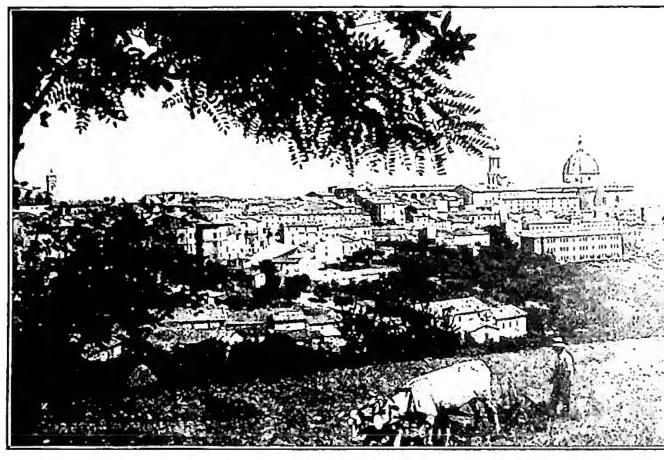
LORETO - Panorama.
The church had already become a sanctuary and a center of pilgrimage for the inhabitants of the region, and gifts were offered in honor of the Virgin venerated there. Indeed, on 9 November 1389 Boniface IX published a concession of Urban VI from 1387 in favor of the “ecclesia Sancte Marie de Laureto, Recanatensis diocesi quae... a christifidelibus illarum partium eius notitiam habentibus in magna veneratione habebatur”: all the faithful who visited the church on the Feast of the Nativity of the Virgin gained the indulgence granted by Gregory XI to the church of S. Ciriaco in Ancona. This is the first papal concession, though it was no different from the others granted in those years (J. A. Vogel, II, p. 119; M. U. Chevalier, pp. 170 f.).
Popular devotion continued to spread and grow: Flavio Biondo wrote in his Italia illustrata, around 1451: “Between Recanati and the Adriatic Sea... there stands in an open and undefended village the church of the Virgin Mary called that of L., most celebrated throughout Italy; and that in that place the prayers of those who beseech her are answered by God through the intercession of his Mother is demonstrated by the greatest and most certain proof, namely that the bishop, to the glory of God and the Virgin, keeps hanging the gifts of those whose vows have been answered, in gold, silver, wax, costly fabrics, linen and woolen garments, so as almost to fill the entire basilica.” The testimony of the historian and humanist, whose works were widely known, is of particular importance and is corroborated by other facts.
(courtesy of Prof. P. Toschi)
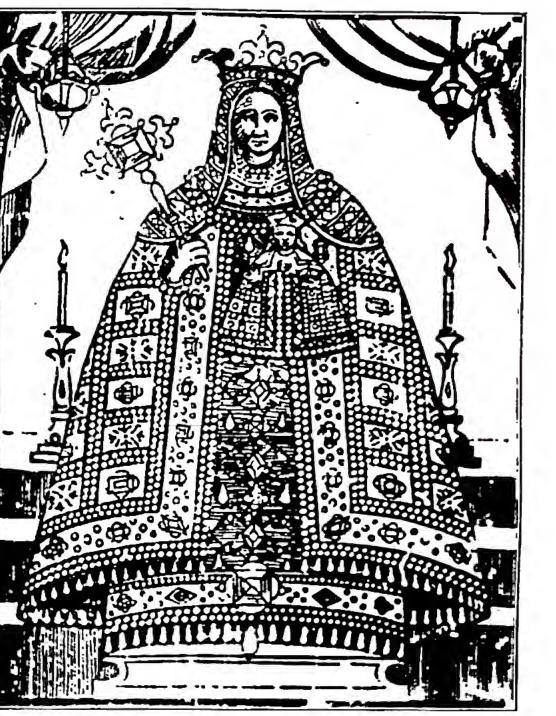
LORETO - Madonna. Popular woodcut from the Soliani presses of Modena.
no mention is made of the translation of the House. It is known, in fact, that in the Sanctuary a wooden statue stood venerated, 93 cm. high, painted blue and red with golden lines on the folds, while the faces of the Virgin and Child had been blackened by time (G. Garratt, op. cit., p. 168 ff.).
The constant growth of the crowds and of devotion created an entire complex of activities around the Sanctuary. In 1412 Andrea d’Adria was « capellanus ecclesiae S. Mariae de Laureto »; in 1428, having contributed to the foundation of a hospital, he assumed the title of « gubernator et administrator domorum et hospitalis almae et gloriosae Virginis Mariae de Laureto ». In 1441 there was a cemetery adjoining the church; indeed, bones of persons buried there were found within the Sanctuary itself (J.A. Vogel, I, p. 333). On 3 Dec. 1459 Niccolò Asti, bishop of Recanati and Macerata, made a donation for the maintenance of the provost, the other priests, and all the other servants and inhabitants « in domibus predicte ecclesie », as well as for alms to the poor « qui veniunt ad dictam ecclesiam » (M. U. Chevalier, p. 196 ff.).
This donation also names Pietro di Giorgio Tolomei, provost of S. Sinedeo at Teramo, « gubernator almae domus dicte ecclesie ». Tolomei, known as the Teramano, had come to L. in 1430 and died there in 1473. Around 1472 he composed in Latin a brief account of the origins of the Sanctuary: « La Chiesa della Beata Maria di L. fu la camera della casa della Beata Vergine Maria » and the Apostles and disciples « di comune consenso tutti stabilirono di fare di detta camera una chiesa in onore e memoria della Beata Vergine Maria e così fu fatto... ed il beato Luca Evangelista con le sue mani fece ivi una immagine a somiglianza della Beata Vergine Maria che sta ivi sino ad oggi ». After the Muslims had occupied the country, « gli Angeli di Dio tolsero via la detta chiesa e la portarono nelle parti della Schiavonia e la collocarono in un castello detto Fiume (10 maggio 1291) dove non fu onorata come conveniva alla Beata Vergine. Un'altra volta gli angeli la tolsero e la portarono sopra il mare nelle parti del territorio di Recanati e la posero in una selva che era di una nobildonna della città di Recanati chiamata Loreta (10 dic. 1294) e da allora quella chiesa prese il suo nome dalla signora che era padrona di quella selva, S. Maria di L. Durante il tempo in cui la chiesa era in quella selva, per l'eccessivo concorso di gente si commettevano in essa grandissimi latrocini ed innumerevoli mali. Perciò per le mani degli Angeli di nuovo fu presa e portata nel monte di due fratelli e sul monte fu posta per mano degli angeli (10 ag. 1295). Quei fratelli, per il grandissimo introito e lucro di denaro e d'altre cose, caddero in grandissime discordie e liti fra loro; e per questo motivo un'altra volta la tolsero dal luogo di quel monte e la portarono sulla strada commune e la collocarono colà e la stabilirono dove è ora (2 dic. 1295) ». « Ed allora tutto il popolo di Recanati si recò a vedere quella Chiesa che era sopra la terra senza alcun fondamento. Perciò il detto popolo considerando un miracolo tanto grande e temendo che la detta Chiesa rovinasse fece circondare la Chiesa di un altro grosso muro ed ottimo fondamento come ancor oggi si vede chiaramente. Ma nessuno sapeva donde questa chiesa fosse da principio venuta » (the dates are not the Teramano’s, but appear with the year 1525). Only in 1296 « la Beata Vergine apparve in sogno ad un santo uomo suo devoto e a lui lo rivelò e costui divulgò il fatto ad alcuni buoni uomini del paese che vollero subito venire al chiaro della cosa e d'accordo fra loro decisero di stabilire la verità della cosa, e cioè che sedici uomini notabili e buoni andassero insieme al Santo Sepolcro... ed a Nazareth ad investigare e portarono seco le misure della chiesa e trovarono là le fondamente della chiesa e constatarono che combaciavano perfettamente con essa; ed in una parete il presso è scritto e scolpito che la detta chiesa era colà e postea s'era allontanata » (G. Garratt, p. 273).
The Teramano’s account circulated widely and became the basis for the narratives that followed, such as that of the friar Battista Spagnoli, known as the Mantovano, in 1489 (G. Garratt, p. 275 ff.; for the date cf. Alfonso M. di Gesù, Gli oppositori..., V. BIBLICA., p. 24), and that of Girolamo Angelita, perpetual secretary of Recanati, around 1525. What is particularly surprising is the transport of the Holy House within a few years to four different places, and of the wooden image from the East, where such statues are not used. The bells, too, were said to have been transported together with the building.
Among the other confirmations and concessions of Sixtus IV, it is recorded that he granted the Sanctuary parochial status on 2 May 1482 and that in 1484 he established that the gubernator should be appointed no longer by the bishop, but by the pope himself. In 1488 Cardinal Girolamo Basso della Rovere, bishop of Recanati and Macerata, entrusted the Sanctuary to the Carmelite friars of the Observance of Mantua, who remained there only until 1497.
Finally, in a lengthy bull of 21 Oct. 1507, in which he reproduced the most important earlier documents, Julius II repeated with Paul II that « in predicta ecclesia de L. imago ipsius beate Marie Virginis » was preserved; not only that, but also « ut pie creditur et fama est », the same « camera seu thalamus » of the Madonna, summarizing what the Teramano had written on the subject. Thus the account of the Translation entered a papal document, although the Pope did not conduct a special investigation into what had been reported to him, as is clear from the cautious « pie creditur » (the very lengthy bull in M. U. Chevalier, p. 257 ff.).
On 8 Dec. 1514 Leo X established the Sanctuary as a collegiate church with twelve canons. On 1 Nov. 1554, fourteen Jesuits were introduced there as confessors, and two years later a college was founded for them. Gregory XIII likewise entrusted the College to the Jesuits; it had been founded by him and was later renewed by Urban VIII in 1627 for the education of young men coming from the opposite shore of the Adriatic.
To bring better order to the affairs of the Sanctuary and put an end to recurring disputes and conflicts of jurisdiction, Innocent XII established in Rome on 5 Aug. 1698 the Lauretana Congregation, with four cardinals under the presidency of the Secretary of State and with a governor or prefect (v. CONGREGAZIONI ROMANE, SACRE). Finally, on 8 May 1728, Benedict XIII granted the Sanctuary the honors of a minor basilica.
The Sanctuary suffered its first disruption of its traditional life at the beginning of 1798, when the French troops of Berthier plundered whatever had remained there after Pius VI had removed the treasure to place it in safety. The statue of the Virgin was then sent to Paris as a museum object; Napoleon had it returned in 1801 on the occasion of the Concordat (cf. A. Eschbach, Un decret..., V. BIBLICA., p. 71 ff.).
In 1860, after the Marches had been occupied by the Piedmontese army and papal rule had fallen, the new laws were applied to the Sanctuary as well. However, the Sanctuary’s extensive properties were not confiscated; by a decree of 8 Nov. 1860 they passed under an autonomous secular administration, which was subsequently reorganized by another decree of 22 Dec. 1861. With the Lateran Pacts and the Concordat, the Sanctuary returned to the direct administration and government of the Holy See, and Pius XI, by a brief of 6 Aug. 1936, granted pilgrims to L. the same indulgences that Pius X had granted on 17 Jan. 1905 to pilgrims to Palestine and Lourdes.
THE BUILDING. — The Holy House is a small building measuring internally 9.52 m in length, 4.10 m in width, and 4.30 m in height, without foundations. Originally it had a single door on the long northern side; opposite it, inside, stood the altar. At the top of the western side there is a small window, and above it an image of the Crucifix, which was said to have been painted by s. Luca. The upper part of the wall was decorated with paintings, now very faded, depicting the Virgin, s. Caterina, s. Giorgio, s. Antonio and, as was said, s. Luigi re; several superimposed layers of painting can also be discerned. Under Clemente VII the building underwent alterations: the ancient door was closed, and for the convenience of visitors the three doors now in existence were opened; under Paolo III the altar was removed and placed beside one of the sides
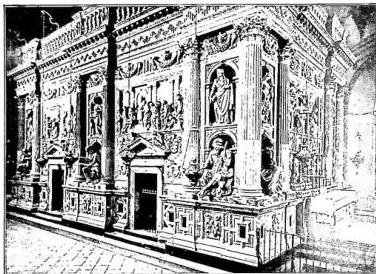
Only in 1468 did the construction begin of the great church with three naves, which holds the building of the Holy House beneath its great dome; its architect was Marino di Marco da Zara, and it was completed in its essential parts in 1471. On 10 November 1531 the foundation stone was laid of the marvelous marble casing that surrounds the Holy House like a box, without being attached to it; in this form the monument has come down to the present day. The church is 95 m. long, with three apses and 13 chapels; the octagonal dome was erected on eight pillars by Giuliano da Sangallo in 1498–1500; the façade was completed in 1570; numerous artists, including Bramante, contributed to the overall construction and to the modifications gradually made to II. The German aerial bombardment of 5–6 July 1944, which damaged the dome above all, necessitated extensive restoration work, but did not affect the solidity of the building.
The square extending in front of the Basilica is bordered on two sides by the great Apostolic Palace designed by Bramante; while the bell tower was built by Vanvitelli (1750–54). The fear of a possible assault by the Turks led to the monumental complex being given the appearance of a fortress, which it still retains. - Vedi tav. CVIII.
id., Lorette et l'ultimatum de M. U. Chevalier, Rome–Paris 1915; id., Un décret du St-Siège et l'étude historique de M. U. Chevalier sur la S. Casa de Lorette, ivi 1917; I. Rinieri, La S. Casa di L., 2 vols., Turin 1911; id., La S. Casa di L. e l'ultima critica di un Dottore Alemanno (Hüffer), Asti 1914; id., La verità sulla Casa di L., 3 vols., Turin 1910. Pio Paschini