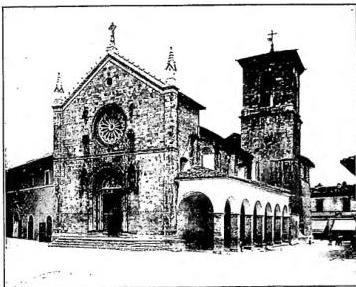
NORCIA

NORCIA. – A city and diocese in the province of Perugia (Umbria). It comprises 8 communes, 3 of which are in the province of Macerata (Castel S. Angelo, Susita, and Visso).

It extends over more than 110 square kilometers, with a population of 28,000 inhabitants, all Catholic, distributed across 102 parishes served by 85 diocesan priests and 11 regular clergy; it has a seminary, 3 male religious communities, and 16 female ones.

An ancient Sabine city; a Roman municipium from 292 BC; birthplace of the Flavii Vespasii, the Flavii Anicii, and Sertorius. It was contested by the Goths, the Byzantines, the Lombards, and the Franks, and sacked by the Saracens; donated in 962 by Otto I to John XII, it became a republic during the age of the Communes, suffering the struggles between Guelphs and Ghibellines; later, the popes entrusted the government of the city to prelates who assumed the office of prefect. In 1798 it was subject to the Trasimeno department; from 1809 to 1814 it belonged to the prefecture of Spoleto; it returned to papal rule from 1814 to 1860, when it was annexed to the Kingdom of Italy.

The first bishop was St. Stephen (c. 495); from the 9th century it was attached to the diocese of Spoleto, but was reestablished in 1820 by Pius VII, with Msgr. C. Bonano as its first bishop. It is immediately subject to the Holy See. The bishop holds the title of perpetual commendatory abbot of St. Eutitius.

The Cathedral, also called S. Maria Argentea, stands on the remains of a Romanesque building; it was rebuilt in the 13th century and demolished by the earthquake of 1328; the side portal dates to the 14th century. It was remade in 1560 and again in the 18th century. The bell tower, demolished in the 18th century, was rebuilt in 1859. The interior has three naves. The episcopal palace stands in the ancient monastery attached to the church, which on its right side has the portico called dei Mercanti, with the old measures for cereals.

The church of St. Benedict, which tradition holds was built on the noble house of Euproprius, father of Sts. Benedict and Scholastica, was constructed in the 6th century and belonged to the Benedictines of the abbey of St. Eutitius until 1280, when the abbey of Eutitius was demolished in 1344.

The Castellina was built by Pope Julius III, “to the praise of God’s glory, for the preservation of the ecclesiastical state, for the exaltation of the good, and for the confusion and perpetual despair of the wicked,” as one of the inscriptions on the towers, organs, and the fortress built by Vignola on the site where the temple of Fortuna Argentea is believed to have stood, later transformed into a church and demolished in 1554 for the new building. Now it houses state offices and the pretura. In the 14th century the Commune enclosed the city with high walls, which divided it into eight districts.

The Palazzo Municipale was built in the 13th century; of that period survives the portico with polygonal columns leading to the notarial archive. In the Sala dei Quaranta, where the peace observers gather, a Latin funerary inscription of the Roman Seftius, plebeian aedile of the 3rd century BC, is preserved. The council chamber, also called the “Sertoriana,” leads to the Secret Archive, which holds documents from the early 13th century. In the mayor’s office a precious reliquary of St. Benedict (1450) is kept.

Enrico Josi.

THE ABBEY OF ST. EUTITIUS. – In Valcastoriana near Norcia. Its origins date back to the 5th century; St. Gregory the Great celebrates in his Dialogues the glorious deeds of Sts. Spes, Eutitius, and Florentius, who first practiced ascetic life there, gathering numerous imitators and disciples, and soon saw the entire surrounding area populated with monasteries and hermitages, renowned for their holiness.

The Congregation of St. Eutitius reached its greatest splendor from the 9th to the 13th century. The former Empress Ageltrude, widow of Guido of Spoleto, enriched it with wealth; Otto III (996) and Conrad II (1027), Gregory IX, and Innocent IV granted it privileges; more than seventy parish churches and simple benefices depended on it; moreover, the abbey held feudal dominion over various castles and villages in the vicinity. Nicholas V in 1451 gave it in commendam to Cardinal D. Capranica, who restored monastic life there, which continued to flourish until well beyond the mid-17th century. Abbot Scaramellotti of Preci enriched the church with an elegant walnut choir stalls with carvings and inlays by Antonio Seneca of Piedivalle (1519), and a splendid marble ark for the relics of Sts. Spes and Eutitius (1514). It then passed into commendam, and Pius VII, upon restoring the diocese of Norcia in 1820, made its bishops perpetual commendatory abbots. Many of the codices from St. Eutitius, through the interest of St. Philip Neri, passed to the Vallicelliana Library in Rome and form its most precious nucleus. From the Eutitian Codex Vall. B 63 comes one of the oldest texts in the vernacular, the famous penitential formula from the early 11th century. The celebrated precarious medical school, specialized in the treatment of stones and cataracts, very likely also originated from St. Eutitius. The ancient church, rebuilt by Abbot Teodino I and completed in 1190 by the master marble-worker Pietro, was enlarged and embellished under Abbot Teodino II, who, among other things, in 1236 adorned its façade with a splendid rose window.

Bibl.: S. Gregory the Great, Dialogues, III, 15; IV, 10; PL 77, 247-57; 333-36; Acta SS. Martii, III, p. 177; Maii, V, p. 245; Iunii, I, p. 20; P. F. Kehr, Italia Pont., IV, Berlin 1909, p. 161; P. Pirri, L'Abbazia di S. Eutizio in Valcastoria, Castellano 1913; Cottineau, II, p. 266; Martyr. Romanum, pp. 115-16; 203-204; P. Pirri, La scuola miniaturistica di S. Eutizio in Valcastoria nel sec. X-XII, in Scriptorium, 3 (1949), pp. 3-10 with plates. For the penitential formula in the vernacular cf. G. Bertoni, in Studi medievali, 2 (1906-1907), pp. 588-89; P. Pirri, in Civ. Catt., 1936, I, pp. 324-35; S. Debenedetti, in Giorn. stor. della lett. ital., 109 (1937), p. 280

The problem of “normativity” has historically received various solutions. Positivism (v.) denies the normative function of reason and thus reduces ethics (v.) from a normative science to a mere science that records or explains facts (cf. L. Lévy-Bruhl, *La morale et la science des moeurs*, Paris 1903). In the conceptions that, under the influence of Kantian criticism, idealism, romanticism, and vitalism, regard the spirit as pure creative freedom, normativity is an essential moment of spiritual activity, which, by positing actual ends, limits itself in order to surpass itself through action. Ethics is therefore normative, but not a science; and it is normative only insofar as it is the self-deduction of the spirit to its own freedom. B. Croce sees this self-deduction in historiography (history as thought), which places the spirit in the actual interest of creative activity (history as action: cf. *La storia come pensiero e come azione*, 4th ed., Bari 1943). The philosophy of values, in its phenomenological position, considers the normativity of science as an essential moment in the development of the axiological cycle (cf. R. Polin, *La création des valeurs*, Paris 1944). Some contemporary thinkers, reviving elements Fouillée (v.), attempt to propose an ethics as a theoretical science intermediate between the normative, which they exclude, and the science of morals, which they deem insufficient (G. Gurvitch, *Morale théorique et science des moeurs*, 1937).

Christian thought is unanimous in recognizing in ethics both the character of a science and that of normativity: the norms it establishes do not arise from a mechanical determinism rooted in the psychic-social order, nor are they pure creations of the spirit; rather, they derive from an intellectual knowledge of the end, of the value of the end, of the real order for attaining the end, and of the concrete present situation with all its pressures and possibilities. Ethics is therefore a speculative science, which presupposes the positive sciences of morals; but it is also a practical science—that is, normative—because its end is the perfection of the practical intellect in view of the rectitude of human action (cf. J. Maritain, *Les degrés du savoir*, 3rd ed., 1934, pp. 618–26; 879–96).

No activity can be accounted for without a final cause: it is the will of the end that imposes order upon the end. “Rationis est ordinare ad finem, qui est primum principium in agendis” (*Sum. Theol.*, 1a–2ae, q. 90, a. 1): reason is normative only insofar as it orders toward the end. God, as first cause, orders every being to its end; His reason is at once supreme normativity and absolute. Irrational creatures participate in divine reason through the physical determinism of their activity. The human person, being spiritual, directs itself to the end, and thus, through reason, participates in divine reason, becoming normative in turn; the absoluteness and value of this normativity depend essentially on such participation. It is normative (reason in the subjective sense) insofar as, with the intellect, it possesses the habit of the first moral principles (v. SINDERESIS), with ethical science it establishes the value and content of the natural order, with political science it constructs the positive order (“politics is the most architectonic of sciences”: St. Thomas, *In I Eth.*, lect. 2, nn. 24–38), and with prudence it applies universal principles—both natural and positive—to the concrete act. It is normative (reason in the objective sense) insofar as, from general principles of the widest extension, through a process of composition (Johannes a S. Thoma, *Log.*, II, q. 1, a. 4)—in which speculative-practical intellect, experimental induction, philosophical deduction, the will of the end and of the means to the end, and all intellectual and moral virtues participate (St. Thomas, *In I Eth.*, lect. 3, nn. 32–42)—it descends to the fullest comprehension of the judgment of moral conscience.

BIBL.: N. Kaufmann, *La finalité dans l'ordre moral*, in *Rev. néos. de phil.*, 6 (1899), pp. 280–99, 352–70; V. CATHREIN, VIKTOR, *Filosofia morale*, trans. it., 2nd ed., Florence 1913; H. D. Noble, *La vie morale d'après St Thomas d'Aquin. La coscienza morale*, Paris 1923; G. Renard, *Le droit, l'ordre et la raison*, 1914; S. Deploige, *Le conflit de la morale et de la sociologie*, 1925; M. S. Gillet, *La morale et les morales*, 1925; E. Elter, *Norma moralitatis ad mentem D. Thomae*, in *Gregorium*, 8 (1927), pp. 337–57; L. Lehu, *La raison règle de la moralité d'après St Thomas d'Aquin*, Paris 1930; R. Le Senne, *Le devoir*, 2nd ed., 1931; Y. Simon, *Critique de la connaissance morale*, 1934; J. Maritain, *Science et sagesse*, 1935; J. Peghaire, *Intellectus et ratio selon St Thomas d'Aquin*, 1936.

V. Leclercq, *Les grandes lignes de la philosophie morale*, Louvain 1946; R. Le Senne, *Traité de morale générale*, 2nd ed., Paris 1947; various authors, *Fondazione della morale* (Atti V Convegno di studi fra filosofici cristiani, Gallarate 1949), Padua 1950; A. Lalande, *La raison et les normes*, Paris 1948.