
TAPARELLI D'AZEGLIO, LUIGI. – Jesuit philosopher, born in Turin on 24 November 1793, died in Rome on 21 September 1862. Prospero (his baptismal name, changed to Luigi upon entering the novitiate) was the son of Cesare, count of Lagnasco and marquis of Montanera, a man of ancient faith, and of Cristina Morozzo di Bianzè; the fourth of eight children, and brother of Roberto and Massimo (v.).
He completed his early studies at the Collegio Tolomei in Siena and continued them at the Turin Athenaeum, obtaining his teaching diploma on 15 November 1809. Appointed by Napoleon first as a student at the military school of St-Cyr and then at St-Germain, after seven months in Paris he obtained exemption from it on 22 October 1810, thanks to the intervention of the archbishop of Turin, Giacinto Della Torre, and was able to devote himself to sacred studies at the Seminary, in order to become a priest. After the fall of the Empire and the restoration of the former sovereigns, the marquis Cesare was appointed by King Vittorio Emanuele I as minister ad interim at the court of Pius VII, and took his two sons Prospero and Massimo with him to Rome. Meanwhile, the Society of Jesus was restored by the apostolic letter Sollicitudo of 7 August 1814, and Prospero offered himself among the first recruits who inaugurated the revived novitiate of S. Andrea al Quirinale on 12 November of that year. Having completed the ordinary training, he was made prefect of the Collegio di Novara (1818–24), where he was ordained a priest by his uncle, Cardinal Bishop Morozzo, on 25 March 1820; then he became the first rector of the Roman College, when it was restored to the Society by Leo XII’s brief Cum multa of 17 May 1824; subsequently he was provincial superior in Naples (1829–33), and finally was assigned to the Collegio Massimo in Palermo.
(courtesy of G. Bertuccioli)
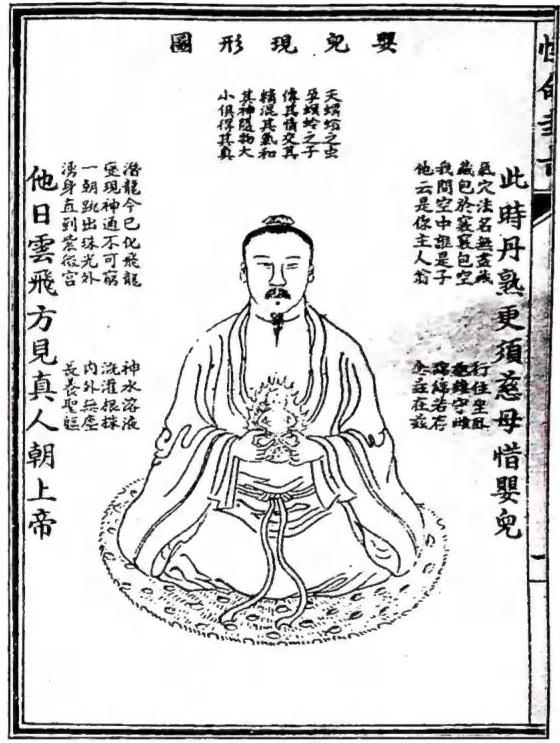
TAOISM — The formation of the immortal embryo. Illustration from the Hsing Ming Kuei Chih, a popular Taoist work of the eighteenth century, facsimile edition, Shanghai 1915.
berti, already his fellow student, etc. But it was a dream of brief duration; T. found himself attacked by defamatory publications, embroiled in controversies, and even suspected and arrested; consequently, he had to emigrate to France, where Fr. General Roothaan and his assistants were living in exile.
As the course of events rapidly changed, by August 1849 T. had returned to Palermo, where he attended to the reorganization of studies at the Collegio Massimo, until he was summoned to Naples to join the first editorial group of La Civiltà Cattolica (v.), founded by Fr. C. Curci, which began publication precisely in Naples in 1850 and was subsequently transferred to Rome after Pius IX returned there from Portici. And to La Civiltà Cattolica he devoted, without respite, the inexhaustible resources of his luminous intelligence, his vast learning, and his uncommon gifts as a writer, during the last twelve years of life that remained to him. Through the authority of his name and the series of his learned and profound treatises, T. contributed greatly to establishing the journal’s renown and worldwide prestige. The political-religious polemic with the brothers Roberto and Massimo, always courteous but without reticence, was T.’s preserve. In any case, the affectionate bond between them never failed, as demonstrated by the beautiful pages Massimo devotes to his «Jesuit» in Miei ricordi and by their correspondence.
(photo Evo. Cart.)
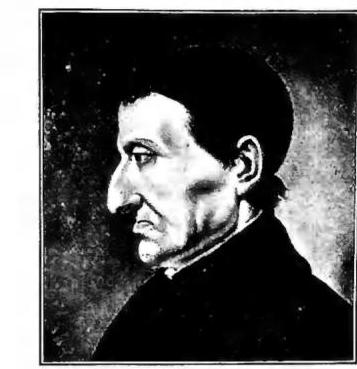
TAPARELLI D'AZEGLIO, LUIGI — Portrait. Rome, Collegio della Civiltà Cattolica.
students, and among the external pupils Gioacchino Pecci, the future Leone XIII, who understood him and remained faithful to him. Now, at the Civiltà Cattolica, the field was divided between Liberatore and T., reserving speculative philosophy to the former, and moral, political, and social philosophy to the latter, with ever-increasing success, finally crowned by the memorable encyclical Aeterni Patris of Leone XIII, which prescribes the philosophy of the Angelic Doctor for all Catholic schools.
As long as he enjoyed good eyesight, which weakened considerably quite early, he also cultivated painting and music. For many years he pursued the invention of a musical instrument which, by means of a mechanical device, combined the properties of keyboard and string instruments; the work was patented in 1854 under the title “violincembalo” and earned the praise of Franz Liszt, who had occasion to play it, but after four or five examples had been constructed, the instrument fell into disuse.
T.’s masterpiece, the work to which his fame is chiefly owed, is the Saggio teoretico di diritto naturale appoggiato sul fatto. It was conceived and compiled as a school textbook, and the author himself explains how this came about (Cartag., cited in the bibliography, p. 738). Having reached mature age, never imagining that he would become a professor or writer, partly because of his precarious health, he suddenly found himself transferred from Naples, where he was provincial, to Palermo to teach natural law, a subject with which he had not until then had occasion to occupy himself; and he found in his hands, as a school textbook, the poor Burlamachi, made worse by notes from a rabid royalist. He was therefore advised by friends to compile a textbook himself. This he did. Taking Grotius, Pufendorf, and those authors who at that time passed “for the only masters in this science” as his starting point, he constructed an ideal system in his own manner, constantly testing it, as it took shape, against the orthodox sense of the Church’s magisterium, St. Thomas, and the worthy but forgotten Scholastics. Nor was he slow to realize that “this science is already fully formed in the Scholastics, and particularly in St. Thomas, Suárez, Bellarmine, de Vitoria, etc.” (ibid., loc. cit.).
The work appeared in 5 vols. from the publisher A. Muratori of Palermo between 1840 and 1843, and even “in its form,” T. says, “it shows signs of improvisation, appearing at first as a single volume, to which a second, larger one was added for completion, and this in turn gave birth to three others much larger than itself, without a preconceived plan, without symmetry in its divisions—in short, like all improvised things.” However modest this 1st ed. may in truth have been, the favor with which it was received by competent readers was such that it was soon exhausted, and editions and translations into various languages multiplied during T.’s lifetime and after his death. With the most recent Roman ed. of 1949, it has reached its 11th reprinting, and its 7th since the definitive edition prepared by the author in 1855—a degree of success not so common in works of this kind.
One would be mistaken if, assigning a one-sided meaning to the words “appoggiato al fatto” added to the title, and to the other expressions “facts and inferences,” which also recur frequently, one understood them in a purely physical and experimental sense. Talamo explains this admirably: “Facts and inferences—this sovereign methodological criterion, he says, is T.’s constant motto, and it means that, having banished hypotheses from the domain of science, he wished to begin from the fact of consciousness and of human nature.” Thus, he adds, “he left us a splendid example of the only form of experimentalism that can be pursued with excellent results in the domain of the moral sciences, and which it is to the credit of Christian philosophy to have constantly vindicated, both against the subjective and fictitious creations of idealism and against the supine materialities of empiricism. Through his work T. provided a truly comprehensive and dialectical doctrine, which reconciles, balances, and consequently corrects the opposing excesses of idealism and empiricism.”
The Saggio is divided into seven dissertations, themselves divided and subdivided into chapters and paragraphs, and interspersed with numerous notes, which are at times veritable brief treatises, such as those on the influence of the clergy on civilization (XCVIII), on Kant’s Christian society (CXX), on the efficacy of Latin for the universality of science and civilization (CXXVII), and on nationality (CXLᵃ). The latter may be regarded as the first systematic treatment of the subject, and gave rise to discussions and controversies on the part of C. Balbo, V. Gioberti, and others.
Beginning with an examination of law and individual action, the Saggio proceeds to treat of social being, the action of the individual, both in the formation of society and within society once formed, the relations between morality and politics, and the reciprocal relations between societies.
The final dissertations, especially, contain perhaps the most personal and original part of the work, “an outspokenly Taparellian treatment, rich in moral and social insights that we might call modern in the best sense of the word.” (Foroni, op. cit. in the bibliography, p. 83). In particular, reference is made to that international organism which he calls “ethnarchy.” From the reciprocal relations among several societies tending toward the same end, T. sees arising, through an irresistible force inherent in their very nature, the need for a higher order and law, tending to bind them into a federative unity. Others have seen in this conception almost an anticipation of the eventual League of Nations and of today’s United Nations (cf. A. Brucculeri, Un precursore italiano della Società delle Nazioni, in Civ. Catt., 1926, 1-11).
The idea was not new, as T. himself acknowledges; from St. Augustine to the late Scholastics and the natural-law thinkers of the 17th and 18th centuries, this natural tendency of civilized and free peoples toward a higher union for the common good had been glimpsed. T.’s merit lies in having studied the problem, to which he devoted the entire V dissertation, with the greatest concreteness and breadth of vision; and in having illuminated its various aspects, both rational and practical, eliminating whatever others might have introduced into it that was utopian and false. T. attributes to this ethnarchic society the highest aims, in support of justice and progress, religion, and peace among peoples.
An Epilogue general to the entire work is appended to the Saggio (printed separately by F. Pergolesi, Bologna 1940); suitably rearranged and expanded, it gave rise to a Corso elementare del natural diritto ad uso delle scuole, which first appeared in lithographed form in Naples in 1843 and was then printed in 1850. As a school manual it enjoyed great popularity and went through various editions, the most recent of which are the Latin edition prepared by C. Pollando, published at S. Francisco di California in 1890, and the Portuguese edition prepared by N. P. Rossetti at S. Paolo in Brasile in 1945.
The second of T.’s major works is Esame critico degli ordini rappresentativi nella società moderna (2 vols., Rome 1854), a thorough critique of liberal doctrinairism and modern parliamentarianism, according to the less than happy embodiments of which examples were seen after 1848, especially in Piedmont. T. was prompted to undertake this treatment in Civiltà Cattolica by an anonymous letter sent to the periodical; and, given the various aspects and important subjects it encompassed, it expanded far more
than the author had intended, so as to provide material for many articles published from 1852 to 1854. In collecting them into two volumes, the author sought to give the material greater cohesion and to eliminate the occasional and ephemeral parts; nevertheless, it still retains the color of the time and circumstances in which it was written, especially in the lively and at times harsh tone of its polemic. It is divided into 2 vols. and two parts: the first is devoted to general theoretical principles, the second to the practical implementations of “modernized governments,” especially in Piedmont, which the author never loses sight of. The work had only one edition and is today almost forgotten. It nevertheless contains the sharpest and most telling critique to which modern representative methods have been subjected.
Civiltà Cattolica offered T. ample scope to unfold the treasures of his inexhaustible vein and vast learning: it would be lengthy to enumerate the articles or series of articles published in that journal on the most varied subjects. Only the last series of articles he began publishing in 1836 on political economy will be recalled, a series left unfinished by the author’s death, but of such interest that T.’s biographer, l’abbé Jacquin, thought it useful to collect them in a volume and publish them in French translation under the title: Essai sur les principes philosophiques de l'économie politique (Paris 1943).