
GROOT, HUIG van (GROZIO). – Dutch jurist, b. at Delft on 16 April 1583, d. at Rostock on 28 August 1645. He studied classical languages and literature at Leiden; thereafter, having gone to France on an embassy to Henry IV with the grand pensionary Oldenbarneveldt, he received his doctorate in law at Orléans (1598).
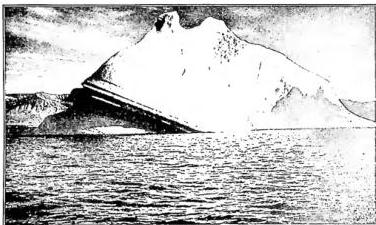
(from L. A. Boyd, The fiord region of east Greenland, New York 1935, p. 17) GROENLANDIA – Large iceberg in Franz Josef Fjord near Cape Petersen.
assertion of Christ’s redemptive function is his Defensio de satisfac- tione Christi adver- sus Socium (Leiden 1617). His tolerant attitude subsequently led him toward an ideal of religious universalism, of which the state was to make itself the instrument. The victory of the Gomarists at the Synod of Dort (1618), and the consequent condemnation of the Arminians, led to Oldenbarneveldt’s death and G.’s condemnation to life imprisonment (1619). Having managed to escape adventurously after two years with the help of his wife, he took refuge in Paris, where he resumed his campaign on a theoretical level, combating Pelagian doctrines in the Disquisitio an Pelagiana sint ea dogmata quae nunc sub eo nomine traduntur (Paris 1622); the De veritate religionis Christianae (Leiden 1627), the Via ad pacem ecclesiasticam (Paris 1642), and the Votum pro pace ecclesiastica contra Rivetum (Amsterdam 1642) return to the theme dear to him of political understanding founded on the commonality of Christian ideals, bringing him closer to Catholic positions. In the Annotationes in libros Evange- liorum (there 1641), ad Vetus Testamentum (Paris 1644), and ad Novum Testamentum (posthumous, there 1646–50), he resumed Erasmus’s objective of a scientific critique of the Bible aimed at restoring true Christian doctrine. Nor did he neglect historical studies, publishing a Dissertatio de ori- gine gentium Americanarum (Amsterdam 1642) and a Dissertatio altera on the same subject (Paris 1643). He had been appointed ambassador of Sweden to Paris as early as 1634, but, having met with no success in his new diplomatic post, he secured his release from it in 1645. Known above all for the De iure belli ac pacis (there 1625), he was hailed for this work as the father of modern natural law. Its objective is the foundation of a universally valid science of law, in order to provide a theoretically secure basis for the peaceful coexistence of nations; to this end G. distinguishes the state and law of nature from the civil state and law, and ius naturale from ius voluntarium. The former arises from a natural need of the human soul, the appetitus societatis, as Aristotle had already affirmed, and therefore cannot be derived empirically from human acts and will, as the latter can. Founded only mediately on the divine will, insofar as this is nevertheless the source of human nature, it is valid « etiamsi daremus... non esse Deum » (Proleg., § 11) and is « adeo immutabile ut ne a Deo quidem mutari queat » (I, 1, § 10). The state of nature is therefore governed by this absolute ius naturale, and is a condition of peace, freedom, and communion of goods. With the development of society through consensual pacts, there is a transition to the civil state. The latter arises from a free contract for the purpose of harmonizing interests, regulating them through ius civile, whose ultimate foundation, through the pact, is always natural law. The sovereignty of the state, arising from the contract, is therefore superior to individual wills. But this dominium eminens must be exercised in the common interest and to ensure the implementation of natural law. In the international sphere, in the absence of a supreme authority, norms do not have an imperative but a consensual character, and their foundation is precisely natural justice. Omnia opera theolo- gica by G. are included in the Index (decree of 10 May 1757).