
GUATEMALA. -
I. GEOGRAPHY
It is the northernmost and most populous State in Central America, situated between Mexico, Honduras, and Salvador.Of its two ocean-facing sides, that on the Pacific is much more extensive: both, but especially that on the Atlantic, correspond for the most part to low and flat areas. The interior is a highland region, cut by deep valleys and dominated by volcanic peaks (Tajumulco, 4210 m.). The hot, humid climate varies with altitude; it is unhealthy along the northern coast, fringed with lagoons.
The population (3.7 million inhabitants, distributed over 109,724 sq km) consists of 65% Amerindians and 30% mestizos. Whites account for barely 10%; Italians number approximately one thousand. G. is an agricultural country: the predominant crops are coffee, sugar cane, and bananas. Livestock raising
and forestry (mahogany, cedar) are of some importance; industry, including extractive industry (salt, gold), is limited.
G. is a unitary republic, with a single-chamber elected representative system. Guatemala la Nueva (at an altitude of 1400 m) is its capital (200,000 inhabitants).
II. CIVIL AND RELIGIOUS HISTORY
Spanish sovereignty over G. was proclaimed at Almolonga in 1524 by Pedro de Alvarado, one of Fernando Cortes’s lieutenants. The evangelization of the largely peaceful Indian population of the present-day state of G. was begun shortly after the conquest, in 1523 and 1524, by the Franciscans, Dominicans, and Mercedarians. Among the warlike Indians of Tuzutlan, Bartolomeo de las Casas carried out his peacemaking mission from 1537 onward, as a result of which the region was given the name Vera Paz. In1534 the diocese of Santiago de Guatemala was established.
The first Franciscan bishop, Marroquín (1534–65), devoted himself energetically to the conversion of the Indians and was the author of the first catechism in the indigenous language of the country. In this way, by the end of the 16th century, the conversion of G. was essentially complete. Even today, the peaceful Indian farmers constitute the majority of the population of G.
In 1821 independence from Spain was proclaimed, and the following year annexation to the Mexican Empire of Iturbide took place.
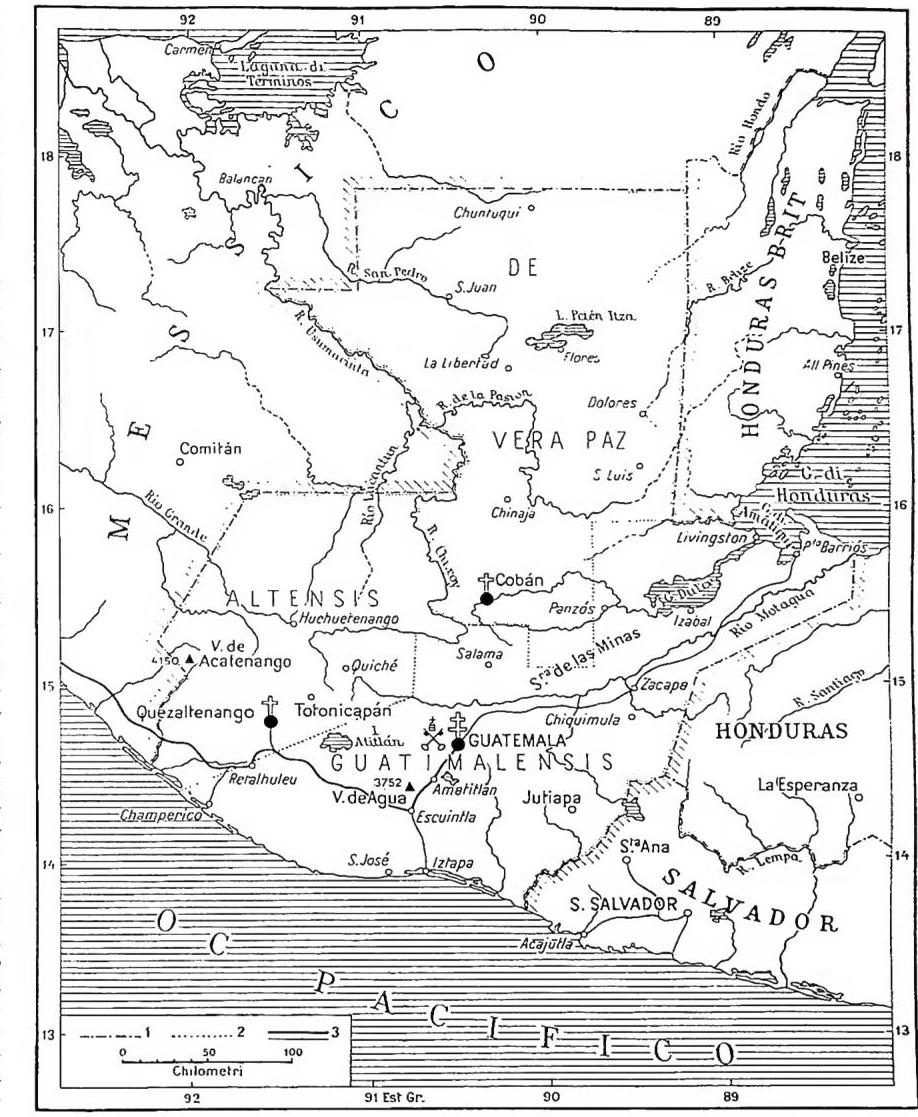
GUATEMALA – Map of the ecclesiastical districts. 1) State boundaries; 2) Boundaries of the ecclesiastical districts; 3) Railways.
(from R. Riccardi, Central America, in Universal Geography, vol. VI, part 5, p. 561, Turin 1925)
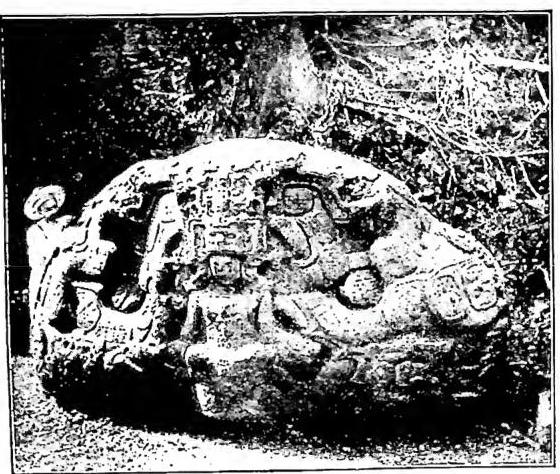
GUATEMALA - “La Tortuga,” antiquities of Quiriguà, in the Montagua valley (Valdeavellano).
This Concordat did not remain in force for long. The government that came to power following the so-called liberal revolution in June 1871 took no account of it; indeed, the archbishop of G., the auxiliary bishop, the archbishop’s delegated vicar, and the Jesuits were expelled from the Republic, while all the flourishing religious communities were dissolved one after another; all the Church’s property was confiscated.
An attempt to regulate the most serious and urgent issues with the Holy See was made by General Barrios, and on 2 July 1884 a new Concordat was signed, in which some of the Church’s principal rights were recognized. But it was not ratified and remained a dead letter.
Under Barrios’s successors, measures of harassment against the Church continued; there were, however, attempts at rapprochement on both sides, which led in 1936 to the successful establishment of diplomatic relations.
From then on, the political and religious situation became in fact somewhat better, nor were the legal provisions contrary to the Church always and in every respect applied with absolute rigor. The legal situation, however, remained unchanged and is still unsatisfactory. The new constitution, promulgated on 11 March 1945, while recognizing freedom of every religious profession, maintains almost unchanged the provisions of the constitution of 1879 that were contrary to Catholic rights and interests; indeed, it further aggravated them by prohibiting “religious societies and groups,” “their members as such, and ministers of religion” from “intervening in politics and in matters connected with the organization of labor” (art. 29).
The Catholic Church is not recognized as a juridical person. Religious congregations and monastic institutes or associations of any kind are forbidden to establish themselves in the territory of the Republic (art. 32). Article 28 prohibits every institution in favor of mortmain and, in authorizing the creation of trusts, explicitly and absolutely excludes religious and monastic congregations, as well as priests or ministers of any faith or religion.
No juridical effect is recognized for religious Marriage, the celebration of which may not precede that of the civil act.
Among the fundamental principles concerning education, the constitution affirms the secular character of instruction (art. 81). Religious instruction is permitted in private institutions. These are subject to State inspection and, for the studies given there to have legal validity, they must obtain express authorization and adopt the official curricula (art. 81).
Guatemalan legislation, unlike that of many Republics of Central and South America, shows no traces of a national patronage in ecclesiastical matters, such as, for example, in the appointment of bishops.
III. SCHOOL SYSTEM
Art. 18, title II, of the Constitution of G. establishes that the education of children from 6 to 14 years of age must be compulsory, free, and secular. The secular character of the school is further confirmed by art. 24 of the same Constitution (title II, « De las garantías »), which establishes that religious instruction may be given only in churches. The Constitution does not, however, prohibit the establishment of private schools, provided that they maintain the secular character of the school.The State seeks to reduce the number of illiterates and to spread education, especially practical and rural education, by encouraging the establishment of practical schools, rural schools, and evening schools and courses. The tropical climate and inadequate communications have led the State to establish numerous schools in order to educate the young population, 60% of whom are indios; thus a country of 2,500,000 inhabitants has 3,500 State schools, divided into 1,580 boys’ and 1,920 girls’ schools, in addition to 236 private boys’ schools and 137 private girls’ schools. Teachers are trained in the 22 teachers’ academies and in the central normal school for professors.
Higher education is provided at the « Escuela de agricultura », the Academy of Fine Arts, the National Conservatory of Music, and the Universidad Nacional of G., founded on 15 Sept. 1918 after the suppression, by decree of 2 May 1918, of the higher schools of medicine, law, and engineering. The education of the Catholic clergy is provided at the « Seminario de Santiago » in G.
IV. ARCHDIOCESE OF G
Archdiocese and capital city of the state of the same name in Central America. The archdiocese, also called S. Giacomo de G., has an area of 36,370 sq. km. and a population of 1,980,000 inhabitants, of whom 1,922,000 are Catholics; it has 65 parishes, served by 47 diocesan and 40 regular priests, one seminary, 6 male religious communities and one female community (1949).The diocese was created by Paolo III on 18 Dec. 1534, and its first bishop was Msgr. Francesco Marroquin. Benedetto XIV raised it to metropolitan status on 16 Dec. 1743. Between 1872 and 1874 the religious communities were suppressed; among the female ones, only the Sorelle della Carità di S. Vincenzo de' Paoli remain.
The Cathedral is dedicated to the apostle St. James the Greater. The suffragan dioceses of G. are Quezaltenango and Vera Paz.