
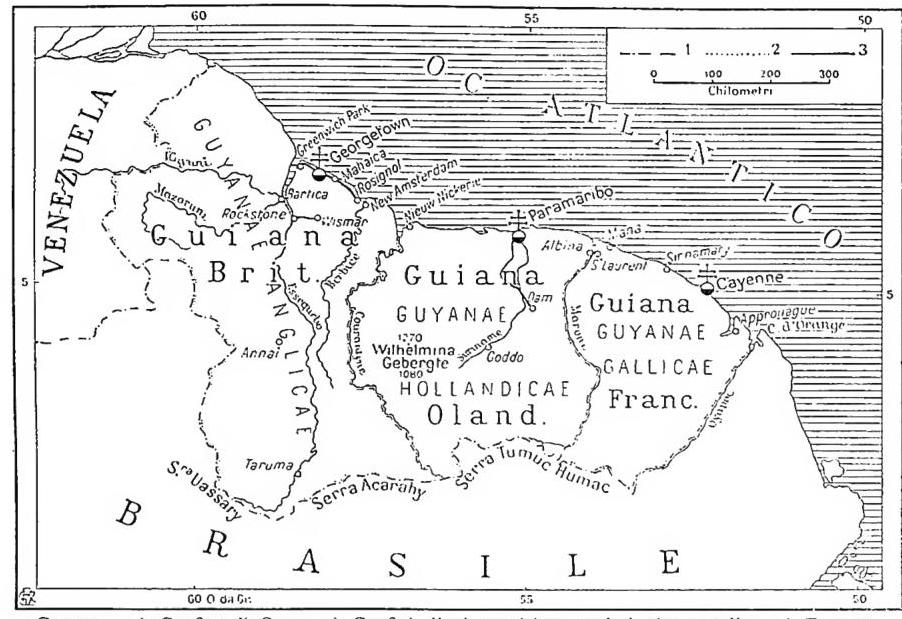
GUIANE. – The name G. is generally given to that extensive (approximately 900,000 sq. km) mountainous region of South America enclosed between the lower courses of the Orinoco and the Amazon and bounded on the west by the Cassiquiare. It consists of a series of ancient uplands, now levelled and reduced to a succession of plateaus, deeply cut by rivers and sloping towards the north, where they descend to the sea across a narrow, flat, unhealthy alluvial strip, while towards the interior they present their steeper side (maximum elevation 2,632 m in M. Roraima). Given the climate (equatorial, with very heavy rainfall), the predominant landscape is forest: the rivers are numerous and abundant in water, but interrupted by
The sparse population (perhaps one million inhabitants in all, on average 1 per sq. km.) consists predominantly of Negroes and Asians (Indians, Malays, Chinese), transported there to work on the plantations (sugar cane, coffee, cocoa, coconut palms). Forest resources are considerable but still essentially untouched, as are the mineral resources, among which only gold, diamonds, and bauxite have so far been exploited. Livestock raising has considerable potential, but is still in its early stages.
Leaving aside the northwestern and southern regions, which fall within the boundaries of Venezuela and Brazil (more than half of the total), the Guiana is divided among Great Britain, the Netherlands, and France, which there possess the only South American territories dependent on European powers.
British Guiana is the northernmost, lying between the Orinoco and Corentyne Rivers; it is the largest (231,774 sq. km.), the most populous (381,000 inhabitants), and the most economically developed. Plantations and the extractive industry permit the considerable export of bauxite, gold, rice, rum, diamonds, etc. Livestock raising (cattle) is also flourishing. The capital is Georgetown (78,000 inhabitants).
Dutch Guiana, or Suriname, lying between the Corentyne and Maroni Rivers (156,000 sq. km., with 208,000 inhabitants, one third of them indigenous), has been a member of the Dutch Union since 1948. The plantations, once flourishing, declined with the abolition of slavery; recently, a certain economic recovery has taken place in the mining industry (bauxite extraction). The capital is Paramaribo (73,000 inhabitants).
French Guiana, between the Maroni and Oyapock Rivers, is the smallest (91,000 sq. km.), the least populated (37,000 inhabitants, excluding the indigenous population), and the most economically backward. Plantations, forestry, and the extractive industry (gold) are in decline there. Since 1947 it has been transformed into a French département. The capital, Cayenne (12,000 inhabitants), was notorious for its penal colony, now abolished.
On 12 April 1837 the Apostolic Vicariate of British G. was erected, separating its territory from the Apostolic Vicariate of the English, Danish, and Dutch islands, to which Barbados Island was united on 20 March 1850. In 1847 the Ursulines went there, and in the following years others joined them. On 6 August 1856 the Apostolic Vicariate was entrusted to the Jesuits, who founded new churches and established new schools and hospitals as well. In 1943 Catholic Action was established under the title of Steard of the Spirit. It has an area of 216,926 sq. km., and the entire territory is an English colony. The population is 375,819 inhabitants, composed mainly of Indians and Africans. The aboriginal population is very small. Almost all speak English. There are approximately 48,474 Catholics. Of the Indians, almost 85% are Hindus and 15% Muslims. The remainder of the population is Protestant, divided among various sects. Barbados Island has 192,991 inhabitants, with only 2,500 Catholics and all the others Protestants. The statistics for 1949 give the following figures: Catholics 52,500, catechumens 700, indigenous priests 4, foreign priests 31, indigenous nuns 42, foreign nuns 45, catechists 67, major seminarians 1.
Saverio Paventi
II. THE APOSTOLIC VICARIATE OF FRENCH G.
- G. was occupied by the French in 1604. Ship chaplains and occasional priests initially attended to religious assistance. In 1651, the apostolic prefecture of the islands and mainland territories in America subject to the king of France was established and entrusted to the Jesuits. The Fathers soon settled in Cayenne, and in 1731 obtained the erection of G., separated from the other aforementioned territories, as an apostolic prefecture.
When the Jesuits were expelled from the French territories (1762), they nevertheless managed to remain in Cayenne together with a secular priest sent by the court of France and appointed parish priest for all of G.; until, in 1775, the prefecture was entrusted to the student priests of the Seminary of the Holy Spirit, founded in Paris by Abbé Poulard des Places. These too were dispersed by the Revolution, and the apostolic prefecture of G. was unable to function regularly until after 1817, that is, after the reestablishment of the aforementioned Seminary. Even when the Society of the Holy Spirit became a religious Congregation, the Fathers continued their mission in G. Expelled from the colony in 1893, they had to yield the apostolic prefecture to priests of the secular clergy, taking it back only in 1925. The vicariate was erected on 10 January 1933. The mission covers 116,000 sq. km, with a total population of 42,700 inhabitants, of whom 36,000 are Catholics, 200 Protestants, 1,500 Muslims, and 5,000 pagans.
The clergy consists of 7 secular priests and 15 Fathers of the Holy Spirit. There are also 2 lay brothers and 73 sisters. There are 16 parishes, 6 churches, and 32 chapels; there is one hospital, 4 orphanages, 1 leprosarium, 4 elementary schools, and 1 middle school. In addition, there are various confraternities and lay associations. The people’s morals leave much to be desired.
III. THE APOSTOLIC VICARIATE OF DUTCH G
The territory is under the rule of the Netherlands, which, after various vicissitudes, definitively took possession of it in 1816. Earlier, in 1640, the French had occupied the mouths of the Suriname River; the English and then the Dutch succeeded them. Portuguese missionaries had begun evangelization there, but the greed of the new colonizers and their Protestant fanaticism destroyed every trace of II. Only in 1775 were Catholics permitted to resume evangelization, and Propaganda sent two secular priests there, who met with no success. After 17 years, another secular priest and a Franciscan went there, but they were unable to initiate any genuine missionary activity.The true founders of the mission were the priests Wennelers and Van der Horst, sent by the archpriest of Haarlen (1817), who first among the old Catholics and then among the pagans gathered good fruits. One of the aforementioned priests was granted the faculties of an apostolic prefect; these were subsequently extended to the entire coast of South America from Suriname to Brazil, for places not subject to another Ordinary, and to the Island of Curaçao. From 1825 to 1865, history records the names of another 18 priests, all sent from the Netherlands, who worked amid every kind of difficulty and in the face of Protestant opposition.
The apostolic vicariate of Dutch G. was erected on 12 September 1842, through the elevation of the apostolic prefecture dating from 22 November 1817. In 1865, Dutch Redemptorists arrived there and found 12,000 Catholics. They immediately undertook systematic work among the various ethnic groups, establishing schools and charitable institutions (the Ven. Fr. Donders devoted himself to the apostolate among lepers). The number of Catholics at present reaches 34,000, and that of catechumens 132, over an area of 142,822 sq. km. There are 43 priests, with 59 brothers and 182 sisters, of whom 25 are native. Catechists 44; Protestants 48,685; Jews 910; Muslims 55,534; Hindus 33,764; Confucianists 1,641; pagans 23,210. Districts 10, quasi-parishes 5, primary stations 9, secondary stations 10, sacred buildings 64, hospitals 1 with 80 beds, dispensaries 8, orphanages 2 with 52 children, 2 homes for the elderly and 1 for lepers; elementary schools 22 with 732 pupils, middle schools 33 with 8,159 pupils, secondary schools 4 with 3,170 pupils, vocational schools 12 with 319 pupils, teacher-training schools 27 with 2,087 pupils.