
ORSOLINE. – Name of the religious congregation founded by St. Angela (v.) Merici, after which many other congregations of the same name developed, but with different habits and customs.
I. COMPANY OF ST. URSULA. — Founded at Brescia on 25 November 1535 by St. Angela Merici of Desenzano. It is the first female secular institute to arise in the Church. Its members remain in their families and devote themselves to all works of charity that fall within a woman’s sphere, but above all to the teaching of Christian doctrine as a means of combating errors and corrupt morals. Through the sanctification of women in the domestic hearth, it seeks to bring about the renewal of society. The Rule, composed by St. Angela for her Company of secular virgins, was approved by the bishop of Brescia, Msgr. Cornaro, on 8 August 1536. In turn, after the founder’s death, Paul III approved it on 9 June 1544.
The Company spread rapidly throughout Italy. Cremona was the first city to receive it, in 1565. Then St. Carlo Borromeo had the Rules sent to him in order to establish it at Milan in 1566, and at the provincial council of 1576 he recommended that all his suffragans establish it in their cities, as an excellent means of reform. In 1581, after the apostolic visitation conducted at Brescia, he approved the Rules anew and obtained their confirmation from Gregory XIII (24 December 1582). Before long, Lombardy and the Veneto saw O. flourishing everywhere.
From Italy the Institution passed into Switzerland and from there into France, thanks to the activity of the ven. Cesare de Bus, founder of the Doctrinarians. In 1594 Fr. Romillon gave the ven. Francesca de Bermond and her companions the Rule written by St. Carlo for the Milanese O., who lived in community, and established them at Isle-sur-Sorgues, in the Comtat Venaissin. This was the origin of the French O. Other similar congregations soon arose in various parts of France, but without any bond of affiliation among them; consequently, eight different branches of monastic O. later arose from them (v. sotto),
Meanwhile, at Brescia, the Company of St. Ursula preserved its primitive form and flourished there until the French Revolution, when all associations of nuns were prohibited; the Company of St. Ursula too was then stripped of all its possessions. After the Revolution, Msgr. Nava, bishop of Brescia, invited the nuns to repopulate the convents; some preferred to remain Daughters of St. Angela; but, since they no longer had any place in which to gather, the Company seemed for some time on the point of disappearing. This lasted until 1864, when the countesses Maddalena and Elisabetta Girelli established at Brescia a group of associates of the “Pious Union of the new O., daughters of Mary Immaculate.” The two Girelli sought canonical erection from the bishop, Msgr. G. Verzeri; but he wished them instead to restore the Company of St. Ursula according to its primitive form. The Girelli willingly submitted to this; and on 13 June 1866, the very day on which the Italian Parliament voted for the suppression of all religious Orders, Msgr. Verzeri issued the decree of erection, which resurrected the Institute of St. Angela, that is, the Company of secular O. It immediately experienced a marvelous flowering. Leo XIII issued the brief of praise (12 July 1901); Pius X favored it with another brief on 15 May 1907, and Pius XI with a further one on 12 September 1930. There is scarcely any town of importance that does not have a meeting place of the “Angelines,” or Daughters of St. Angela, as they now like to call themselves. Since the early years of this century the Company has also spread into France, Monaco, the East Indies (Mangalore), Mexico, Colombia, and Venezuela. All these foundations depend on the superior general, who resides at Brescia. In Italy alone the Company has approximately 16,000 nuns, distributed among 46 dioceses.
II. O. OF ST. CARLO (Milan). — In 1566 St. Carlo Borromeo obtained the primitive Rule of the Company of St. Ursula and gave it to a group of pious young women of his city, introducing certain modifications required by the Milanese environment. These secular O. soon multiplied throughout the diocese and did immense good, so much so that at the provincial council held in 1576 the holy archbishop urged all his suffragans to adopt the Company of St. Ursula as the principal means of organizing parish catechesis and female education. In 1582 they were approved by Gregory XIII.
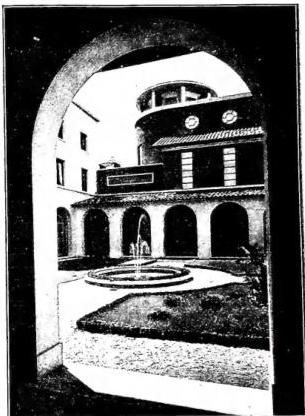
St. Carlo’s Rule was reissued by Cardinal Monti in 1643. A list of 17 December 1789 records the names of 14 houses of congregated O. operating in the Milanese region. All were dispersed by the Revolution. In 1843 Cardinal Gaisruch, archbishop of Milan, gave a group of Franciscan tertiaries, led by Maria Maddalena Barioli, the Rules of the Congregated Sisters of St. Carlo and a convent on Via Lanzone. From then on they took the name of O. of St. Carlo. The houses subsequently founded, at first autonomous, later grouped themselves under the authority of a superior general residing in Milan. The O. of St. Carlo now have two houses in Milan, one in Rome, and eight others in various cities of Italy, where they provide instruction according to every
(phot. Marconi)
ORSOLINE — Detail of the inner courtyard of the Institute of St. Ursula of the O. of St. Carlo in Rome.
at all levels, from nursery school through the classical secondary school and higher teacher-training schools. The religious number approximately 600 in all.
III. ORDER OF S. ORSOLA. - In France, eight different branches of congregated O. had been founded, according to the Milanese model (v. SORA), independent of one another, while all recognizing the same Brescia origin. The Paris group, founded by Francesca da Bermond, “the first Ursuline of France,” requested and obtained, by a bull of Paul V dated 1612, that it be established as a monastic Order. The other original groups soon obtained the same status: Toulouse in 1616, Bordeaux in 1618, Lyon and Dijon in 1618, Tulle in 1621, Arles in 1624, and Avignon in 1632.
The Order spread in these eight forms, somewhat different from one another but all united in spirit, and thus lived, divided into eight monastic congregations, for almost three centuries. The most numerous were the nuns originating in Paris, Bordeaux, Lyon, and Toulouse. In 1639, the ven. Guyart (v.), of the Tours community (Bordeaux observance), departed with several companions from Tours and Paris for Canada, where she founded the first work of female education in a mission country. The monasteries of O. soon spread throughout Europe, but especially in France, where at the time of the Revolution they numbered 350. The first monastery of the Order in Italy was founded in Rome (via Vittoria) in 1688 by Orsolina delle Fiandre, summoned there by Laura d'Este, duchess of Modena, and by her daughter, Maria d'Este, wife of James II, king of England. The French Revolution then destroyed two-thirds of the monasteries of the Order in France; in compensation, they developed considerably during the 19th century in the other countries and in the Americas.
At present, not counting the numerous ones affiliated
with the “Roman Union” (v. sotto), the monasteries of the Order are divided into autonomous houses (about 65) and groups of branch houses around a central house, whose superior bears the title of mother general; such, for example, is the group deriving from Québec and recently organized under the name “Union of the French-Canadian O.,” and that of Chatham (Ontario), founded in 1860 by the O. of Faouët (Brittany), which gathers under a superior general almost 300 religious of English Canada and possesses about thirty schools and boarding schools in the dioceses of London, Toronto, and Calgary (Alberta).
IV. O. DI DÔLE. — Founded at Dôle in Burgundy in 1616 by the Venerable Mother Anna di Xainctonge for the education of girls; they were never enclosed.
Their Constitutions were approved by Innocent X in 1648 and by Innocent XI in 1678. The French Revolution closed their houses, but Mother de Vers subsequently re-established the convent at Dôle, and Mother Rolando de Bussy founded that at Tours. In 1898 this house obtained approval of the revised Constitutions and its establishment as the mother house of the entire Institute. Expelled from Tours in 1903 by the French sectarian laws, the religious transferred their mother house to Haverloo-les-Bruges, in Belgium, where it is still located. Houses were subsequently founded in New York (1902), Rome (1904), and Sluis in Holland (1911); they direct a flourishing boarding school at Fribourg in Switzerland and have houses in Germany and England. Their method of education is that of the Jesuits. In 1902, they added the designation « della Santa Vergine » to the original title of O., in order to distinguish themselves from the Daughters of s. Angela Merici, with whom they have nothing in common except the patronage of s. Orsola.
V. O. DI MARIA IMMACOLATA. — Founded at Piacenza in 1649 by Mother Brigida di Gesù, in the world Brigida Morello, widow Zancani.
The Institute was approved from the outset by the bishop, Monsignor Alessandro Scapi. In our time, the Countess Radini-Tedeschi was its superior general for some twenty years and brought it to great prosperity. It has flourishing houses in Rome, Rapallo, Fidenza, and La Spezia; Rezzanello Castle is a center for spiritual exercises for young women. Since 1934 it has had three mission houses in the diocese of Calicut (India).
VI. O. DI GESÙ. — Also called Daughters of the Incarnation and O. di Chavagnes.
Founded at Chavagnes-en-Pallier (Vendée, France) in 1802 by the venerable servant of God Luigi Maria Baudouin, they took the name O. in order to obtain official recognition for their educational houses, since Napoleon at that time granted such recognition only to the O. However, they have no connection with the O., descendants of s. Angela Merici. They have houses in France, Italy, Algeria, England, Scotland, and Holland.
VII. O. GEROSOLIMITANE DI MARIA IMMACOLATA, CALLED THOSE OF GANDINO. — They originated from a group of young women from Brianza, in the Milanese area, gathered together in 1818 by don Francesco della Madonna, himself from Brianza.
Canonically erected by the bishop of Bergamo in 1858, they founded their first branch in 1864. Until 1858 they had observed the Rules of s. Carlo Borromeo; but the bishop of Bergamo gave them new ones, which were preserved in manuscript until 1889 and then printed with an appendix concerning the works undertaken at Gandino: a hospital in 1864; an infant school in 1886; an orphanage in 1888.
In 1921, the Institute numbered 34 houses: nursery schools, boarding houses for working women, educational institutions, residential homes, hospitals, homes for the elderly and the deaf-mute, elementary schools, assistance to the apostolic houses of missionaries, orphanages, and schools for the deaf-mute. From 1921 to 1934, a further 48 houses were established. At present, the religious number approximately 500; those receiving education, 6000, and those receiving assistance, 7000. The motherhouse is in Bergamo.
VIII. O. DI THILDONCK. — This designation includes all the houses of O. that sprang from that of Thildonck, which was founded in 1818 by the parish priest of the place, the ven. Jan Cornelius Lambertz, in order to be assisted in his works. He placed the first sisters under the protection of s. Orsola and gave them Rules derived from the monastic constitutions of Bordeaux, but without enclosure. During his lifetime he founded no fewer than 90 houses in Belgium, Holland, England, and Germany.
In 1899 the houses in Belgium united in two centralized diocesan Unions, each headed by a superior general: that of the diocese of Malines, with Thildonck as its motherhouse; and that of the diocese of Liège, with its motherhouse at Maesyck. Two communities refused to affiliate: Saventhem, which joined the Roman Union, and Wavre-Notre-Dame, which developed independently, later founding 8 branches, one of them in the Belgian Congo.
Other Unions of O. houses originating from Thildonck were also formed in Holland; for example, the Union of Ruremonde, which as such was incorporated into the Roman Union in 1929. This Dutch Union has founded flourishing houses on the island of Java, which now form a province of the Roman Union.
At present the Union of Maesyck numbers 500 religious, 11 houses, and a mission in the Belgian Congo.
The Union of Malines, the only one that retains the title of O. di Thildonck, numbers more than 800 religious, 17 houses, 4 mission stations in Bengal, and two branches in North America.
IX. O. DI SOMASCA di VERCURAGO (Bergamo). — The Institute was founded in 1822 at Somasca.
Approved by the bishop on 4 Dec. 1857, it was confirmed by the Holy See on 5 Aug. 1917. It has 37 houses in Italy, where 300 religious work for the benefit of 3000 children, young girls, and apprentices, and provide religious and social assistance in the parishes.
X. O. DI CALVARIENBERG. — They were founded in 1838 through the transfer to Calvarienberg (diocese of Trier) of an ancient convent, originally from Bordeaux, re-established in 1828 at Monschau, near Cologne.
The O. prospered there to such an extent that they founded several other monasteries, which remained administratively grouped around the motherhouse in the form of a diocesan congregation, approved by the bishop of Trier. Expelled from the country during the Kulturkampf, they founded flourishing houses in Holland and Belgium; they returned to Germany as soon as the persecution ended. On 21 December 1909 they were approved by Pius X and became a Union of pontifical right. They have four branches in America. At present they number 560 religious in 14 houses.
XI. O. DAUGHTERS OF MARY IMMACULATE. — The Institute originated at Mornese, in the diocese of Acqui, through the work of the devout young woman Angela Maccagno, who had joined five companions to practise religious perfection in the world (1854). The servant of God Giuseppe Frassinetti composed a rule of life for them, under the title « La Pia Unione delle Figlie di Maria Immacolata ».
In 1859 they realized that the Rule was almost identical to that which s. Angela Merici had given to her Company; the new association then took the name « Pia Unione delle Nuove O., Figlie di Maria Immacolata, sotto la protezione di s. Orsola e di s. Angela Merici ». The Rule was approved under this title by the bishop of Novara, mons. Giacomo Filippo de' Gentile. Later, in several places where they had established themselves, the associates simply resumed the primitive Rule of s. Orsola, under the name « Compagnia di S. Orsola ». It is noteworthy that s. Maria Mazzarello, cofoundress with s. Giov. Bosco of the Daughters of Mary Help of Christians, came from the Pia Unione di Mornese.
XII. O. OF VELTEVREDEN. — This house, founded in 1859 by that of Batavia-Nordwyck, itself a branch of Thildonck (1856), was affiliated for some time with the Union of Ruremonde; then, in 1922, it became autonomous under the jurisdiction of the apostolic vicar of Batavia and became the motherhouse of a congregation whose Constitutions were approved by the Holy See in 1929. This Union of Veltevreden joined the Roman Union in 1939.
XIII. O. OF VERONA, called the DAUGHTERS OF MARY IMMACULATE OF VERONA. — They were founded in 1860 by d. Zeffirino Agostini, parish priest of SS. Nazario and Celso, who wrote their Rules, drawing inspiration from the Constitutions and life of s. Angela Merici.
The bishop approved them on 28 November 1860. From the outset, the sisters conducted schools and assisted in all parish activities, including those for the elderly. As their numbers increased, they spread throughout the diocese of Verona and twelve others, with 85 branch houses, approximately 300 religious, and an average of 150 pupils per house. The Institute was definitively approved by Cardinal Bacilieri in 1917; in 1932 it received from Pius XI the decree of praise, and definitive approval in 1940.
XIV. O. DELL'UNIONE ROMANA. – In order to come to the aid of the monastery of Rome, reduced to poverty by the subversive laws of the Italian government, the O. of Blois, beginning in 1878, accepted on behalf of that monastery the novices whom the Italian laws prevented it from accepting. But soon they themselves had to come to Rome to place the O. in another house, because the monastery had gradually been occupied by the Royal Academy of Music (which is still located there).
(through the courtesy of the Superior General)
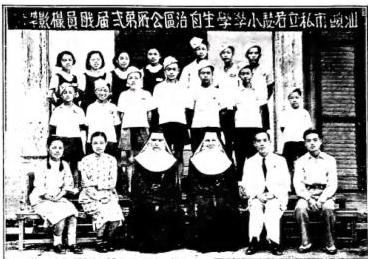
ORSOLINE – Mission of the O. of the Roman Union. St Joseph’s School. Committee of pupils (July 1948) – Swatow (southern China).
union to all the O. in their dioceses (letters from Cardinal S. Vannutelli, prefect of the Congregation of Bishops and Regulars). The proposal, however, guaranteed the religious women complete freedom.
On 15 November 1900, the first General Chapter of the Order opened in Rome, with representatives of 70 houses from all countries and all the Congregations. On the 21st, the union was voted, and on the 28th Leo XIII approved it verbally, reserving the decree for a later date on account of the persecution in France. The first superior general, appointed by the Pope upon the unanimous recommendation of the Chapter, was Mother St Julien Aubry, a professed religious of Blois. On 17 July 1903 Leo XIII promulgated the decree of approval; on 17 September of the same year Pius X approved its first Constitutions experimentally; and finally, in 1926, at the desire of the Church and under the effective impetus of the third mother general, the Institute was perfected in accordance with ecclesiastical norms and fully centralized. The Constitutions, revised, were definitively approved on 17 March 1936.
Since its foundation, the Roman Union has never ceased to receive autonomous monasteries from various countries, as well as entire regional Unions, such as those of Ruremonde and Poland (1929 and 1936); and in 50 years it has grown from 63 to 240 houses, bringing more than 7,000 religious women under Roman obedience. The Roman Union is solidly constituted, with a centralized and hierarchical government. Each province (there are now 20), or at least each country, has its own novitiate, after which the young religious women spend at least three years in houses of study, until their perpetual profession.
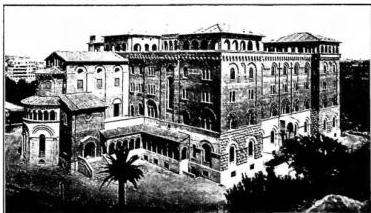
The motherhouse is in Rome.
(photo by Sciamanna)
ORSOLINE – Mother House of the O. of the Roman Union – Rome.
As their number increased, they founded three other branches, two in Germany and one in Brazil. Their apostolate is the same as that of the other O.; their Constitutions are close to those of Thildonck. They are governed by a superior general under the jurisdiction of the bishop of Limburg, and currently number 4 houses and 130 religious.
XVI. O. OF DÜSSELDORF. — They are also called O. of the Holy Saviour, because during their exile, on account of the Kulturkampf, they joined the German Sisters of the Holy Saviour, who, like them, devoted themselves to the education of young women.
The merger of the two Institutes was approved by Leo XIII on 16 March 1883. The mother house, temporarily located in Ruremond (Holland), was established in Düsseldorf in 1907. The group numbers 140 religious in 7 branches.
XVII. O. OF THE AGONIZING SACRED HEART OF JESUS. — Also called the Grey O., they were founded in 1920 by Mother Orsola Countess Ledochowska, a professed Ursuline and former superior of the monastery of Krakow. Impressed by the spiritual and material misery of the young people in the countryside, and prompted by a succession of providential circumstances, she left the community on the advice of her brother, Fr. Wladimiro, Superior General of the Jesuits, and with the consent of the ecclesiastical authorities, and founded this new Congregation.
The Constitutions, drafted by her herself, were approved by the Holy See on an experimental basis in 1923 and definitively in 1930. In addition to teaching in schools and caring for poor young people, the O. devote themselves to the conversion of schismatics and maintain boarding schools for young noblewomen and female students. At present the O. number more than 600, with 25 houses.