
Angela Merici, Saint

ANGELA MERICI, saint. — Foundress of the Ursulines, born at Desenzano sul Garda in 1474 to a humble peasant family, died at Brescia on 27 January 1540.

After spending her childhood attending to domestic tasks, following the death of her parents she was taken in, at the age of fifteen, together with her sister, by an uncle at Salò. She willingly became a Franciscan tertiary “so that she might have greater opportunity to attend holy Masses, devout confessions, and the most holy Communion”; in fact, she had devoted herself to a most pious life and to holy reading. She then entered the household of a good widow, Caterina Patengola, and with her moved to Brescia in 1516, which from then on was her usual residence, though interrupted by pilgrimages: in 1522 she was at Mantua; on 26 May 1524 she departed from Venice for the Holy Land, and when she returned, an attempt was made to retain her as an assistant at the Hospital of the Incurables. Instead, she returned to Brescia on 24 November, only to leave for Rome the following year to gain the Jubilee; on that occasion she met Clement VII, who encouraged her in her plans.
Article illustration
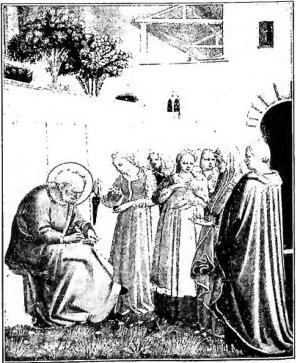
There was no lack at Brescia of monasteries observing a good rule, but M. aimed to create an institution of virgins living in the world, bound neither by the constraints of a conventual timetable nor by a conventual programme, who would know how to make themselves useful to children, especially girls and the many abandoned and endangered orphans. Thus arose the Company of the Retired Women of St Ursula, composed of young women belonging to every social class, consecrated to God and to their neighbour through works of charity. They numbered 12 when they accompanied St A. on pilgrimage in 1532; they numbered 28 when, on 25 November 1535, in the church of St Afra, they bound themselves to obedience to their Mother; at the founder’s death they numbered 159.

For them she dictated to her confessor Gabriele Cozzano the Ricordi delle Avvisatrici and the Testamento Spirituale, which, together with the first outlines of the Rule, constitute the saint’s spiritual inheritance. The Rule approved by the curia of Brescia on 8 August 1539 was repeatedly approved by the Holy See after the saint’s death. The cult of the saint was approved by Clement XIII on 30 April 1768; Pius VII canonized her on 24 May 1807 (cf. Litterae decretales super canonizatione b. A. M., Roma 1807). Her feast, assigned to 31 May, was extended to the entire Church by Pius IX on 11 July 1861.

BIBL.: G. Lombardi, Vita della beata A. M., Venezia 1778; C. Doneda, Vita di s. A. M. di Desenzano, 2ª ed., Brescia 1788; V. COMPOSTELLA, Histoire de s. A. M. et de tout l'ordre des Ursu- lines, 2 voll., Parigi 1878; A. Bertolotti, Storia di s. A. M. vergine bresciana, 2ª ed., Brescia 1926; M. Monica, A. M. and her teaching Idea, Nuova York 1927; G. Lubienska, Ojczyzna Sto. Anieli i Jei Zycie, Cracovia 1935; P. Guerrini, S. A. M. e la Com- pagnia di s. Orsola, Brescia 1936; B. Delcampo, S. A. M. fon- datrice delle Orsoline, 2ª ed., Alba 1937; G. Varischi, S. A. M. a Cremona, a ricordo del IV centenario della morte, Cremona 1941; A. Cistellini, Figure della Riforma pretridentina, Brescia 1948, pp. 47-55; a pp. 198-212 scritti della Santa.

Carlo Castiglioni

Cite this article

“ANGELA MERICI, SANTA.” Enciclopedia Cattolica, vol. I (1948), p. 753. Azione Romana digital edition, https://azioneromana.com/article/angela-merici-santa.