
PIUS IX, POPE. – Descendant of the Mastai family of Cesena, which, for its merits, received the comital title from the Duke of Parma and added to its own surname that of the Ferretti, a noble family of Ancona related to it through marriage. Giovanni Maria Mastai Ferretti was born in Senigallia on 13 May 1792 to Count Girolamo and Caterina Solazzi.
He studied at the Piarists of Volterra and continued his studies at the Collegio Romano, which he had to interrupt due to the Napoleonic events. Once matters were settled, he resumed his studies in Rome. Afflicted by epilepsy, he feared he might not be able to receive Holy Orders; however, having overcome this difficulty, he was ordained a priest on 19 April 1819. From a young age, he was involved with the Ospizio di Tata Giovanni, to which he remained deeply attached.
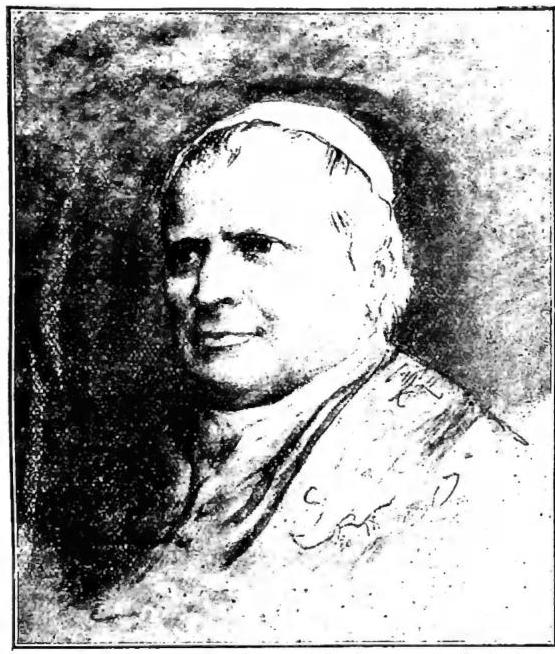
(Courtesy of the name, A. P. Frutuc)
PIUS IX, pope – Portrait. Study from life by F. Podesti for the fresco of the Immaculate Conception – Vatican Library, cod. Vat. lat. 13949.
I. ELECTION TO THE PONTIFICATE. FIRST ACTS. REFORMS. - In the Conclave that followed the death of Gregory XVI, from 15 to 16 June 1846—one of the shortest in history—Cardinal Mastai was elected Pope and took the name Pius IX. The eminent pastoral qualities he had demonstrated and his knowledge of the needs of the State were the qualities that drew the electors' attention to him. Contrary to a widely held opinion, no nation raised a veto against Mastai. Cardinal Gaysruck, Archbishop of Milan, who was said to bear Austria's veto, did not arrive in Rome until after the election had taken place. The Pope's coronation on 21 June unfolded amid demonstrations of vibrant enthusiasm.
As his principal collaborator, Pius IX immediately Corboli-Bussi (v.) of Urbino, secretary of the Conclave. Together with Cardinal Pasquale Gizzi, appointed Secretary of State on 8 August, he became the Pope's right hand. On 17 July, Pius IX granted a broad amnesty to political prisoners and the repatriation of exiles upon a simple declaration of faithful submission to public authorities. He sought to improve the condition of Jews in Rome, who in any case enjoyed far more humane treatment than in other countries, by ordering the abolition of the ghetto's enclosure. His pastoral experience had given him direct knowledge of the true needs and aspirations of the people. He had formed a friendship with Count Giuseppe Pasolini of Ravenna, a passionate scholar of political and social sciences and a moderate liberal, from whom he received updates on the various currents of ideas emerging among the educated class and on the recent writings of Balbo, Gioberti, and others, which were shaping a new national consciousness, both federalist and unitary. He had read the Manifesto of Rimini of 24 September 1845 and the Casi di Romagna by Massimo d'Azeglio. He recognized that d'Azeglio, with whom he had been in contact since 1845, spoke many truths in his pamphlet, though mixed with exaggerations and falsehoods.
He immediately set about remedying the ills of the Papal States, beginning with the establishment of a special Congregation of State to study some of the most urgent matters: amnesty, railways, financial organization, tribunals, and the militia. He called Cardinals Macchi, Lambruschini, Mattei, Amat, Gizzi, and Bernetti to be part of it and appointed Corboli-Bussi as its secretary. The meetings were held in the Pope's presence, and in five important sessions, which also included Monsignor Morichini, pro-treasurer, all the predetermined topics were addressed. Measures were taken to ensure that the amnesty, granted with the repatriation or release of so many individuals politically compromised, would not disrupt the normal functions of the State. The amnesty, published with the historic Proclamation drafted by Corboli-Bussi on 17 July 1846, gave rise to frenetic demonstrations that seemed unending; thus, Cardinal Gizzi had to intervene with circulars and ordinances, calling authorities and citizens to greater austerity in order to achieve the normal implementation of the reconstructive and reformist program the Pope had proposed. It soon became clear that those repeated demonstrations were merely a ploy by hidden agitators to accustom the people to acting as sovereigns. With the Edict of 15 March 1847, censorship of the press was mitigated, though this left liberals somewhat disappointed, as they had hoped for the abolition of all restrictions. By motu proprio of 18 June, a Council of Ministers was established. An edict of 5 July instituted the civic guard in Rome and provided regulatory provisions for other cities of the State. On 14 October, the Council of State was established, presided over by a cardinal and composed of 24 councillors appointed by the Pope upon designation by provincial and municipal councils. Several moderate liberals, such as Pasolini, Minghetti, Silvani, and Gualterio, were part of II.
II. THE ITALIAN QUESTION
On 24 August 1847, Corboli-Bussi departed from Rome with secret instructions to propose a customs league, modeled on the German Zollverein, to the courts of Florence, Turin, and Modena. The aim of this initiative was to awaken the patriotic sentiment still dormant in many and to direct it toward a national federative course. For this reason, the instructions to the papal envoy made no mention of Austria. The league was intended to pave the way for a closer union among the Italian courts in civil, military, and political matters. The initiative met with prompt and unconditional acceptance in Florence. In Turin, however, it was subjected to such numerous cautions, examinations, and restrictions as to demonstrate that it was far from welcome. More than two months were required to conclude certain preliminaries, which were signed on 3 November, giving Austria ample opportunity to undermine the papal initiative in Modena and the duchies and to negotiate secret commercial and military treaties with them on highly advantageous terms, concluded on 24 December. When Corboli-Bussi, together with Ricci and Martini—delegates from Turin and Florence, respectively—presented themselves to offer the league to Duke Francesco V, he feigned good disposition and took advantage of the three envoys’ efforts to smooth over existing frictions between himself and Florence, which sought to delay the cession of Fivizzano. Having achieved his aim, he dismissed them in a manner that not only offended the three envoys but also the Holy See, which had offered itself as mediator.Despite the failure of the league, the name of P. IX, now hailed throughout Italy as the champion of nationality, continued to drive the demonstrations that multiplied with the aim of pushing for a national war. This was especially true after August of that year, when Austria, with a highly impolitic gesture, reinforced the garrison in Ferrara and occupied the city’s militarily important points. The incident was soon resolved diplomatically by the parties involved; nevertheless, demonstrations multiplied endlessly, and the name of P. IX became linked with that of Carlo Alberto, who, in a letter deliberately circulated, declared himself ready, “pour la cause guelphe,” to play a second Shamil.
The Ferrara episode would have lent itself well to the designs cherished by Piedmont to attack Austria, under the pretext of safeguarding the rights and independence of the Pontiff, posing as the champion of Italian nationality. Strong pressures were exerted on P. IX to abandon neutrality. But he, having examined the problem from every angle, deemed it his duty—given the conditions in which the State found itself—to use his authority to ensure that national unity would be achieved not through war but through peace. From the beginning of his government until November 1848, that is, until his flight to Gaeta, he never lost sight of the idea of an Italian confederation and supported the projects elaborated to this end by Corboli, Abbot Rosmini, and Pellegrino Rossi.
III. THE YEAR 1848. CRISIS OF P. IX’S ITALIAN POLICY. GAETA. – Following the example of other Italian princes, on 14 March 1848 P. IX granted the Statute. Its study was entrusted to a special commission composed of Cardinals Ostini, Orioli, Altieri, Vizzardelli, Antonelli, Bofondi, and the prelates Corboli, Bernabò, and Mertet, adapting it to the conditions arising from the fact that the prince was also the head of the Church. It delimited the competence of public powers within the purely civil sphere; the College of Cardinals constituted the Senate of the new regime; two elective legislative bodies were established, the High Council and the Council of Deputies; laws required the Pope’s sanction, having heard the opinion of the cardinals, to become effective. The Pope was assigned a civil list of 600,000 scudi annually, including the appanage for cardinals, the expenses of ecclesiastical dicasteries, and the court.
After the Five Days of Milan and Piedmont’s intervention in Lombardy, pressures on P. IX to participate in the war to expel Austria became even stronger and more insistent. The lay members of the Ministry, Minghetti and Pasolini, were in favor of war. Already in the edict of 22 June 1847, which sought to avert the event of a war that would set populations devoted to their common father against one another, it was made clear that in such an event the Pope would not take the field against Austria. The same hesitations persisted, and to the moral and religious reasons (rumors of schism circulated in Austria and Germany) were added others of a military and financial nature. P. IX, while acceding to the Sardinian government’s request to send a corps of troops to the Lombard-Venetian border to relieve the pressure of the Austrian army, never resolved to assume the responsibility of a declaration of war.
Nevertheless, on 9 April 1848, he sent Corboli-Bussi to Carlo Alberto’s headquarters with the mission of urging the conclusion of the national league, which he deemed all the more urgent as it would relieve him of the responsibilities he so feared; and also to request a loan. The Pope’s requests went unheeded: Piedmont, overconfident in its own strength and early successes, refused to commit itself. Thus, on 29 April, P. IX delivered the famous allocution in which he solemnly declared that he would not declare war. The repercussions of the Pope’s words were enormous, nor was any effort spared to distort their meaning in the most odious ways. He publicly declared his true sentiments, and on 3 May wrote an autograph letter to the Emperor of Austria, imploring him to grant Italy a peace founded on the recognition of nationality. To the same end, he sent Monsignor Morichini on a special mission to Vienna. But nothing could erase the undeserved stigma of being an enemy of the fatherland. The ministerial crisis that followed the allocution of 29 April forced P. IX, due to the influence of turbulent elements dominating circles and squares, to entrust power to Mamiani, whose advanced ideas he was not unaware of and with whom he found himself in constant disagreement throughout his ministry (May-August). Finally, on 16 September, he entrusted the government to Pellegrino Rossi, with the intention of establishing a strong regime, restoring the now-declining authority of the State. His program was progress within order and the federal unity of the nation. The distinguished statesman, who enjoyed the full confidence of the Pope and was resolute in his intention to curb anarchy, was barbarously assassinated at the foot of the steps of the Chancellery on 15 November as he went to inaugurate the Chamber and deliver his programmatic speech. The material author of the crime was believed to be one of the sons of the popular leader Angelo Brunetti (Ciceruacchio), but the conspiracy behind it must have been vast. With Rossi’s death, the most effective bulwark of legality, abhorred by the élites and the mob, disappeared, and Rome fell prey to anarchy; the Quirinal was assaulted by the rabble, who tumultuously demanded a demagogic government. The Pope’s secretary, Monsignor Palma, was struck down by bullets that rained into the courtyards and halls of the Palace from nearby houses, at whose door Prince of Canino had a cannon aimed. In this critical situation, P. IX gave an admirable example of self-control.
Uncertain of his safety in Rome, on 24 November, advised by various ambassadors and by Cardinal Antonelli, he secretly departed and took refuge in Gaeta, where he was received with filial devotion by King Ferdinand II, who placed the royal palace at his disposal and supplied him with all he needed. From Gaeta, Pius wrote to the sovereigns who maintained relations with the Vatican, informing them of the events that had occurred and requesting their assistance. He declared null and void the acts issued by the government of Rome. He rejected the invitations sent to him by the government he had disavowed to return to his see, as well as the offer made by Gioberti, on behalf of the Sardinian government, to restore the temporal power alone and reconcile the Pope with his subjects.
IV. THE ROMAN REPUBLIC
Meanwhile, in Rome, a supreme state junta was established, which on December 20 called for a Constituent Assembly, and the new chamber that emerged from the elections of February 5, 1849, declared the Pope’s government deposed and proclaimed the Republic (February 8-9). Executive power was entrusted to a triumvirate, initially composed of Armellini, Montecchi, and Saliceti, and shortly thereafter of Mazzini, Saffi, and Armellini. With this, all ties between Rome and Gaeta were severed. There, the representatives of the courts that had responded to Pius’s appeal—Austria, France, Spain, and Naples—gathered in a conference under the presidency of Cardinal Antonelli to discuss the modalities of restoring the Pontiff’s throne. Against the wishes and pressures of France, they decided to abolish the Statute. An Austrian army corps, having crossed the Po on May 16, occupied Bologna and on June 10, Ancona. The French, who had landed at Civitavecchia on April 15, after some unsuccessful military operations, tasked Lesseps with negotiating with Mazzini, but to no avail. Finally, they attacked Rome with adequate forces and, overcoming fierce resistance, forced its surrender on July 3.From Gaeta, the Pope had moved to Portici on September 4. For various reasons, partly political and partly financial, Pius, having to delay his return to Rome, appointed a regency commission there, composed of three cardinals: Della Genga, Vannicelli, and Altieri. Only on April 12, 1850, did he re-enter the Eternal City, where he was met with grand and jubilant celebrations. From Portici, on September 12, 1849, he had issued a motu proprio granting a broad amnesty and several reforms, including the establishment of the Council of State with advisory functions, a Consultative Board for finances, regulations for the election of municipal and provincial councils, and announced further concessions.
V. RESTORATION. INTERNAL POLITICS. — The conditions in which the Pope resumed governance of the State were extremely grave: thus, the task of restoration that fell to him appeared all the more arduous. Public administration was divided into four departments: 1) Interior, Grace, and Justice; 2) Finance; 3) Agriculture, Industry and Commerce, Fine Arts, and Public Works; 4) War. The ministers convened under the presidency of the Cardinal Secretary of State, Antonelli, who, first as Pro-Secretary and then from 1852 as Secretary, held this office for many years until his death (v. ANTONELLI). The first and most difficult undertaking was the restoration of finances, left by the republican government in a state of bankruptcy. The treasury was empty, the meager fiscal sources dried up, and the state was flooded with eight million in paper currency unbacked by any gold reserve. Nevertheless, without resorting to tax increases, the budget, which in 1850 recorded a deficit of over two million, was balanced in less than a decade, thanks to the prudence of the ministers and the generosity and extreme frugality of the Pope. Many grandiose public works were completed in those years: reclamation of the Pontine and Ostian marshes, regulation of river courses, port works in nearly all maritime cities, railways (in addition to the lines of Frascati, Montalto, and Ceprano, the Rome-Ancona-Bologna route was undertaken and brought to a good stage of completion). It can be said that there was no city in the Papal States that did not benefit from the Pope’s munificence: he also promoted trade, sciences, arts, and works of public charity; on the very eve of the breach of Porta Pia, the Acqua Pia (ancient Marcia) was inaugurated, brought from Arsoli to Rome. Nor can one overlook the significant progress made, under his pontificate, in historical and archaeological sciences, thanks to the protection and aid granted to Pietro Ercole Giovanni Battista de Rossi (v.), the former placed in charge of excavations of classical antiquities and the latter of Christian antiquities. Such was the urban development of the city under P.’s governance that it truly took on the character of a modern capital.
To dispel the rumors that he was universally detested by his subjects, in 1857 the Pope undertook a tour of all the cities of the State, stayed in Bologna for a couple of months, listened to whoever wished to speak with him, and extended his journey to Modena and Florence, everywhere greeted with warm and enthusiastic demonstrations. He returned to Rome on 5 September, as if in triumph.
After the unfortunate outcome of the constitutional experiment of 1848, P. was always reluctant to grant democratic concessions. However, he was not opposed to reforms. Beyond the program published with the motu proprio of 12 September 1849, further concessions were agreed upon with France in November 1859, though they were not made public only because France failed to fulfill what it had led him to hope for in return, namely the restitution of the Legations. In 1863, under the ministry of Drouyn de Lhuys, with improved relations with Paris, P. spontaneously presented and implemented an important program of improvements and reforms extending to nearly all branches of administration, such as postal services, customs, justice (special tribunals of the S. C. Lauretana, the Fabbrica di S. Pietro, the S. Visita del Vicariato, etc., were abolished), civil and commercial legislation, etc. And while rejecting the proposal for the total exclusion of the clergy from civil offices, advocated by liberal governments, in practice ecclesiastical officials were reduced to the proportion of two percent.
VI. THE ROMAN QUESTION
With Piedmont, the old jurisdictional disputes persisted, exacerbated by the anticlerical spirit dominating governmental circles. Following the so-called Siccardi Laws, which abolished the ecclesiastical forum, Nuncio Antonucci left Turin on 8 April 1850, and the Pope protested in a consistorial allocution. New deplorable events further complicated the situation, with the abolition of congrua for parish priests and the suppression of collegiate churches, simple benefices, and religious congregations, provoking a reaction from the episcopate and clergy and vigorous protests from P.On the occasion of the Congress of Paris in 1856, Cavour seized the opportunity to raise the Italian question before the assembled governments, attributing the origin of the nation’s ills primarily to papal misgovernment. In July 1858, at Plombières, secret agreements were reached between Napoleon III and Cavour on how to exclude Austria from the Peninsula and give it a new order.
On the eve of attacking Austria, Napoleon III, through verbal assurances and an autograph letter, assured the Pope that, whatever the outcome of the war, he had nothing to fear for his principality. To further guarantee this, the belligerents accepted the Holy See’s declaration of neutrality, with both France and Austria pledging to consider their respective troops still stationed in the Church’s territories as exempt from acts of war. In practice, however, the observance of neutrality gave rise to so many disputes that Austria, after Magenta, decided to withdraw its garrisons, simultaneously causing the insurrection of the Duchies, the Legations, and Perugia, where provisional governments aligned with Piedmont were established. The Legations were lost forever; Perugia was recovered thanks to the prompt intervention of the papal government. The Armistice of Villafranca, which ended the Lombard War, left the program agreed upon at Plombières half-completed: the two emperors, of France and Austria, agreed on the restoration of the princes deposed by the revolution.
VII. FALL OF TEMPORAL POWER
In the peace treaty signed in Zurich on 10 November 1859, it was agreed that a European congress to be held in Paris would provide for the definitive settlement of affairs in Italy. Pius IX delegated Cardinal Antonelli as his representative to the congress, but when the famous pamphlet inspired by Napoleon, Le Pape et le Congrès, came to light—demanding severe mutilations of the Papal State—he withdrew his adhesion to the congress, which thus came to nothing.Having returned to power on 24 January 1860, Cavour secured Napoleon III’s acquiescence to the annexations of Tuscany, the Duchies, and the Legations through the plebiscites of 11 and 12 March. However, on 26 March, a major excommunication was issued from Rome against all those who, in any way, had cooperated in the usurpation. In response to Pius IX’s refusal to renounce the Romagna, the Marches, and Umbria, these territories were violently occupied by regular forces under the pretext of preventing Garibaldi’s occupation. The small CASTELFIDARDO, BATTAGLIA DI (v.) on 18 September, leaving the Pope with only Rome and the surrounding Patrimony of St. Peter. Various projects were then devised by the interested powers, particularly France and Piedmont, to provide some settlement for the Head of the Church Roman Question (v.), but without success. A modus vivendi, which would have preceded the September Convention (v.), was on the verge of being concluded between Paris and Turin when Cavour’s death occurred, suspending the negotiations.
After Cavour’s death, Napoleon notified his recognition of the Kingdom of Italy but simultaneously initiated a more respectful policy toward the Holy See. In 1864, with Minghetti as minister, the September Convention was concluded between Paris and Turin, by which the Italian government pledged not to attack nor allow the residual papal territory to be attacked, to assume a fair share of the public debt burdening the pontifical budget, and to transfer the capital from Turin to Florence. General Kanzler was tasked with reorganizing an adequate military corps, reinforced by the so-called Antibes Legion, formed of volunteers, with unofficial French protection. The French garrison definitively left Rome on 12 December 1866.
Two missions sent to Rome to address the 106 vacant dioceses in Italy (the first by Vegezzi in 1865 and the second by Tonello in 1868) failed to improve relations between the two powers. The resurgent Freemasonry and increasingly intolerant anticlericalism obstructed any attempt at reconciliation. When the King fell gravely ill at San Rossore in November 1869, he obtained absolution from Pius IX for the censures through Cardinal Corsi, Archbishop of Pisa.
In the autumn of 1867, against the extremist elements led by Garibaldi—which brought sorrowful episodes to Rome, such as those at Villa Glori, Casa Ajani, and the Serratori Barracks—France intervened in favor of the Pope. Garibaldi, with the bulk of his expedition, was halted at Monterotondo and Mentana (v.). The following November, Napoleon invited governments to Roman Question (v.), to which the Holy See also adhered; however, the initiative failed due to opposition from England and Russia. Nevertheless, the French Parliament resolved to restore the garrison in Civitavecchia, which remained there until 1870.
The Franco-Prussian War, which broke out in July 1870, marked the final chapter of temporal power. Pius IX wrote to both sovereigns offering to mediate peace, but to no avail. With the first reversals of imperial arms, the French garrison was recalled—a move Pius IX sought in vain to prevent—and on 20 July, Napoleon informed the Pope that the custody of the Papal State was entrusted to Italian arms.
At the outset of the conflict, the Italian government, through Minister Lanza, assured that it would observe the September Convention. However, as Napoleon’s fortunes began to falter, the papal territory was encircled by troops. After Sedan, the ring tightened, and on 20 September, royal forces entered Rome through the breach of Porta Pia. On 10 September, the King sent a letter to the Pope via Count Gustavo Ponza di San Martino, offering to guarantee order and ensure the Pontiff’s inviolability. Pius IX declined the offer but ordered General Kanzler, commander-in-chief of his troops, to limit defense to what was indispensable to demonstrate that surrender was due to force. Initially, the Vatican and the Leonine City remained exempt from occupation; but due to the insolence of the mob, which even threatened to force the bronze door, Cardinal Antonelli had to request Cadorna to maintain order, and the occupation extended to the thresholds of the Vatican.
On 13 May 1871, the Gazzetta Ufficiale of the Law of Guarantees (v.). Pius IX condemned the law in the encyclical Ubi nos of 15 May 1871, rejected the annual endowment assigned to him, and shut himself in the Vatican in protest, as he declared in a letter to Cardinal Antonelli on 8 June 1872.
---
BIBL.:
For the general context, see the works cited under PIO IX, PAPA; for the Roman Question, V. QUESTIONE ROMANA; for the September Convention, V. CONVENZIONE DI SETTEMBRE; for the battles of Castelfidardo and Mentana, V. MANA; for the Law of Guarantees, V. GUARANTIGIE (Legge delle). Specific studies: A. DE LA GORCE, Histoire du Second Empire, Paris 1894-1905; P. PIERLING, La Russie et le Saint-Siège, Paris 1896; G. MARTINA, Pio IX, Rome 1974-1990; R. AUBERT, Le Pontificat de Pie IX, Paris 1952; A. M. GHISALBERTI, Storia costituzionale d’Italia, Bari 1974; L. SALVATORELLI, Storia d’Italia nel periodo fascista, Turin 1956; F. CHIAPPETTA, La Questione romana, Rome 1967.
A. MERCATI
VIII. CATHOLIC ACTION AND POLITICAL DIRECTIVES
The sectarian and even openly irreligious manner in which Italian unification was achieved opened an irreparable rift between the Pope and official Italy, and sowed division among Catholics themselves.In all countries where religion found itself struggling against the encroachment of sectarian secularism—France, Germany, Switzerland, and elsewhere—associations were formed for the defense of Catholic interests, inspired by Rome’s directives, often with aims of social renewal. Even the Sardinian episcopate, in 1849, took steps to establish an Italian Catholic association in defense of the Church, modeled after the German Katholischer Verein, blessed and encouraged by Pius IX. However, as far as is known, this initiative did not achieve significant results.
In Bologna, Casoni gave life to a Catholic Association for the Freedom of the Church, blessed by Pius IX, which in 1871 became the Opera dei Congressi Cattolici with a distinctly religious and national program, free from any political preconditions. Alongside it, other organizations carried out notable work: the Società della Gioventù Cattolica Italiana, the Florentine Società Promotrice, the Roman Primaria, the Unione delle Donne Cattoliche, and others. A Pian Federation based in Rome sought to unite them under a single purpose and action.
IX. RELIGIOUS LIFE IN OTHER COUNTRIES
In France, where political divisions made the Holy See’s action particularly delicate even in the religious sphere—still deeply marked by Jansenist and Gallican survivals—Pius IX’s influence was truly broad and profound. In highly contentious matters, such as the law on freedom of education, the exclusion of pagan classics from Catholic schools in 1850, the adoption of the Roman liturgy, and other similar issues, Pius IX’s wisdom and moderation overcame no small difficulties, thanks also to the universal sympathy that his name and his misfortunes aroused throughout the great nation.After the restoration of 1849, Austria more earnestly supported Pius IX’s religious action, and in 1855 concluded new concordats with him that eliminated the Josephinist spirit of those previously in force. However, in protest against the proclamation of papal infallibility, the new concordats were abolished throughout the Empire. Yet, despite certain stances of official religious policy, the true spiritual revival and union with Rome—animated by men of the stature of a Windthorst in Germany, a Vogelsang, a Lueger, and a Rauscher in Austria—was great, as in all other countries: as in Switzerland through the work of a Mermillod and a Lachat; as in Spain, under Balmes and St. Antonio Claret, despite its subjugation to sectarian liberalism and political factionalism; as in Protestant countries, in Holland (1853) and England (1850), where the hierarchy was reconstituted, and in the United States, where Catholic life was able, within a few years, to achieve a leading development that was the admiration of all the world.
Pius IX’s solicitude for Latin America is attested by the diplomatic relations he reestablished with those republics, the concordats concluded with most of them, and especially by the foundation in Rome of the Pontifical Latin American College, for the benefit of all the South American republics.
The pontificate of Pius IX marked a period of exceptional importance for the revival of Catholic life in Germany. The early years were full of bright promise. But the political supremacy achieved by Prussia—hitherto the stronghold of Protestantism—over the other German principalities, and the iron regime established by Bismarck, unleashed that fierce and violent struggle against Catholics known as the Kulturkampf (v.). Its repercussions were felt not only in Prussia but also in other principalities with which good concordats had been concluded, such as Württemberg (1857), Baden (1859), and Nassau (1861). Pius IX did not live to see the glorious outcome of this titanic struggle, but he took satisfaction in witnessing the German Catholic clergy and laity drawing ever closer and more devoted around the papacy. The tragedy of Catholic Poland, which had been a source of concern and tears for Gregory XVI, was likewise for Pius IX, who did not fail to press Nicholas I and Alexander II with the most urgent appeals for a modus vivendi that would ensure the religious and civil liberty of that unhappy nation. Yet he had to endure the bitter disappointment of seeing the agreements he himself had concluded in 1847—after so many laborious negotiations—repudiated in 1866, and of witnessing the apostasy of the Uniate Church of Chelm (1875), fomented and imposed by the czarist government.
X. EXPANSION OF MISSIONS
Missionary activity had suffered a mortal blow in the final decades of the 18th century, and the work of reconstruction after the restoration of 1815 progressed, but at a slow pace; an initial vigorous impulse given by Gregory XVI, who had been Prefect of the S. Congr. de Propaganda Fide, was followed by a far greater one under PIO IX.A highly intense effort was directed toward recalling the schismatic Churches to unity; on 14 December 1847, PIO IX addressed a warm appeal to them, sent an apostolic visitor, and stirred movements toward union in the Balkan countries and the Near East—Moldavia, Wallachia, Serbia, Romania, Greece, Armenia, Palestine. Particularly promising was the Church in Bulgaria, hopes that were dashed by Russia’s reaction. PIO IX reconstituted the Latin patriarchate of Jerusalem, established an archdiocese in Athens, etc., and with the constitution Romani Pontifices of 16 January 1862 erected a special Congregation within the S. Congr. de Propaganda Fide for the Oriental Churches. Denmark, Norway, and Scotland, previously closed to Catholic influence, each received an apostolic prefecture in 1868.
As for the evangelization of the infidels, it suffices to mention the names of Massimiliano Ryllo, apostle of the White Nile; Lavigerie (v.) in the regions of the Great Lakes; Comboni (v.) in Central Africa; Massaja (v.) among the Galla; De Jacobis (v.) and Ghebra-Michael in Abyssinia; CALÒ, PIETRO (v.) in Patagonia and Tierra del Fuego. During this period arose the Seminary of SS. Peter and Paul in Rome for Foreign Missions (1867), the Seminary for Foreign Missions of Milan (1850), the Pontifical Albanian College (1858), the Brignole-Sale College in Genoa (1855), and the Mill Hill Seminary near London (1866); and the missionary congregations of Scheut (1863), the White Fathers, the Nigrizia (1867), and Steyl (1875) were established.
XI. DOCTRINAL MAGISTERY
Pius IX was tireless in promoting all that pertained to sacred studies and sciences, repressing, as opportunity and need arose, deviations or errors that could endanger the purity of doctrine and ecclesiastical discipline. The action undertaken by Pius in this field makes him the worthy precursor of Leo XIII.Worthy of mention are the encyclical Qui pluribus (9 November 1846) on biblical rationalism, the consistorial allocutions Ubi primum (17 December 1847) on religious indifferentism, Quibus quantisque (20 April 1849) on secret societies, In Consistoriali (1 November 1850) concerning ecclesiastical immunity, Singulari quadam (9 December 1854) on the intrusions of civil authorities into matters pertaining to the Church, Iamdudum (18 March 1861) against the separatism of national Churches; as well as the apostolic letters by which the errors of Nuytz (22 April 1851), Günther ([V. GÜNTHER](15 June 1857)), Baltzer ([V. BALTZER](30 April 1860)), Frohschammer (11 December 1862), and others were condemned. The struggle of Masonic radicalism against the Church in many countries provided him with the occasion to clarify, in various documents, the Church’s doctrine on the relations between the two powers. His tender devotion to the Most Blessed Virgin inspired him to promote her cult and illustrate her singular prerogatives. In 1848, his first thought upon arriving in Gaeta was to honor the Mother of God; with an encyclical dated 2 February 1849, he sought the opinion of the episcopate regarding the definability of her Immaculate Conception; and on 8 December 1854, with the dogmatic bull Ineffabilis, he proclaimed it an article of faith.
On the occasion of the solemn canonization of the Japanese Martyrs on 9 June 1862, in the presence of over 300 bishops from all parts of the world, he delivered the allocution Maxima quidem, which synthesizes the condemnation of the principal errors of the time. This preluded the celebrated encyclical Quanta cura of 8 December 1864 and the Syllabus appended to it, wherein, referring to his previous documents, he listed in 80 propositions the false principles of speculative, moral, political, and social order of the decadent modern civilization, systematically classified. In various countries governed by liberal regimes and dominated by Freemasonry, a veritable uprising erupted against the Syllabus, which was considered a challenge to civilization and progress. In France, the minister Baroche prohibited the clergy, by means of a circular, from communicating it to the faithful.
The most memorable religious event of Pius IX’s pontificate is the Vatican Council, which was announced in 1867 on the occasion of the jubilee of the holy Apostles Peter and Paul, and carefully prepared by special commissions. It was convoked by the bull Aeterni Patris of 29 June 1868, inaugurated on 8 December 1869, and continued its work until July 1870, that is, until the outbreak of the Franco-Prussian War. The invitation was extended even to the separated Churches, and an appeal was addressed to Protestants. Catholic sovereigns, who had long since abandoned their mission as defensores fidei, were not invited. The work of the Council is distinguished into two phases: the first dedicated to dogmatic matters, which concluded with the constitution De fide catholica; the second, which culminated in the proclamation of the infallibility of the Pope as an article of faith (v. CONCILIO).
Epilogue. — Pius died on 7 February 1878, and his remains were placed in a provisional tomb in the Vatican, until they were transferred, as he had arranged, to the basilica of San Lorenzo fuori le Mura, which he had restored and embellished. The translation took place in 1881, at night, amid shameful scenes of sectarian hatred. He rests in the crypt, artistically decorated by Ludovico Seitz, at the initiative of the Gioventù Cattolica Italiana, with the contribution of Catholics from all over the world.
Though the pontificate of Pius, the longest in history, unfolded amid incessant political and religious turmoil, the work of regeneration and expansion he promoted was intense and profound in all fields. "Many things changed in the world and in the Church between 1846 and 1878," concludes Aubert (op. cit. in bibl., p. 502); "Perhaps nothing changed more than the quality of average Catholic life."
Indeed, that fervor of enthusiasm aroused at the beginning of his pontificate never waned, even when the historical phase had changed. This is demonstrated by the ever-growing crowds flocking to him, the generous contributions that poured in from all sides to alleviate his august indigence, and the veneration and esteem that even his political adversaries nurtured for him. Even during his lifetime, his figure appeared to contemporaries surrounded by an unmistakable aura of sanctity, for which, in 1897, Leo XIII authorized the regular process of beatification.
Braz.: la letteratura relativa a P. è quasi sconfinata; fra molti scritti d'intonazione apologetica e viziata da livore e pregiudizi politici, non mancano studi seri e monografie pregevoli. Essa sarà fondamentalmente rinnovata quando gli studiosi potranno usufruire degli Archivi Vaticani i quali per il pontificato di P. ancora non sono, se non eccezionalmente, accessibili. Cf. i due preziosi saggi di bibl. sistematica di P. Dalla Torre, uno sulla attività amministrativa nello Stato romano, in appendice allo studio L'opera riformatrice ecc. (v. sotto), l'altro sugli armamenti, in Rassegna stor. del Risorg., dic. 1937. Per un orientamento critico si veda l'opera dell'Aubert citata appresso. Fonti: Acta Pii Papae IX, 7 voll., Roma 1854 agg.; Acta S. Sedis, 35 voll., ivi 1865 agg.; Collec. Lacaeus: Acta et decreta SS. Concil. recentium, II-VII, Friburgo 1876-90; Jus Pontif. S. C. de Prop. Fide, II, VI, VII, Roma 1894-1909; Mansi, XL-LIII; A. Mercati, Race, di concordati su materie ecclesiast. tra la S. Sede e le autorità civili, Roma 1919; P. Gasparri, CIC, Fontes, 9 voll., ivi 1923-39, V. indici; Civ. Catt., 1850 agg.; D. Charmard e A. Chaurrel, Annales ecclesiast., 2 voll., Parigi 1893 e 1899. Biografie: Moroni, LIII, pp. 188-235; M. Marocco, Della vita, del pontif. e del regno di P., 7 voll., Torino 1863 agg.; M. De St-Albin, Hist. de P. et de son pontificat, Parigi 1870; id., La captivité de P. Hist. des huit dernières années de son pontif., Parigi-Bruxelles 1878; P. Balan, Continuaz. alla Storia universale dell'ab. Rohrbacher, 3 voll., Torino 1879-86; id., Storia d'Italia, vol. IX, Modena 1879; B. Castaldi, P. e i suoi tempi, Roma 1882; G. S. Pelczar, P. e il suo pontif., trad. it., 3 voll., Torino 1909-11; E. Clerici, P. Vita e pontif., Milano 1928; A. Monti, P. nel Risorgim. ital., Bari 1928; J. Schmidlin, Papstgeschichte der neuesten Zeit, II, P. und Leo XIII, 1846-1903, Monaco 1931; G. Mollat, s. V. in DThC, XII, coll. 1686-1716; J. Hayward, P. et son temps, Parigi 1948; R. Aubert, Le pontificat de P. (1846-1878), ivi 1922 [Hist. de l'Eglise di Fliche-Jarry, 21], con ricca e aggiornata bibl. Monografie e studi: G. Spada, St. della rivolta di Roma e della restaurazione 1846-49, 3 voll., Firenze 1869-70; G. Margotti, P. e il suo episcopato di Spoleto ed Imola, Torino 1877; Mem. stor. della vita episcop. in Spoleto di P., Roma 1877; R. Ballerini, Le prime pagine del pontif. di P., ivi 1909; id., La quest. ital. nel 1850, in Civ. Catt., 1859, I, pp. 609-656; id., P., Vittorio Emanuele II e Napoleone III, ibid., 1889, III, pp. 257-69, 402-17; id., La causa nazionale negli anni 1847, 1848, 1849, ibid., 1898, IV, pp. 129-43, 373-86, 657-77; A. Cani, Procès romain pour la cause de béatific. et de canonisat. de P., Parigi 1910; G. Pontrandolfi, P. e Volterra, Volterra 1928; F. Mourret, Hist. g'nér. de l'Eglise, VIII, Parigi 1928; E. Vercesi, P., Milano 1930; F. Zanetti, Nella Città del Vaticano: cinque Papi attraverso gli aneddoti, Roma 1929; D. Massè, P. e il gran tradimento del '48, Alba 1938; A. M. Ghisalberti, Nuove ricerche sugli inizi del pontific. di P. e sulla Consulta di Stato, Roma 1939; F. Crispolti, P., Leone XIII, Pio X, Benedetto XV, Pio XI.
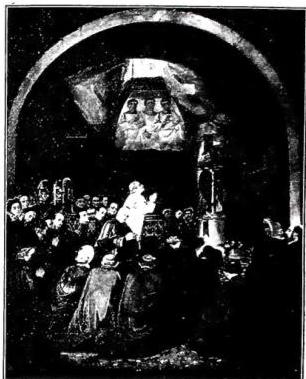
(fot. Mansi Vaticani)
Relations politiques et religieuses avec les États italiens: N. Bianchi, Stor. document. della diplomazia europea in Italia dall'a. 1814 all'a. 1861, 8 vols., Naples-Rome 1869-72; A. Rosmini-Serbati, Comment. della missione a Roma negli anni 1848-49, Turin 1881; L. Chiala, Lettere edite e ined. del conte C. di Cavour, 5 vols., ibid. 1883; P. De la Gorce, Hist. du Second Empire, 6 vols., Paris 1903-1905; E. Bourgeois and E. Clermont, Rome et Napoléon III, 1849-1870, ibid. 1907; A. Bozzola - Buttini, Stato e Chiesa nel Regno di Sardegna negli anni 1849-50 e la missione Pinelli a Roma, in Risorgim. ital., new series, 13 (1920), pp. 217-60; 14 (1921), pp. 294-375; P. Matter, Cavour et l'unité ital., 3 vols., Paris 1922-27; A. Omodeo, L'opera politica del Conte di Cavour, part 1°, 2 vols., Florence 1940. With foreign states: B. D'Harcourt, Les quatre ministères de M. Drouyn de Lhuys, Paris 1882; P. Berthe, Garcia Moreno président de l'Équateur vengeur et victime du droit chrétien, ibid. 1890; P. Thoreau-Dangin, La renaiss. cathol. en Angleterre au XIXe siècle, 2 vols., ibid. 1909; E. Lecanuet, L'Église de France sous la IIIe République, 4 vols., ibid. 1910-31; G. Goyza, Bismarch et l'Église: Le Kulturkampf, 1879-78, 2 vols., ibid. 1911-22; A. Boudou, La St-Siège et la Russie, 1814-1882, 2 vols., ibid. 1922-25; E. Palandri, La nuova orientaz. polit. relig. della Toscana nei primordi del pontif. di P., in Rass. stor. del Risorgim., 1929; J. Maurain, La politique ecclésiast. du Second Empire de 1832 à 1869, Paris 1930; R. Mori, Il Concordato del 1851 tra la Toscana e la S. Sede, in Arch. stor. it., 99 (1941), pp. 133-46; Ch. Poulet, Hist. de l'Église de France, III, Époque contemporaine, Paris 1949. Religious and social action: V. VATICANO, CONCILIO. Furthermore: G. Lamantia, Stor. della legislaz. ital., Roma e Stato rom., Turin 1888; F. Olgiati, La storia dell'Az. Catt. in Italia, 1865-1914, 2nd ed., Milan 1922; A. Quacquarelli, La crisi della religiosità contemporanea dal Sillabo al Conc. Vatic., Bari 1946; R. Aubert, op. cit. Furthermore: Kathol. Soziallehre: Kirche und modernes Leben, Lexikon päpstl. Weisungen, I and II, Eichstätt, Rome, Munich 1948-50; DThC, under the entries GÜNTHER; IMMACULÉE; LIBERALISME CATHOLIQUE; ONTOLOGISME. Pietro Pirri