
ANTONELLI, GIACOMO. — Cardinal, born on 12 April 1806 at Sonnino to a modest family that had grown wealthy through government contracts and the drainage works in the Pontine Marshes, and had remained faithful to the Pontiff during the French domination; he died in the Vatican on 6 November 1876. He studied at the Roman Seminary and then at the Sapienza, and, having left as a deacon and obtained his doctorate, received from his father Domenico the funds necessary to establish himself in a family prelature. He immediately turned to public affairs, demonstrating keenness of intellect, skill in extricating himself from difficult situations, and rare gifts as an administrator. Gentle, imperturbable, refined and obliging in manner, while at the same time quick to discern the proper way out of the most intricate and controversial questions, he soon came to be effectively supported especially by Cardinals Zurla and Lambruschini, who opened the way for him to a brilliant career.
Thus, successively, he was a referendary of the Signatura, assessor at the criminal tribunal of Rome, and apostolic delegate in Orvieto, Viterbo and Macerata. The critical condition of the treasury and the discontent that arose in certain provinces because of the cholera epidemic of 1837 gave him the opportunity to demonstrate clearly his administrative insight and political sensitivity. He soon became Cardinal Mattei’s substitute at the dicastery of the interior (1841), while shortly thereafter Gregory XVI appointed him a canon of St Peter’s and an apostolic protonotary; on 5 January 1845 he called him to succeed Cardinal Antonio Tosti as pro-treasurer of the Apostolic Camera, sending him in March the letter appointing him general treasurer. Only a month later, A. succeeded in successfully settling the difficult pro-
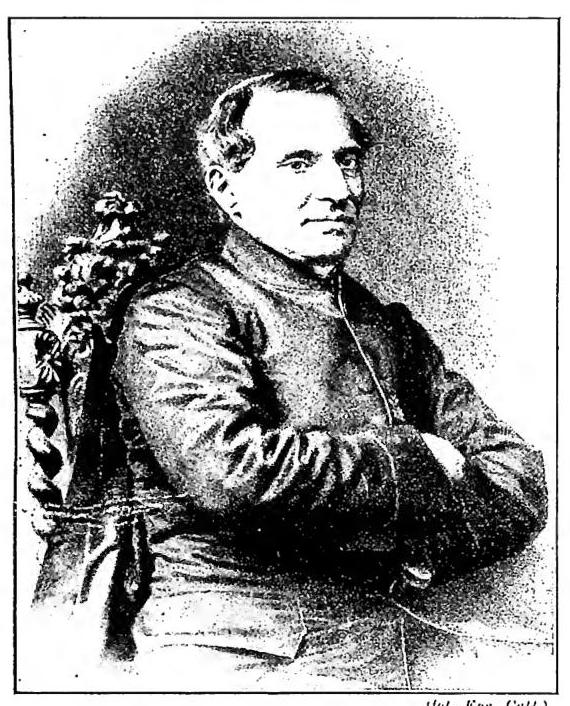
Close to Pius IX from the moment of his election, he alone became his intimate and devoted adviser and collaborator in temporal affairs, overcoming, through his tenacity in action, calculated coolness, and unsurpassable firmness, the exceptional internal and external political difficulties. Cardinal deacon of the title of S. Agata de' Goti and subsequently of S. Maria in via Lata, on 11 June 1847 he followed with conviction and effectively collaborated in the broad programme of reforms that Pius IX intended to implement in order to make the Papal States capable of sustaining themselves effectively in the new age. As President of the Consulta di Stato, he supported the plan for a defensive league among the Italian states; he contributed to the drafting and promulgation of the Statute; he broadly supported the programme and work of Pellegrino Rossi; but he opposed, with keen foresight, everything that, through the demanded declaration of war against Austria, might in any way impair the full sovereignty of the Papacy and the Church. Between 10 March and the celebrated 29 April 1848, he became convinced that the critical moment was approaching, when it would be necessary to break with the innovators who saw in the Pope only the Italian prince, or sought definitively to undermine his authority before his subjects and the world, in order then to depose him. Thus, after Rossi’s assassination and the assault on the Quirinal (15–16 November), A. skilfully knew how to take advantage of the efforts of the representatives of the major powers, united in wishing Pius IX to leave Rome but divided over the place of exile, which each wanted to be in its own territory in order to exploit him either in a liberal or in a reactionary sense; and he succeeded in having the Pontiff conveyed to Gaeta, from where, with the help of France and others, he was able to return him to Rome after the fall of the Republic.
Pius IX rewarded him by appointing him Secretary of State, and he remained so until the end of his life, striving internally, and not without success, to modernize the governmental structure through enlightened and well-conceived reforms, to maintain public order, and to establish a sound nucleus of military forces; abroad, to exert pressure on governments in favour of the Pontiff through the increasingly influential Catholic public opinion. A. understood, in fact, like Consalvi and Bernetti before him, that sooner or later the great liberal movement would ultimately prevail, overwhelming the Church’s temporal principality; but precisely for this reason he knew that the Pope neither should nor could bargain. And these were twenty-one years of unyielding resistance, conducted with rare skill through increasingly uncompromising notes and protests, intended to establish the use of violence by the adversaries and to preserve the honour of the thousand-year-old institution, without compromising its future or impairing its right, so that the principle of effective and visible sovereignty might triumph intact—a principle on which, essentially, the Conciliation was able to be achieved in our own day. Even after 1870 he continued to fight, refusing to accept the unilateral solution represented by the Law of Guarantees, and relying still more upon the forces of the great Catholic world, especially by making manifest the dangerous absurdity of the treatment accorded to the Pontiff.
The complex political personality of A. was and still is the object of many accusations and criticisms; from many points of view it recalls certain great ecclesiastical statesmen of earlier centuries, perhaps also because of his sympathetic and agreeable presence, to which his slender figure and lively, penetrating eye contributed not a little, as did his taste for conversation and society, his love of the fine arts, and a certain collection of precious stones and marbles. He was not without feeling, as was seen, among other things, in the generous assistance he gave to the impoverished family of the hatter Antonio De Felici, who attempted to kill him in the Vatican in 1855. He was a most devoted friend of s. Giovanni Bosco and a benefactor of the Salesian works. He generously favoured his brothers and relatives. The series of misunderstandings with De Merode may be explained through the opposing temperaments of the two disputants: one so generous, impulsive, and open, the other so reserved, cold, and calculating. Moreover, all the criticisms levelled against him, being polemical in nature and lacking documentation, are gradually fading away, like the intrigue woven around the Fausti–Venanzi case, which accomplished nothing other than strengthening A.’s influence with Pius IX, who probably, rather than being particularly fond of him, fully appreciated the importance of his work.
biografici. Palermo 1911: J. Schmidlin, Papstgeschichte der neuesten Zeit, II, Munich 1934, passim: G. De Chambrun, Un projet de séjour en France du Pape Pie IX, in Revue d'histoire diplomatique, Oct.–Dec. 1936: P. Dalla Torre, L'opera riformatrice ed amministrativa di Pio IX dal 1850 al 1870, Rome 1945. - On A.’s love of the fine arts cf. P. Dalla Torre, Le plastiche a soggetto indigeno nordamericano del Pettrich nel Pont. Museo Miss. Etn. Vicende e significato d'una raccolta romana dell'Ottocento (Con documenti inediti), in Annali Lateranensi, 4 (1940). And, in general, the excellent entries A. by A. De Waal, in Kirchenlexikon, I, cols. 978–82; by P. Richard, in DHG, III, cols. 832–837; by M. Rosi, in Dez. del Ris. Naz., II, pp. 85–87; by E. Soderini, in Enc. Ital., III, pp. 547–48.