
GREGORIO XVI, POPE. – Bartolomeo Alberto Cappellari, born at Belluno on 18 September 1765 to the noble Giovanni Battista and Giulia Cesa-Pagani, died at Rome on 1 June 1846. Of quick and lively intelligence, reflective and simple in spirit, he soon demonstrated an austere, firm, and tenacious temperament, profound expressions of convinced and evangelical goodness and religiosity, and a marked inclination toward study and learned speculation.
The entry into religious life of his sister Caterina among the Benedictines of S. Gervasio, together with the consoling support of the canon Giovanni Carrera, his educator, led him, at the age of eighteen, to enter the Camaldolese monastery of S. Michele at Murano (1783), where he assumed the religious name Mauro. Having made his solemn vows on 23 August 1786 and become a priest the following year, he was teaching philosophy and the sciences in 1790; he successfully defended in public disputation a thesis on papal infallibility for qualification as a lecturer in theology, and was entrusted by the Holy Office of Venice with reviewing works intended for publication.
At the age of thirty, on 5 August 1795, Don Mauro accompanied the procurator general of the Order to Rome as associate, to S. Gregorio al Celio and S. Romualdo. The tragic events of the Jacobin occupation induced him to publish, with a dedication to the martyr Pius VI, Il trionfo della Santa Fede e della Chiesa contro gli assalti dei novatori, combattuti e respinti con le stesse loro armi (Venice 1799), a substantial apologetic work and a convinced, timely act of faith in the imminent and inevitable victories of the papacy and Catholicism.
Abbot of S. Michele at Murano in 1805 and procurator general in 1807, despite the intensifying Napoleonic persecution he succeeded, with the help of his confrere Placido Zurla, in preventing the dissolution of the Camaldolese communities of Venice and Padua. In 1814 Cardinal Fontana, with the support of Pius VII, recalled him to Rome, where he was soon appointed consultor to various Congregations and was also entrusted with examining bishops, supervising certain universities and institutions of higher education, and reviewing the books of the Eastern Church. At the same time, he declined repeated offers of the episcopal sees of Zante and Tivoli in order to devote himself entirely to the restoration of his Order, of which he became vicar general in 1823.
Meanwhile, the times were coming to maturity: held in the highest esteem by Leo XII, respected by scholars, well acquainted with the affairs and workings of the Curia, pious, learned, and extraordinarily active, he was created cardinal in pectore by that same Pontiff on 21 March 1825 and published on 13 March of the following year. He did not hesitate then to assume the prefecture of Propaganda Fide, where, because of the slackening decline brought about by the very climate of the preceding century, and because of the abandonment and stagnation caused by the Revolution, everything had to be taken up again and rebuilt, both in Rome and in the mission territories. There he distinguished himself through apostolic zeal and energetic activity, elegantly resolving even difficult and long-standing questions, such as that of the Dutch Concordat (1827), or the appointment of a Catholic metropolitan for the Armenians (1829).
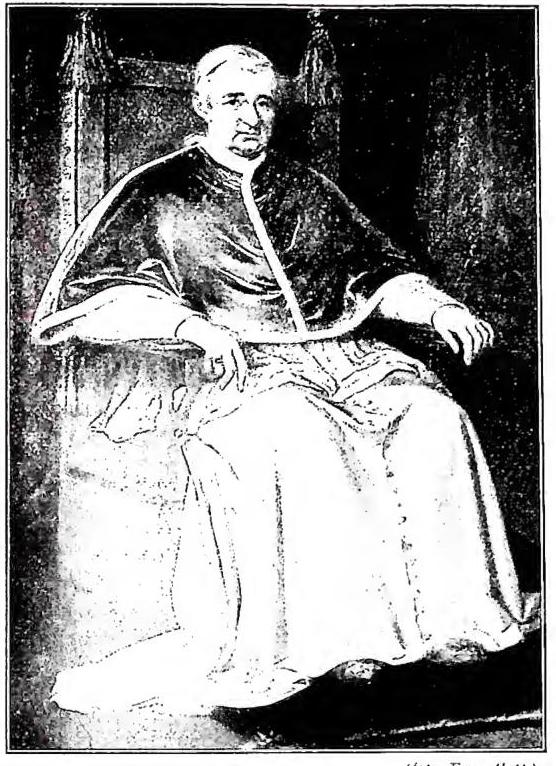
(phot. Enc. Catt.)
GREGORIO XVI, PAPA — Portrait — Rome, monastery of S. Gregorio al Celio.
for the sake of that complete ecclesiastical freedom which, with regard to the wholly free and vigorous Catholic expansion of North America, made him exclaim: “Nowhere in the world do I feel so much a pope as in the United States!”
Hence his entire inflexible programme, his almost warlike effort to reclaim and restore in their entirety the religious and civil liberties of the papacy, of the Church, and of the faithful masses, poised between the modern age, now approaching its twilight, and the contemporary age, still at its dawn. Freedom and independence to be reclaimed and restored, both in the face of the languishing Caesaropapist oppressions of the old monarchies of divine right and with regard to the rising jurisdictionalist claims of Enlightenment and secularist liberalism. In short, in the presence and against a society either sceptical or broadly imbued with a vague and empty romantic theism, so intimately permeated with anti-Christian preconceptions and so absorbed in material interests as to demand freedom for everything and everyone except the Church, and no longer able to believe in or trust the perennial inner strength—not only religious, but also social and political—of Catholicism. His was therefore a pontificate of a clear return to past evangelical glories, of resistance to the hostile forces of the moment, and of recovery and propulsion towards the future. G.’s work was thus essentially orienting, misunderstood and misconstrued by too many contemporaries and successors, but one to which time and events have given, and are giving, justification.
Most devout and simple, clear in thought and consistent in action, nourished by religious and humanistic culture, which he had acquired through a monastic formation traditionally imbued with the most Christian and civil medievalism, G. saw clearly and precisely, amid the convulsive and confused tangle of the ideas, tendencies, and aspirations of the age, the great high road that had to be taken up again and followed. Thus his constructive and far-sighted teaching once again found an echo, on the universal plane, perhaps for the first time in several centuries, in that concerted wave of fruitful enthusiasm, in that devout obedience of the episcopate, clergy, and faithful multitudes, which was destined precisely to constitute the fulcrum of the Church’s present greatness. “A marvelous power has arisen as if by enchantment,” wrote Eichendorff, “and it is the affirmation of Catholic opinion.”
With regard to his teaching office, the arduous problems arising from the succession and collision of opposing political regimes were resolved by the Pontiff through the natural development of considered ecclesiastical practice. Unwilling to enter into the merits of the various systems for ordering public affairs, or to make legitimism or progressivism a matter of principle, he declared himself ready to deal, solely for the protection of spiritual interests and the good of souls, with anyone who in fact held political power. And he imposed upon the hierarchy and the faithful of every nation the duty of obeying the existing regime, in order to preserve public tranquillity without prejudice to the rights of the Church or to the pending questions de iure between the contending parties (encyclical Sollicitudo ecclesiarum, 7 Aug. 1831). He thus also untied the knot of the “liberal equivocation”; he unmasked its snares by striking at the roots of the philosophy of common sense and Lamennais’s theory of liberating regenerations (encyclicals Mirari vos, of 15 Aug. 1832, and Singulari nos, of 25 June 1834). Nor did the reservations expressed regarding the writings of Bonald and De Maistre appear any less well-founded or opportune, since they were too inclined to disparage nature and reason, while the anti-intellectualist fideism of Abbé Bautain was likewise condemned (apostolic letter Accepimus, 20 Dec. 1834).
Next came the false doctrines of Hermes, intended to reduce faith to an empty romantic sentimentalism devoid of rational content, and to deny the charismatic work of Grace and the actual human faculty of free will (apostolic letter Dum acerbissima, 26 Sept. 1835). But the culminating document remains that in which G. rose up sternly against the infamous slave trade, condemning it definitively in all its aspects. The sorrowful apostolic letter concerning it, dated 3 Dec. 1839, reverberated so strongly throughout the civilized world that three years later it induced the principal European powers to conclude a specific treaty for its suppression: this was the mortal blow dealt to a barbarous custom and a shameful commerce, which had already been repeatedly condemned and prohibited by several pontiffs.
G.’s great solicitude for the “savages”—that is, also for those primitive peoples whose members the Pope insisted must be regarded, in the light of divine fatherhood, as all members of the human family, equal, brothers, and free, in other words, as “men” like everyone else and not “impure animals,” as the pseudo-official science of naturalism and evolutionist sociologism was then beginning to do—could not, in the heart of the former prefect of Propaganda Fide, be separated from a very particular love for the missions. Sylvain aptly observes that G. “devoted every moment of his pontificate to the development of the Catholic missions,” and that “none among the many grave and multifaceted concerns was ever capable of distracting [him] from so glorious and important an objective.” Indeed, G., in this respect also a worthy son of s. Romualdo, may be regarded as a far-sighted pioneer of the missions’ successes today in every part of the globe. The rapid strengthening of missionary penetration among both pagans and heterodox peoples—a penetration soon sealed by the blood of new martyrs, especially in the Far East, and by the spread of mission stations in Abyssinia, Egypt, Algeria, India, the Americas, and Oceania, as well as in northern and eastern Europe—was matched by the establishment and flourishing of specific institutes devoted to the training of missionaries and the collection of the necessary financial means. Thus, alongside the full and fervent revival of old and new religious families, including in the missionary sphere, one should recall the meritorious initiatives of the Society for the Propagation of the Faith of Lyon, the Society of the Holy Childhood, and the Leopoldine Society of Vienna. Nor were prudent measures lacking on the part of the Pontiff to counter Protestant activity, reorganize and strengthen the S. Congregation of Propaganda and its College, and establish special seminaries in mission territories for the indigenous clergy. The establishment of no fewer than thirty-six new apostolic vicariates, the founding of fifteen new dioceses, and the appointment of ninety-five bishops, always by decree of Propaganda, are clear evidence of the well-deserved reward G. garnered in this field of his multifaceted pontifical activity.
Likewise directed toward the highest and purest religious ends was his ecclesiastical government, in every sphere and at all times. His solicitude for the harmonious union of the episcopate and for the better formation and discipline of the secular clergy was accompanied by constant care for the rebirth of Religious Orders and Congregations after the revolutionary upheaval, for the establishment and strengthening of new foundations, especially those devoted to the education of youth and to social assistance. He canonized five saints (1839), among them s. Alfonso de' Liguori and s. Pietro d'Alcantara, and completed several beatifications, recognizing the ancient and constant cult of thirty-four servants of God. He extended to the universal Church the Office and Mass of s. Luigi Gonzaga and desired the introduction of the cause of the apostle of children, Giovanni Battista de la Salle. Important norms were issued for observance of the liturgical prescriptions and for a return to the genuine sources and forms of sacred music. Most devoted to the Virgin, he became a vigorous promoter of the movement and of the preparatory acts for the proclamation of the dogma of the Immaculate Conception. It is enough to recall the interest G. took in clarifying the prodigious circumstances of the conversion of the Jew Ratisbonne; the indulgences granted to the faithful devoted to the Miraculous Medal; the introduction of the adjective immaculata into the praefatio of the proper Mass of the Conception; and the addition of the invocation Regina sine lube originali concepta to the Litany of Loreto. In addition to several notable structural reforms of the organs of the Curia, such as the reorganization of the body of apostolic protonotaries, he held fifty consistories, delivering allocutions almost always noteworthy for their zeal and firmness. He was deeply concerned with the dignity and prestige of the S. College: fortunate in his choice of the eighty-two cardinals whom he created (one need only think of the palaeographer Mai, the polyglot Mezzofanti, and the most pious pastor Mastai-Ferretti), in every action he availed himself of the counsel and collaboration of the most competent Curial cardinals. He knew how to bring new energies and abilities to the episcopate by preconizing no fewer than seven hundred and fifty-five patriarchs, archbishops, and bishops.
Equally directed toward the exclusive safeguarding of the moral and spiritual rights of the immense flock entrusted to him, and always free from any temporalistic concern or influence, was his prudent and far-sighted ecclesiastical “policy” in the difficult and arduous relations with the various States. This policy, while able to rely effectively upon the increasingly harmonious, coordinated, and acquiescent pastoral force of the overwhelming majority of the episcopate and clergy of every country, found, on the other hand, new and considerable support in the growing civic and social influence of the masses of the faithful upon public opinion in their respective nations.
Assisted and supported by direct collaborators such as Bernetti and Lambruschini, G. thus succeeded in upholding on every occasion the prestige of the Church and of the S. Sede, sometimes overcoming, and at other times preparing the way for the overcoming of, the gravest and most numerous difficulties.
In Piedmont, long-standing disputes were brought to a close by reestablishing the nunciature and settling questions relating to civil status, the suppression of the Sardinian tithes, taxation for the clergy, and ecclesiastical immunities. Vigilant and agile was the line of conduct followed by the Pontiff in the face, first, of the suspicious indifference and then of the self-interested intrusiveness of the July Monarchy, which was in essence too skeptical to wish to appear persecutory, while among those Catholics Ozanam’s admonition prevailed: “Renounce the political spirit in favor of the social spirit.” The S. Sede encouraged there the sound neo-Guelph tendencies and supported the movement for freedom of education; the generous sacrifice of the Jesuits found some compensation in the discreet return of the Benedictines and the Dominicans. A happy balance of constructive compromise was achieved in Belgium, where, through the prudent and skillful work of the nuncio Pecci, even the thorny controversy over the examination commissions was overcome. In the Iberian Peninsula, amid Cristina, Isabella, and Don Carlos, Miguel, Pedro, and Maria da Gloria, as dynastic conflicts grew more complicated, amid ideological clashes between a functioning royalist absolutism and an emerging secularist liberalism, the Church suffered widespread persecutions and vexations, as usual paying the price for all. Until, thanks to G.’s firmness in safeguarding principles and his flexibility in seizing every opportunity for a solution, in Spain, after Espartero had been defeated, the way was opened to a new concordatory settlement (1843–45), while in Portugal, through receiving Carreira in Rome and sending mons. Capaccini to Lisbon, a climate of evident pacifying détente began to take shape.
The same cannot be said of Switzerland, where, in the political conflict between federalists, faithful to the ancient autonomies of the cantons, and radicals with centralizing and unifying tendencies, a bitter religious conflict arose, since the former sought to safeguard the freedoms of the Church, while the latter tended toward secularist and rationalistic oppression. Supported by the force of justice and by the encouragement of G., and led by Leu and Meyer, the Catholics fought victoriously from 1832 onward against the attempt to organize the Swiss Church along national lines and autonomously from the S. Sede. But the radicals, defeated on the plane of democratic legality, resorted to the law of force: on 11 December 1845 the defensive league of the Sonderbund arose, and thus the hostilities of the civil war began.
While in Austria there appeared (1833–44) signs heralding an impending détente through the practical and gradual disuse of Josephinist legislation, with a consequent renewed accentuation of Rome’s influence, relations with Prussia necessarily moved to extremes, as efforts to achieve the confessional unification of the State grew ever more intense through the campaign concerning mixed marriages and through insidious maneuvers intended to produce a syncretistic synthesis of the various confessions. To the yielding complicity of certain bishops and prelates, G. XVI promptly responded by reaffirming the wise directives of Pius VIII (brief Litteris, 25 March 1830) and condemning the doctrines of Hermes. Then, in the persons of Droste-Vischering and Dunin, admirable champions of truth and the Faith arose; against their arrest the Pope raised his voice (alloc. conc. of 10 December 1837, 13 September 1838, and 8 July 1839), arousing a wave of enthusiasm and indignation not only in the country but throughout the civilized world. More prudent than Frederick William III, his successor, the fourth of that name, realizing that instead of unity the State was threatened with irreparable ruptures of its structure, changed policy as early as 1840, freed the imprisoned pastors, and, by creating a special Catholic section within the Ministry of Worship with Catholic officials (1841), prepared thirty years of religious peace in the country.
As for England, Scotland, and Catholic Ireland, G. XVI’s action was no less vigorous and intense, but was always deliberately confined to the purely religious sphere, aiming more at breaking through the prejudices and laws that prevented those faithful from enjoying the traditional freedoms recognized for all other citizens than at risking, through diplomatic negotiations, predictable state interference. Thus, thanks also to his paternal friendship with Wisemann and his undisguised admiration for the Irish efforts to vindicate their rights, the Roman Church in those lands experienced remarkable flourishing, while the number of apostolic vicariates doubled (1840) and the solution of the Irish problem became increasingly unavoidable, politically as well; for its clergy the Pope expanded and reorganized the national college of S. Agata ai Monti.
And finally, alongside such varied vicissitudes of old Europe, Russia on the one hand and the Americas on the other presented a sharp contrast of threatening shadows and vital lights. Faced with martyred Poland and oppressive Russia, the attitude of G. XVI took clear and equitable form in the repeated appeals addressed to the Polish faithful to refrain, for their own spiritual and material good, from resorting to disorder and violence, but even more so in the reiterated protests intended to expose the perfidious hypocrisy inherent in Muscovite barbarous absolutism. In the Americas, by contrast, the prompt consent and recognition practically expressed by the Pontiff for systems of democratic liberty that were not anti-religious, against every claim of Iberian interference or of an a priori distinction among different types of government, provided that the freedom of the Church was always safeguarded, laid the sound foundations for the achievements reached today. Suffice it to mention the consolations that came to G. from the United States, where, through persuasive and free proselytism, new ecclesiastical jurisdictions were continually arising, and the national councils held successively in Baltimore grew at every session ever larger and more edifying.
If, then, not only was G., in the government of the Church and in his ecclesiastical “policy” toward the various States, not in principle opposed to regimes of free constitution, but, on the contrary, as Hofmann wrote concerning Greece, he “in strenuously defending religious principles in the internal struggles [of every nation] certainly rendered services to the cause of holy liberty against the deification of the state,” showing that he appreciated the advantages of the free expression of public opinion in a sense that was not Enlightenment-oriented, but medievally civic and Christian, what remains of the vaunted “obscurantism” of this Pontiff? The “obscurantism” of G. was in large part no more than an ingenious propagandistic device of the liberals of his own and later times. And this is precisely the glaring error in which many historians, including with regard to G., continue to struggle: instead of judging certain figures within the framework of the age in which they lived and of the institutions they governed, they reduce their function to that of becoming
spokespersons for the impassioned and contingent polemical positions of one or another opposing side.
Nor does the easy, typically liberal distinction made by Farini hold—and cannot hold—between the enlightened and apostolic wisdom of G.’s religious government and the alleged faults of short-sighted and reactionary obscurantism in his civil government and in the face of the burning problems of Italian nationality. This distinction now appears groundless upon an objective and dispassionate examination of the facts and circumstances, from which, on the contrary, the Pope’s perfect and consistent coherence emerges clearly.
G., as Audisio observed a century ago, “had a mind capable of understanding his age, its dangers and trials... [But] he found [in the Papal States and in Italy] a system established, tenacious, and compact in every part... [Thus,] frank in religion, [he had] to proceed in politics with caution and restraint. The thought of the great popes of the Middle Ages, of making Italy their support and themselves the nucleus of the Italian powers, seemed forgotten. Nor did the Italian powers well remember the Italian tradition of joining themselves civilly to the papacy. And while the secret societies conspired by iniquitous means in order to achieve independence and a
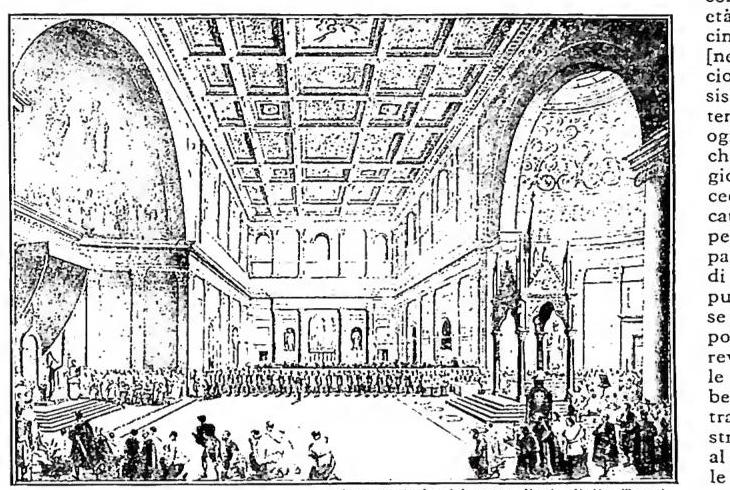
GREGORIO XVI — G. XVI consecrates the altar known as that of the Confession in the basilica of S. Paolo (5 October 1840). Lithograph from a drawing by Francesco Grandi.
some unification of dismembered Italy, they abandoned to those very principles this powerful lever.” It is therefore clear that, even had G. wished it, in order to revive Italy in the sense indicated—which could be none other than the neo-Guelph sense of yesterday and today—it would certainly not have sufficed for him alone and on his own to wish it; rather, all those Italian and foreign princes would also have had to understand it in that way, and even more so the moderate liberals who erroneously sought to impose their ideological schemes upon the papacy and the Church, and above all the extremist sects and their anticlerical adherents. The subsequent tragedy of Pio IX, between 1846 and 1850, teaches this: from the failure of his famous League among the states of the peninsula owing to the decisive hostility of Piedmont, and the collapse of his negotiations for Austria’s peaceful renunciation, to the assassination of the constitutionalist and federalist Pellegrino Rossi, the revolution, the assault on the Quirinal, and the departure for Gaeta.
On the other hand, as a convinced proponent and restorer, in a medievalist sense, of the freedom of the Church—so much the better if within the general framework of civic and political liberties—G., not only as pontiff but also as temporal sovereign, could neither sacrifice the former to the latter nor ought he to have done so, especially in his own States. Thus, with regard to the political and administrative problems of the Papal States, what Cardinal Antonelli declared to Balbo in exile at Gaeta (May 1849), after the experiences of Pio IX, applies perfectly to him: “the conscience of the Holy Father absolutely does not permit him to establish anything that would impede his spiritual freedom: the temporal dominion of the popes was established for no other reason than to secure for them such freedom vis-à-vis the external powers; such freedom is useless if it does not remain with the pontiffs within their own State” (cf. P. Dalla Torre, L’opera riformatrice ed amministrativa di Pio IX fra il 1850 e il 1870, Roma 1945, pp. 9-13; and, for the whole of the Italian policy of Pio IX mentioned above, the fundamental studies of P. Pirri, in Rivista di storia della Chiesa in Italia, 1 [1947], pp. 38-84; 2 [1948], pp. 183-214). G. was therefore not characterized by closed and blind obscurantism, but rather by a prudent, coherent, and attentive awareness of insuppressible and often uncontrollable realities and demands, not only political but also, and above all, religious. It is true that, in the face of such categorical rights and duties belonging to an entirely particular sovereignty, there remained the legitimate rights of subjects, who in any event, in the Catholic sense, were entitled not only to the secular privilege but also to the traditional duty of serving and collaborating above all in the great spiritual cause of the papacy’s independence and necessary freedom—that is, of the Church. But here too, if G.’s conduct is viewed in this light and judged rightly, it cannot give rise to objections of principle, because he did everything it was possible for him to do for his subjects; at most, reservations may be expressed concerning the manner in which some of the many and well-conceived measures and provisions were implemented and applied, owing to circumstances or to the responsibility of those carrying them out.
Indeed, having chosen as the only possible path that of renewing the institutions rather than granting constitutions; having rejected, as injurious to his sovereign freedom, the foreign imposition of the reforming provisions of the Memorandum of the powers of the Holy Alliance (1831); and having freed himself, through the strengthening of the army, from the constraining burden of the dual Franco-Austrian occupation, G. essentially did much more on his own initiative than the Memorandum itself demanded of him. Thus, thanks to the wise counsel of Cardinal Gamberini and others, every field of administration once again became the object of thorough study, often radical modifications, and valuable innovations: from central to local, municipal, and provincial administration; from administrative jurisdiction to civil and criminal jurisdiction; and from the State’s juridical and social activity to its financial and military activity. Yet, according to an expert scholar of the historical precedents of Italian administrative law, Schupfer, and as the recent research of Ventrone and others also demonstrates, “to say that the administration of the Papal States was among the least praiseworthy in Italy would be to say something untrue... Its merits were not lacking [from the time of Pio VII onward]... and the upward movement of organic reforms continued on its course under G. XVI” and under Pio IX, so that “the most difficult step toward freedom is toward a perfected administration; it could by then be said to have been overcome.” “It certainly cannot fail to be noted,” Ventrone observes, “that liberties, especially political ones, [were] greatly limited... [But] on the other hand,” he adds, “one certainly cannot fault a State for not wishing to commit suicide.” At this point, since it is impossible to provide even a summary account here of G.’s vast work as temporal sovereign, or even of all that, with conspicuous devotion, he—highly learned as he was—did for the sciences, the arts, and culture in general, and especially for public education, V. the study by P. Dalla Torre, L’opera riformatrice ed amministrativa di G. XVI (in G. XVI. Miscellanea commemorativa, Roma 1948, II, pp. 29-121, with extensive bibliography).
Death, received with the humble and austere monastic simplicity in which he had always lived (“I wish to die as a friar and not as a sovereign,” he said with gentle firmness to one who was still striving to surround his final moments with pomp), found him at his post on 1 June 1846. He had reigned for fifteen years and was eighty-one years old. He was buried in S. Pietro, and on the monument erected to him there stands, with just cause, as a virtually unified commemoration of all his great deeds, the “Propagation of the Faith.” Holding his right hand upon the globe, G. points out the Cross to the missionaries surrounding him, as if urging them to pursue their apostolic work through the centuries with the same intrepid courage and the same steadfast perseverance that were his.
37. — CATHOLIC ENCYCLOPEDIA. — VI.
edited by A. M. Bernasconi, likewise 1901–1904; Raccolta delle leggi e disposizioni di pubblica amministrazione dello Stato Pontificio, likewise 1834–71. Few are the constructive and objective, or simply up-to-date, studies on G. In addition to the entry G. and the many others connected with it, in the Diz. di erudizione storico-erci. di G. Morena, XXVII, Venice 1845, pp. 312–28, which takes as its source a work of considerable contemporary importance, an extensive and well-informed critical revision of the historiography is found in the two volumes published by the Camaldolese on the occasion of the centenary of his death: G. XVI. Miscellanea commemorativa, Rome 1948. Cf. also: G. Baraldi, Pio VIII e G. XVI, Modena 1831; G. Battaglia, Cemil cronologico sul sommo pontefice G. XVI, Venice 1837; A. Nibby, Roma nell'u. 1838, Rome 1838; F. Fabi-Montanari, Notizie istoriche di G. XVI P. M. di santa memoria, likewise 1846; B. Wagner, Papst G. XVI, sein Leben und sein Pontifikat, Sulzbach 1846; Pius VIII und G. XVI, in The Edinburgh Review, January 1859; N. Wiseman, Recollections of the last four Papes, 1st ed., London 1858, Italian translation, Milan 1860; G. Audusio, Storia religiosa e civile dei Papi, V. Rome 1868, pp. 356–94; G. B. Del Bravo, Storia del pontificato di G. XVI di s. m., manuscript (1870) in the Biblioteca di S. Gregorio al Celio; A. Reumont, Geschichte der Stadt Rom. III, II, Berlin 1870; La vérité sur G. XVI et son temps. Plaidoiries de MM. Collin et Van Biervliet devant le tribunal de première instance de Gand au procès intenté à la « Flandre Libérale » par M. Moreni, Paris 1877; M. Brosch, Geschichte des Kirchenstaates, Gotha 1882; G. Lamantia, Storia della legislazione italiana, I, Roma e Stato Romano, Turin 1884; C. Sylvain, G. XVI et son pontificat, Lille-Paris 1889; L. Farges, Le pouvoir temporel au début du pontificat de G. XVI, in Revue historique, 42 (1890); J. Heifert, G. XVI, und Pius IX, Prague 1895; P. Balan, Storia d'Italia, IX, Modena 1897; B. Gamberale, Gli inizi del pontificato di G. XVI. La conferenza diplomatica in Roma e le riforme, in Rassegna stor. del Risorg., 16 (1927), p. 657 ff.; F. Hayward, Le dernier siècle de la Rome pontificale, Paris 1927–28; H. Bastgen, Forschungen und Quellen zur Kirchenpolitik G. XVI, I, Paderborn 1929; G. Mollet, La question romaine de Pio VI à Pio XI, Paris 1932; A. Ventrone, L'amministrazione dello Stato Pontificio dal 1814 al 1879, Turin 1936; E. Veressi, Tre pontificati: Leone XII, Pio VIII, G. XVI, likewise 1936; A. Muñoz, Roma cent'anni fa, Rome 1939; J. Schmidlin, Histoire des papes de l'époque contemporaine, I, part 2, Lyon-Paris [1940], pp. 195–209; L. Salvatorelli, Pensiero e azione del Risorgimento, Turin 1943, V. index; D. Federici, G. XVI tra favole e realtà, Rovigo 1947; D. Demarco, Il tramonto dello Stato Pontificio. Il Papato di G. XVI, Turin 1948; A. C. Jenoio, Chiesa e Stato in Italia negli ultimi cento anni, likewise 1948, V. index; J. Leffon, La crise révolutionnaire 1780-1848, in Histoire de l'Église directe de A. Fliche-V. Martin, XX, Paris 1949, pp. 436–71; N. Storani, Viaggio di S. Santità G. XVI alla visita del santuario di S. Maria Loretana, nel sett. 1841 (s. n. 12); C. Schupfer, I precedenti storici del diritto amministrativo vigente in Italia, in V. E. Orlando, Primo trattato completo di diritto amministrativo italiano, I, Milan (s. n.), pp. 1256–84; to be kept in mind for the listing of public works [A. Tosti], A. G. XVI, Epigrafi (s. d.).
Paolo Dalla Torre