
PIETRO d'ALCANTARA, saint. — Franciscan, promoter of a reform within the Order.
I. LIFE
Born at Alcantara (Extremadura) in 1499, died at Arenas (diocese of Avila) on 19 October 1562. He studied at the University of Salamanca (1513–15), then entered the Franciscan Order at Los Majaretes. Shortly after 1519, even before being ordained a priest, he was sent as superior to found the convent at Badajoz. After receiving Ordination (1524), he became superior at Robredillo, near Placencia, and once again at Badajoz, until in 1532 he obtained permission to withdraw to a more secluded life in the convent of S. Onofrio de La Lapa. In 1538 he was elected provincial of the discalced province of S. Gabriel.II. THE BEGINNINGS OF THE ALCANTARINE REFORM
During this office he had already drawn up very strict Statutes for his religious, approved at the Chapter of Plasencia in 1540. But his reform began in 1544, when, with the consent of Julius III, he withdrew to the small church of S. Croce of Cobollas, near Coira, placing himself under the obedience of the Conventuals, because of the difficulties he had encountered among the Observants, who saw in his undertaking the danger of a new internal division within the Order. In 1555 he built the celebrated convent of Pedroso, followed by others. In 1556 the Vicar General of the Conventuals appointed P. d'A. Commissary General of the convents of the Reform in Spain. From that moment the custody flourished greatly, obtaining the approval of Paul IV through the brief Cum a nobis (8 May 1559), which permitted its spread abroad as well. The custody was raised to the status of a province in 1561. The Observance did everything possible to bring the new Province back under its obedience, and finally the Alcantarines had to yield; the transfer to the Observance was sanctioned by Pius IV through the bull In suprema (25 January 1562), though it was carried out only the following year. In the meantime, however, s. P. d'A. died. He was beatified by Gregory XV on 18 April 1622 and canonized by Clement IX on 28 April 1669; Clement X extended his cult to the whole Church in 1670. Patron of the diocese of Coira in Spain and of Brazil.III. THE SPIRIT OF S. P. D’A. — The life of s. P. d’A. was dominated by a strong spirit of penance and mortification, from which there also proceeded an intense love of the poverty imposed upon his reform in an exceptionally strict manner, so as to renew the examples of the « Franciscan origins ». Through such austere asceticism, the Saint attained an exceedingly high
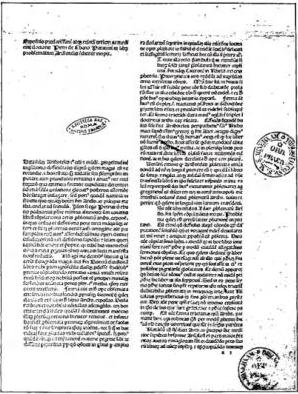
PIETRO D'ABANO — Title page of the Expositio problematum Aristotelis, Padua 1482 — Rome, copy in the National Library.
IV. GLI SCRITTI
Degli scritti di s. P. d'A. non resta molto: gli Statuti della Provincia di S. Giuseppe, le lettere indirizzate a s. Teresa e a s. Francesco Borgia, e soprattutto il famoso opuscolo Traitolo de la oración y meditación sulla cui autenticità tanto si è discusso, senza ancora giungere a una soluzione definitiva e accettata da tutti. La controversia verte sul fatto della grande somiglianza, spesso anche verbale, fra il trattato attribuito al nostro e un trattato simile del celebre domenicano fra Luigi da Granata, molto più sviluppo. Comunque sembra non doversi dubitare dell'autenticità alabatarina dell'opuscolo così come ci è pervenuto. Esso presenta due parti: nella prima viene esposto ed analizzato un metodo di meditazione con due serie di meditazioni svolte sui novissimi e sulla Passione di N. S.; nella seconda si parla più in generale della vita devota. L'opuscolo presenta abbastanza chiari i caratteri della spiritualità francescana, nell'affectività, nella concretezza plastica dei quadri e nella praticità dell'insegnamento. L'opuscolo ebbe larga fortuna, con numerosissime edizioni e versioni in tutte le lingue (in italiano recentissima [ed. di P. Valugani, Quaderni francescani di spiritualità, 3, Roma 1952).Biografia de Fr. Luis de Granada, Madrid 1896; C. d'Atençon, Louis de Granada et Pierre d'A., in Etud. Francie, 35 (1923), pp. 198-231; P. Michel Ange, Le Traité de St Pierre d'A., ibid., 36 (1924), pp. 63-83, 141-66; id., Editions connues du Traité de l'oraison de St Pierre d'A., in Orient, 14 (1930); 16 (1936) in 7 puntate; id., Les sources d'une vie de St Pierre d'A., in Etud. Francie, 49 (1937), pp. 92-105, 189-212. Alberto Ghinato