
TERESA di GESÙ, saint. — Reformer of the Order of Carmel, mystical writer, in the world Teresa de Ahumada, born in Avila (Spain) on 29 March 1515, died on 4 October 1582 at Alba de Tormes.
I. ACTIVITY
Her childhood was fervent; in her youth, however, she experienced a period of dissipation, from which she recovered when, at the age of 16, after the death of her mother Beatrice, she entered as a boarder among the Augustinian nuns. Returning to her father’s house toward the end of 1533, she governed it until, secretly, given the opposition of her father Alfonso Sanchez de Cepeda, she left it to enter the Carmelite monastery of the Incarnation at Avila; she received the habit on 2 November 1536.Even in the convent, an initial period of great fervor was followed by lesser fidelity, and this time for a long period. In the year of her religious profession (1537), she fell seriously ill and underwent such treatment that, after placing her life in danger, it left her in a pitiful state, all curled up upon herself like a ball of wool (Life, c. 6). At that time, however, she devoted herself fervently to prayer and was favored with certain graces of infused contemplation. But these disappeared when T., having recovered from her illness through the intercession of s. Joseph, whom she fervently invoked, began to associate too frequently with worldly people and became so distracted that she came to abandon mental prayer. The death of her father (1543) impelled her to resume its practice assiduously, and from then on she never abandoned it again; yet in her the struggle between the demands of God and those of the worldly spirit lasted a full 18 years, as she herself relates. Her definitive conversion to a life of fervor took place at about 40 years of age, and was due to providential encounters that recalled her to greater seriousness of life. With fervor, the mystical graces also returned; infused contemplation returned, and within two years (in 1557)
it reached ecstasy, while interior locutions began, to which visions were added in 1559; the vision of the «transverberation», which was repeated several times, has remained famous. These graces were for T. the occasion of many tribulations, because at first the persons whom she consulted about them believed her to be deceived by Satan, but she was subsequently reassured by holy personages, among them s. Francesco Borgia and s. Pietro d'Alcantara. In 1560 she made the «vow of the most perfect» and labored without respite in founding her monasteries, which from the year 1567 began to multiply. She reached the summit of the mystical life (the seventh dwelling places) around 1570; it seems that the Grace of mystical marriage should be dated to 18 November. Her last extensive spiritual account, from 1581, the year before her death, presents her in a state of profound peace: «The imaginative visions have ceased. Yet it seems to me that I always have before me the intellectual vision of the Three divine Persons and of the Humanity of Our Lord... The interior locutions continue still... However strong the desires (to act) may be, I desire more the fulfillment of the will of God and the possibility of contributing to his greater glory... I love God alone: and this love, it seems to me, far from diminishing, is constantly increasing, in proportion to the desire that the Lord be served by all» (to the bishop of Osma). She died after an ecstasy lasting 14 hours, at the age of 67. Her body remained incorrupt and flexible for a long time.
T.’s work as a reformer falls within the general movement of Catholic religious reform centered on the Council of Trent (1545-63): an air of renewed fervor breathed throughout all of Catholic Europe. The Carmelite Order, to which T. belonged, was far from flourishing in Castile, and her own monastery did not even have obligatory enclosure. Feeling the need for greater solitude in order to devote herself to the life of prayer, to which she felt impelled by the contemplative graces she enjoyed, she joyfully welcomed the idea, which arose during a conversation among friends, of founding a reformed monastery under strict enclosure, and afterward received confirmation of it in her interior locutions. On 24 August 1562 she succeeded in founding it, despite the very great opposition she encountered in Avila, but T. had to leave it on the very day of its foundation, having been promptly recalled to her original monastery; only after a year was she able to join her first companions.
The four years that followed were devoted to the spiritual organization of the new foundation: T. gave it an eminently apostolic spirit: her daughters would become intimate friends of the Lord through a life of total self-giving, and would use their power of intercession to draw divine graces upon the Church and especially upon its priesthood. The «penitential» life of the Discalced Carmelites finds its special motive in the intention of responding to the needs of the Church. During these same years T. made the first draft of her Constitutions, which rendered more concrete the return to the «primitive» Rule of Carmel, which in 1432 had been mitigated precisely in its central precept, namely, great withdrawal from worldly life. Through specific provisions concerning enclosure, solitude, and silence, T. created in her monasteries such a distinctive atmosphere of retreat that she could write: «we intend to live not merely as nuns, but as hermits» (Way of Perfection, 13, 6), and proclaim that the whole ideal of her daughters consists in wishing to live «alone with Him alone» (Autobiography, 36, 29), intent solely on pleasing him and praying for the needs of the Church, accompanying prayer with self-immolation.
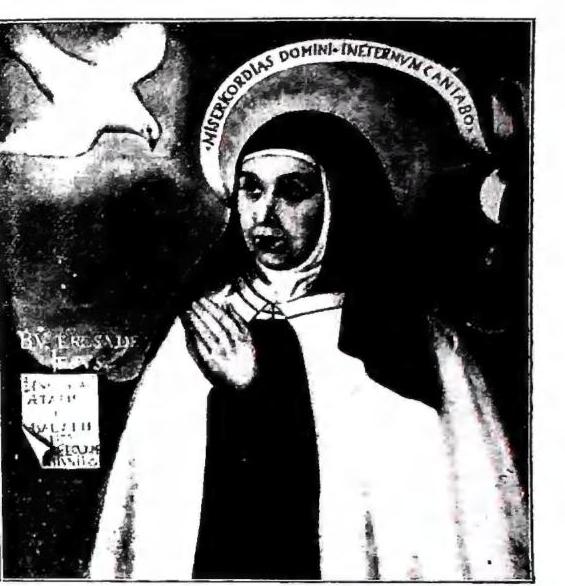
(courtesy of Msgr. A. P. Frutus)
TERESA DI GESÙ, santa - Portrait of s. T. d'Avila, work of fra' Giovanni della Miseria - Seville, monastery of S. Joseph.
she founded her «dovecotes of the Virgin». So that her Daughters could be suitably guided in their spiritual life, she had found it necessary to have fathers of the same Order who would live a life similar to theirs, and she had obtained from the superior general permission to found convents of «contemplative» fathers. Thus, with the collaboration of s. Giovanni (v.) della Croce, the reform of the Discalced Carmelite fathers was born (1568). After some time, however, extremely painful conflicts of jurisdiction arose between the nascent branch and the old stock, and the superior general himself became so displeased that he ordered T. to remain confined in a monastery. But then the storm was calmed, and one year before her death, in 1581, T. had the joy of seeing her Constitutions excellently arranged and approved at the Chapter of Alcalà. She therefore left her Institute perfectly oriented and organized.
II. MYSTICAL DOCTRINE
Without having devoted herself specifically to study, T. greatly loved reading, and in fact went through numerous spiritual books that sharpened her great intelligence and enriched her conception of the interior life, which she later set forth in her mystical works. Her gifts as a writer, moreover, are not limited to this field; in her very extensive correspondence she touches upon the most varied subjects, with lively narratives and suggestive descriptions of her foundations. Her mystical writings, however, merit a uniquely special attention, because they offer a very notable and outstanding contribution to the advancement of spiritual science. T.’s mysticism is descriptive rather than properly doctrinal and theological; it concerns the experience of contemplative souls and especially, often concealed behind anonymity, her own experience, upon which her exposition in fact hinges. T., however, knew how to place contemplative and mystical graces so well within the whole of the spiritual life, and to indicate so clearly their relationship with the other elements of the interior life, that the entirety of her teaching constitutes a true doctrine of the contemplative life and serves as an excellent guide for souls devoted to the spiritual life. Its essential points may be summarized under five headings. — 1. Concept of perfection. T. does not confuse Christian perfection with contemplative graces: her thought on this matter is clear and constant: «It is clear that supreme perfection does not consist in interior sweetnesses, nor in great raptures, nor visions, nor in the spirit of prophecy; but in our will being so conformed to that of God that there is nothing which we understand He desires that we should not desire with our whole will, and that we accept with the same cheerfulness the sweet and the bitter, once we know that His Majesty wills it» (Foundations, 5, 10). — 2. Contemplative graces. Nevertheless, T. greatly esteems contemplative graces and believes that God in some way invites everyone to this «source of living water», although not everyone is to drink from the fountain with equal abundance. She holds that God willingly grants these graces to souls who prepare themselves for them through a life of continual prayer and generous self-giving, and that they constitute a shortcut to reaching holiness more quickly. They are therefore truly desirable; but since they are divine gifts which God grants «to whom He wills, when He wills», we can make no claim regarding them. One must also distinguish from contemplation the extraordinary Graces: supernatural visions and locutions, which are much more subject to deception and cannot be desired, since that would be like opening the door to various illusions. — 3. Contemplative asceticism. There therefore exists a form of asceticism that prepares the soul to receive contemplative graces from God, an asceticism practised in the monasteries of Discalced Carmelite nuns founded by T.; and the Saint testifies that, for the most part, the overwhelming majority of her daughters did in fact attain such graces. This asceticism, described in the Way of Perfection, consists fundamentally in the heroic practice of various virtues, which effect in the soul complete detachment from creatures, and in the active exercise of intense mental prayer, whose progressive development T. sets forth. — 4. Infused contemplation. In her Interior Castle, from the «fourth mansions» onward, T. describes the various forms of infused contemplation, characterized by the greater or lesser passivity of the soul receiving God’s gift: at times in such a way as not to suppress all personal cooperation (semi-passive prayer, for example: the prayer of quiet), at times so as to absorb the soul entirely, leaving no room for its personal activity; nevertheless, the soul acts, because it knows and loves (the prayer of union, wholly passive). Each of these two types of prayer has various nuances. The most important are those of the prayer of union, which may be simple union (fifth mansions), or may become ecstasy through the vehemence of God’s action and the profound manifestation of the divine object (sixth mansions), or may assume a form that is in some way permanent, although the experiential union with God does not always display the same intensity (seventh mansions). In the Teresian schema of mystical Graces, the «true» visions appear only in the sixth mansions (when the soul in contemplation reaches ecstasy), while imaginative visions tend to disappear in the seventh mansions. — 5. Christological mysticism. T. possessed a profound sense of Christ’s mediating function throughout the mystical life as well. Not only did she never wish to admit that it was appropriate to set aside the memory of Christ’s Humanity for the development of contemplation, but she positively recommended that the soul engaged in prayer cultivate contact with Him who, even in the realm of mystical graces, is the way leading to the Father. T. of Jesus was and remains ever thus.The works of s. T. were published very shortly after her death. The major ones are: the Autobiography, the Way of Perfection, the Foundations, the Interior Castle or Mansions; the minor ones: the Spiritual Relations, the Thoughts on the Love of God, the Exclamations, the Counsels, the Poems, and two writings of an organizational and administrative nature: the Constitutions and the Method of Visiting the Monasteries of Discalced Carmelites. Most of them are still preserved today in autograph manuscripts. In the edition of Luis di León (1588), among the major works only the Foundations are lacking. They were progressively translated into all the principal European languages and down to the present day have continued to spread throughout the world in revised versions and numerous editions. In Italy there are two recent versions of the Works: the first by the Discalced Carmelite Fathers Egidio di Gesù and Federico del S.mo Sacramento, collected in a single volume (Milan 1932; 2nd ed., Rome 1950); the second is by M. N. Morando (4 vols., Rome, S. Paolo ed., 1945–50). These works are certainly among the most widely read spiritual works. In this way they nourish a broad spiritual current within the Church. With regard especially to mysticism, it must be acknowledged that T.’s descriptions, so precise—she possessed an extraordinary gift of introspection and a special talent for expression—have supplied scholars with such abundant and important material that they have made it possible, in a certain way, to renew the study of mysticism by giving it a broader documentary basis. But the especially precious influence of the great Saint in the Church consists in the admirable expansion of her Institute: the monasteries of Discalced Carmelites currently number 700 throughout the world, about fifty of them in Mission lands.
S. T. is usually depicted at a moment of ecstasy, when an Angel pierces her heart with a golden dart. The most notable of the representations of this mystical scene is by Gian Lorenzo Bernini, in the Church of S. Maria della Vittoria in Rome (v. riproduzione vol. II, tav. xcii). Of the same kind is the Visione di s. T., painted at the same time by Guercino, now preserved at the Brera in Milan. The statue by Pietro Legros in the Cathedral of Turin, dating from half a century later, likewise depicts the Saint in ecstasy, but there is no Angel beside her.
In a painting now in the Museum of Antwerp, P. P. Rubens depicted Christ appearing to s. T., helper of the souls in Purgatory. In the church of the Scalzi in Venice, Gian Battista Tiepolo painted the Gloria di s. T. Vedi tav. CXLI.