
LEGROS (LE GROS), PIERRE, IL GIOVANE

PIERRE LEGROS (LE GROS), THE YOUNGER. – French sculptor, b. in Paris on 12 Nov. 1666, d. in Rome on 3 May 1719. Son of the sculptor Pierre L., who worked in the park of Versailles, he received his first training from his father. From 1690 to 1695 he was a pupil at the French Academy in Rome, after which he settled there permanently, remaining until his death, except for a two-year interval between 1713 and 1715 when he went to France.

A typical representative of exuberant Baroque taste, he sought pathetic effects through the intense movement of masses and the vividness of expression. Most of his works are in Rome; the best known are: *La religione che castiga l'eresia* (1693–99), in the church of the Gesù to the right of the altar of St Ignatius; the statue of St Stanislaus Kostka on his deathbed, in his chamber adjoining the church of S. Andrea al Quirinale; the tomb of Cardinal G. Casanate (1708) and the grand statues of the Apostles Thomas and Bartholomew in the basilica of S. Giovanni in Laterano. His masterpiece, the statue of St Ignatius with three silver angels for the church of the Gesù, was unfortunately lost when it was melted down at the end of the 18th century to pay the contributions imposed on the Papal States under the Treaty of Tolentino.
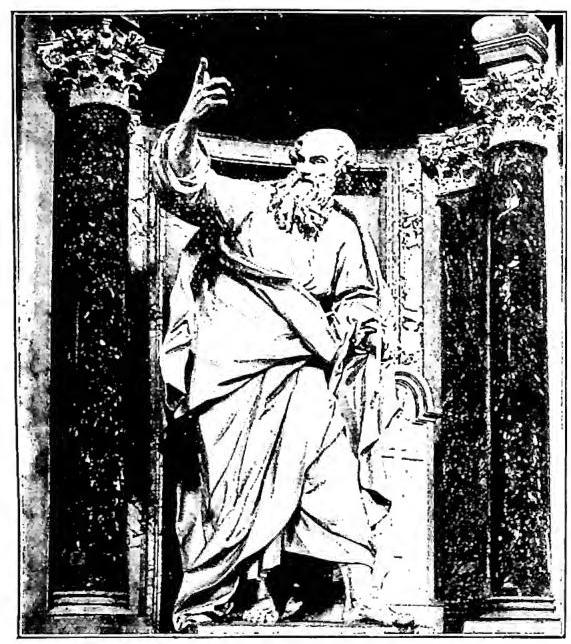
Some of his works went to France, for example the fine details of the mausoleum of the Duke of Bouillon at Cluny. Among his decorative architectural works, the most celebrated was the catafalque designed in 1711 in the church of S. Luigi dei Francesi in Rome for the funeral of the Grand Dauphin of France.

Article illustration
(1st. Anderson)

WOOD – A 14th-century armadio dei piumi, probably designed by Giotto – Padua, Scrovegni Chapel, Sacristy.

In the 15th century, the art of wood carving flourished in Italy, especially in the Veneto and Lombardy, where it reached a high degree of perfection. Notable examples include the choir stalls of the cathedrals of Como and Bergamo, executed by artists such as Giovanni da Monteoliveto and Fra Damiano da Bergamo, with the doors of S. Pietro in Perugia and the stalls of S. Domenico in Bologna. During the same period, in Germany, sculptors such as Lucas Moser, Erasmus Grasser, Michael Pacher, Hans Leinberger, and later Veit Stoss in Nuremberg, flourished with pronounced national characteristics, while the choir stalls of the cathedral of Ulm and the altars of Bamberg and Heilbronn attest to the vigour of woodworking skill, particularly in sacred art. No less admirable are the choir stalls in the cathedrals of Rouen and Amiens in France. Spanish art, after Burgundian and Flemish influences, underwent those of the Italian Renaissance, especially through Alonso Berruguete, who lived in Italy.

The general characteristics of the Baroque period are also reflected in wood sculpture and inlay work, which display a great variety of stylistic motifs and technical devices, expanding the achievements of the late 16th century. In Italy, the leading masters of the 17th century were the Venetians and Lombards, including Francesco Planta the Younger and Giacomo Piazzetta (father of the celebrated painter Giambattista) in Venice, with the figured dossals of the school of S. Rocco and the sacristy of SS. Giovanni e Paolo; G. B. Salmoiraghi, active in Milan and the Valtellina; Giacomo Bertesi and Domenico Capra in Cremona; Giuseppe Bulgarini in Brescia; and the prolific dynasties of the Fantoni (notably Andrea) and the Caniana in Bergamasque territory. In Genoa, Filippo Parodi and Antonio Maria Maragliano are remembered; in Rome, the executants of the still classical decorations in the choir of the canons in S. Peter’s and in the sacristy cupboards of S. Francesco a Ripa stand out; in Lucca, the gilded splendours of the alcove in the Palazzo Mansi are a source of wonder. No less prestigious, and towards the end of the century more elegant and restrained, were the activities of the 18th century. In Venice, Andrea Brustolon of Belluno, a devotee of Bernini, achieved world renown and trained Giovanni Marchiori in his markedly plastic style; in Piedmont, G. L. Bosso, Pietro Pifetti and Giuseppe Maria Bonzanigo worked with accomplished diligence; in Liguria, G. B. Girolamo Pittaluga; in Rome, D. Antonio Colicci, author of the richly decorated choir of Montecassino, and the executants