
BAROCCA, ARTE. — The term “baroque,” which criticism today uses in a historical sense—that is, without any intrinsic judgment of value—to designate the art of the seventeenth century and a large part of the eighteenth, arose with a derogatory meaning; despite the uncertainties surrounding its etymology or derivation, it contained the sense of false, extravagant, and blameworthy. And this makes it clear how the art of that period finds its chronological limit in the fierce polemic that the
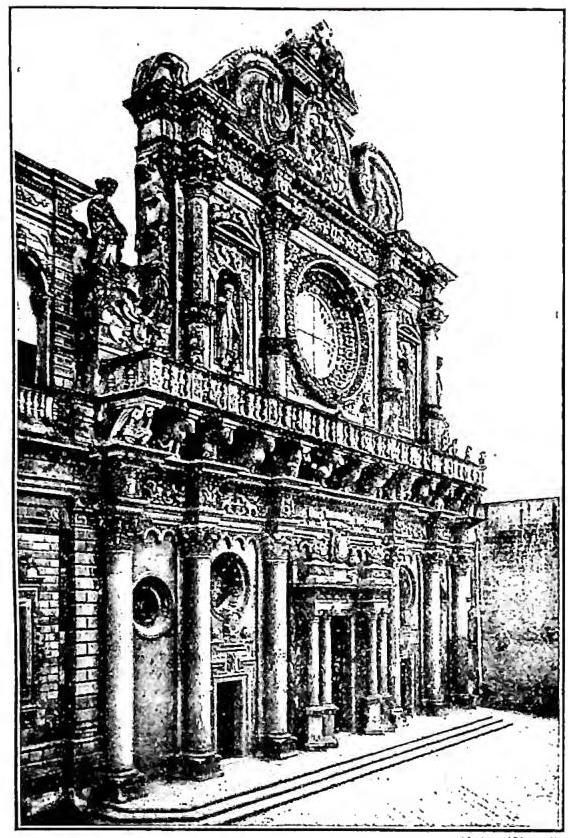
(photo by Alinari) BAROCCA, ARTE - Façade of the church of S. Croce. (beginning of the seventeenth century) - Lecce.
The famous tercet by Marino is customarily taken as an almost quintessential symbol of Baroque taste: “The poet’s aim is wonder:— / I speak of the excellent, not the clumsy— / Whoever does not know how to astonish should go to the currycomb.”
And in truth the sense of wonder may well signify—in the context of a summary approximation—the inner formal content of the artistic expressions of the seventeenth century.
Having attained, in the intellectualist assumptions of the sixteenth century, the fullness of the ideals pursued by the fifteenth century, artists believed they ought to adhere to the imitation of the supreme masters, and they shaped their figurative theory accordingly; so much so that art, intrinsically, came to reside in the composition rather than in the invention of individual formal elements, finding therein its new language (v. MANIERISMO).
But against this undeniable subjection rose free fantasy, which turned to overcoming cultural conceptuality, crossing every theoretical limit, and, especially, overstepping, in every direction, the forms established and consolidated in whatever sense.
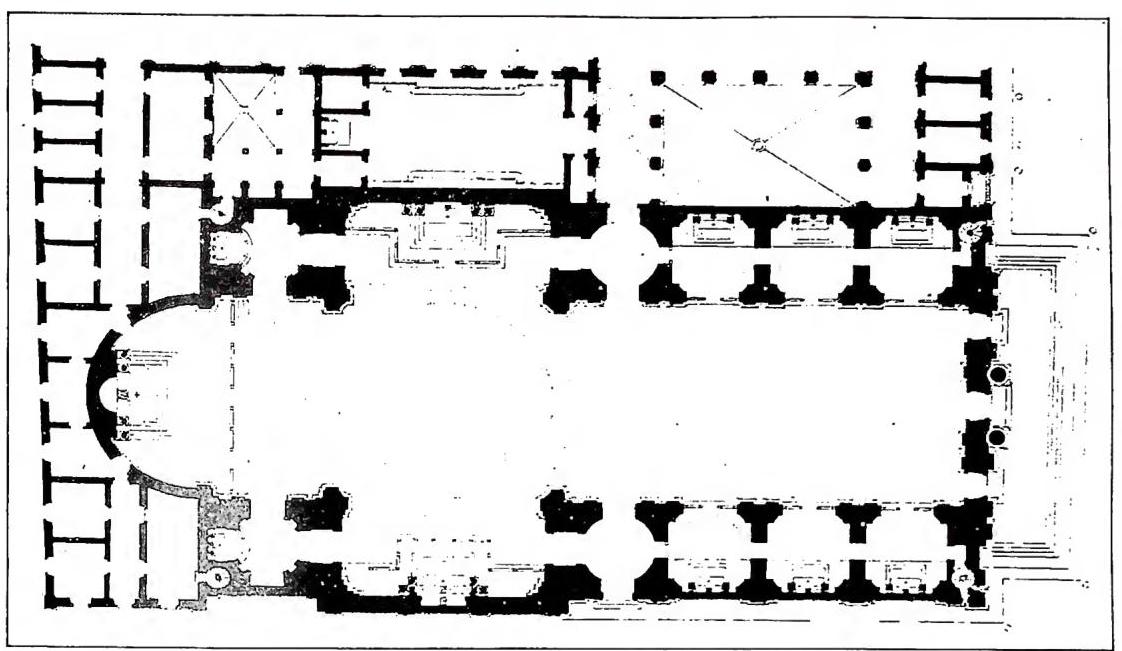
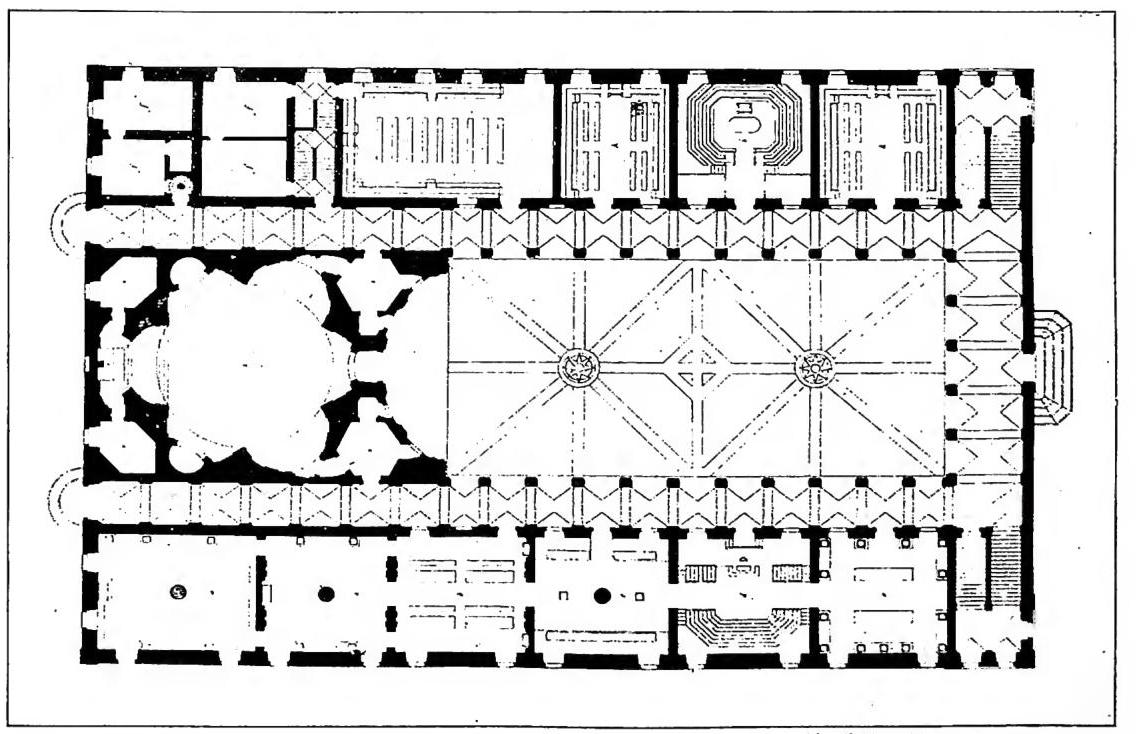
A distinctly Roman phenomenon, architectural Baroque created the setting suited to the visual triumph of the Catholic Church emerging from the care of the Counter-Reformation (v. CONTRORIFORMA, ARTE DELLA); and the style attained its peaks—opposed in such freedom of expression, yet identical in historical value—in the lofty personalities of Bernini and Borromini. Maderno had already, in the façade of S. Susanna (1666), introduced the theme of the dynamic façade, enriched—indeed almost formed—by contrasts of luminous values; and the statues assumed a value that was not so much decorative as constitutive, owing to their architectural intrinsic character. Taking up and intensifying Vignola’s contribution (not, in fact, a new one) in the church of the Gesù (begun in 1568), the side aisles disappear, allowing the central one to triumph: an immense vaulted hall, populated by composite, at times almost machine-like altars, scenographically completed in the side chapels and, more significantly, in the deep apse: the ultimate setting where, amid gilded “glories” and bursting lights, the diffused and grandiloquent value concludes
(phot. Alinari)
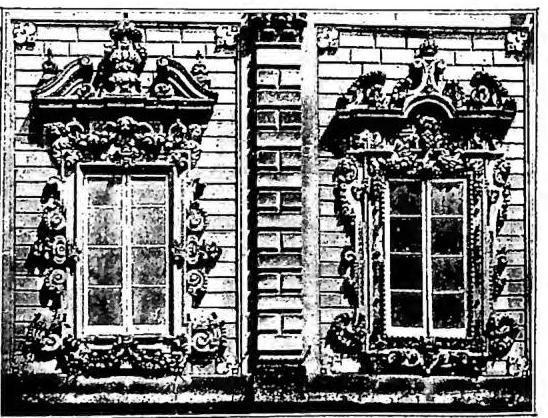
BAROCCA, ARTE - Detail of the Prefecture palace.
(early seventeenth century) - Lecce.
the pictorial expression of polychrome marble, funerary monuments, and vast paintings, which never before had so harmoniously accorded in the architectural unity.
Bernini’s work sums up the intentions and achievements of his predecessors, and from it his followers radiate, from the last Mannerists to the true Baroque artists: from Giacomo della Porta (facade of S. Luigi dei Francesi, 1584), to Rughesi (S. Maria in Vallicella, 1605); from Martino Longhi the Elder (d. 1591, S. Girolamo degli Schiavoni), from Domenico Fontana (1543–1607; side facade of S. Giovanni in Laterano) and Maderno (facade of S. Pietro, 1607–14), through G. B. Soria (1581–1651; facade of S. Gregorio al Celio) and Algardi (1595–1654, facade of S. Ignazio), to Rainaldi (1611–91; facade of S. Maria in Campitelli), Carlo Fontana (1634–1714; facade of S. Marcello), Martino Longhi the Younger (1682–1753; facade of SS. Vincenzo e Atanasio a Trevi), and Sardi
(phot. J. Stene)
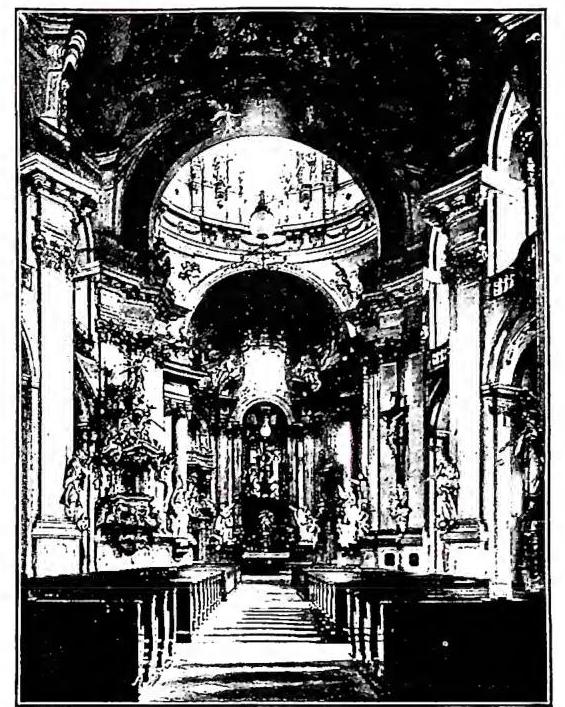
BAROCCA, ARTE - Interior of the church of S. Niccolò at Malà Strana (mid-eighteenth century) - Prague.
(1680-1753; façade of the Maddalena), and even as far as the reactionary eighteenth-century restraint of Salvi (although grandiloquent in the Trevi Fountain), of Specchi (who, together with De Sanctis, wrote the magnificent testament of Roman Baroque in the staircase of Trinità dei Monti), and even of the classicizing Galilei (façade of S. Giovanni in Laterano), a contemporary of the already Neoclassical Vanvitelli.
Through the building prodigality of the popes and noble families (especially the Barberini and Chigi), all Rome acquires its unmistakable appearance, where urban planning seems (and in this sense is resolved) to have been replaced by scenographic and panoramic values. Thus, as a backdrop to the streets, articulated and animated by the restored obelisks, there are the new city gates (the greatest example being Bernini’s Porta del Popolo); and the fountains, which rendered the instability of water architectural in the most intimately Baroque sense and gave rise to the greatest exasperation of the marvelous (one may recall the one called the Fiumi in Piazza Navona, also by Bernini, where the obelisk is set upon the void). The broad portals, framed within solemn architecture, become the foreground of the perspective of the courtyards, which are transfigured into the im-
(phot. Alinari)
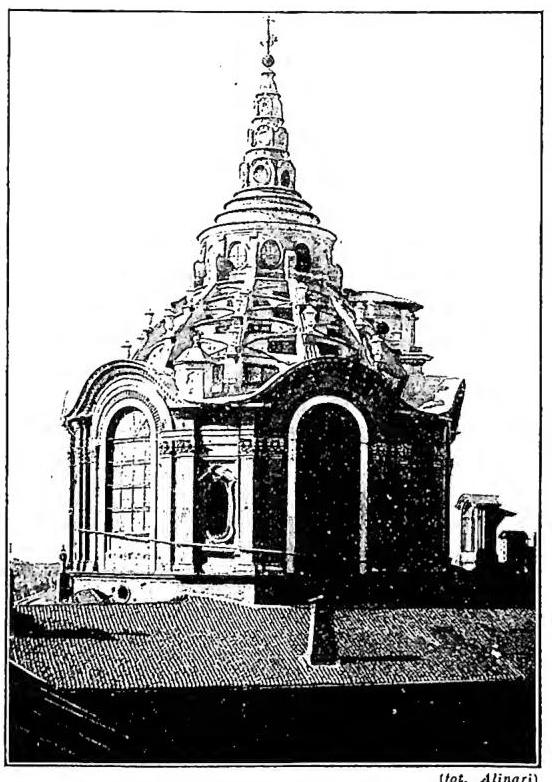
BAROCCA, ARTE — Dome of the chapel of the Holy Shroud by G. Guarini (17th century) — Torino.
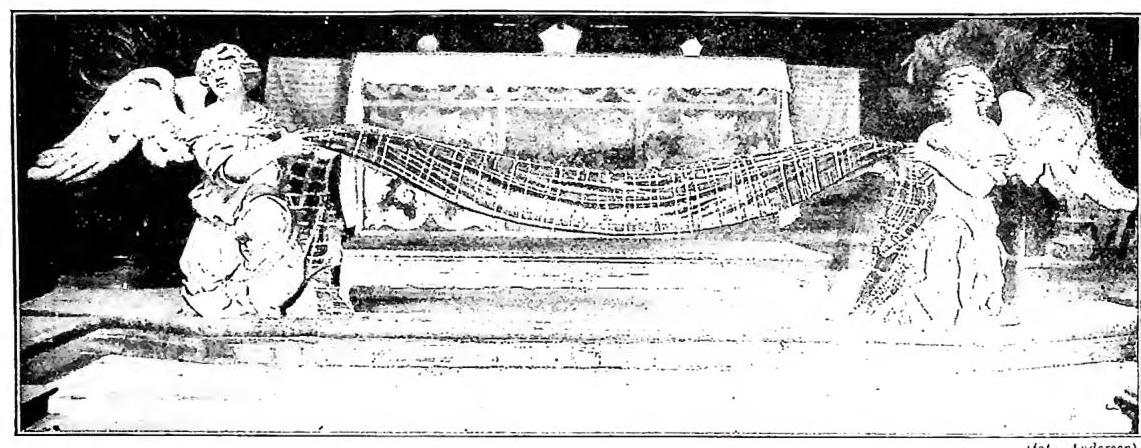
BAROCCA, ARTE - Balustrade in the Spada Chapel in S. Girolamo della Carità (17th cent.) - Rome.
(Anderson photograph)
sudden pictorial quality of the gardens and panoramic backgrounds; and finally, minute particular elements participate in the scenography of the whole—for example, the windows of the Barberini Palace, “receding upward” in the perspectival simulation of depth—so that even individual forms undergo complete renewal.
Borromini (1599–1667), who, through uncontrolled anecdotal tradition, is regarded as Bernini’s antagonist, in truth completes his inspired art, integrating the meaning of the Baroque.
Not by virtue of a fantastic play of masses, but through the richest elaboration of linear elements in the gentle and extraordinarily complex undulation of façades, and, in short, in the complete transcendence of every traditional realism, Borromini expresses the truest meaning of the art of his time.
The ground plans of his churches, although derived from rigorous geometric compositions, suggest such indefiniteness in spatial values as to justify the proposition of more recent criticism, which sees in Borromini the triumph of an intimate “Gothic” sensibility. All the more so because, in elevation, he replaces the enhancement of constructive, or in any case heavy, elements with an interweaving of architectural members, bands, and meshes that exalt above all the value of design. The interior of the dome of the celebrated S. Carlino alle Quattro Fontane, and especially the spiral spire of the dome of S. Ivo, provide full examples.
Bernini and Borromini are the source of the rich expansion of Baroque architecture in Italy and abroad.
In Italy, with Guarini (1624–83, chapel of the Holy Shroud in Turin) and Juvarra (1685–1737, hunting lodge at Stupinigi), Piedmont became notable for palaces and churches in which the complexity of the original schemes was refined until it foreshadowed the later eighteenth-century “Rococo”; in the Veneto, despite the powerful local tradition, Longhena in particular (1598–1682; S. Maria della Salute in Venice) created the last great Venetian art; there are few traces in Florence and Tuscany, faithful to Renaissance nobility; sporadic but firmly established forms in Romagna and Emilia; and less significant traces in Lombardy, where anticipation of Neoclassicism was more lively. In Naples, on the other hand, especially through the work of Fanzaga (1591–1678; church and cloister of S. Martino), the taste for the polychromy of inlaid marbles spread widely, while Sicilian architecture was enriched in a Spanish manner,
continuing into the eighteenth century, especially in Catania. Entirely original was the Baroque of Apulia (which in fact was connected with the Spanish “Plateresque”), where the special quality of the stone, soft yet compact, encouraged an abundant ornamental sculpture wholly placed at the service of architecture, which flourished and effervesced in the monuments of Lecce, popularly known as the Florence of the Baroque.
Abroad, the Baroque was enthusiastically received; and the legacy of Bernini, who authored a project for the Louvre, spread from the best-known Parisian churches (Val de Grâce) to influence even the sensibility of the Swede Tessin (1615–81): in Germany, especially in Dresden, examples abound. In Spain, where Italian artists had been lavishly producing their works since the sixteenth century, the new style was limited, as indeed almost everywhere outside Italy, to pictorially enriching traditional forms. Yet it is certain that throughout Europe the schemes of Roman Baroque churches still predominate over forms subsequent to the seventeenth century.
Likewise, in every part of the world, the theme of the villa was adopted, as it had matured in Rome through the supreme examples of the Tusculan and Tiburtine villas, as a complete expression of Baroque taste.
Sculpture, not content merely to exalt its already illustrated architectural value, expressed its triumphant Baroque essence in itself.
The commemorative monument in itself imposes—reciprocally—the necessity of composing statuary within architectural complexes. The “group” and the isolated statue, too, lose every trace of sixteenth-century academicism and satisfy the age’s desire for the marvelous. Bernini, without doubt, proclaimed the style of the age, from his youthful works (the celebrated Apollo and Daphne in the Borghese Gallery) to the great statues in the churches. Everywhere, the agitation of draperies, the simulation of matter, and the eruptive, expansive attitudes of the figures transfigure plastic value through an absolute pictorialism, in the exclusive sense of movement, in which form emerges from its traditional definition. Thus in the monuments in S. Peter’s (for example, those of Urban VIII and Alexander VII), in the celebrated S. Teresa in S. Maria della Vittoria, and in B. Ludovica Albertoni in S. Francesco a Ripa; and especially in the ensemble of the Chair of S. Peter, almost a triumphal “machine” set against the background of the basilica and baldachin.
Painting, like the other manifestations of figurative art, likewise revealed the new attitudes of the spirit and the demands of taste.
Against the stifling academicism of formal types, painters polemically opposed either the freedom of an intimate and expressed judgment concerning the masters of the Renaissance, drawing from them elements (not models) for new works of art, or absolute novelty, that is, a radical transposition of iconographic, compositional, and formal themes. Carracci (v.) and Caravaggio (v.) emerged.
The Carracci composed on a grand scale, with a boldness that at the time seemed daring in comparison with the tranquil works of Barocci, still faintly sixteenth-century in character, creating scenes rich in imagination, while nevertheless concerned to imitate, after careful selection, those parts of Raphael, Michelangelo, Correggio, and the Venetians that then appeared best. But this academically flavored eclecticism—wrong in theory—they dissolved in compositional freedom; and while their “Accademia degli Incamminati” and their “Scuola dei Desiderosi” sought to halt the progress of art in that theoretical and didactic position, in fact the Carracci produced a whole series of fantastic scenes (one need only recall the examples in the Farnese Palace)
But the true revolutionary was Michelangelo Merisi da Caravaggio (1573–1610). Proceeding from Lombard painting, enlivened—but in an entirely general way—by Venetian painting, he fiercely opposed the lingering intellectualism of the Carracci; and he rejected the cultural contribution of the great but exhausted predecessors in order to turn frankly to the observation of reality. And the more this reality was spare, simple, essential, corporeal, the more abundantly it offered a pretext for art in Caravaggio’s mind, for he renewed a kind of expressive primitivism. The elemental spontaneity of a basket of fruit became painting of the same nobility as a sacred subject; indeed, a “painting of flowers” was certainly truer than a tribute to Michelangelo. And so it was with the most properly pictorial values: in Caravaggio’s most mature and characteristic works, light is the sole and supreme creator of form. No longer, then, is it drawing that defines and exhausts every aspect, determines spaces, and creates an illusion of dimensions; rather, it is a plastic and chromatic world, as rich as reality itself, but made true only by the sudden incidence of light, which reveals it to lived experience, and therefore only in those parts that such light—as it bursts in—surprises. Thus light ceases, for the first time in the history of painting (apart from occasional exceptions, consisting for the most part in investigations of nocturnal effects), to be a merely optical premise or a pictorial “setting,” and becomes the despotic protagonist of the visible and therefore of the expressible. Hence that dramatic effect, those contrasts of shadow, in which the terms are always violent and immediate; hence space no longer as-
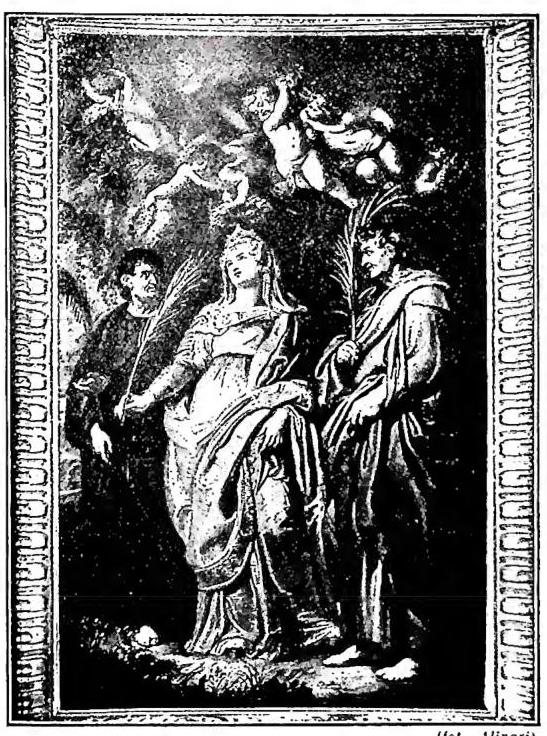
(phot. Alinari) BAROCCA, ARTE - S. Domitilla among the ss. Nereo and Achilleo. Painting by P. P. Rubens - Rome, church of S. Maria in Vallicella.
Opposed by his contemporaries, who branded him with brutal realism and irreverence toward tradition and toward the schematism of iconography, he was instead adopted by painters as a liberating revelation. Many heirs of the Carracci, such as Reni (1575–1642) and Guercino (1591–1666), were also revitalized by the warmth of Caravaggio; and Rembrandt and Velázquez drew from him a decisive stimulus to their own expressive power.
But with Guercino, Lanfranco (1582–1647), and especially Pietro da Cortona (1596–1669), Fra Pozzo (1642–1708), and even more forcefully Baciccio (1639–1709), painting exalted its premises of b. a.; and became, in the highest sense, decorative: in that it simulated open space and projected into it, with the utmost freedom of imagination, the richest and most sumptuous compositions, through which architecture exalted itself, decisively transcending every determination of space and all formal limits. Linear perspective, raised to the highest virtuosity, enabled the “quadraturista” Andrea Pozzo to “break through” the vault of S. Ignazio by means of the ideal prolongation of complex architectural structures, among which the glory of the titular Saint is exalted, and still more the glory of the name of Jesus which, carried by the Society, spreads throughout the world; and aerial perspective leads the fantastic resources of Gaulli, author of the vault of the church of the Gesù, to the highest peaks. Here the colors, as they gradually change, are precisely accompanied by the inverse progression of luminous intensity, greatest at the apex of a radiant pyramid; and the astonishing “sottinsù,” suspended without any visibly drawn support in the open sky, the enhancement of light, the necessity of going beyond the frame of the vault and of extending the painting onto canvases spanning the moldings and architectural members—this supreme transgression seems to summarize in itself the experiences and ideals of the century.
The subjects change: from Salvator Rosa’s “battles” to Albani’s mythological scenes, from Ruoppolo’s (1620–85) “still lifes” to Strozzi’s (1581–1644) war scenes; from the cloudy and radiant “settings” of the sacred scenes of the Carracci and Domenichino (1581–1641) to landscape, valid in itself: from the “classical” landscape of Lorenese (1600–82) to that of Poussin (1594–1665), the “philosopher painter,” more oriented toward a theorizing neoclassicism, and finally to the delight in the rustic, the characteristic, and the picturesque of ruins; it is, in short, an exhaustion of the repertory that was later to close in the cultural rigor of the educational and evocative painting of the following century; and in the last heir of the Baroque and of Gaulli, Tiepolo (1696–1770), light subsides into the bleached, however splendid, brightness of the vast and swept skies; just as the historical, realistic, and cultural premises of the seventeenth century, no longer handmaids to imagination, are revived in the prelude to the true academicism inherent in the painting of Carlo Maratti (1625–1713).
But by now the Baroque is extinguished, and it will suffer the acrimonious condemnation of the cold neoclassicism that follows. - Vedi TAVV. LIX-LXII.