CARAVAGGIO, MICHELANGELO MERISI (AMERIGHI), known as - Painter, son of the mason Fermo Merisi, born in Caravaggio near Bergamo, probably on 28 September 1573, died at Porto Ercole on 18 July 1610. He is the founder of the "naturalistic" movement of the 17th century and one of the greatest artistic geniuses of the century.
"Poorly provided with money," as Mancini says, Caravaggio arrived in Rome not yet twenty years old; his beginnings were difficult; he was exploited by unscrupulous people, fell ill, and was admitted to hospital. In the "environment" of the backward Mannerism of the Zuccari, Nebbia, Pomarancio, and Muziano, which was then in vogue, Caravaggio had little to learn. But the necessities of life forced him to place himself in the service of Cavalier d'Arpino, another of the empty but well-paid Roman Mannerists, for whom he painted flowers and fruit; then he associated with a certain Pierino delle Grottesche to paint figures, lacking, on his own, the money for models. It was in these years that his first works were produced, in which still lifes play a large part, and which already reveal in embryo the power and novelty of his painting, in clear antithesis to Roman academicism and the classicism of the Mannerists. It was these works that, around 1592, earned him the favor of Cardinal del Monte, who took him into his palace and later commissioned from him the canvases with the Stories of St. Matthew for the Contarelli Chapel in San Luigi dei Francesi. The altarpiece, because of its crude naturalism, was rejected and repeated by the artist in a more traditional sense; the other two scenes aroused enthusiasm in some and indignation in others. Caravaggio's name was on everyone's lips, as that of a revolutionary: the old men despised and misunderstood him, while the young followed him as the revelation of a new pictorial creed. The two canvases executed around 1600–1601 for the Cerasi Chapel in Santa Maria del Popolo increased his fame. By nature impetuous and quarrelsome, Caravaggio quarreled with his enemies, created masterpieces to demonstrate his artistic ideals, engaged in polemics, and became embroiled in lawsuits for defamation and assault. From 1603 to 1605, four serious lawsuits hung over him. In 1605, Caravaggio took refuge in Genoa, then returned to Rome, where he worked for Pope Paul V and Cardinal Scipione Borghese. Following a gambling dispute, he was guilty of murder. He fled from Rome, and Prince Don Marzio Colonna gave him asylum on his estates in Zagarolo, Palestrina, and Pagliano, pending a pardon. But this did not come, and in September 1607 Caravaggio went to Naples, where he immediately received important commissions. Restless and tormented, the following year he continued on to Malta, where he painted the portrait of Alof de Wignacourt, Grand Master of the Order of Malta, from whom he obtained favors and protection and was made a knight. But following an offense given to a Maltese knight, he was thrown into the prison of Valletta and stripped of the Order recently conferred upon him. He escaped on 6 October 1608, and, having crossed the sea, landed in Syracuse; after two months he was in Messina, painting everywhere; and finally he arrived in Palermo, where he was commissioned to execute a Nativity for the Oratory of San Lorenzo. Persecuted by de Wignacourt, he left Sicily and returned to Naples. There he was attacked and wounded in the face by the knight's assassins. Finally, having obtained a pardon from Paul V through the intercession of Cardinal Gonzaga, he embarked on a felucca to return
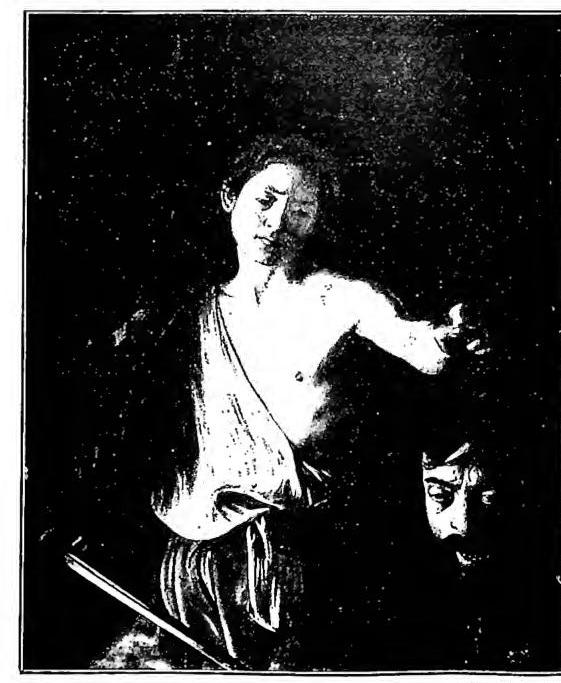
CARAVAGGIO - David with the Head of Goliath.
[Non-Text]
But at Porto Ercole he is mistakenly arrested; and, freed shortly afterward, he neither finds the felucca nor his belongings again. Desperate, he wanders along the shore under the scorching sun, is struck by fever, and dies in inhuman solitude at only 37 years of age.
In a twenty-year span of activity marked by the milestones of his masterpieces, Caravaggio revolutionized the course of painting, not only Italian but European: his new naturalistic vision influenced vast areas of Italian art as well as Rubens, Vermeer, Rembrandt, Murillo, and Velázquez.
In his early period, Caravaggio’s painting is enlivened by a vivid sense of color, of distinctly Venetian origin, a fact that only the absurd would deny; and in these early works there is also an elegiac quality, with a distant Giorgionesque flavor, which he soon abandons to pursue an exacerbated naturalism through investigations into luministic plasticity. The Bacchus in the Uffizi, the Boy Bitten by a Lizard in the collection of Professor Longhi—almost exactly matched by the Sick Bacchus and the Young Man with a Basket of Fruit in the Borghese Gallery, the Still Life in the Kress Collection in New York, and the famous Basket of Fruit in the Pinacoteca Ambrosiana in Milan (unfortunately overpainted in the background)—serve as examples of his early creations, in which the “still life” plays an important role both as an element of realistic pictorial skill and as a note of poetic suggestiveness. A feeling of intimate humanity pervades the Penitent Magdalene in the Doria Gallery in Rome and, above all, that elegiac masterpiece, the Rest on the Flight into Egypt, in the same gallery, where exquisite “Venetian” nostalgias resound. To the “gypsy” genre belong, still in the early period, The Cardsharps, once in the Sciarra Gallery in Rome, the Fortune Teller in the Louvre and its replica in the Capitoline Gallery, as well as the splendid Lute Player in the Hermitage in Leningrad and the Lute Player in the Augsburg Gallery. In these early years must also be counted the St. Francis Supported by an Angel, once in Trieste, the half-length figure of a Young Woman in the Kaiser Friedrich Museum in Berlin, the almost Antonellesque Portrait of Maffeo Barberini in the Corsini Collection in Florence, the St. Catherine, once Barberini, now in the Thyssen Collection in Lugano, and the Incredulity of St. Thomas in the Neues Palais in Potsdam.
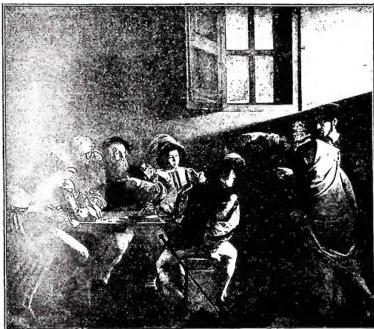
With the works executed for San Luigi dei Francesi, the period of Caravaggio’s maturity begins, informed by more decisive aims of dramatic realism. In the first version of St. Matthew, now in the Berlin Museum, the artist’s program is expressed with the most unflinching pictorial rendering; but the work, precisely for this reason, is rejected and must be repeated in a more traditional and conformist sense, as it is today on the altar. In the Calling of St. Matthew and the Martyrdom of St. Matthew, executed for the same chapel, the luministic interpretation prevails, from which dramatic solutions emerge both for the intensity of the chiaroscuro contrasts and for the anxious agitation of the figures. After these works (executed around 1595–98), Caravaggio set about painting for the Cerasi Chapel in Santa Maria del Popolo in 1601 the two canvases of the Crucifixion of St. Peter and the Conversion of St. Paul, works of harsh and almost “rustic” realism, executed after the first two versions had been rejected by Cerasi. Probably one of these is the Conversion of St. Paul (the only painting by Caravaggio on panel besides the Medusa in the Uffizi) in the Balbi Collection in Genoa, while the Crucifixion of St. Peter in the Hermitage may be a copy of the lost version for the chapel itself.
At this time belong: the Entombment, executed between 1602 and 1604 for the Church of Santa Maria in Vallicella, now in the Vatican Pinacoteca; the Madonna of Loreto, probably painted in 1605 for the Cavalletti Chapel in Sant’Agostino, where it is still preserved; the Madonna and Child Crushing the Serpent, executed in 1605 or 1606 for the altar of the Palafrenieri in St. Peter’s Basilica but later removed from the church and now in the Borghese Gallery; the Death of the Virgin, rejected from the altar of Santa Maria della Scala in Trastevere, sold in 1607 to the Duke of Mantua, and now in the Louvre. Alongside these large altarpieces, then misunderstood, Caravaggio also painted in this period a considerable number of works on private commission, which instead
CARAVAGGIO - The Calling of St. Matthew - Rome, church of S. Luigi dei Francesi.
Among the works of this period, which reveal the artist’s mature style, we may recall the following, which enjoyed considerable favor among discerning patrons: St. John the Baptist, St. Jerome, David with the Head of Goliath, and Narcissus in the Borghese Gallery; Love Victorious in the Kaiser Friedrich Museum in Berlin; The Supper at Emmaus in the National Gallery in London, and a slightly later version in the Brera Picture Gallery; and the Portrait of Paul V in the Borghese Palace in Rome.
During his brief stay in Naples, Caravaggio produced three major sacred works: the Madonna of the Rosary, completed on 25 September 1607, soon sent to Antwerp and now in the museum in Vienna; the altarpiece The Seven Works of Mercy, painted the same year for the Monte della Misericordia in Naples, where it still remains; and The Flagellation of Christ, also from 1607, which remains in the church of S. Domenico Maggiore. In Malta in 1608, Caravaggio provided for the churches of Valletta a Beheading of St. John the Baptist and a Penitent St. Jerome, both still in situ; at the same time, he executed the remarkable Portrait of Alof de Wignacourt, Grand Master of the Order of Malta, now in the Louvre. In Syracuse, he painted The Burial of St. Lucy for the church of the same name in the last months of 1608. In Messina, he produced The Raising of Lazarus for the chapel of the Crociferi, delivered on 10 June 1609 and now in the museum; and also The Adoration of the Shepherds, painted for the church of the Capuchins and now likewise in the museum. The last known work by Caravaggio is The Nativity in the oratory of S. Lorenzo in Palermo, painted there in 1609.