
LOTTO, LORENZO. — Painter, born in Venice (?) around 1480, died in Loreto in September 1556. Already in his earliest works, his personality reveals itself in the acute search for every vibration of light. The masterpiece of this first activity, carried out between Treviso and the Marches, is the polyptych of Recanati, from 1508.
(Anderson photograph)
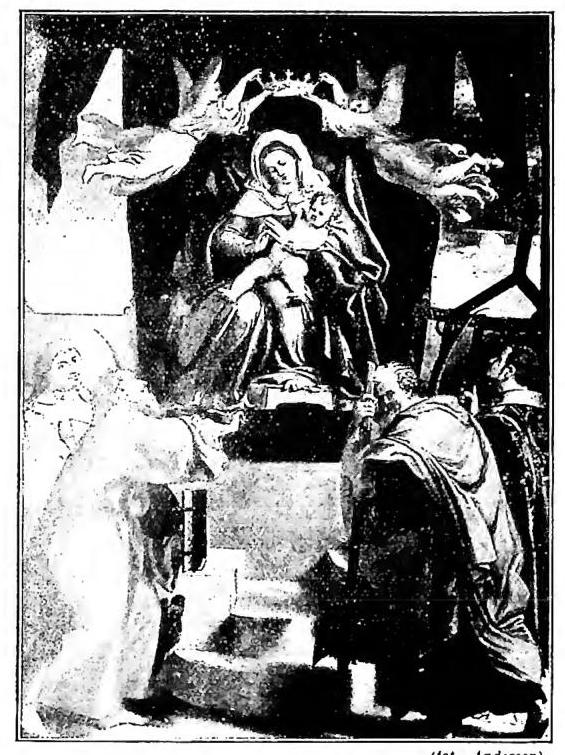
LOTTO, LORENZO - Virgin in glory and saints - Ancona, Pinacoteca.
from the composure of the altarpiece of S. Bartolomeo (1516) to the audacious fantasies of the altarpieces of S. Bernardino and S. Spirito (1521), among the highest expressions of his genius. Among the works of this period are the Farewell of Christ from His Mother in Berlin, the Marriage of s. Caterina in the Galleria Carrara in Bergamo, the Sacred Conversation, now in the Galleria Borghese in Rome, the frescoes of the Suardi chapel at Trescore Balneario, and those of S. Michele al Pozzo Bianco in Bergamo. The same chromatic acuteness recurs in the works painted in the Marches (the altarpiece in the Museo di Jesi of 1526; Annunciation, there; Annunciation at Recanati). In 1529, his journey to Venice, marked by the Carmine altarpiece, brought him closer to Titian—a temporary rapprochement, since immediately afterward, having returned to the Marches, he resumed expressions of Nordic Romanticism in the altarpiece of S. Lucia at Jesi, whose predellas display an impressionistic freedom of touch of astonishing modernity. Masterpieces of these years are the great Crucifixion of S. Maria in Telusiano at Montesangiusto (1531), the Sacred Conversation in Vienna, and the Cingoli altarpiece (1539). His return to, and prolonged stay in, the Veneto (between Venice and Treviso) from 1540 to 1549 marked a new rapprochement with Titian (the altarpiece of S. Zanipolo, of 1542; S. Girolamo del Prado), by which, however, the personality of L. does not appear overwhelmed, but merely restrained in its Romantic impulses. Also belonging to this period are some of the finest among the many Lotto portraits (Milan, Brera). Little remains of the very numerous works that L. executed during his final years in the Marches, where he had been summoned in 1550 to paint the great altarpiece of the Assumption for S. Francesco in Ancona, now badly damaged. In the last works, which are found in the Palazzo Apostolico at Loreto, where the artist had in 1547 become an oblate of the Holy House, the forms seem to have been consumed in the rarefied atmosphere. This extreme sensitivity to every vibration of light is the dominant characteristic in the richly varied aspects that L.’s work assumes from time to time, reflecting the variety of experiences of his itinerant life and his Romantic spirit.