
RECANATI, DIOCESI of. – City in the province of Macerata. The diocese extends partly through the province of Macerata and partly through that of Ancona; it has 42,707 inhabitants, all Catholic, with 23 parishes, 6 male religious communities, and 10 female religious communities. Immediately subject diocese.
I. ORIGIN AND HISTORY
On 22 December 1240, Gregory IX, suppressing the diocese of Osimo, elevated the Castle of R. to a diocese and the church of S. Flaviano to a cathedral, removing it from the jurisdiction of the bishop of Umana. In 1263 Urban IV took from R., which supported the cause of King Manfredi, the title of city and once again subjected it to the bishop of Umana; but the title and episcopal see were restored to R. by Niccolò IV, a native of the Marches, in 1289. From Avignon, John XXII (at a time when R. was torn apart by struggles between Guelfs and Ghibellines, and the latter, having emerged victorious, had driven out the bishop Federico Niccolò di Giovanni, a native of Recanati, together with all the Guelf families) united R. with Macerata, which had been erected as a diocese on 18 November 1320; but in 1357 the diocese of R. was re-established, united under a single bishop with Macerata. In the Consistory of 5 November 1585, Sixtus V proposed the erection of the diocese of Loreto, which he carried out on 17 March 1586 by suppressing the diocese of R., assigned to Loreto. But on 18 December 1591 the diocese of R. was re-established and united aeque principaliter with Loreto. In 1934, following the suppression of the diocese of Loreto, the municipalities of Castelfidardo, Montelupone and Montecassiano became part of the diocese of R., which had previously comprised the municipalities of R. and Porto-R.; the apostolic administration of the sanctuary of Loreto, by decree of the S. Congreg. Concistoriale of 11 October 1935, received ordinary jurisdiction over the city and territory of the municipality of Loreto, with the jurisdiction of the Ordinary of R.-Loreto consequently suspended there.II. PERSONAGES
R. gave birth to Monaldo Leopardi, to his son Giacomo, to the musician Persiani, and to not a few illustrious figures of ancient and modern times, among them the goldsmith and engraver Giacomo Braccielarghe; Antonio Colombella (d. at Ancona in 1466) is also remembered: a preacher of renown, a doctor at the Sorbonne, professor of theology at Paris and Louvain, and finally bishop of Senigallia; as was Cardinal Lorenzo Nina, Secretary of State to Leo XIII. Certain bishops are especially worthy of remembrance, such as Angelo Cino(fol. Fotocotere, Turin)
of Bevagna, elected bishop of R. and Macerata in 1383, during whose episcopate the Cathedral was enlarged and restored (1384), and R. earned the title of « Iustissima civitas » as a reward for a famous code of laws compiled and accepted there for the government of the city. Cino was subsequently appointed by Gregory XII cardinal legate of the March and his vicar, and died at R. in 1412. Another illustrious bishop was Cardinal Agostino Galamini, b. at Fognano di Brisighella in 1552, Master General of the Dominicans, made cardinal in 1611 and bishop of R. from 1613.
Before being elected pope (30 Nov. 1406), Gregory XII had been appointed by Innocent VII pontifical delegate of the March (Apr. 1405) and governed the church of R. through Bishop Martino di Tocco. On 4 July 1415 he solemnly renounced the pontificate and was appointed Tusculan bishop, perpetual legate of the March, and administrator of R. and Macerata; he remained at R. until his death (17 Oct. 1417), and is buried in the Cathedral. Father Nicola Bobadilla, one of the first nine companions of St Ignatius, who died at Loreto on 23 Sept. 1590, is buried in the church of S. Vito at R.; his remains underwent a final examination on 23 Aug. 1926.
III. RELIGIOUS MONUMENTS
It is not known when the present Cathedral was built; it already existed in 1240, when the diocese of R. was established. The ancient Gothic-style church was enlarged and restored by Bishop A. Cino in 1384; it has three naves, and the central one, 45 m. long and 8 m. wide, has a coffered ceiling decorated in gold, with Greek-cross and octagonal panels: the former have paintings in the background (angels, Virtues), while the central octagon bears, carved in wood in high relief, the figure of St. Flavian; the octagonal panels bear the coat of arms of Paul V, of Cardinal Borghese, and of Cardinal Galamini, under whose direction the work was carried out (1623) by Andrea Costa, a Bolognese. The apse, originally octagonal in shape, was reduced to its present form around 1633 by Cardinal Giulio Roma, bishop of R. The rest of the church also underwent a radical transformation in the 18th century. In the Chapel of the Blessed Sacrament in the cathedral of R. there is Guercino’s painting of St. Lucy (1665), and in the chapter hall Mantegna’s painting of the Holy Family (late 15th century). Several paintings by Lorenzo Lotto are preserved in R.: a St. Vincent in the church of S. Domenico; in the Municipal Picture Gallery, a Transfiguration and a polyptych: Madonna with the Child, St. Dominic, Angels; and in the church of the Sopramercanti, the Annunciation and St. James. In the Capuchin church there is the painting of the Holy Family, also called La madonna dell'insalata, attributed to Michelangelo da Caravaggio, and that of the Madonna of Loreto by Pomarancio. Worthy of note are the portals of the churches of S. Domenico and S. Agostino, executed, from a design by Giuliano da Maiano, by Giacomo Giovanni delle Fiandre, and the church of S. Maria in Castelnuovo, with its Romanesque façade and a fine portal dating from 1235. Worth mentioning at Montelupone is the painting of the Madonna del latte by Mastro Antonio da Faenza and the three-naved Romanesque church with a crypt dedicated to St. Firmano, abbot of that abbey (951-92); at Montecassiano, a terracotta altar by Mattia da Fiorenza, the most celebrated of the lesser Robbia artists, dedicated to Saints Rocco and Sebastiano; the work was executed at Montecassiano in 1527; at Castelfidardo, a Supper, a valuable work by Tibaldi, dating from 1591.A school of sculpture and bronze casting flourished at R. in the 16th and 17th centuries, begun by the brothers Girolamo and Aurelio Lombardi, pupils of Sansovino, who settled at R., summoned by Clement VII for the work on the sanctuary of Loreto.
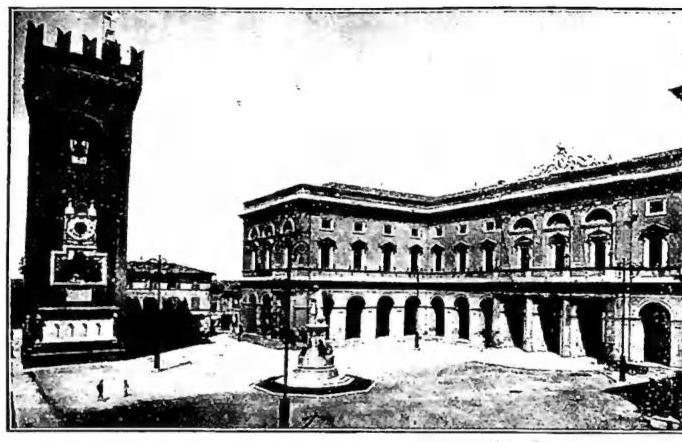
The following belonged to this school: Tiburzio Vercelli of Camerino, Antonio Calcagni (d. 1593), among other works the author of the statue of Sixtus V at Loreto (he is buried at R. in the church of S. Agostino), Pier Paolo Jacometti, and Tarquinio Jacometti. Pier Paolo was a sculptor, painter (Pomarancio was his teacher), and architect: one of the side doors of the basilica of Loreto is his work, and preserved at R., on the civic tower (torre del Borgo), is his bronze bas-relief (1634) depicting the Translation of the Holy House.