
MARCHE. — The M. (or the Marca), so called because of the frontier position that the region held in the early Middle Ages with respect to the Byzantine possessions, corresponds to the Adriatic slope of the Apennines between the Foglia and Tronto rivers, which respectively delimit it toward Romagna and Abruzzo.
I. GEOGRAPHY
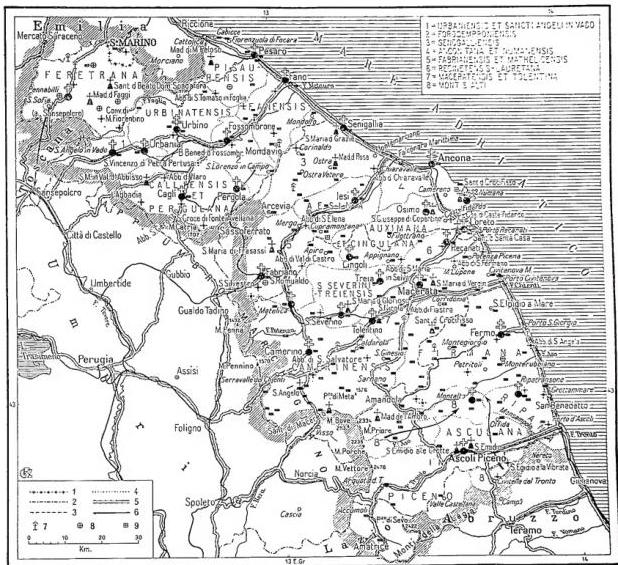
Inland, the boundaries of the physical region coincide with the watershed between the Adriatic and Tyrrhenian Seas,MARCHE - 1) State boundaries; 2) regional boundaries; 3) provincial boundaries; 4) ecclesiastical district boundaries; 5) roads; 6) railways; 7) oratories; 8) parish churches; 9) abbeys.
The economy of the M. is essentially agricultural (66.6% of the population is engaged in it), but with the growing participation of industrial and commercial activities. In addition to cereals, the cultivation of sugar beet, vines, and silkworm cocoons is widespread. Cattle and pigs predominate in livestock farming. Among the industries, textiles (silk and hemp manufacturing at Jesi), paper (Fabriano), food processing, and chemicals predominate.
The population lives predominantly in scattered settlements (the corresponding percentage, 55%, is the highest among the Italian regions); consequently, large urban agglomerations are lacking. Only Ancona and Pesaro exceed 50,000 inhabitants. Ancona is the largest port on the Adriatic after Venice and Bari.
| Provinces and provincial capitals (population in thousands of inhabitants [1949]) | Number of municipalities | Area | Population | ||
|---|---|---|---|---|---|
| Census (1936) | Estimate for 1949 | absolute (thousands of inhabitants) | density per sq. km | ||
| Ancona (82) | 49 | 1938 | 372.229 | 391 | 192,1 |
| Ascoli Piceno (46) | 72 | 2000 | 303.869 | 324 | 145,5 |
| Macerata (30) | 57 | 2774 | 290.057 | 296 | 104,5 |
| Pesaro (52) | |||||
| -Urbino (24) | 67 | 2893 | 311.916 | 326 | 107,8 |
| Marche | 245 | 9695 | 1.278.071 | 1337 | 131,8 |
II. HISTORY
The M. were inhabited, from the earliest times, by peoples of Italic stock, the principal one being that of the Piceni. The Christian religion must have been preached in Picenum very early. But scholars hold differing opinions concerning the period in which the individual cities of the M. received the light of the Gospel. Nevertheless, judging from the holy propagators of the faith, whose acts, moreover, are not always reliable, it seems beyond doubt that at the beginning of the fourth century it had reached throughout the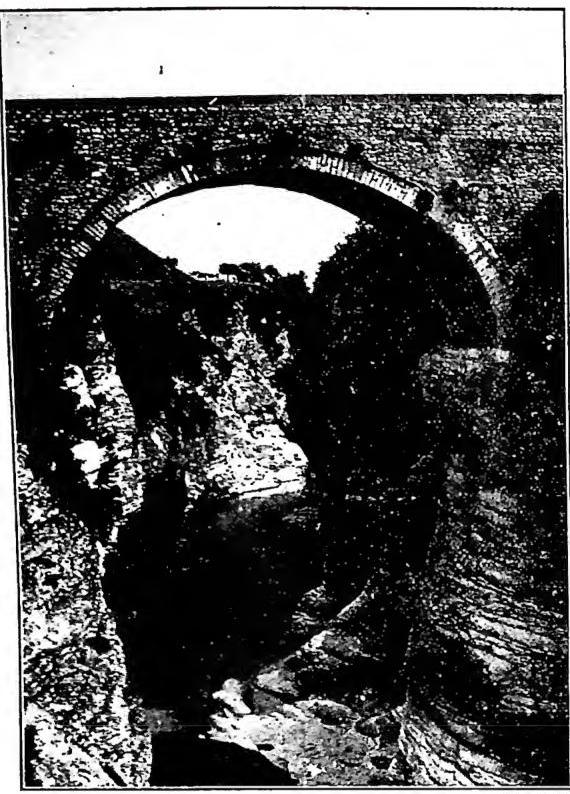
During the barbarian invasions, when administrative unity had broken apart, the bishops and abbeys remained almost the only authorities recognized by the populations and also concentrated civil powers in their hands. This state of affairs, after the expulsion of the Lombards, evidently induced first Pepin and then Charlemagne to donate those lands to the Church (752 and 774), which, however, could not immediately take advantage of them or at that time establish a State that would make the donation effective. Feudalism had already arisen as a disintegrating force. With the accession of the emperors of German stock (961), the first names of “march” begin to appear, from the Germanic Mark, that is, “border”: in chronological order, there followed the march of Camerino, of Fermo, of Ancona, etc. In addition to the feudal families, the Communes contributed to undermining the authority of the bishops and monasteries: the most powerful of them was Ancona, which was notably active in the Levant, held its own against Venice, and victoriously resisted Barbarossa. Religious life then received a broad new impetus, especially through the work of the Franciscans and Dominicans, and magnificent churches, convents, and sanctuaries arose everywhere, among them the celebrated shrine of Loreto.
At the same time as the Communes, several great feudal families established themselves in the region. Thus the Montefeltro extended their dominion to Gubbio, Urbino, Cagli, and Fossombrone; the lords of Varano made themselves masters of Camerino and many other places; the Malatesta asserted their predominance in the area between Pesaro and Osimo, and for a short time also ruled Ancona. But the Holy See never renounced the rights deriving from the ancient donation over those lands, and never neglected any means or opportunity to reaffirm them and demand respect for them, both in relation to imperial authority and in relation to the Communes and the local petty lords. In the mid-fourteenth century, in the face of new usurpations and political defections, Cardinal Legate Egidio D'Albornoz, through energetic, methodical, and enlightened action, succeeded in restoring the fullness of papal authority in the M.: the fundamental code of the ecclesiastical State, known as the Constitutiones Aegidianae and approved at Fano by a general parliament (1357), remained memorable.
In the following century as well, after the end of the Western Schism, the Holy See continued its work of assistance and protection in its territories and, sooner or later, succeeded in asserting its supremacy everywhere. Only for a brief period (1433–44) were the lordship of Francesco Sforza, extending over almost all the M., and, somewhat longer, the more limited and circumscribed lordships of his brother Alessandro at Pesaro and of Sigismondo Malatesta at Fano (1463), able to resist and maintain themselves. At the beginning of the sixteenth century, Cesare Borgia, fighting with both valor and perfidy, overthrew other local petty lords unwilling to submit. In 1532, through the efforts of Cardinal Benedetto Accolti, the Commune of Ancona capitulated, renouncing its autonomy; later, in 1545, the lordship of Camerino, under the government of Ottavio Farnese, re-entered the Papal State; finally, in 1631, the Duchy of Urbino, with Pesaro and Senigallia, after the extinction of the della Rovere family, also returned to form part of the Church’s territorial dominions.
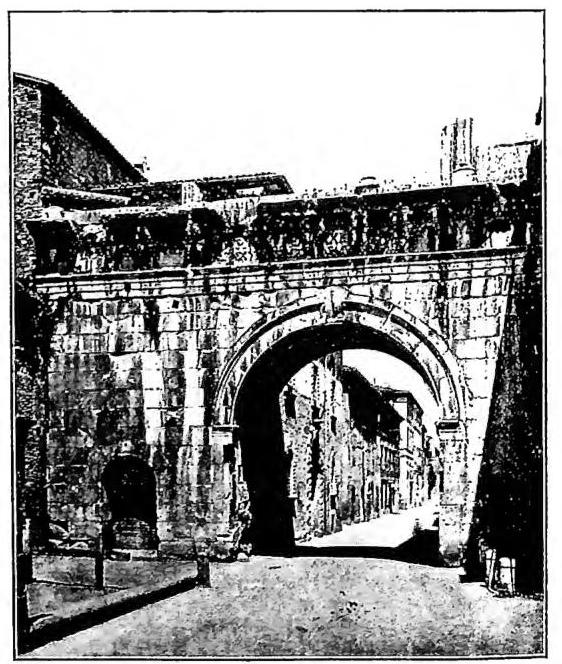
(phot. Anderson)
MARCHE – Arch of Augustus – Fano.
Shortly before the M. became provinces of the new Kingdom of Italy, they had remained under the devotion and obedience of the Holy See for more than a thousand years.
Emilio Michel
III. CONCILIAR REGION
The conciliar Region of the M. embraces, with minor variations, the territory of the civil region, that is, the four provinces of Pesaro-Urbino, Ancona, Macerata, and Ascoli, from the Tavullo River to the Tronto. The dioceses composing it number 26, but the bishops number only 19, since the following dioceses are united under a single prelate: Fabriano and Matelica, Osimo and Cingoli, Macerata and Tolentino, Montalto and Ripatransone, S. Severino and Treia, Cagli and Pergola, S. Angelo in Vado and Urbania, not to mention Ancona and Numana, since in the latter see there is nothing more than a parish, without a curia or Chapter.The city of Loreto was moreover erected, on 11 October 1935, as an apostolic administration (entrusted to the apostolic nuncio in Italy, who is represented there by a vicar of his own with episcopal character). There are two ecclesiastical provinces in the region: that of Fermo, which has as its suffragan dioceses those of Macerata and Tolentino, Montalto and Ripatransone, and S. Severino; and that of Urbino, which has as its suffragan dioceses those of Cagli and Pergola, Fossombrone, Montefeltro, Pesaro, Urbania and S. Angelo in Vado, and Senigallia. Immediately subject to the Holy See, on the other hand, are the archdioceses of Ancona and Numana and of Camerino, and the dioceses of Ascoli Piceno, Fabriano and Matelica, Fano, Jesi, Osimo and Cingoli, Recanati-Loreto, and Treia.
The episcopal Conferences are convoked and presided over by the nuncio; in his absence, by the metropolitan of Urbino.
For cases of matrimonial nullity, the M. have a single tribunal, that of Fermo, of which the local archbishop is the moderator (motu proprio: Qua Cura, 8 December 1938; Normae of the Sacred Congregation of the Sacraments, 10 July 1940). The appellate tribunal is the Etruscan Regional Tribunal of Florence.
For secondary school and theology, the clerics of the dioceses of Ancona, Fabriano and Matelica, Fano, Jesi, Osimo and Cingoli, Montalto and Ripatransone, Urbino, Cagli and Pergola, Fossombrone, Montefeltro, Pesaro, San Severino and Treia, Urbania and S. Angelo in Vado, and Recanati and Loreto attend the Pontifical Regional Marchigiano Seminary « Pio XI » of Fano. The remaining dioceses, on the other hand, each provide independently for the education of their own seminarians.
IV. ART. 1. Introduction. - Testimonies from the prehistoric period and from the Bronze and Iron Age civilizations were discovered in numerous necropolises scattered throughout the region and gathered for the most part in the National Museum of Ancona, where important objects are also preserved dating from the Picene, Greek, Etruscan, Gallic, and Roman civilizations, which exerted their influence in the territory during successive periods.
Architectural evidence of the pre-Roman civilizations is scarce; that relating to Roman civilization is abundant and imposing, scattered throughout the region. The Arch of Trajan and the remains of the amphitheatre at Ancona are worthy of mention; at Ascoli, a « Templum in antis » (now the church of S. Gregorio), the Porta Cappuccina bridge, and the so-called Porta Gemina; at Fano, the Arch of Augustus, and so forth. There are also important ruins of destroyed centres, such as those of Urbs Salia (Macerata) and Faleria (Ascoli). Finally, in the M. is the famous Furlo Gallery, built
by Vespasian in A.D. 76 to make the Via Flaminia more convenient along the section passing through that narrow gorge.
2. Architecture. - From the early Christian period there remain the foundations of two fifth-century churches beneath the Romanesque church of S. Maria della Piazza in Ancona. Romanesque architecture triumphs throughout the region and leaves interesting examples there, with Lombard and Byzantine influences, the latter explaining the presence of structures with complex plans and central development, such as the cathedral of Ancona.
The advent of the Renaissance brought about a new architectural flowering. Urbino was the site, chronologically, of the first manifestation of that new artistic civilization, namely the portal of the church of S. Domenico, the work of the Florentine Masaccio (1450). In the same city, during the second half of the century, arose the most solemn, grandiose, and pure example of Renaissance civil architecture: the Ducal Palace, the work of Luciano Laurana, Francesco di Giorgio Martini, and others. The new beauty of the building led to the spread of a movement inspired by it; manifestations of this include the Palazzo Passionei of Urbino, the ducal palace of Pesaro, and others. Francesco di Giorgio was the architect of the Palazzo della Signoria of Jesi
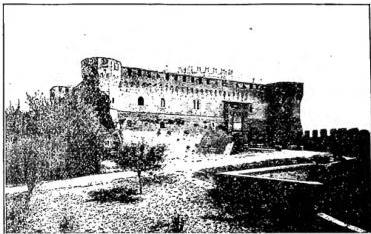
MARCHE – Malatesta Fortress (14th century, enlarged in 1494) – Gradara.
and perhaps also the Palazzo degli Anziani (prefecture) in Ancona. Tuscan artists worked at Loreto (the basilica of the Holy House), while the influence of the Urbino-born Bramante can be felt in his native city itself (if the S. Bernardino is to be attributed to him, as criticism today tends to do, rather than to Francesco di Giorgio), in Loreto, in Macerata (S. Maria delle Vergini), and in the beautiful sanctuary of Macereto (Visso), a work constructed under the direction of the Lombard Filippo Salvi. With the “Imperiale” at Pesaro, erected by Girolamo Genga da Urbino (who enlarged a pre-existing building), the type of the pre-Baroque villa was created, in which the landscape and scenographic element acquired fundamental importance; meanwhile, in Ancona, Pellegrino Tibaldi erected the Palazzo Ferretti, the finest building in the region among the numerous ones constructed during the sixteenth century. Finally, the architectural work of Cola dell’Amatrice, active in Ascoli, should be recalled. Military architecture has left notable monuments. The fortresses of Pesaro and Senigallia are prototypes of modern fortifications in connection with the emergence of artillery. In this field Francesco di Giorgio, Laurana, and Baccio Pontelli were particularly active in the region.
Baroque architecture produced no works of exceptional importance, whereas in the eighteenth century Luigi Vanvitelli erected numerous monuments, among which the beautiful church of the Gesù and certain palaces in Ancona that should derive from him are worth recalling (Palazzo Jona, etc.).
3. Sculpture
From the early Christian period there remain several sarcophagi (that of Gorgonio, from the fifth century, in Ancona Cathedral, and others) and several ivories. Notable examples remain from “barbarian” art, among which are the ambon formerly in the church of the Misericordia in Ancona and the gravestone of S. Vitaliano at Osimo.Romanesque sculpture generally displays cultural elements similar to those found in northern architecture, as, for example, the portal of S. Maria della Piazza in Ancona, the work of maestro Filippo, as well as Byzantine influences, such as the beautiful plutei in the cathedral, also in Ancona (twelfth century). The name of Giorgio Orsini recurs as the executor of the elegant decorations of his Anconitan buildings, among which the group of Carità, in the Loggia dei Mercanti, one of the most refined sculptures of the fifteenth century, should be recalled. Examples of wooden sculpture, almost always of Tuscan-Abruzzese influence and sometimes under the influence of Francesco Laurana, are widespread in the M. during the fifteenth century (the group of the Annunciazione in the Gallery of Urbino). The finest sculptor from the Marche in the sixteenth century was Federico Brandani da Urbino, active in his native city, in Senigallia, at Piobbico, etc. The brothers Jacometti da Recanati should also be recalled; they created bronze sculptures in Loreto, Osimo, Camerino, etc., and were active between the end of the sixteenth century and the middle of the following one.
4. Painting
The history of painting in the M. is long and complex. Traces of early frescoes, in two layers, can be seen in the early Christian church beneath S. Maria della Piazza in Ancona; interesting Romanesque wall paintings are found at Fabriano and Pesaro. Romanesque paintings have also recently come to light in the churches of S. Gregorio and S. Maria inter vineas at Ascoli.The Rimini school left numerous works in the region (Mercatello, Urbania, Urbino, S. Agata Feltria) and the imposing frescoes of the Cappellone of S. Nicola at Tolentino, attributed to Baronzio; likewise, the Bolognese school had very considerable importance in the history of painting in the region (the altarpiece by Andrea da Bologna at Fermo, frescoes at Offida, etc.); and finally the Venetian school, already present in the fourteenth century, asserted itself even more strongly in the following century and exerted considerable influence on the formation of local schools. Their principal centers were at S. Severino (Jacopo and Lorenzo Salimbeni [v.]), at Fabriano (Allegretto Nuzi, Gentile, and Antonio), and finally at Camerino, by then displaying Renaissance tendencies (Giovanni Boccani and others). At Urbino, in the second half of the fifteenth century, a school flourished under the influence of the artists who came to the court of the Montefeltro (Piero della Francesca, Melozzo da Forlì, Pedro Berreguete, Giusto di Gand); its leading representatives were Giovanni Santi, whose fame is overshadowed by the immense fame of his son Raffaello, Timoteo Viti, and Evangelista da Pian di Meleto. Throughout the Renaissance, Tuscan artists and artists from other regions were active in the region, including the aforementioned Pietro and Melozzo, followed by Signorelli at Loreto and Arcevia, il Giambellino, Crivelli (who made the M. his second homeland), and finally Lotto, who left a large part of his works there. In short, although the M. did not give rise to a school of great and decisive importance, they participated actively in Renaissance painting and gave birth to two of the greatest Italian artists: Gentile da Fabriano (v.) Raffaello Sanzio (v.). It should be added that the M. are rich in frescoes, many of which remain unpublished. Among the local artists of the Renaissance, Stefano Folchetti da Sanginesio, Lorenzo di Alessandro da S. Severino, Vincenzo Pagani, Pier Paolo Agabiti da Sassoferrato, Taddeo and Federico Zuccari, and finally the great painter of the transitional period between the Renaissance and the Baroque, Federico Barocci da Urbino, should also be recalled. For the seventeenth century, it will suffice to mention G. B. Salvi, called, after his birthplace, il Sassoferrato; and for the eighteenth century, Carlo Maratta (active chiefly in Rome, and a native of Camerano in the territory of Ancona). The best-known artist from the Marche in the nineteenth century was the Anconitan Francesco Podesti, who also executed numerous frescoes in the Vatican. See also UMBRO-MARCHIGIANA, SCUOLA. – See plates II–III.