
SAN SEVERINO (Septempeda), DIOCESE of. — City and diocese in the Marches, province of Macerata, on the right bank of the Potenza River.
It has an area of 45 sq. km. and a population of 20,000 inhabitants, all Catholics, distributed among 29 parishes served by 45 diocesan and 31 religious priests; it has one seminary, 4 male and 7 female religious communities (Ann. Pont. 1952, p. 361).
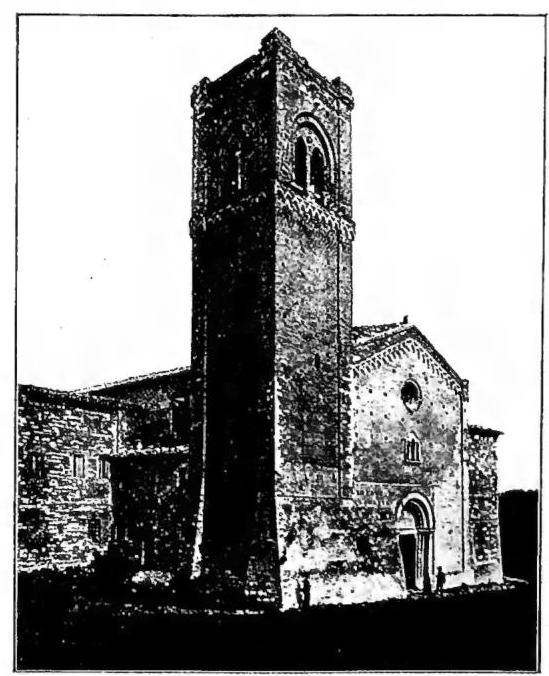
(phot. Alinari)
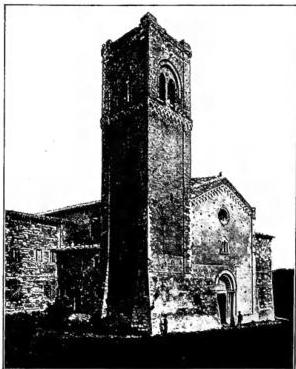
(phot. Alinari)
SANSEVERINO, DIOCESE of — Exterior of the old Cathedral (1000–1061). The façade dates from the mid-fourteenth century.
that succeeded one another in the region; that of the Smeducci until 1426; for a few years it was under the lordship of Francesco Sforza, and finally, in various forms, passed into the definitive dependence of the Church, while enduring civil struggles between the Gentili and the Caccialupi (first half of the sixteenth century); it formed part of the apostolic delegation of Macerata and followed the fortunes of the rest of the Marches. Since 20 February 1920, the bishop of S. S. has TREIA (v.), formerly held by the bishop of Camerino.
The cathedral of S. S., originally located in the ancient church dedicated to the Saint on the Castle, after various disputes was transferred, by Pius VII’s bull Cathedrales Ecclesias of 22 May 1821, to the church of S. Agostino (in the more recent part of the city, called the «Borgo») and consecrated on 28 June 1827. The diocese provides locally for the formation of the clergy through the minor seminary (in a modern building) and the regional seminary of Fano. A small seminary for the clerics of the territory, supported by the citizens, existed in S. S. from the sixteenth century, by concession of the bishop of Camerino, Berardo Buongiovanni.
The diocese comprises two municipalities in the province of Macerata (S. S. and Poggio S. Vicino), with 29 parishes, 4 of them urban and the others distributed among the localities of Aliforni, Colleluce, S. Elena, Serrone, and Ugliano (Poggio S. Vicino). In S. S. there are various educational and instructional institutions and an orphanage. Several male communities are established there: Cistercians, Friars Minor, Capuchins, Figli della Provvidenza (don Orione); and female communities: Poor Clares, Benedictines, Suore Convittrici del Bambin Gesù, Figlie della Carità, della Provvidenza, and Cieche Sacramentine. The patron saint of the city and diocese is St. Severino.
MONUMENTS. — S. S. is noteworthy for its churches and works of art, some of considerable importance: S. Lorenzo in Doliolo, very ancient, whose original construction dates back to the 8th–9th century; the old Cathedral (S. Severino), the first church of the Castle, from the 10th century, rebuilt and altered several times: 14th-century façade with a contemporary Romanesque-Gothic bell tower, and a 15th-century cloister; the new Cathedral, formerly S. Maria Maddalena, then (1260) S. Agostino, renovated inside in 1776 and 1827; a bell tower similar to that of the old Cathedral; in the sacristy, the celebrated Madonna della Pace, a masterpiece by Pinturicchio; S. Maria del Mercato or S. Domenico, believed to have been founded by the Saint himself, with its interior renovated in the 17th century; S. Maria del Glorioso (from Grilloluso), a Renaissance rebuilding with an octagonal cupola: an image of the Madonna (the Pietà) is venerated there, which shed tears in 1519, hence the title «delle lacrime»; S. Maria dei Lumi, named for the lights or splendors emanating from an image of the Virgin (16th century); the Grotte di S. Eustachio, with remains of an ancient church of S. Eustachio di Domora (11th century), and others. The town hall dates from the 18th century and contains a rich picture gallery, in which works by Salimbeni, Vittore Crivelli, Nicola da Foligno (l'Alunno), Allegretto Nuzi, etc., are preserved.
PERSONAGES. — Mention should be made of St. Pacifico (1653–1721), of the noble Divini family and a member of the Reformed Observant Friars, whose tomb is a destination for pilgrimages; of the Blessed Masseo, Pacifico, and Domenico, known as da Leonessa, born in the territory of the diocese; of the Blessed Marchesina Luzio and Camilla Gentili; and of others. In the church of the Most Holy Trinity, in the parish of S. Anna di Frontale, the body of St. Domenico Loricato, a monk of Fonte Avellana who died at Frontale in 1660, is preserved.
At S. S. an important school of painting flourished between the fourteenth and fifteenth centuries, founded by the Sanseverino brothers Lorenzo (born in 1374) and Jacopo Salimbeni; the two painters L. d’Alessandro, of the sixteenth century, were also born there; as was Domenico Indivini (sixteenth century), an excellent woodcarver; Ercole Rosa, sculptor (1846–93); the scientists Bartolomeo Eustachio, famous for his anatomical discoveries (died in 1575), and Eustachio Indivini, optician and mathematician (died in 1685); F. Panfilo, author of the well-known poem De laudibus Picens; Ireneo Aleandri, architect (1795–1885), author of the famous bridge at Ariccia (Castelli Romani) and of the monumental Sferisterio in Macerata, etc.; and Fr. Giovanni Severano.