
TRINITÀ, Santissima. - The Trinitarian mystery, the revelation to humanity of the intimate constitution of God, is expressed in the following terms: "God is absolutely one and relatively three; that is, in a single nature or essence, most simple, there subsist three distinct Persons—the Father, the Son, and the Holy Spirit—to whom all essential divine attributes equally belong."
I. HOLY SCRIPTURE
In the Old Testament, God did not openly reveal the mystery, perhaps to avoid giving the Hebrew people, surrounded by idolaters, an occasion to fall into polytheism. However, traces of a distinction of terms within the Divinity can be found, especially in the Wisdom Books; Divine Wisdom is described there as assisting and cooperating with God (Prov. 8:22); in Eccl. 24:5: « I came forth from the mouth of the Most High before all creatures » and in Wis. 7:25 it is said: « She is the refulgence of eternal light, the spotless mirror of the power of God, the image of his goodness ». It will not be inappropriate to note that in these same books mention is made of the Word-Λόγος of God, divinely operative (Wis. 9:1; Eccl. 42:15, etc.). Other hints are found in the messianic texts (Ps. 2 and 109; Is. 7:14; Dan. 7:13 and others), in the Theophanies or divine apparitions, called the « Angel of Yahweh » (for example, that of the burning bush, Ex. 3:2). Even more vague and obscure are the indications of the Old Testament regarding the Holy Spirit. All these clues, vague in themselves, acquire value and consistency in the light of Christian Revelation. The Synoptics present the Trinity in concrete expressions, accessible to popular understanding. Without diminishing in any way the unity of God, a heritage of ancient Revelation, the three Divine Persons, Father, Son, and Holy Spirit, are indicated distinctly and with real mutual relationships of existence and action. Jesus is the Son of God; upon him descends the Holy Spirit in the form of a dove, while the voice of the Father resounds: « This is my beloved Son » (ἀγαπητός = only, according to the language of the time). Thus in the waters of the Jordan and on Tabor (Mk. 17:11; Mt. 3:16-17, 1; Lk. 3:21). Jesus acts as God: he forgives sins (Lk. 5:20), perfects and completes the law of God (Mt. 5:21), is Lord of the Sabbath (Mt. 12:8; Mk. 3:1), is judge of all men and promises eternal life to those who love him above all things (Mt. 7:22 and 25:31; 8:21 and 10:37; 19:21; Lk. 9:59 and 6:22; Mk. 10:21); only the Son knows the Father perfectly, as the Father knows the Son (Mt. 11:27 and Lk. 10:22). Peter’s cry: « You are the Christ, the Son of the living God », at Caesarea, is a supernatural truth, revealed to the Apostle directly by the heavenly Father (Mt. 16:16-17), and Jesus himself confirms it forcefully before the High Priest in the Sanhedrin; indeed, for this declaration he is condemned to death (Mt. 26:63-65; Mk. 14:61-64; Lk. 22:70).The Holy Spirit, even if his personality is not indicated with unequivocal clarity in the Incarnation of the Word (Lk. 1:35; Mt. 1:18), is certainly attested in relation to John the Baptist (Lk. 1:15), Simeon (Lk. 2:25), the baptism of Jesus (Mk. 1:9-11), the blasphemy against him (Mt. 12:31-32), and in Jesus’ promise (Lk. 24:49). The testimonies of the Synoptics conclude with the Trinitarian formula of Baptism: « Go therefore and teach all nations, baptizing them in the name of the Father and of the Son and of the Holy Spirit » (Mt. 28:19). In the Greek text one reads: εἰς ὄνομα = « into the name »; and the conjunction καί = « and » is repeated, with the article τοῦ = « of », before
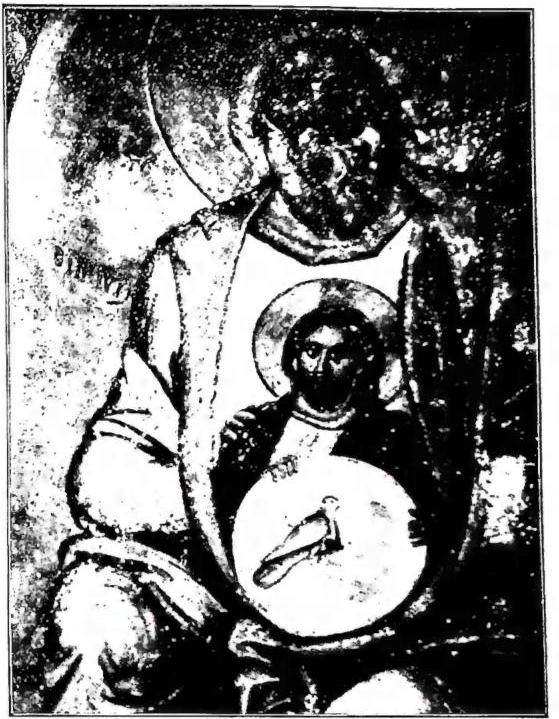
SANTISSIMA TRINITÀ - Important Byzantine representation of the Most Holy Trinity illustrating the Catholic doctrine of the Procession of the Holy Spirit "ex Patre per Filium." Fresco from the church of Κουζεμνίσου, dating to the 9th century - Kastoria (Greece).
each of the three Persons, emphasizing the absolute equality, despite the real distinction among the three Terms to which the baptized is consecrated. The attempt made by some critics (Conybeare) to undermine the authenticity and integrity of the baptismal formula is vain (cf. J. Lebreton, Les origines du dogme de la Trinité, I, 2nd ed., Paris 1927, pp. 599-609).
Of the Acts of the Apostles, which echo the Synoptics, it suffices to cite the following text: "The Holy Spirit placed them (the Bishops) to govern the Church of God, which He acquired with His own blood" (Act. 20, 28). Auguste Sabatier (L'Apôtre et Paul, Paris 1896, p. 366) wrote that the Trinitarian dogma is foreign to the thought of St. Paul. Such an assertion, gratuitous and false, is contradicted by the innumerable texts in which the Apostle explicitly names the three divine Persons, as in the Trinitarian formula that became customary, especially in the opening of his letters. The divine personality of Christ in relation to the Father is highlighted with powerful language and thought. The expression is frequent: "Grace and peace from God, our Father, and from the Lord Jesus Christ" (Rom. 1, 7; Gal. 1, 3). Jesus is sent by the Father to save the world (Gal. 4, 4; Rom. 8, 3) and is the Father's own Son, ἴδιος (Rom. 9, 5; Tit. 2, 13). Christ, continuing to subsist as God in the divine nature, took on our nature, becoming man (Phil. 2, 6), and He: "is the image of the invisible God, the firstborn of all creation: for in Him all things were created in heaven and on earth... All things were created through Him and for Him, and He is before all things, and in Him all things hold together" (Col. 1, 15 ff.). The two terms, Father and Son, are Persons really distinct and operative, to whom the name of God is equally attributed, because they share the same identical divine nature.
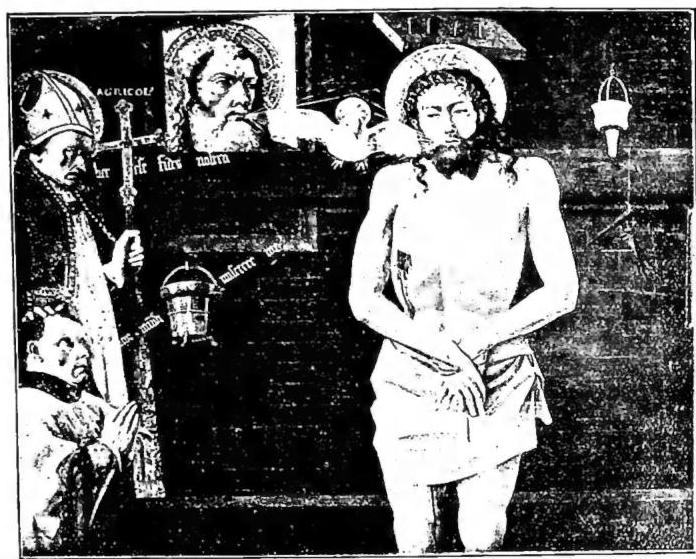
SANTISSIMA TRINITY - Procession of the Holy Spirit « ex Patre Filioque ». Christ stands in the tomb surrounded by the instruments of the Passion. On the left, St. Agricola of Avignon and a devotee. Avignon School (second half of the 15th century) - Paris, Louvre Museum.
if the Spirit of Him who raised Jesus from the dead dwells in you... and the other in I Cor. 3:16: « Do you not know that you are the temple of God and that the Spirit of God dwells in you? » (cf. Eph. 6:19). In Tit. 3:5, it is said that the Spirit is sent to us by the Father through the Son. Furthermore, the mutual relation of the three Divine Persons is clearly signified in such a way that the Son proceeds from the Father and the Holy Spirit from the Father through the Son: « When the fullness of time came, God sent His Son... so that we might receive adoption as sons. And because you are sons, God has sent the Spirit of His Son into our hearts, crying: 'Abba, Father' » (Gal. 4:4 ff.). While St. Paul’s doctrine is eminently soteriological and Christocentric, it is neither lawful nor possible to erase from his doctrinal framework the concept of God as One and Triune.
St. John, moreover, not only affirms the distinction of the three Persons but also indicates the ways of the processions and the divine relations, expressing in concrete language those relationships between nature and Persons which the Fathers and theologians will later translate into philosophical language. The Fourth Gospel opens with the proclamation of the divinity of the Word: « In the beginning was the Word, and the Word was with God, and the Word was God ». The eternal Word is the Only-Begotten of the Father, μονογενής (ibid.), and cannot be confused with all creatures, who were made through Him, whereas He is not an instrument of the Father, though He is by nature subsequent to the Father: He is sent and given by the Father (Lk. 3:16), receives from the Father (16:5), yet is one with the Father, who is immanent in Him: « Philip, he who sees me sees the Father also... do you not believe that I am in the Father and the Father is in me? » (14:9). « I and the Father are one » (10:30). The Holy Spirit is sent by the Father and the Son (14:16 and 15:26); He is the Spirit who must complete the sanctification, instruction, and confirmation of the Apostles in the truth already preached by the Lord (3:5 and 16:13-14). While St. John preserves as predominant the concept of the intimate and vital unity of God, he simultaneously affirms the three Divine Persons as truly distinct terms and active within that unity. Thus, the fundamental lines of the Trinitarian mystery are not merely sketched but so deeply embedded in the consciousness of the Christian community that the Fathers and theologians were able to develop a rich and harmonious conceptual elaboration.
II. TRADITION
The enunciations of the dogma of the Most Holy Trinity, which in the earliest tradition remain on the plane of concreteness and simplicity, are found as early as the first century of Christianity in the creeds, in the liturgy (especially in the baptismal liturgy), in prayers, and in art. The Didachè (second half of the 1st century) instructs that Baptism must be conferred « in the name of the Father, and of the Son, and of the Holy Spirit ». In the 2nd century, St. Justin (I Apol., 61, 3-13), St. Irenaeus (Demonstratio, 3 and 7), and Tertullian (Adv. Praxeam, 26) consistently gather the schema of this baptismal liturgy, which is Trinitarian and Christological in character. The words of Tertullian (loc. cit.) must be cited: (Christus)... mandans ut tingerent in Patrem et Filium et Spiritum Sanctum non in unum. Nam nec semel, sed ter, ad singula nomina in personas singulas tingimur. In Tertullian, St. Hippolytus, St. Cyprian, St. Dionysius of Alexandria, and others, traces are found of a profession of faith, in common use in all the Churches, with a Trinitarian baptismal formula so clear as to leave no room for doubt or discussion. Echoes of this profession are found in the doxological formula of St. Clement of Rome, in the celebrated letter to the Corinthians (58, 2): « May God live, and may the Lord Jesus Christ live, and the Holy Spirit, faith and hope of the elect », and in an ancient Greek vesper hymn, which hails Christ as « Joyous Light of the holy glory of the immortal Father », and concludes: « Let us praise the Father and the Son and the Holy Spirit of God ».Around the year 265, St. Gregory Thaumaturgus, substantially anticipating the Creed that would be sanctioned at Nicaea, had thus synthesized in the Expositio fidei the faith of the Church in the mystery: « One God, Father of the living Word... perfect begetter of the perfect (Son), Father of the Only-begotten Son. One Lord... God from God... true Son of true God... And one Holy Spirit, who receives substance from God... in whom God the Father and God the Son are manifested... Trinity perfect, undivided in glory, in eternity, in kingdom... Nothing created or subordinate in the Trinity... Never was the Son absent from the Father, nor the Holy Spirit from the Son, but there has always been the same immutable Trinity ». The Council of Nicaea, sixty years later, would fix the fundamental expression of the mystery with the term homoousios (= consubstantial). However, to understand and evaluate the Nicene definition of 325 and the Arian heresy that prompted it, it is necessary to recall the genesis of Trinitarian theology, which developed laboriously from the 2nd to the 3rd century.
The Christian proclamation of the one and triune God encountered, from the outset, two adversaries: Judaism, opposed to the Trinity, and polytheism, opposed to divine unity. Over the more or less decadent religious practices, especially of polytheism, philosophical currents with Stoic and Neoplatonic backgrounds were superimposed, aiming to rationalize religion by reducing it to the metaphysical sphere. Stoicism, having cleared the field of polytheism through a naturalistic interpretation of its mythological basis, constructed its religious world in a form of pantheism, whereby the universe is conceived as the living whole that embraces and unifies spirit and matter, God and cosmos. In this whole, the principal part belongs to the Logos or universal reason (sometimes identified with fire, pyr noēton), which is the vital force immanent in matter and which in man becomes thought and word (Logos endiathetos - prophorikos). Neoplatonism, on the other hand, in the religious sphere, in opposition to Stoicism, asserted itself as transcendent monotheism and, on the cosmic-psychological plane, as irreducible dualism. The Neoplatonic Divinity is inaccessible, entirely detached from the material world: between the eternal God and eternal matter are arrayed infinite intermediate divine beings (aeons and demiurges), which, operating upon matter, transform it into our sensible world, imitating the ideas—absolute, subsistent perfections closer to God. Among these intermediate beings, a Logos also emerges here, the principal architect of the universe.
Now, while Philo attempted in Alexandria to reconcile Neoplatonism with the Jewish religion, in Gnosticism there was an attempt at a more universal synthesis, based on Persian dualism (Mazdaism), also accepting elements from various Eastern religions called « of the mysteries ». The ambitions of conquest by such a complicated « gnosis » in a mystical-rational hybridism extended also to the new Christian religion and its mysteries. With regard to the Trinity, God the Father was identified with the transcendent divinity: Jesus was considered a mere man, into whom Christ, one of the aeons, descended to liberate the spirit, that is, the soul, from the slavery of matter.
Valiant apologists, such as St. Irenaeus and Tertullian, rejected the Gnostic distortions, appealing simply to tradition; others, however, such as St. Justin, Athenagoras, Clement of Alexandria, and Origen, coming from philosophical schools not averse to Neoplatonism and Stoic elements, more boldly undertook the task of demonstrating that the data of Revelation were not at all in conflict with human reason, and thus the first schemas of translating the Trinitarian mystery into the categories and formulas of a philosophical language emerged.
The first object of study was the mysterious relationship between Christ and the Father. The apologists certainly did not doubt what Revelation had suggested to reason, especially through the Fourth Gospel, which presents Jesus Christ as true God, distinct from the Father, and bound to the Father by a bond of spiritual generation, according to the process of divine knowledge, to which the term Logos = « Word » belongs. But the Logos awakened in them memories of Stoicism and Neoplatonic longings, from which they borrowed certain modes of expression that seemed to lower the divine dignity of the Word to the level of the intermediate beings of Neoplatonism, which, however high, always remained in the category of « creature ». The consequence of this somewhat confused state of affairs was an exaggerated separation of the Son from the Father, under the influence of Neoplatonic transcendence, and the tendency to reduce the eternal generation of the Word to a temporal generation, coinciding with the creation of the world, given also the important function attributed to the Word in the prologue of St. John: « Through him all things were made, and without him nothing was made ». Stoicism, moreover, favored this tendency, leading to the understanding of the Word first as hidden in the bosom of the Father (Logos endiathetos), then as generated or manifested in the act of universal creation (Logos prophorikos). Thus, Origen called the Father ho Theos, God par excellence, and the Son simply Theos, without the article, and also deuteros Theos (God of the second order). Equally unfortunate expressions are found in St. Justin, Athenagoras, and Tertullian.
III. ERRORS AND DEFINITIONS – The exaggerated "henotheism" of the Stoic school, with its single God immanent in the world, along with the Judaizing sects and the Eastern religions that were rapidly spreading throughout the Roman Empire, crept across the West under the name of "divine monarchism" and barred the way to any truly Trinitarian conception, also undermining the divinity of Christ. Teachers of this current included, among others, in the 2nd and 3rd centuries, Noetus of Smyrna, Praxeas, Artemon, and especially Sabellius, from whom the name "Sabellianism" derives. This system is a nominalistic modalism that effectively nullifies the mystery of the Trinity, since the three Divine Persons are reduced to three aspects or modes of being of a single God (Father = God the Creator; Son = God the Redeemer; Holy Spirit = God the Sanctifier). Alongside this modalism (v. MODALISM), Adoptionism (v. ADOPTIONISM) also developed, particularly through the efforts of Theodotus of Byzantium, who sought to propagate this erroneous doctrine in Rome itself, from where he was promptly expelled by Pope Victor (2nd century). The Adoptionists, consistently with modalist doctrines, unable to recognize in Christ a true God, the natural Son of the Father, taught that He was, in reality, only a man, and Son of God only in an adoptive sense. The proponents of this error in the East took the name of Subordinationists (v. SUBORDINATIONISM) and denied the equality of the Son with the Father, making Christ an inferior being to the Father, though excellent in comparison with other creatures. Modalism, Adoptionism, and Subordinationism, intimately connected to one another, are clearly found in Paul of Samosata (v.), bishop of Antioch, around the middle of the 3rd century. A controversy that might appear, at first glance, purely verbal but is in fact the prelude to a long struggle between Catholic orthodoxy and Arianism, with its critical peaks in the 4th century, is linked to him. This controversy revolved around the term homoousios = consubstantial, which passed into the Antiochene school through derivation from Aristotle’s philosophy. The Stagirite distinguished in his philosophy a primary essence (or substance), ousia prōtē, and a secondary essence, ousia deuterā. Primary substance is being in its real, physical concreteness, as found in the individual, e.g., man in Titus; secondary substance is the specific, abstract essence in which multiple individuals of the same species converge, e.g., humanity. Homoousios could therefore signify either a subject that shares the same specific nature with another (as, for example, Titus and Gaius) or a subject that possesses the same concrete substance, numerically one, as another. It is clear that the term homoousios cannot be attributed to the Divine Persons in the first sense, but only in the second.
In Rome, as early as the 2nd century, homoousios was used in the correct sense, as demonstrated by a letter of Pope Dionysius.
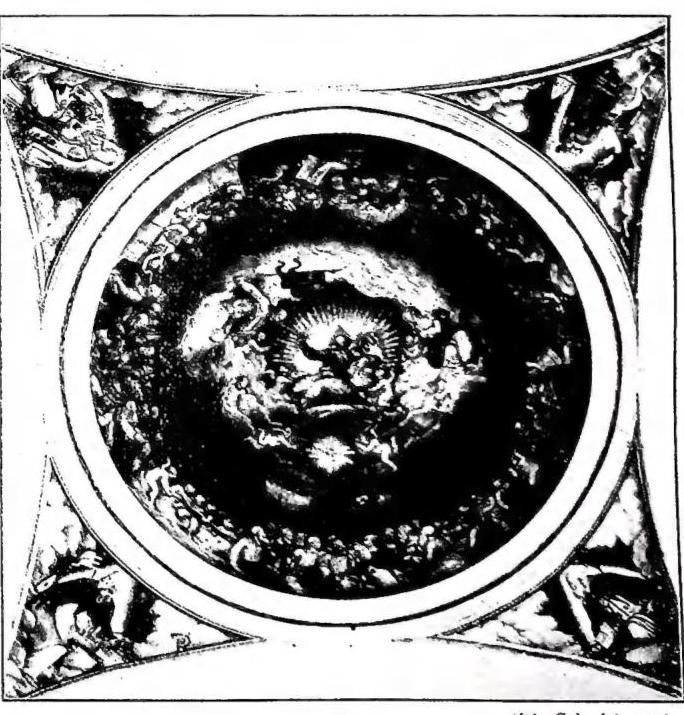
SANTISSIMA TRINITY - The Most Holy Trinity in the Glory of Paradise, by G. B. Ragazzini (1336). Fresco in the dome of the Chapel of S. Paterniano. Fano, Church of S. Paterniano.
to Bishop Dionysius of Alexandria, while Paul of Samosata, in the following century, abused that term in a modalistic sense, confusing the οὐσία πρώτη with the οὐσία δευτέρα, thereby reducing the Word not only to the same substance as the Father, but also to the same Person. However, the interpretation of the Samosatene was to remain isolated, for the Council of Antioch in 268 proscribed the term ὁμοούσιος, which he had abused, without overly concerning itself with the fact that that term, correctly understood, was used in Rome and almost everywhere.
But even setting aside the technicality of that term, it is certain that the concept it signified was already part of the early tradition, and the first Ecumenical Council did nothing but definitively sanction it against the heresy of Arius. The novelty, therefore, lay not in the definition of Nicaea, but in the Arian heresy (v. ARIANESIMO), which can be summarized in these main points: 1) The true God is ἀγέννητος, that is, unbegotten, nor can He communicate Himself to anyone due to His transcendence; 2) God is not Father from all eternity, because He created the Word, His Son, and through Him all other things, at a determined time; 3) the Word is not properly God, because He is heterogeneous to the Divinity, like any other creature, and one cannot even say that He knows God perfectly: both the Son and the Holy Spirit are clearly separated from God, because they are made from a substance that is not that of the Father; 4) the filiation of the Word cannot be said to be absolutely natural, but merely adoptive. Such pernicious errors demolished the Trinity of God and the divinity of Christ.
The new heresy, despite the Apology of Arius and his followers, was condemned, and the doctrine of the faith was sealed in a Creed, which, with slight revisions by the First Council of Constantinople (a. 381), passed into the liturgy of the Mass. Here is the principal formula of the creed: «We believe... in Jesus Christ, our Lord, Son of God, born only-begotten of the Father, that is, from the substance of the Father... born, not made, consubstantial (ὁμοούσιος) with the Father.» The epigones of Arianism (Anomeans, Acacians, Homoiousians) strove in vain for nearly the entire fourth century to distort the meaning of ὁμοούσιος or to erase it altogether from the doctrine of the faith. St. Athanasius and many other Fathers strongly defended the Nicene definition until its complete triumph, thus safeguarding the foundation of Trinitarian theology, which, after the elaboration by the three Cappadocians and Hilary of Poitiers, found its definitive systematization in the fifteen books De Trinitate by St. Augustine. Some hypercritical scholars of our time have attempted to argue that the Nicene definition would be based on an equivocation, because ὁμοούσιος would have been understood by the Westerners in the sense of a numerical unity of substance or nature, while the three great Cappadocians would have understood it only in the sense of a specific unity. However, the false interpretation of the pure doctrine of St. Basil, St. Gregory Nazianzen, and St. Gregory of Nyssa (proposed by Harnack, Loofs, and Turmel, who equivocally called it «Neo-Nicenism») would not only mark a step backward or an involution of the Trinitarian mystery, tritheism (v.). The in-depth study of these Fathers, in the most genuine Catholic tradition, has demolished the foundations of this Protestant attempt to rehabilitate the Arian heresy (cf. St. Basil, Homilia contra Sabellium, Arium et Anomaea, 3: PG 31, 605; St. Gregory of Nazianzus, Oratio 31, 9; St. Gregory of Nyssa, Oratio Catechetica, 3). In the year 381, the First Council of Constantinople confirmed the Nicene definition and reaffirmed the concept of consubstantiality, applied to the Third Person in relation to the Son and the Father, against the heresy of the Macedonians or Pneumatomachi, who denied the divinity of the Holy Spirit. The following year, a particular Council convened in Antioch drafted a profession of faith to be sent to Pope Damasus, in these terms: «We believe that the Divinity, the power, the essence (= οὐσία) is one in the Father, in the Son, and in the Holy Spirit; equal the glory, coeternal the dominion in three perfect Hypostases, that is, in three perfect Persons.» It remained to explain how, given the numerical unity of the divine essence, a real distinction of the Persons could be conceived. First the Cappadocians, led by St. Basil, and then more acutely St. Augustine, elaborated the doctrine of the divine relations, which constitute the logical presuppositions of the real distinction of the Divine Persons, without in the least compromising essential unity. Their doctrine passed directly into Scholasticism, which was able to present Trinitarian theology in an organic and systematic treatment. The Church does not, for this reason, dispense with vigilance and intervention when new opinions threaten the purity of the dogma established in conciliar definitions. Thus, in the thirteenth century, the Fourth Lateran Council intervened to clarify the terms and concepts of the mystery, against FIORE, IL (v.), who was nominalism (v.) Roscelin (v.), already energetically combated by St. Anselm. In the fifteenth century, the Council of Florence clarified, with the decree Pro Jacobitis, the concept of the relation of origin and the procession of the Holy Spirit from the Father and the Son (ab utroque), in response to the positions of the schismatic Eastern Church, which rejected the Filioque inserted into the Nicene-Constantinopolitan Creed, beginning in the sixth century (for the first time in Spain).
A. Piolanti
IV. THEOLOGY OF THE MYSTERY
When confronted with the mystery of the Most Holy Trinity, human reason may follow two paths: either it begins from the Trinity of Persons to arrive at the unity of nature (substance), according to the itinerary of Greek thought, synthesized by St. John Damascene; or it moves from the unity of substance (or nature) to reach the Trinity of Persons, following the itinerary of Latin theology, expounded especially by St. Thomas (Sum. Theol., 1ª, qq. 27-43). For the Trinitarian speculation of Scholasticism, it is necessary to start, regarding the Trinity, from the meaning of the two terms "nature-person" and their mutual relations. Indeed, all Trinitarian and Christological heresies and errors arose from the confusion of these terms.However, the precedents of Scholastic speculation are already found in the Fathers. St. Augustine had insisted on the analogies that the spiritual soul presents with the Trinity, based on cognitive and volitional processes, while firmly maintaining the infinite distance between the created reality of the soul and the uncreated Divinity. In fact, in the soul, Augustine identified and highlighted the following ternary states: "mens, notitia, amor" (= intellect, cognition, love); "memoria, intelligentia, voluntas" (memory, intelligence, will); "esse, nosse, velle" (= being, knowing, willing). St. Thomas focused his attention on the two specific and immanent operations of the human soul: intellection and volition, which, despite the individuality of the human spirit—a spiritual and simple monad—lead to a duality on the operative plane. Now, when the soul directs its knowledge not toward an external object but toward itself, and turns to itself with love, there arises a thinking subject that, in the mental word or idea of itself, contemplates and loves itself with total self-adherence. The thinking subject thus becomes a thought object, and between the two terms, a line of connection is established, which is love. Even in the supreme Spirit, who is God, by way of analogy, one may consider two operations—intellection and volition—as perfectly immanent, yet without compromising His essential simplicity, as they are identified with His very nature. To understand this immanent dynamism of God, the following diagram may be somewhat useful:
GOD
thinking thought thought thought
love
Thus, the two divine processions immanent in God, explicitly contained in the Creeds and the definitions of the ecclesiastical Magisterium, which necessarily imply distinct terms, may be more easily understood. Indeed, every operative procession cannot be conceived without starting from a terminus a quo and arriving at a terminus ad quem; divine intellection and volition, in themselves,
will therefore require four terms, two for each operation. Now, intellection has all the characteristics of a spiritual generation, as is evident from the very terminology used for human cognition (to conceive, concept, to reproduce, etc.). The first divine procession, understood according to intellection, will have as its terminus a quo God, the subject and principle of thought (= the Father), who, in thinking, conceives and thus generates the Word (= the Son). The second procession, understood according to volition, is more obscure and does not have the character of generation. The Father contemplates Himself in the Son (the Word) and loves Himself: the love that ineffably unites the Father with the Son constitutes the third term, which we call the Holy Spirit. And thus, the Son proceeds, by intellectual generation, from the Father, and the Holy Spirit proceeds, according to the operation of the will, from the Father and the Son. The mystery is barely glimpsed through the processions of origin, as theologians call them, and already serious difficulties arise. The real distinction of the terms, which would be the Persons, seems to clash with the absolute simplicity of God, in whom existence and nature, attributes and operations are one and the same thing in the most absolute manner, thus rendering any real distinction in the Divinity impossible. Nevertheless, theologians rightly admit a distinction of reason, with a real foundation (distinctio rationis ratiocinatae), among the various divine attributes, which are therefore not synonymous. In this way, it becomes possible to speak distinctly of intellection and volition in God, with their respective terms, while always preserving the absolute unity and simplicity of the divine essence. The difficulties are not yet overcome, for it is not clear how one may pass from this distinction of reason, even if it be "rationis ratiocinatae," to the affirmation of three terms or Persons, really distinct and subsisting in the same unique nature or divine essence, as faith requires. The Fathers and Doctors of the Church found another logical presupposition of the Trinitarian mystery in the doctrine of relations, which are already hinted at, concretely, in Sacred Scripture, which presents a paternity and a filiation in God, now called Father, now Son, now Holy Spirit. Aristotle, grasping its intimate meaning, defines relation as "τὸ πρὸς τι" (= ad aliquid), that is, a mutual reference of two things, as, for example, of father to son. It belongs to the category of accidents, but has entirely special characteristics. While, for example, quantity and quality denote a perfection that inheres in the subject and enriches it entitatively, relation essentially denotes a reference to another, a dynamic order of reference from one term to another. Its consistency is not entitative, and, though it is a real relation or reference, it remains almost at the margins of reality, bringing no increase of perfection to the subject on the metaphysical plane. In it, therefore, one usually distinguishes a twofold formality: the esse in, by which it is in a given subject, and the esse ad, by which it refers to another subject. The true constitutive note of relation is, without doubt, the esse ad. From this, it follows that relations, precisely because they do not bring to the subject a perfection of entitative order but merely a state of reference to another, cannot be distinguished from one another except by way of opposition. Transposing this doctrine, always by way of analogy, onto the plane of the Divinity, the two divine processions give rise to four relations: paternity, which denotes the reference of the Father to the Son, and filiation, which denotes the reference of the Son to the Father; divine spiration, which refers the Father and the Son together to the Holy Spirit, and passive spiration (also called simply procession), which refers the Holy Spirit to the Father and the Son. The absolute simplicity of the divine essence certainly does not allow relations to be understood as accidents inhering in God Himself: rather, they are said to subsist by virtue of the unique divine nature, with which they are identified according to the esse in. According to the esse ad, however, they cannot be identified with the divine essence, because the two formal concepts—being in itself and being toward another—cannot be reduced to identity.
There is, therefore, between the nature of God and the relations, a
V. TRANSCENDENCE OF THE MYSTERY
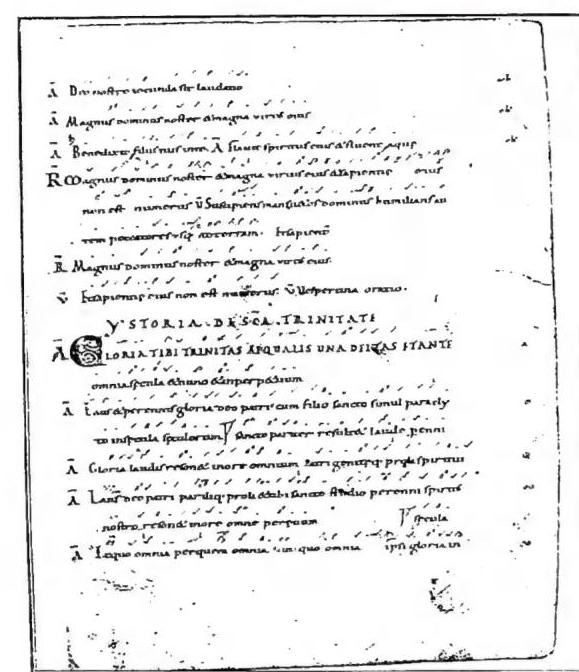
Catholic theology has certainly not claimed to resolve, and thus to nullify in rationality, the lofty mystery, but has left it above any human conception. Conversely, superficial and faithless scholars of modern times, driven by blind confidence in the power of reason, have attempted, in vain, to eliminate the Christian mystery, classifying it among the inconsistent triads of various pagan religions and philosophies. More than Greco-Roman mythology, it is the rich literature of Eastern religions that offers material for comparison with the Christian Trinity, particularly the religions of Babylon, India, Egypt, and Persia. In the Babylonian pantheon, the prevailing triads are two: a cosmic one composed of Anu (= heaven), Enlil (= earth), and Ea (= water), and an astral one composed of Sin (= moon), Šamaš (= sun), and Ištar (= Venus the planet). Other triads consist of a man, a woman, and a son. These triads are nothing more than polytheistic groupings of three subjects endowed with their own nature and personality, united only accidentally. Furthermore, it is demonstrated that among the Babylonians they never hadThe opening of the Office for the Feast of the Most Holy Trinity, composed by Stefano di Lami, from the Antiphonale officii monastici of Blessed Hartker (d. 1011 or 1017). The Office, undated, is placed among the ferial Offices and the vigil of St. Sebastian—St. Gall, Library, cod. no. 390, f. 101².
neither a theological nor a ritual character (cf. G. Boson, La religione sumero-accadiana e babilonese-azzira, in P. Tacchi-Venturi, Storia delle religioni, I, 3rd ed., Turin 1949, p. 201 ff.). Some have considered the Indian religion more suitable for comparison. Among its multitude of gods, a popular trimurti (triad) stands out, composed of Brahma, Vishnu, and Shiva (= God the creator, God the preserver, God the destroyer), which took shape at the beginning of the Christian era (after the 5th century A.D.). The people see in it simply three gods, while theologians discern three aspects of the one divinity (Brahma), in relation to the world. The theological schools of Shankara, Ramanuja, and Vallabha, drawing from the Upanishads and the Vedanta, developed a higher trimurti, composed of Sat (= being), Cit (= thought), and Ananda (= bliss), which together form the supreme divinity (= Brahma). The triadic expression saccidananda also gained popularity. Impartial critics, after lengthy studies, have concluded that these trimurti, at first glance so striking, are either formally polytheistic or figurative explanations of the various aspects of divinity. None of them properly contains the idea of one substance in three persons, quite apart from the question of mutual influence between the Christian religion, which spread early in that part of Asia, and Indian religion—a question difficult to resolve due to the lack of reliable chronological data (cf. A. Ballini, Le religioni dell'India, in P. Tacchi-Venturi, op. cit., I, p. 416 ff.). Egyptian religion also presents ternary and novenary classifications of its countless deities. The most famous triad, also for its diffusion in the Roman Empire at the dawn of Christianity, is that composed of Osiris (= father and husband), Isis (= wife and mother), and Horus (= son), in which Isis, who gathers the scattered limbs of her husband Osiris and resurrects him, ultimately prevails in worship, becoming an enigmatic symbol in which many aspects of divinity and nature are personified. A simple exposition suffices to understand that the Egyptian triad has nothing to do with the mystery of the Christian Trinity (cf. A. Calderini, La religione degli Egiziani, in P. Tacchi-Venturi, op. cit., I, p. 289). Nor can the late Persian triads, linked to the cult of Mithra (= sun), be judged differently. These consist of Ahura-Mazda (= supreme and true God), Mithra (= sun), and Sraosha (= a hero), or of Mithra, Cautes (= rising sun), and Cautopates (= setting sun). The first is a heterogeneous grouping, and the second is the personification of the sun in its phases. One can confidently conclude with the following judgment of Fr. Lebreton, a specialist in Trinitarian matters: « Je ne pense pas qu'il soit utile de discuter toutes ces fantaisies; elles marquent une phase curieuse, mais bien dépassée maintenant, de l'histoire des religions. En réalité la mythologie n'a rien fourni par elle-même à la théologie trinitaire » (Histoire du dogme de la Trinité, I, Paris 1927, pp. 17-18). Another point of comparison is finally drawn from Neoplatonism: the philosophical triad of Plotinus, the mystical philosopher who lived in the 3rd century A.D. He taught that the transcendent Divinity, in the Platonic manner, is the Εὖ (= the One), from which emanates the Νοῦς (= Intelligence), which in turn gives rise to the Ψυχή (= Soul). The Neoplatonic triad, which is not entirely free from Christian influences, represents a pantheistic degradation of divinity, in perfect antithesis to the mystery of the One and Triune God of Christianity, who in His transcendence is sharply distinct from the created world. Thus, the alleged similarities between the Christian Trinitarian mystery on the one hand and the triads of polytheistic religions and various philosophical systems on the other do not go beyond a verbal analogy and present no affinity other than that of the ternary number.
The Most Holy Trinity in the souls of the just, Angers 1932; A. Maltha, De processione Verbi divini, in Angelicum, 11 (1934), pp. 23-55; R. Arnou, De Deo Trino in fontibus Revelationis, Rome 1938; A. Stolz, De Sanctissima Trinitate, Freiburg im Breisgau 1939; A. Maltha, De divinarum relationum existentia, quidditate, distinctione, in Angelicum, 17 (1940), pp. 3-31; M. T. L. Penido, À propos de la procession d'amour, in Ephemerides theologicae Lovanienses, 15 (1938), pp. 338-44; F. Leotta, La persona dello Spirito Santo nella dottrina di s. Agostino, Acireale 1943; S. Sottolana, Un trattato inedito sullo Spirito Santo di Agostino Trionfi d'Amore, Rome 1943; F. Taymans d'Espéronnet, Le mystère primordial. La Trinité dans sa vivante image, Paris 1946; P. Parente, De Deo Uno et Trino, 3rd ed., Rome 1949; S. Vallaro, Quaestiuncula de mysterio Sanctissimae Trinitatis, in Angelicum, 26 (1949), pp. 205-17; A. Krapiec, Inquisitio circa d. Thomae doctrinam de Spiritu Sancto prout Amore, in Divus Thomas Plac., 53 (1950), pp. 474-95; H. Paissac, Théologie du Verbe. Saint Augustin et saint Thomas, Paris 1951.
PIETRO PARENTE
VI. LITURGY
Since the Catholic liturgy aims to render to the One and Triune God the worship of latria or adoration, everything within it is ordered toward this supreme purpose, from the sacrifice of the Mass to the Sacraments, the Divine Office, the veneration of Mary and the Saints, and even catechesis. It is therefore unsurprising that Rome, until the fourteenth century, deemed it superfluous to honor the Most Holy Trinity as such with a special feast. Moreover, the Eastern Church still lacks a feast for the Trinity, whose mystery, in the Byzantine rite, is particularly Pentecost (v.). It is also worth noting that the few Latin liturgical prayers directly addressed to the Trinity do not conform to the spirit of the ancient Roman liturgy, which in principle addresses God the Father, and reveal a later period: such are, for example, the Suscipe Sancta Trinitas and the Placeat Sancta Trinitas of Frankish origin, which begin to appear in the Ordo Missae in Sacramentaries and Missals between the ninth and eleventh centuries (cf. P. Batiffol, Leçons sur la Messe, Paris 1927, pp. 20, 22). Even the feast of the Most Holy Trinity, celebrated on the first Sunday after Pentecost (elevated by Pius X on 24 July 1911 to the rank of a double of the first class: AAS, 3 [1911], p. 351), is not of Roman origin: it arose from private devotion to the mystery of the Most Holy Trinity, which flourished in Frankish lands during the Carolingian era and received considerable impetus from the Admonitio generalis (§ 32) of 789 and the Capitulare XXVIII (§ 33) of 794, which prescribed the exposition of Catholic doctrine concerning the Most Holy Trinity (ed. A. Boretius, in MGH, Capitularia regum Francorum, I [1883], pp. 56, 77). The earliest centers of this devotion were the monasteries of Aniane and Tours: in the former, its founder St. Benedict dedicated the abbey church to the Most Holy Trinity in 789 (cf. Vita, 5: Acta SS. Februarii, II, Antwerp 1658, p. 614; other examples of dedications in Brown, cited in the bibliography); in the latter lived Alcuin, an ardent proponent of this devotion and author of the treatises: De fide sanctae et individuae Trinitatis (PL 101, 11-58); De Trinitate ad Fredegesium questiones XXVIII (ibid., 58-64; the Confessio fidei, ibid., 1027-98, has now been attributed to Giovanni di Fécamp [v.]). To fully understand the purpose of the current solemnity, it is worth noting that from the Carolingian era onward, this devotion bore the distinctive character of a profession of faith in the august mystery: suffice it to recall the prayers to the Most Holy Trinity contained in the Libelli precum of that period, recently edited by A. Wilmart (Precum libelli quattuor aevi Karolini, Rome 1940, p. 188, index), of which at least three originate from Tours.1. The Mass
In addition to the aforementioned treatises on the Trinity, Alcuin is also credited with the Mass of the Trinity still in use today, with the exception of the Epistle, the Gospel, and other minor modifications introduced by St. Pius V. Indeed, in a letter addressed between 796 and 804 to the monks of St-Waast, he states that he had extracted from a Sacramentary—undoubtedly from Tours—a series of votive Masses, the first of which was that of the Trinity (Ep. 296: ed. E. Dümmler, in MGH, Epp. Kar. Aevi, II [1895], p. 455). To the monks of Fulda, between 801 and 803, he sent the Cartula missale, that is, his Liber sacramentorum, containing the well-known series of private votive Masses for the entire week, the first of which, for Sunday, was that of the Trinity (text of the Mass in PL 109, 445-46; Ep. 250, ed. cit., pp. 405-406). Now, this Mass appears in first place among the votive Masses in various Frankish Sacramentaries from the first half of the ninth century onward.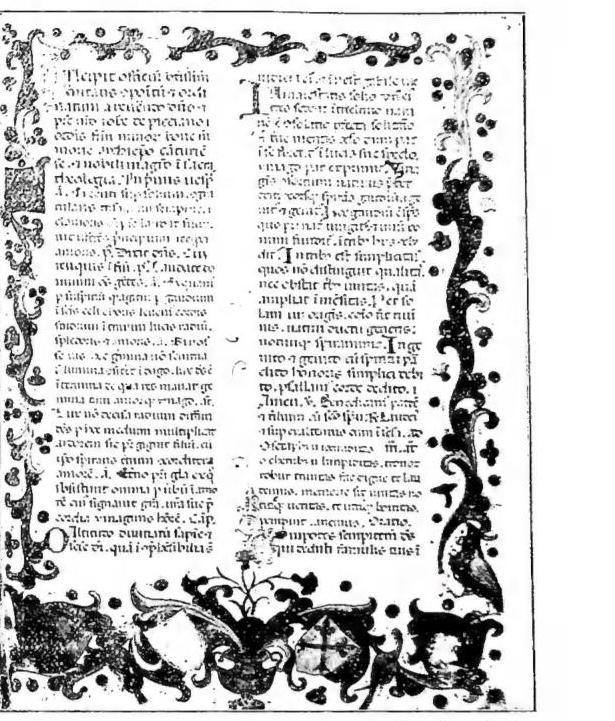
2. Diffusione della festa
Con il sec. X la festa della T., la cui istituzione era già stata sollecitata invano nel 775 ca. da Catulfo a Carlomagno (Epp. Kar. Aevi, cit., II, p. 505), andò lentamente affermandosi: venne infatti introdotta a Liegi, alla data tradizionale, dal vescovo Stefano (903-20), che la dotò di uno splendido ufficio (testo e melodia) che figura tuttora, con qualche ritocco, nel Breviario romano (cf. Auda, cit. in bibl., pp. 67-121); a Reichenau ca. il 1030; a Cluny prima del 1091; a Canterbury da s. Tommaso Becket nel 1162; a Citeaux nel 1175; tra i Certosini ca. il 1222; tra i Domenicani ca. la metà del sec. XIII; tra i Francescani nel 1260 (Capitolo di Narbona), ma nel Capitolo di Assisi del 1279 tale solennità venne soppressa perché non celebrata dalla Chiesa romana (Le Carrou, cit. in bibl., pp. 194-95). Il Sinodo di Arles del 1263 ne prescrisse la celebrazione alla 1ª domenica dopo Pentecoste con ottava (Hefele-Leclercq, VI, II, p. 115), ottava del resto già in uso presso altre Chiese, come in(fot. Büdarchio d. Ö. Nationalbibliothek)
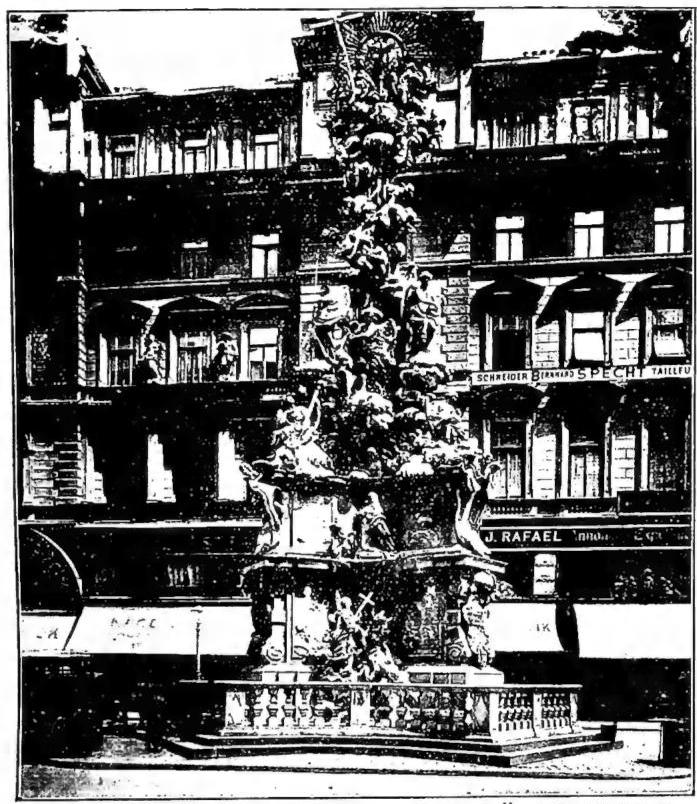
TRINITÀ, SANTISSIMA - Colonna votiva in onore della S.ma T. e dei nove
cori angelici per la cessazione della peste del 1679, eseguita tra il 1682 e
il 1694 - Vienna, « Graben ».
è raro trovare nei Breviari manoscritti, accanto all'Ufficio
della T., la postilla « a sede apostolica repellitur ». Infatti
secondo il Micrologus, 60 (PL 151, 1020) Alessandro II
(1061-73) non si dimostrò favorevole alla festa della T.
perché superflua « cum in omni dominica, imo quotidie
utriusque [trinitatis et unitatis] memoria celebretur » (le
Decretales Gregorii IX, II, IX de feriis : ed. Ae. Friedberg,
Lipsia 1881, p. 271 [Jaffé-Wattenbach, 14109] attribuiscono invece questo atteggiamento negativo a Alessandro III). Questo contrasto circa l'opportunità della festa
della T. si rispecchia anche nei liturgisti dei secc. XI-XIII :
ad es., il Micrologus, 60 (PL 151, 1019-20) non le è favorevole, Ruperto di Deutz (De divinis officiis, XI, 1 : PL 170,
293-95) ne è invece entusiasta, mentre Sicardo di Cremona
(Mitrale, VIII, 1 : PL 213, 385-89) non ne è contrario,
ma dice che è meglio celebrare l'Ufficio della Domenica.
Nonostante l'opposizione di Roma, la festa della S.ma T.
andò ognor più diffondendosi, tanto che Giovanni XXII
nel 1331 credette opportuno di estenderla a tutta la Chiesa.
« Scito autem - scrive un anonimo del sec. XIV - quod
anno Domini 1331, dominus Johannes XXII, de consilio
fratrum suorum, ordinavit et statuit quod deinceps Romana
et universalis Ecclesia faceret festum solemnpissimum de
semper benedictam Trinitate divinarum personarum et divine essentie unitate in tribus divinis personis. Statut
autem quod Romana Ecclesia et omnes qui faciunt officium ecclesiasticum secundum eam faciant predictum
festum dominica prima post Penthecostem et sine octavis,
non improbans tamen eos qui cum octavis et aliqua alia
dominica anni festum celebrant antedictum » (St. Baluzius, Vitae Paparum Avenionensium, ed. G. Mollat,
II, Parigi 1928, p. 294). Una nota poi inserita in un
Breviario Romano della 1ª metà del sec. XIV attribuisce
l'Ufficio che si cominciò « cantari in curia Romana tem-
pore domini Iohannis pape XXII, alio
officio antiquo praetermisso » a Giovanni
Pecham (Leroquais, Bréviaires, III, p. 136).
L'ufficio ritmico composto dal Pecham, di
cui si ha ora l'edizione critica (cf. W. Lampen, Jean Pecham O. F. M. et son Office
de la Ste Trinité, in La France Franciscaine, 2ª serie, 11 [1928], pp. 211-29) fu accolto difatti in molti breviari sino a s. Pio
V che introdusse nuovamente nel suo Breviario riformato (1568) lo splendido Ufficio
composto da Stefano di Liegi, ritoccandolo qua e là. Da notare che l'omelia inserita allora nel III Notturno, già attribuita a s. Gregorio di Nazianzo da s. Agostino, deve appartenere invece a Gregorio
di Elvira (cf. G. Morin, Etudes, textes et
découvertes, Maredsous-Parigi 1913, p. 492).
Il magnifico Prefazio, che si recita non solo
il giorno della T., ma in tutte le domeniche dopo Pentecoste, durante l'Avvento
e dopo l'Epifania figura già alla domenica
« Octavorum Pentecostem » nel Sacramentario gelasiano antico (ed. H. A. Wilson,
Oxford 1894, p. 129), nei Gelasiani del sec.
VIII (cf. P. De Puniet, Le sacramentaire romain de Gellone, Roma [1938], pp. 102-103) e parte nella inlatio della IVª messa
quotidiana del Lib. movarabicus Sacramentorum, cod. 55, 3 di Toledo del sec. IX
(ed. M. Férotin, Parigi 1912, coll. 519-20).
Il Micrologus, 60 (PL 151, 1020) asserisce
poi che questo Prefazio è uno dei nove prefazi prescritti da Pelagio II (579-90).
moyen âge, Città del Vaticano 1934-41 (v. indice, IV, p. 421: benedix.
episc). Cf. inoltre Giovanni d'Avranches, in PL 147, 58 (per il grado
del rito); Radulfo de Rivo, ed. K. Mohlberg, II, Münster in V,
1915, pp. 30, 104, 117, 146 (per data della festa e ottava); Missale
Romanum, Mediolani 1474, ed. R. Lippe (H. Bradshaw Society,
17, 33), I, Londra 1899, pp. 252-54, 450-51; II, ivi 1907, pp. 140,
274; P. Bruylants, Lesorations du Missel romain, I, Lovanio 1952,
pp. 55, 179. - Studi : S. Bäumer, Hist. du Bréviaire, II, Parigi
1905, pp. 60-61 e passim; K. A. H. Kellner, L'anno eccles., 2ª ed.,
Roma 1914, pp. 110-12; A. Auda, L'école music. Liégeoise au Xe siècle. Etienne de Liège (Mém. de l'Acad. R. de Belgique, classe des Beaux
arts, in-8, 11), Bruxelles 1923; F. Cabrol, Les écrits liturg. d'Alcui,
in Rev. hist. eccl., 19 (1923), pp. 507-21; A. Le Carrou, Le Bréviaire
romain et les frères mineurs au XIIIe siècle, Parigi 1928; F. Cabrol, Le
culte de la Trinité dans la lit. et l'institution de la fête de la Trinité, in
Ephem. lit., 45 (1931), pp. 270-78; G. Ellard, Alcuin and some favored votive Masses, in Theological Studies, 1 (1940), pp. 37-61; O.
Heiming, Die mailänd. sieben Votivmessen für die einzelnen Tage der
Woche u. d. Lib. sacr. des sol. Albain, in Miss. L. C. Mohlberg, II, Roma 1949, pp. 317-39; P. Browe, Zur Gesch. des Dreifaltigheidsfestes,
in Archiv. f. Liturgieviss., 1 (1950), pp. 65-81. A. Pietro Frutaz
VII. ART
It appears that early Christian art did not represent the Most Holy Trinity; in any case, no work depicting it has come down to us. The figurative concept of the three Divine Persons was initially strictly symbolic. The hand seen emerging from Heaven indicated the Eternal One, the Lamb the Redeemer, and the dove the Holy Spirit. In this manner, Paulinus of Nola described the image of the Most Holy Trinity in the basilica of St. Felix (Ep. 32, 10: ed. G. Hartel, I, p. 286):« Stat Christus agno, vox Patris cælo tonat
Et per columbam Spiritus Sanctus fuit ».
From the 10th century onward, the practice emerged of representing the three Divine Persons in the form of three identical human figures seated side by side. Each, however, bore its own attributes: the Eternal Father, seated in the center, wore a crown on his head and held a golden apple in his hand; the Divine Son, seated at his right, bore a Cross or displayed wounds in his hands and feet; and the Holy Spirit was indicated either by a dove or by a book. To emphasize the unity of the three Divine Persons, they were sometimes covered by a single mantle. This iconography persisted until the early 16th century. A typical representation of this can still be seen in the parish church of Merano.
From the 13th century onward, another figurative scheme of the Most Holy Trinity appeared: a single human figure with a three-faced head, or just such a head. The Most Holy Trinity was represented in this way, for example, by Donatello (1495) in the tabernacle of St. Thomas in Orsanmichele (Florence, V. fig. at the entry TOMMASO, APOSTOLO), by the Master of Villa d'Utta at the end of the 15th century (Novacella), and by Andrea del Sarto around 1520 in the frieze of his Cenacolo at San Salvi in Florence. This seems to be the last example of such a depiction. It must be noted, however, that the vultus trifrons is not always the emblem of the Trinity but is also that of the devil.
These two figurative schemes of the Most Holy Trinity were abandoned during the 16th century and subsequently expressly prohibited by the constitution of Benedict XIV of October 1, 1745. Meanwhile, a third iconographic scheme of the Most Holy Trinity developed in Gothic painting. This depicts Christ on the Cross, supported in the arms of the Eternal Father; the Holy Spirit is represented by its symbol, the dove (v.), seen above the Cross of the Redeemer. Numerous examples follow this scheme. Among them, very typical are those by masters of the Orcagnesque circle: in the 14th-century triptych by Jacopo di Cione in the National Gallery of London, in another triptych from the Accademia in Florence, and in a panel from the early 15th century by Mariotto di Nardo, which adorns the Pieve of San Giovanni Valdarno. The same scheme is used in the grand adoration of the Most Holy Trinity, called the All Saints' Picture, by Albrecht Dürer (1508, Vienna Museum). Guido Reni still employed it in his large altarpiece, painted in 1624, for the church of the Most Holy Trinity of the Pilgrims in Rome. From this manner of depicting the Most Holy Trinity derives a painting by Guercino in the Vatican Pinacoteca.
Meanwhile, a final scheme took shape in Baroque art, namely a horizontal arrangement; it became the usual figurative representation of the Most Holy Trinity in modern art. This most recent iconography consists of the representation of the Eternal Father and Christ seated on clouds, with the dove of the Holy Spirit rising between them. The representations of the Trinity by Raphael, that is, his early fresco in the church of San Severo in Perugia and the one with the grand Disputa del Sacramento painted in the Stanza della Segnatura in the Vatican, foreshadow this last scheme and represent a kind of transitional bridge between the vertical figurative formula with Christ on the Cross and the modern horizontal one. Indeed, even if a vertical arrangement of the three Divine Persons remains, Christ is no longer presented on the Cross but seated on clouds. Among the very numerous Baroque representations of the Most Holy Trinity, conceived according to the last horizontal figurative scheme, one may cite: the altarpiece by Pietro da Cortona on the altar of the Chapel of the Most Holy Sacrament in St. Peter’s in the Vatican, and the grand canvas by Anthony Van Dyck in the Museum of Budapest.
It should also be noted that the Coronations of the Virgin, where Mary is introduced into Heaven by the Most Holy Trinity, often provide beautiful depictions of the latter, as is the case, for example, with the magnificent painting by El Greco, preserved in the Hospital de la Caridad in Illescas, Spain.
In the countries of the former Austro-Hungarian Empire, churches and columns dedicated to the Trinity are frequently found. - Vedi tav. LIV.