
TRASFIGURAZIONE (gr. μεταμόρφωσις). -
I. THE EVENT
The miraculous apparition of JesusChrist, toward the end of his preaching, to his three
favorite disciples, Peter, James, and John, in
glorious form.
The event is described in considerable detail by the Synoptic Gospels, each of which displays its own characteristics, while agreeing on the substance of the event. The three Apostles were struck not only by the splendor of Jesus’ garments, but also by the presence of Elijah and Moses, whom they heard speaking, and by the mysterious voice that, through a cloud, uttered the words: “This is my beloved Son (Mt. adds ‘in whom I am well pleased’), listen to him.” Coming down from the mountain, Jesus required the Apostles to keep silent about what they had seen and heard. Lc. 9, 28-36 limits its account to this; whereas Mt. 17, 1-13, together with Mc. 9, 1-12, adds the question raised by the disciples concerning the second coming of Elijah. Jesus explains that the mission of this prophet has already been carried out by John the Baptist.
The event of the T. is also recalled in II Pt. 1, 16-18, where it is affirmed that the three Apostles were able to contemplate “the majestic manifestation” (μεγαλειότης) and that they heard the words of the heavenly Father. From the Pauline antithesis (Psal. 2, 6) between the “form of God” (μορφὴ τοῦ Θεοῦ) and the “form of a slave” (μορφὴ τοῦ Βούλου), and from the various statements of the Evangelists, it must be concluded that the presence of a divine nature emerged from the whole event. The phenomenon is described in relation to the impression produced upon the Apostles. It is by no means necessary to suppose that the human nature had ceased to be present (cf. Giovanni Damasceno, Ham. in Transfig. Domini, 12: PG 96, 564; s. Tommaso, Sum. Theol., 3ᵃ, q. 45, a. 2). Through the T., Jesus confirmed Peter’s confession, strengthened the Apostles, to whom shortly before he had foretold his passion and death, and showed his own superiority and that of the Gospel over the most renowned figures of antiquity and over the Mosaic law. He manifested his divinity, while the words of the Father affirmed his eternal, real, transcendent sonship.
All exegetes prior to biblical rationalism admit the authenticity of the account and the objective reality of the miracle. Those who do not believe in the supernatural offer a “naturalistic” explanation (Paulus, Spitta, Schleiermacher), attributing perhaps a major role to the Apostles’ illusion (Neander, Gratz, Bleek, Weizsäcker, B. Weiss, A. Reville, A. Harnack, Ed. Meyer), or else resorting to a “myth,” attributable to Jewish (Strauss, De Wette, Reisenfeld), Greek (Lohmeyer, W. Bousset), or Indian influences (Seydel, Van den Bergh van Eysinga).
II. THE LOCATION OF THE T
The location of the mystery of the T. is indicated by the Synoptic evangelists as being on «a mountain» (Lk. 9:28), «high» (Mt. 17:1; Mk. 9:1), and called by St. Peter, an eyewitness, «holy» (II Pt. 1:18), without specifying either its name or its topographical position. Eusebius, who collected the local traditions of Palestine, showed himself uncertain about the site of the T. In explaining Ps. 88:13, «Thabor and Hermon shall rejoice...» (PG 13, 1092), he writes: «I think that on these mountains the extraordinary T. of our Saviour took place»; in the Onomasticon, when describing the two mountains, he makes no allusion to II. A tradition of the fourth century (the text of Selecta in Psalmus attributed to Origen, which affirms the T. on Mount Thabor, does not seem authentic: cf. R. Devreesse, in DBs, I, cols. 1120–22), uninterrupted to the present day, recognizes Thabor as «the holy mountain of the T.».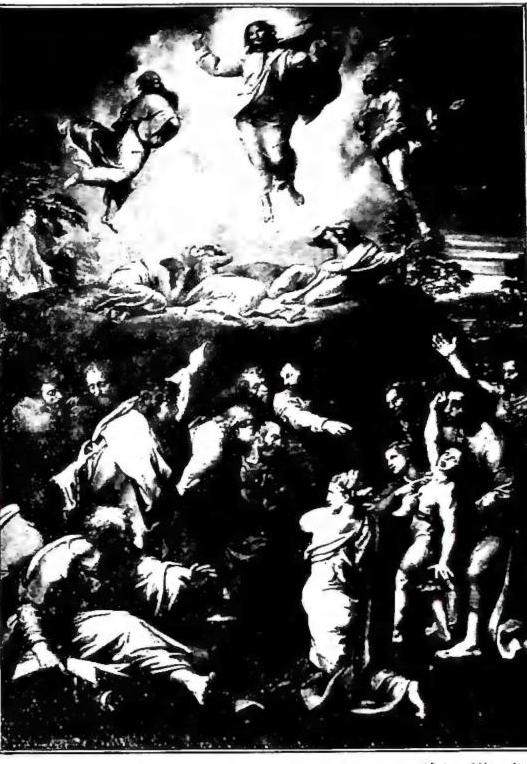
(Ist. Alinari)
TRASFIGURAZIONE — The T., painted by Raffaello (1517–20). Rome, Pinacoteca Vaticana.
and because the snow covering its summit offers an analogy with the whiteness of the garments of the Transfigured One. But in favor of Thabor it is observed that “the journey of a week” would be too long for reaching Hermon, whereas it would be sufficient to travel from Caesarea Philippi to Thabor; that, having descended from the mountain, Jesus found a crowd of Jews around the epileptic whom the disciples had been unable to heal; but at the foot of Hermon he would have found only pagans. Thabor (v.), 588 m. high and isolated on the broad plain of Esdraelon, appears as a high mountain. It is also objected that, since its summit was occupied by a fortress, it was not an isolated place; but the fortress was put in a state of defense by Flavius Josephus, at the time of the Jewish revolt against Rome in 67 B.C. (Bell. Iud., I, 8).
The history of the mountain from the 4th century onward is intertwined with that of the Sanctuary, erected in memory of the mystery. The anonymous pilgrim from Piacenza (570) found there three basilicas commemorating the three tents mentioned by St. Peter, and Arculf (670) noted there a great number of monks (“monachorum inest grande monasterium et plurimae eorundem cellulae”). In 808 the Commemoratorium de casis Dei speaks of the bishopric of Thabor with 18 monks serving 4 churches. In 1100 a community of Benedictines settled there, and Tancred, prince of Galilee, endowed it with substantial revenues. In 1113, 72 Benedictines were massacred there by the Turks, but a new community repopulated the ruins, rebuilding and fortifying the monastery and completing the work on the church. In 1183 the community held out against Saladin, while the Greek convent was stripped and plundered; but after the Crusader defeat at Hattin (1187), the Benedictines too had to abandon II.
The sultan al-Malik al-ʿAdil had a fortress rebuilt there, completed in 1212 and demolished by his order in 1218. Transferred by Alexander IV in 1255 to the Hospitaller Order, the church and religious buildings were ruined by Bajbars’s campaign in 1263. The site, which remained abandoned for more than four centuries, was visited by pilgrims accompanied by the Franciscans of Nazareth; it was purchased by them in 1631. Only in 1924, above the ruins of the ancient churches, rebuilt on the same site, did the Custody of the Holy Land cause the magnificent Basilica to rise again (architect A. Barluzzi).
III. THE LITURGICAL FEAST OF THE T
The feast of the T. is celebrated today in the Latin Church on 6 August, with a double rite of the second class. The Mass has an Oremus of magnificent composition; the Office has a proper psalmody and is of a very solemn character.The pericope of Matthew (17:1-8), the only one to have entered liturgical use, is also read on the Saturday of the Lenten Ember Days and on the following Sunday. It is erroneous, or at least highly misleading, to speak of a “feast” of the T. celebrated by the Roman Church in Lent in the fifth century, which was later transferred outside the Lenten season: this concerns the reading of one of the many Lenten pericopes for a purely doctrinal purpose, within the framework of Lenten instruction, which focuses on the idea of redemption as the passage from the state of sin to that of grace, through participation in the Passion and Death of Christ. The episode of the T., which reveals the final state of glory of Christ and, with him, of the elect, is connected by the Lord himself with his Passion, in the words that conclude the episode. The sermon of St. Leo the Great, delivered on this Saturday (the Sunday Mass is later; in his time it was still aliturgical; or rather, the concluding Mass of the Saturday vigil already fell on the same Sunday), is not a festal sermon, but one of the series of Lenten sermons, perhaps more solemn and longer because it was delivered during the Ember vigil (Serm., 51: PL. 54, 308-13). The sermons of the Greek Fathers generally form part of the continuous exposition of the Gospel, as does the celebrated sermon of St. John Chrysostom, Hom. 75 in Matth. (PG 57, 549 ff.).
In the East, however, apart from and outside Lent, the T. soon appears as the object of a genuine liturgical feast. The Armenians trace this feast (celebrated on the seventh Sunday after Pentecost) directly to their “Illuminator,” St. Gregory (fourth century), who is said to have replaced the popular feast of Venus, “Rosa flamma,” with that of the glorified Lord; this, at least, is what the tradition preserved by Gregory Arbauni (c. 690) maintains in the seventh century. Shortly afterward (fifth-sixth centuries), the Nestorians of the Sassanid kingdom celebrated it as the “feast of tabernacles.” In Ethiopia it appears at the same time, on 13 August.
To find, in all probability, the reason for the more usual date, 6 August, we must return to Mount Thabor itself, which was very early regarded as the place of the T. (Origen). Although the report that St. Helena founded a church (oratory) on that mountain does not seem to be established, an oratory, if not a basilica, nevertheless existed on the summit of Thabor as early as the fourth century; the bishopric established there in 553 by the Fifth Council of Constantinople contributed to the formation of a group of churches, oratories, and monasteries, as the Piacenzian Anonymous saw it in 570.
Now, the date of 6 August could be explained as the date of the consecration of the episcopal church and of its anniversary. In any case, traces of a feast of the T. also appear very early in the West, though with dates that are not always certain. In Visigothic Spain the feast was celebrated on 6 August, as St. Isidore assures us (indeed, three Masses were celebrated, as at Christmas). In the versified Martyrology of Wandalbert of Prüm, written in 847, the feast is found on the same date. Various calendars of St. Gall, Tegernsee, and Cologne from the eighth to the eleventh centuries place the feast on 27 July, 5, 6, or 8 August; the autograph Calendar of St. Willibrord (702-706) places it on 27 July. During the Middle Ages the T. was solemnized in various places and on different dates; at the end of the Middle Ages, to give a few examples, in Meissen the feast was celebrated on 17 March (it had remained in the vicin-
ity of the Ember Saturday!); on 26 July at St-Omer, Bruges, Sion (Sitten), and in the ancient Irish Calendar of Aengus (ninth century); on 27 July, for example, at Cambrai, Paris, and Amiens; on 4 August at Lebus, in the diocese of Poanan; on 5 August at Worms, Liège, and Five Churches (Hungary); on 26 August at Passau; on 3 September at Halberstadt, etc.
The feast of the T., therefore, especially toward the end of the Middle Ages, was no longer unknown; but its official extension to the entire Church and the unification of its date are connected with the pontificate of Callistus III, the Catalan Pope who devoted himself so energetically to the struggle against the Turks. The news of the victory of the Christian forces at Belgrade (21 and 22 July 1456), which reached him on 6 August, provided the occasion for raising the feast of the T. to the rite of duplex and imposing it upon the entire Church. Callistus did so with the bull Inter divinae dispositionis arcona, dated 6 August 1457 (Bull. Rom., ed. Cocquelin, III, 3, Rome 1743, pp. 85-88), and through a series of briefs to the princes gave greater prominence to this liturgical imposition. The date of 6 August was chosen because it was already in use as the principal date of the feast and because of the coincidence mentioned above with the date of the bull. Callistus III had a new office composed by the Dominican Giacomo Gil, which was, however, partly (lessons and hymns) changed by Pius V. Clement VIII gave the feast the rite of dupl. maius, which he had introduced; Pius X, in the reform of 1911-13, raised the feast to its present rite, especially because it was the titular feast of the Lateran Basilica, head and mother of all the churches of the world. Indeed, the T. is repeated as the titular feast of all churches dedicated to the Savior without any particular additional title.
Among the various liturgical-popular customs, it is worth noting that in certain places on this feast it was customary to press the first bunch of red grapes, mixing their juice with the wine of the Mass, in memory of the light emanating from the Lord’s glorified body at the T.
Giuseppe Löw
IV. ARCHEOLOGIA
S. Agostino insegna che nella T. Gesù Cristo significa il Vangelo che riceve la sua testimonianza dalla legge rappresentata da Mosè e dai Profeti, raffigurati da Elia (Tractatus XVII in Evangelium Iohannis: PL. 35, 1529). Nel ciclo della Basilica Ambrosiana a Milano si trovava rappresentata la T. accompagnata dal distico: «Maiestate Sua rutilana sapientia vibrat discipulisque Ducem si possint cernere monstrat» (G. B. De Rossi, Inscr. christ., II, Roma 1888, p. 242; S. Merle, Die Ambrosianischen Tituli, in Römische Quartalschrift, 10 [1896], p. 214). La scena si trova raffigurata anche in avori, dalla cassetta della Lipsanoteca di Brescia, ad un avorio già Barberini, ad un altro del British Museum. A Ravenna nel musaico absidale di S. Apollinare in Classe in luogo del Redentore è la croce gemmata tra Mosè ed Elia; in basso tre Apostoli sono simboleggiati da tre agnelli. R. Garrucci riconosce la rappresentazione in una miniatura dell'Evangelario di Rabbàlà dell'anno 586 (Storia dell'arte crist., Prato 1873-81, tav. 133, 1). Nel musaico sull'arco trionfale dei SS. Nereo e Achilleo (795-816) Gesù Cristo in una mandorla a fondo azzurro in tunica, pallio, nimbo crucigero, destra in gesto oratorio, sinistra con rotolo; a destra e a sinistra più piccoli Elia vecchio, Mosè giovane, prostrati e nimbati i tre Apostoli. Di poco posteriore è la scena nella cappella di S. Zenone in S. Frassede (817-24). In Milano la scena della T. fu rappresentata nell'altare di Volvinio in S. Ambrogio (824-59) secondo il tipo bizantino. Nel manoscritto greco delle omelie di S. Gregorio di Nazianzo, al sermone ottavo, fol. 75, Gesù è sul monte con nimbo aureo, tunica azzurra listata di porpora, fa il gesto oratorio con la destra, mentre con la sinistra stringe il volume; a destra è Mosè giovane, imberbe, a sinistra Elia anziano barbato. La scena è indicata dall'iscrizione in lettere unciali: Ἡ ἁγία μεταμόρφωσις. Ai piedi del monte e di due palme sonoPietro, Giovanni e Giacomo. Alla miniatura è ispirata la scena nel calendario musivo del Tesoro di S. Giovanni in Firenze (sec. x), come pure nella miniatura del sec. x del cod. Greco 1156 della Biblioteca Vaticana e in un musaico portatile del Musco del Louvre a Parigi. Dello stesso tipo è la rappresentazione nella cappella di S. Caterina al monte Sinai e in un evangelario di Iviron al monte Athos.
V. ARTE
Apparently, the mandorla depicted in the mosaic of SS. Nereo and Achilleo is the oldest known to date, and the use subsequently made of it in sacred representations, down to the 16th century, should be considered to derive from the iconography of the T. and also of Christ’s Ascension.The iconographic scheme of the T. in the so-called dalmatic of Charlemagne, a very fine Oriental embroidery dating from the end of the 13th century, in the Treasury of the Vatican Basilica (reproduced under the entry BIZANTINA ARTE), does not substantially differ from that of the manuscript of the homilies of St. Gregorio di Nazianzo. Christ is seen in the upper part of the scene, flanked at some distance by the two prophets, shown in profile, while below are three Apostles dazzled by the divine radiance. This iconographic arrangement was subsequently established in all representations of the T. of Christ. Among these, as a typical example of fourteenth-century art, one may recall a panel painted by Taddeo Gaddi, in the Accademia in Florence, and, for the art of the first half of the fifteenth century, a bronze panel by Lorenzo Ghiberti, on the first door of the Florentine Baptistery. Beato Angelico frescoed, in a cell of the convent of S. Marco in Florence, a T. in which Christ is presented with ingenious simplicity; the figures of the two prophets, as well as those of the Virgin and St. Domenico, who here witness the Holy Mystery, are merely indicated at the sides. Angelico’s model was imitated some years later by Alessio Baldovinetti, in the painted shutters made for the cabinet of the Santissima Annunziata, now in the Museo di S. Marco in Florence. At the threshold of the sixteenth century, Giovanni Bellini painted the beautiful T. in the Museo nazionale of Naples, while Perugino frescoed the representation on the walls of the Collegio del Cambio in Perugia, following the traditional iconographic scheme more rigorously. The most famous representation of Christ’s T. is that by Raffaello, in the Pinacoteca Vaticana. This grandiose work, left unfinished at the master’s death and completed in its lower part by Giulio Romano and Giovanni Penni, appears, in its representation of the people witnessing the divine mystery, to constitute a free iconographic innovation, certainly attributable to the genius of the Urbinate. In a notable panel in the church of the Virgin Mary in Bruges, in the early years of the sixteenth century, the Flemish master Gerard David painted a T. of Christ in which the traditional iconographic scheme was supplemented by the blessing figure of God the Father, placed above among the clouds, over the radiant figure of Christ. — Vedi tav. XLV.