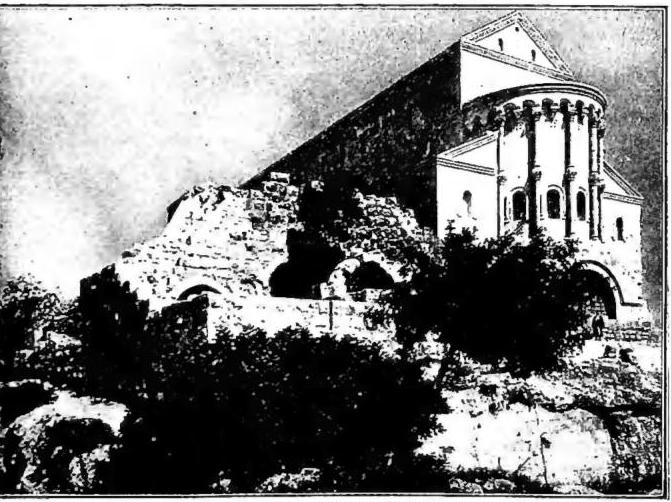
THABOR (Gr. Θαβώρ or τὸ Ἰταβόριον, Arabic Çebel et-Tôr). - Mountain of Palestine, about 7 km south-
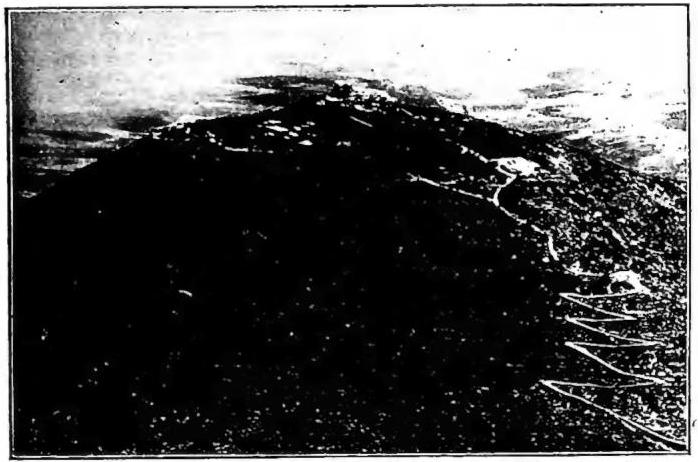
Isolated by two watercourses that form the Wādī el-Bīreh, a tributary of the Giordano, it appears from afar like a solitary sentinel, and dominates the main southern approach to Galilea. Its flanks are covered with holm oaks, carob trees, and terebinths; on the summit, crowned by an esplanade 1200 m long and 400 wide, the woodland thicket is denser and thicker. Giacobbe alludes to T. in his blessing upon Issacar and Zabulon as a gathering place of peoples to offer sacrifices there (Deut. 33, 19); not included within the borders of any tribe (Ios. 19, 22), it was sacred to all those of the north. There Debora summoned Barac of Cades with his army formed of people from the tribes of Nephthali and Zabulon, to fight the enemy who dominated the plain. The Israelites rushed down from the mountain upon Sisara's army, defeated it, and pursued it along the river Cison (Nahr el-Muqatta'), winning a complete victory (Iudc. 4,5).
Because of its characteristic profile, it always aroused religious admiration; in Ps. 88, 12 it is paired with Hermon to sing the praises of God; and in Ier. 46, 18 the greatness of victorious Nabuchodonosor is compared to T. and Carmelo. The veneration of T., perhaps revived by the priests of Ephraim, is stigmatized as schismatic by the prophet Osea (5,1), «a snare spread upon the mountain to draw the ignorant into it». In 218 B.C. Antioco III, having seized Filoteria south of the Lake of Tiberiade, took possession of T., which he fortified (Polibio, V, 70). Later, at the time of the Jewish revolt, T. was fortified again by Flavio Giuseppe (Vita, 37; Bell. Iud., II, 20,6), but fell in 67 into the hands of Vespasiano. Christian tradition since the 4th century has venerated on T. Trasfigurazione (v.), and since then the history of the mountain has been that of the Sanctuary. Donato Baldi