Machine translation of the 1948–1954 Italian original. The original text is authoritative.
TABARCA. – This is ancient Thabraca in Proconsular Africa, a flourishing commercial port on the Mediterranean. It was a municipium and later a Roman colony under Antoninus Pius.
Christianity is attested by the bishop Vittorio, present at Carthage in 256 (P. Monceaux, Histoire littéraire de l'Afrique chrétienne, I, Paris 1901, p. 4 ff.). Repeated explorations have brought to light the importance of the Christian community. Vittore di Vita reports that in the time of Genseric there were in T. a men’s monastery and a women’s monastery (Historia persecutionis vandalicae, I, 10: PL, 38, 193–95). A single-nave Christian basilica with a deep apse was discovered; on the left there was an octagonal baptistery, with apsidioles on the inside and, in the center, the hexagonal baptismal font (P. Gauckler, Basilique chrétienne de Tunisie, Paris 1913, pl. 16); behind it, an extensive Christian cemetery was found, with an imposing series of tombs decorated with mosaics, including one representing the prophet Jonah resting beneath the pergola. In an apsidal chapel many sealed tombs were discovered, also decorated with mosaics, the most notable of which were transported to the Bardo Museum in Tunis. Mention should be made here of the mosaic representing the interior of a Christian basilica in all its details, and of the inscription «Ecclesia mater Valentia in pace». Particularly noteworthy is the inscription of the deacon Crescentino, which reads:
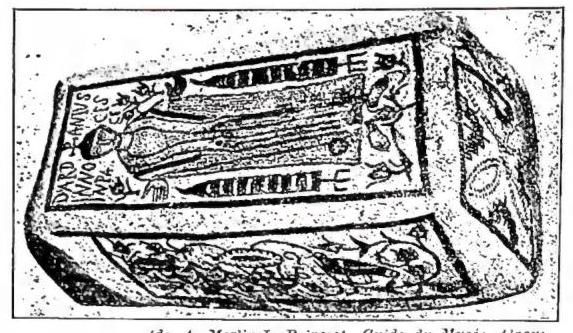
(from A. Merlin-L. Poinsoot, Oseida du Musée Alaoua, Tantii 1896, pl. 28, no. 1)
TABARCA - Christian tomb in the shape of a chest, with a mosaic depicting the deceased woman praying between two candelabra (5th century) - Tabarca.
« Angelorum hospes, Martyrum comes, vitamque spirans placulam ad te sancte profectus sit nostri memor, grata pietate qua solet. Crescentinus diac(onus) in pace red(didit) III die Kal(endarum) aug(ustarum) ». Of the spouses Stercorius and Crescentia it is said that « perpetuitatis coronam acceperunt ». A Victoria is called Dei famula; the following inscription is also noteworthy: « Privata cum Victoria gaude virginitatis et confessionis victricia portantes tropaea veste induta angelica in pace », followed by the acclamation « dignis digna vincentibus corona ». Of a widow Vittorina it is said: « viduitatis et verecundiae preconium castitatis et pietatis exemplum »; of the presbyter Privato it is affirmed that he was « disciplinae custos, pietatis magister »; of a Naucelius this praise is given: « pauperu(m) amator, cultor Dei »; of a Castula it is declared that she « properans kastitatis sumere premia digna, meruit immarcescibilem coronam. Perseverantibus tribuet Deus gratiam ». On a white-marble sarcophagus the Good Shepherd is represented (A. Merlin, Découvertes effectuées en Tunisie, in Bull. arch. du Comité, 1907, p. 274).
BIBL.: L. La Blanchère and P. Gauckler, Catalogue du Musée Alaoui, Paris 1887, pp. 117-20, pl. 7; J. Fontain, Fouilles et explorations à T. et aux environs, in Bull. arch. du Comité, 1892, pp. 193-96; G. Benet, Les fouilles de T. en 1904, ibid., 1905, pp. 378-94; P. Gauckler, Mosaïques tombales d'une chapelle de martyrs à Thabraca, in Fondation E. Piot. Monuments et mémoires, 13 (1906), pp. 175-227; P. Monceaux, Enquête sur l'épigraph. chrét. d'Afrique, Paris 1908, pp. 259-60; P. Gauckler, Inventaire des mosaïques, II, there 1911, pp. 330-37, nos. 940-1056; L. Poinsoot and R. Lantier, L'arch. chrét. en Tunisie (1920-37), in Atti del III Congresso internaz. d'arch. crist., Rome 1934, p. 403 ff. Enrico Josi
Cite this article
“TABARCA.” Enciclopedia Cattolica, vol. XI (1953), p. 1015. Azione Romana digital edition, https://azioneromana.com/article/tabarca.