
GIONA. — Prophet, son of Amathi (Heb. Amitta) of Geth (Gath) of Opher (Hépher) in Galilee; he foretold to Jeroboam II (787–746) his victories (II Reg. 14:25). A Jewish legend says that he was the son of the widow of Sarephta, raised from the dead by Elijah (I Reg. 17:17–24). Unreliable traditions place his tomb at Geth of Opher, or in Assyria near the village Nebî Jûnus, “prophet G.,” on the site of ancient Nineveh.
G. is the hero of the book bearing his name, fifth among the Minor Prophets of the Hebrew and Latin Bibles, and sixth in the Greek. The book contains no discourses, but an episode from the life of G.
Sent by Yahweh to preach penance at Nineveh, capital of the Assyrian Empire and oppressor of Israel, G. refuses and seeks to evade God’s command by embarking at Joppa on a Phoenician ship. A storm breaks out, and the lot indicates G. as the culprit. Thrown into the sea, he is swallowed by a large fish (ch. 1). In its belly G. composes a canticle (a true psalm), and after 3 days he is vomited onto the Palestinian coast (ch. 2). Following a new command, G. brings the message of destruction to Nineveh: in 40 days the capital will be destroyed. The inhabitants do penance, and Yahweh forgives them (ch. 3). This is precisely what G. did not want; he becomes angry and calls for death. Yahweh reproaches him for this feeling of hatred and instructs him concerning his mercy, which wishes even the gentiles to be saved, through the castor-oil plant that grows and then withers on the same day, this time to G.’s great regret (ch. 4).

The author’s purpose is to teach that God wishes the Gentiles also to be saved (4:2). The prophet rebuked by God personifies narrow Jewish particularism. The universalist spirit that animates this little book makes it one of the pearls of Hebrew literature. This teaching, which is its essence, remains intact whether the book is regarded as fully historical or is assigned rather to the didactic genre.
The historicity, commonly defended until the 19th century, seems to be taught by Jesus (Mt. 12:39-41; Lk. 11:29-32), who places the example of the Ninevites alongside that of the certainly historical queen of Sheba (I Kings 10) and compares his own fate with that of G.: he will remain three days in the tomb, as G. did in the fish. The reference in Tob. 14:4 (only in cod. B) is entirely uncertain (R. Galdos, Tobit, Parigi 1930, p. 296; A. Miller, Tobin, Bonn 1940, p. 106). The attempted references to cuneiform texts (J. B. Schaumberger) prove unfounded. On the other hand, G.’s disobedience (cf. Jer. 20:7-9), the canticle in the belly of the fish, and the total and sudden conversion of Nineveh appear improbable. Nineveh is spoken of as a city of the past, with inaccurate references (3:3, 6).
Jesus speaks of G. and the Ninevites for didactic purposes; he makes an illustrative reference that may be derived from a historical event as well as from a partially fictional or legendary account. Thus I Cor. 10:4 and Jude 9 ff. refer to Jewish legends: cf. II Tim. 3:8; Mt. 23:35; Hebr. 7:3, etc. Likewise, the liturgy wishes the soul eternal peace “with Lazarus, once poor.” A set of indications favors the parabolic interpretation, which is increasingly followed by modern exegetes (Lagrange, Van Hoonacker, Tobac, Lesêtre, Holzhey, Gigot, Dennefeld, Chaine, Feuillet, and already St. Gregory Nazianzen and R. Simon).
G.’s literary and theological dependence on Jeremiah is noteworthy: the prophet of the nations was the principal source for the author of G. (cf. 1:14 = Jer. 36:15; 3 = Jer. 36; 3:8 = Jer. 18:11; 23:22; 3:10b = Jer. 18:7 ff.). The verses of the canticle are reminiscences of the Psalter. All this would tend to confirm the narrative’s not strictly historical, but didactic, character.
The style, with Aramaisms and neologisms, places G. among the latest Hebrew writings of the Old Testament. Modern critics, Catholic and Protestant, hesitate regarding the interpretation: whether symbolic (E. König), parabolic, allegorical, or mystical. The date of composition is placed between approximately 500 and 300 B.C.; probably, the book was composed around 300, during the period of the greatest dispersion (v. DIASPORA) and of proselytism. Against the more restrictive tendency that opposed the spread of Yahwism among the Gentiles, there arose a need to affirm the non-exclusiveness of the religion of Yahweh toward the pagans (cf. Is. 56:1-9). The book’s divine authority is attested by Jesus (Mt. 12:39-41; Lk. 11:29-32).
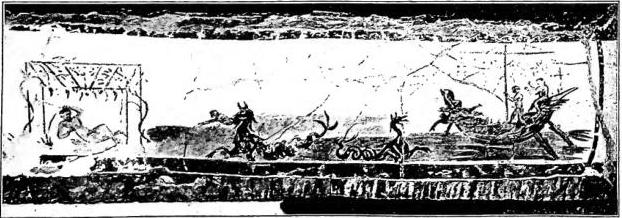
ICONOGRAPHY. - 1. In Christian antiquity. The Divine Master himself taught the symbolic meaning of the episode of the prophet G., saying: «As G. remained three days and three nights in the belly of the sea monster, so also the Son of Man will remain for three days and three nights in the heart of the earth» (Mt. 12:40). G., thrown into the sea and swallowed by the monster, is a symbol of the deceased faithful person laid in the tomb,
GIONA - G. cast into the sea and swallowed by the monster, restored by it and at rest. Fresco (late 2nd–early 3rd century), Rome, cemetery of Callistus.
while the monster represents eternal death, from which the Lord will save the deceased, just as he saved G. This concept is expressed in a pseudo-Cyprianic prayer in which it is said: “just as you, O Lord, heard G. from the belly of the monster, so also hear me and cast me from death into life.”
He was one of the subjects most frequently represented in early Christian funerary art; the cycle is sometimes expressed in four scenes: G. cast from the ship and swallowed by the monster; G. regurgitated onto the shore; G. at rest; G. tormented by the sun after the plant had withered. These four scenes are painted in the cemetery “ad duas lauros.” Generally, however, only the first three are represented; sometimes the ship is omitted; in some cases there is a single scene, or only the prophet’s being regurgitated, as in the so-called cubiculum of the veiled woman in Priscilla, or only G. at rest. The storm produced by the wind is sometimes indicated by its personification; the effect of the storm is also expressed by the sailors’ gestures: one, terrified, covers his face with his hands, while another is praying. As for the kind of plant beneath whose shade the prophet rested, a controversy arose between s. Girolamo and s. Agostino because in the Vulgate version the Hebrew word qīqōfōn was rendered as hedera, whereas in the Septuagint version one finds zōzōzōvōr, that is, cucurbita. In art, cucurbita is always represented, except in a fresco at Priscilla (Wilpert, Pitture, pls. 44, 2). Sometimes the city of Nineveh is also represented in the background, as in cubiculum A of the cemetery of Callistus, on a sarcophagus lid from Arles, and on a graffito slab in the cemetery “ad duas lauros” in Rome. The oldest representations of the cycle of G. are found in Rome: in mosaic in the funerary chamber discovered in 1942 near the confession of S. Pietro in the Vatican; in painting in the cemetery of Callistus (Wilpert, ibid., p. 338, pl. 26, 1); and in sculpture on the Lateran sarcophagus no. 119 (id., Sarcofagi, pls. IX, 3; LIX, 3). Outside Rome, it is found in painting in the cemetery known as that of S. Gennaro in Naples, at Bonaria in Sardinia, and at Cinque Chiese in Hungary. He is also represented in funerary mosaics; in Rome, on terracotta slabs discovered in a cemetery on the Via Latina, now in the Lateran Christian Museum; in Africa, at Tabarca; and on a floor now in the Alauni Museum in Tunis. From Tarso, now in the Metropolitan Museum of New York, comes a sculpture showing G. cast from the ship, swallowed, and restored by the monster. The scene of G. and the monster is also depicted on a marble slab in the Lateran Museum, originating from the cemetery of Praetextatus; and in the inscription of Beratius Nikatoras in the same Museum. It is also found on bronze lamps (R. Garrucci, Storia dell'arte cristiana nei primi otto secoli, VI, Prato 1880, pl. 471, no. 3), and on terracotta lamps from Marseille, Syracuse, Sémur-en-Auxois, Paris, Cologne, and Carthage. On plates (R. Garrucci, ibid., VI, pl. 465, 4 and 5). On bronze medallions from Ponziano, now in the Vatican Museums; on a lead cup; on gold glass, gems, and stuccoes, as at Ravenna in the baptistery of S. Giovanni in Fonte (R. Garrucci, ibid., II [Prato 1876], pl. 132, 1). On the marble rims of basins originating from Salona and preserved in Zagreb, the scene of the monster regurgitating G. appears on a fragment from Athens, on one in the Russian Archaeological Institute in Istanbul, originating from Smyrna, and on another from Laodicea, now in the Tchili-Kiosk Museum, also in Istanbul (E. Michon, Rebords de bassins chrétiens ornés de reliefs, in Revue biblique, new series, 12 [1915], p. 517 ff.). In miniatures, as in the manuscripts of Rabula and Cosmas Indicopleustes, and in the homiliary of s. Gregorio di Nazianzo. In ivories, as in the pyxis formerly belonging to S. Ambrogio in Milan, now in the Hermitage Museum in Leningrad, or in that of the Museum of Bonn; in the lipsanotheca of Brescia; and on the Gospel-book cover of S. Michele di Murano, now in Ravenna.
As a prophet, G. is depicted at Ravenna in S. Martino, “in caelo aureo,” now S. Apollinare Nuovo (R. Garrucci, op. cit., III [Prato 1876], pls. 246–247).
2. In medieval art
Later, medieval painting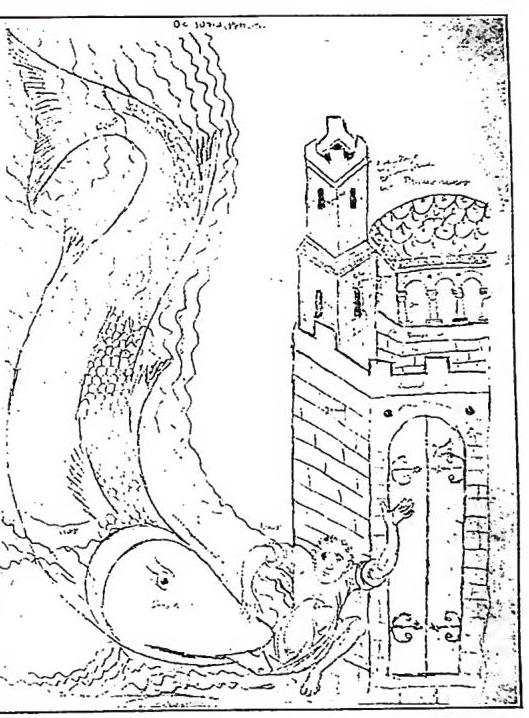
(from Herrada of Landsberg, Hortus deliciarum, Strasbourg 1881, pl. 11) GIONA - G. regurgitated by the fish at the gates of Nineveh. Pencil drawing by Engelhard from a miniature in the Hortus deliciarum (ca. 1230).
artistic level in Michelangelo’s fresco in the Sistine Chapel, Correggio’s other fresco in S. Giovanni Evangelista in Parma, and Lorenzetto’s statue (after a design by Raphael) in S. Maria del Popolo in Rome. The same may be said of the shipwreck scenes painted by Rubens (Nancy, Museum) and Poussin (Windsor Castle).