
CORREGGIO, ANTONIO ALLEGRI, detto il. — Born in Correggio near Reggio Emilia before 30 August 1489, died there on 5 March 1534.
He perhaps began his artistic education in his native town with his uncle Lorenzo Allegri, a mediocre painter, and then, it is believed, went to Modena, to the school of Francesco Bianchi Ferrari (1503–1507). From there he seems certainly to have gone to Mantua, where he drew extensively from Mantegna, whose profound influence persists even in the works of his maturity, while from Costa, who succeeded the Paduan master at the Gonzaga court, he derived the Emilian-Ferrarese element most immediately evident in his beginnings. Leonardesque, insofar as it is understood through radiance of light rather than veils of shadow, is his pictorial manner of conceiving volumes; but atomism, which is ultimately the keystone of his distinctive, unlimited colour—in other words, of his entire art—is his defining characteristic.
His works may be grouped as follows: paintings of his early youth inspired by Mantegna and the Emilian-Ferrarese masters, from the Deposizione in the atrium of S. Andrea in Mantua, and the Madonna col Bambino ed i ss. Francesco e Quirino, a detached fresco now in the Estense Gallery in Modena, to the Sposalizio di s. Caterina in Detroit and the other one in the Kress Collection in New York, where Mantegnesque forms are combined with those of Leonardo, permeated by an infantile and spontaneous grace, up to the altarpiece of S. Francesco in Dresden, his first dated painting, from 1514. Also belonging to this period are the Ginditta in the Strasbourg Gallery, the Madonna col Bambino tra due angolii musicanti e serafini in the Uffizi Gallery, the Presepe notturno and the Adorazione dei Magi at Brera, the Madonna Bolognini in the museum of the Sforza Castle in Milan, the Madonna Malaspina in the picture gallery of Pavia, etc.
The years extending from the execution of the altarpiece of S. Francesco to his first great decoration, the vault of the Abbess’s chamber in the convent of S. Paolo in Parma (1518–19), include a series of works in more cheerful and vivid colours—pink, violet, and light blue—as in the Madonna Campori in the Estense Gallery in Modena, one of the most representative paintings of this period. Here the Emilian masters and Leonardo are joined by a certain knowledge of Raphael, who at precisely this time had sent the altarpiece of S. Cecilia to Bologna. Inspired by it are also the Madonna di Casalmaggiore in the Städel Museum in Frankfurt, that in the art gallery of Orléans, the other in Hampton Court, and the delightful Madonna col Bambino e s. Giovannino in the Prado Museum in Madrid, the true masterpiece of this period.
Whether he had been to Rome and drawn new strength for his art from it, or whether the sudden robustness should be attributed to the natural enhancement of maturity, it is certain that in the convent of S. Paolo in Parma, while executing for the abbess Giovanna Piacenza the decoration of the vault of a small room, he revealed an unsuspected strength through a vivid intensity of colours, in which the golden tonality that would become characteristic of him was beginning to dominate.
From the same period comes the detached fresco of the Madonna della scala in the Parma Gallery, who appears seated in backlighting, radiant with grace and her own light,
rendered in supple harmonies of pink and gold, a warm setting that pervades all the works of his maturity, as can already be seen in two small, delightful paintings in the picture gallery of Naples, the Zingorella and the Sposalizio di s. Caterina, or in the Riposo sulla via dell’Egitto in the Uffizi Gallery, or in the S. Girolamo in the church of S. Fernando in Madrid.
In the decoration of the dome of S. Giovanni Evangelista in Parma (1520–22), he created, through new and extraordinarily daring foreshortenings, effects of infinity. The same grandeur and intensity of expression appear in the S. Giovanni seated with the eagle at his feet, in the lunette near the sacristy, and in the Incoronazione of the apse, of which only the central section remains. This section has been transferred several times together with its masonry support, and only the recent restoration and cleaning have restored it to its original essence, with all its transparent and intact glazes: intense in the expression of the Redeemer, exquisitely sweet in the face of the Assumption, where the Roman and Mantegnesque elements evident throughout the composition seem submerged in the inspired élan of his superb figures.
Among the paintings executed during the decoration of the dome of S. Giovanni or in the years between it and that of the Cathedral, many mark an evident regression, due above all to an accentuation of an expressive sweetness that is rather conventional, even in the poses. Thus in the Noli me tangere in the Prado, the Adorazione del Bambino in the Uffizi, the Cristo nell’orto in London, the Deposizione and the Martirio dei ss. Placido, Flavia, Eutichio e Vittorino in Parma, and the well-known altarpiece of S. Sebastiano in Dresden, where, in order to contemplate the divine vision, S. Sebastiano twists around the trunk to which he is bound, while Gemignano points it out to the viewer.
More closely aligned with the past, although enriched by the opulence of the drawing, are the Sposalizio di s. Caterina in the Louvre and the S. Caterina leggete in the Royal Palace at Hampton Court, spontaneous like the Educazione di Amore in the National Gallery in London, with which the series of profane paintings begins.
But it is in the cupola of Parma Cathedral, executed from 1526 to 1530, that his particular colour is most fully defined, permeating things and figures alike. And this atmosphere, enveloping clouds and figures, is truly a sky of amethyst and rose, suddenly opened to let pass the hymn-singing choir of angels forming a crown around the Assumption, while around the balustrade the funeral rites of the Madonna are celebrated, with Apostles in daring foreshortenings and ephebes bearing smoking torches and pine branches scattering sparks.
Certainly contemporary with the cupola of the Cathedral are the restored fresco lunette with the Annunciazione in the Parma Gallery, the admirable altarpiece of the Madonna del s. Gerolamo in the same gallery, among the C.’s greatest works, and the Madonna della scodella there, which, like that of S. Giorgio in Dresden, likewise reflects the most salient characteristics of the Cathedral cupola, while
in the Sacra Notte, in the same gallery, the early experiments in the treatment of light are brought to a pre-Caravaggesque solution.
Other works of the final period are marked by a more serene and intimate familiarity, such as the Madonna della cesta in the National Gallery in London and the Madonna del latte in Budapest, possessing a divinely human reality like the group of the Amori di Giove: canvases commissioned from him by Federico Gonzaga and left unfinished at the painter’s death. Among them are the Antiopo in the Louvre, whose face is the same as that of the Assumption in Parma Cathedral, but furrowed by pagan sensibility; the Danae in the Borghese Gallery in Rome; the Leda in Berlin; and the Io and the Ganimede rapito dall’aquila in the Vienna Gallery. — Vedi tav. XXXII.
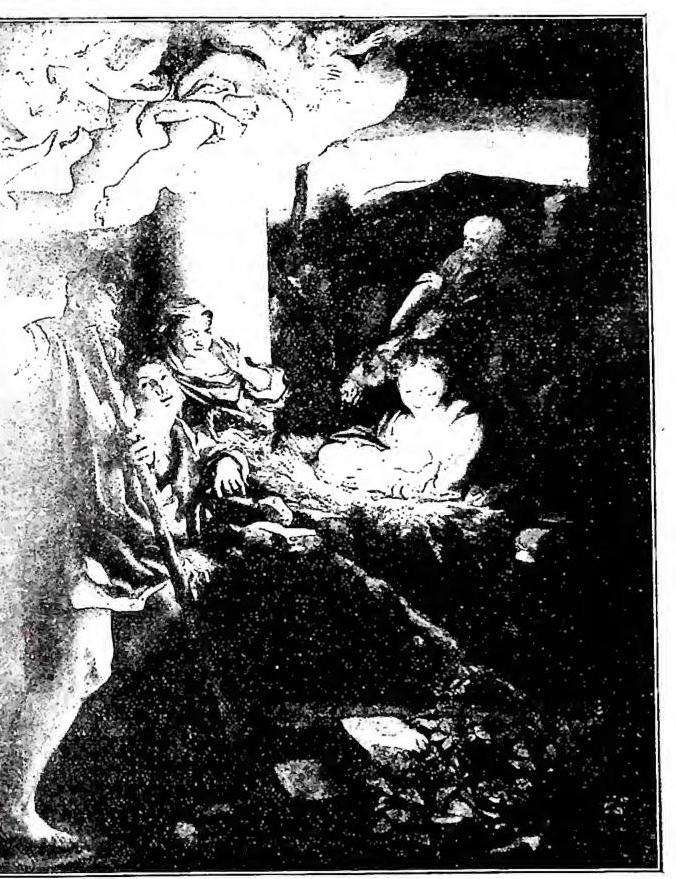
(Int. Alinari) CORREGGIO, ANTONIO ALLEGRI — La Santa Notte — Dresden, picture gallery.
Bibliografia, Rome 1934.