
COSTA, LORENZO. - Painter, b. in Ferrara around 1460, d. in Mantua on May 3, 1535. He was a pupil in his native city of Cosmé Tura, as the St. Sebastian in Dresden would suggest, if it is by him and not by Cosmé. Probably in 1483 he was in Bologna to pa-
The St. Sebastian in the Dresden Gallery, according to Berenson a work by Tura and signed by C., has elements
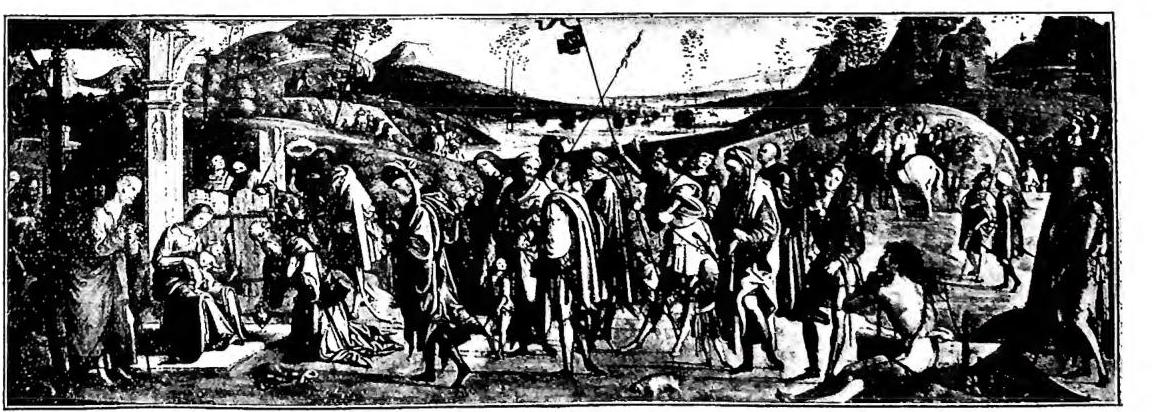
The altarpiece of the Bentivoglio Chapel in S. Giacomo Maggiore in Bologna (1488) also shows echoes of Tura: in the same chapel are the Triumph of Fame and the Triumph of Death. The Madonna Enthroned between Sts. Sebastian, James, Jerome, and George in S. Petronio in Bologna, of 1492, marks a great advance over the inexpressive paintings of the Bentivoglio Chapel; perhaps C. had traveled to Venice, as similarities with Venetian altarpieces indicate. This nobly expressive panel may be considered the master's masterpiece. In the painting in S. Giovanni in Monte, also in Bologna, depicting The Madonna with Four Saints and Two Angels, the influence of Francia is visible instead; the figures take on sinuous forms as in Perugino, of whom some elements are found in the background of pillars receding perspectivally at the sides of the throne. The Coronation of the Virgin, also in S. Giovanni in Monte (1501), likewise has figures inspired by Umbrian models. Also worthy of mention in Bologna, in the Oratory of S. Cecilia, are the frescoes depicting the Conversion of St. Valerian and St. Cecilia Distributing Alms (1504-1506). C. remained essentially an eclectic, wavering between Tura, Ercole Roberti, the Venetians, Perugino, and Francia.