
PERUGINO, PIETRO VANNUCCI detto il. — Painter, born in Città di Castello in 1445. Despite the flourishing of studies concerning this artist, the problem of his training has not yet been clarified, and every solution still remains in the realm of hypotheses; all the more so because youthful works of certain attribution are lacking.
According to Vasari, he would have completed his education under Piero della Francesca at Borgo S. Sepolcro, then moving to Florence where, in 1472, he was enrolled in the painters’ register and was working in Verrocchio’s workshop. But from this period too, apart from the two
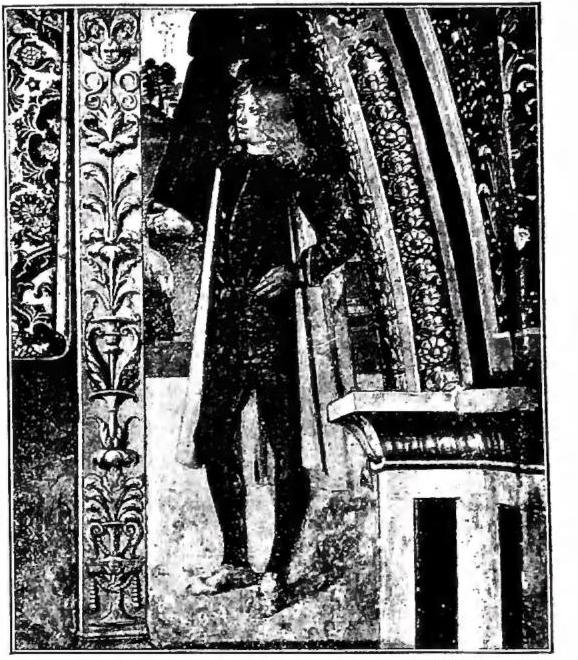
saints in the Oratorio dei Pellegrini at Assisi (1468), there are no works that are secure or securely datable. Recently an attempt has been made to deny him authorship of the Storiette di s. Bernardino (1473) in the Pinacoteca of Perugia. For the Adorazione dei Magi, in the same gallery, the dating fluctuates between about 1470 and 1475, and the S. Cristoforo in the Galleria Borghese Pinturicchio (v.). It is therefore with the S. Sebastiano of Cerqueto (1472) that his exact chronology and the development of his art can be said to begin, on the basis of certain and dated works. With this painting we are still at the Florentine or, better, Pollaiuolesque phase of P., when the plastic force, which detracts nothing from the elegance of the modeling, reveals him as an artist already fully formed and confident in his abilities. Moreover, the list of his earlier Perugian and Florentine works that have been lost — frescoes in the Convent of Porta a Pinti in Florence, the decoration of the Palazzo dei Priori in Perugia, and others — provides good evidence of the fame he had achieved. To these paintings must be added the apse decoration of the old basilica of S. Pietro in Vaticano (1479), destroyed when the church was rebuilt. Already during this first stay in Rome, P. had come into contact with Melozzo da Forlì, whose influence is evident in certain works of the following period; this was a period of ascent for the artist, reaching its climax in the final decade of the century. The works in the Cappella Sistina date from 1481, where he executed the Consegna delle chiavi alone and, in collaboration with Pinturicchio, the Circoncisione dei figli di Noè and the Battesimo di Gesù; from 1488–89 date the Annunciazione di Fano and the Apparizione della Vergine a s. Bernardo in the Museum of Munich, followed by the Albani triptych with the Presepe, the two paintings depicting the Vergine col Bambino in Vienna and at the Uffizi, the Resurrezione di Cristo in the Pinacoteca Vaticana (1495), an Orazione nell'Orto and a Pietà at the Uffizi. In all these works there is a kind of crescendo of those essential elements of his art that culminate in the great Florentine fresco in S. Maria Maddalena de' Pazzi: the solitary, sculptural figure of Christ Crucified, the figures of the Virgin and the Saints, so detached and absorbed in devout contemplation and expressing a sense of mystical religiosity, find their counterpart in the landscape, which opens out deep and luminous, permeated by a serene and tranquil atmo-
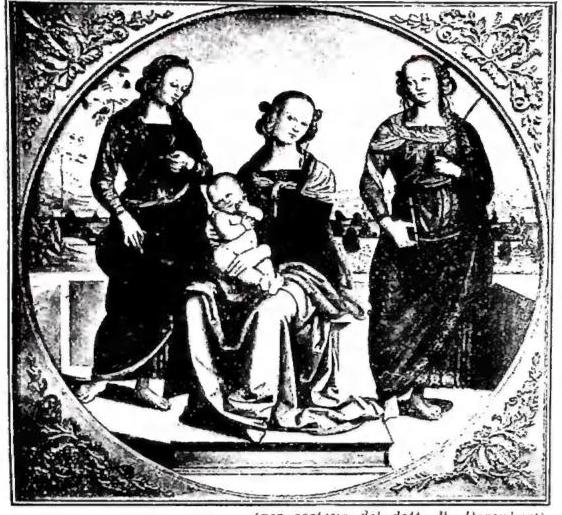
In the colors, the composition, the figures, and the landscape, there is an equilibrium that P. would never again manage to attain, although in the works that followed up to 1500 (Vergine col Figlio in the Pinacoteca of Bologna; triptych for the Certosa di Pavia, now in London; Assunta degli Uffizi; the dismembered ancona for S. Pietro in Perugia) he still appears fully master of his means. But already in what should have been the masterpiece of his maturity, the decoration of the Collegio del Cambio in Perugia, the painter’s decline begins with the repetition of the old formulas, a repetition that would become increasingly tired and superficial: he would continue to work until the end of his life according to the now outdated modes of fifteenth-century painting. This is also attested by the best among his final paintings: an'Adorazione dei Magi at Città della Pieve, a S. Sebastiano at Panicale, a Crocifissione in Siena, an'Adorazione dei pastori at Montefalco, and finally the frescoes at Fontignano, the Vergine col Figlio and the Adorazione dei Magi, interrupted by his death (1523).
Numerous other works are variously attributed to him. His pleasing, elegant, and serene manner won him a large following, who, with the exception of Raffaello, generally remained inferior to the master. He deserves credit, as a great artist especially during the period of his early maturity, for having encouraged the renewal of Umbrian art by nourishing its specific traits with the most recent discoveries of the Florentine Renaissance. — Vedi tav. LXXXII.