
PIERO della FRANCESCA. — Born c. 1416 at Borgo S. Sepolcro, and died there in 1492, the very great artist came into contact with early fifteenth-century Sienese painting (especially that of Sassetta, active in S. Sepolcro), as well as with that of Masaccio, Paolo Uccello, and Domenico Veneziano; but his highly personal nature immediately turned toward an architectural determinant, the ultimate outcome of the Florentine researches of the beginnings of the Renaissance: his natural inclination toward architectural rhythms dictated to him, toward the end of his life, the celebrated treatise De prospectiva pingendi, from which Luca Pacioli derived a large part of his mathematical studies.
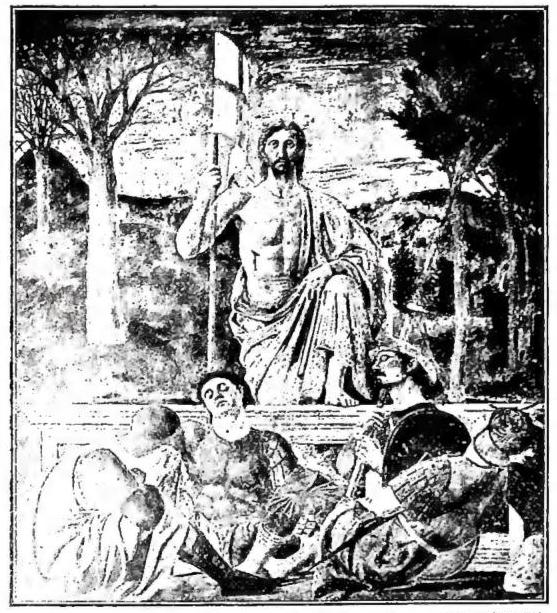
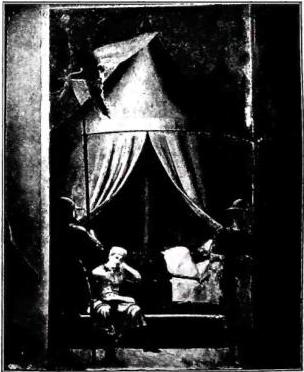
For Federico da Montefeltro and Battista Sforza the painter executed the double portrait now in the Uffizi, on the reverse of which are painted allegorical chariots bearing the virtues of the two illustrious personages. Projected against a clear, cold sky and dominating the landscape seen from above, the two symmetrical profiles surpass, in stylistic elevation, the customary portraits of the early Renaissance and acquire a value of exceptional monumentality. But it is above all in mural painting that the artist achieves extraordinary effectiveness: thus in the Resurrection of Christ at Borgo S. Sepolcro, the symbolic theme of the artist’s birthplace, developed with an unusual breadth of effects and grandeur of compositional manner; thus in the kneeling Sigismondo Pandolfo Malatesta facing s. Sigismondo, in the Malatesta Temple at Rimini; but above all in the cycle of frescoes in the choir of the church of S. Francesco in Arezzo, where he narrated the Stories of the Cross (1453–64). Here the artist laid out his world, transcending the narrative pretext in a solemnity of compositional forms, enlivened by a palette which, while recalling the experiences of Paolo Uccello, brought pictorial abstraction to its fullest development, modelled on the surrounding world, both rustic and courtly. Among the many scenes in the fresco cycle, the following should be remembered: the Meeting of the Queen of Sheba with Solomon, in which, as in the Flagellation of Urbino, architecture establishes the rhythm of the composition; the Finding of the True Cross, with the tests undertaken to recognize the truth of the relic, narrated with rhythmic solemnity against backgrounds of Albertian architecture, which confirm the artist’s architectural activity; and the two Battles of Constantine and Chosroes, in which Paolo Uccello’s heraldic and decorative inspiration gives way to the immobile and grandiose projection of the combatants in a rigorous perspectival arrangement, such as to justify the definition given of his painting as: «perspectival synthesis of form-colour» (Longhi). In the Dream of Constantine, moreover, from the same series of frescoes, the sudden light descending from above causes a plastic intensification of the entire setting, creating, in the open tent where the Emperor sleeps and around the armed guards, a dreamlike atmosphere such as painting had never before attempted: these investigations in fact gave rise to the luminism of Raffaello in the Liberation of s. Peter in the Vatican Stanze, and, later, even to Caravaggesque investigations of constructive light.
Among the works of his mature period, the polyptych of Perugia should be remembered, with the surprising Annunciation in the upper panel, conceived in an entirely new manner, including in relation to the lower part of the painting, and the predella with the Stigmata of s. Francesco, a passage of extraordinary atmospheric suggestiveness. From the same period are the Madonna of Sinigallia, now in the Ducal Palace of Urbino, a perfect plastic construction in an environment whose luminous effects are extremely carefully calibrated and still recall Flemish investigations; and, in the Brera Art Gallery, the large altarpiece with the Madonna and Saints and Federico da Montefeltro, the latter kneeling and dressed in full armour, a painting that summarizes the problems confronted by the great artist and resolves them through a perfect fusion of style between the already Bramantesque architecture of the background and the figurative composition. To P. della F. or to his school are attributed several perspective panels with architectural subjects, of which the one in the Ducal Palace of Urbino is a splendid example. Although these works do not reveal the master’s direct execution, they are a rare testimony to his pictorial problems and also to his architectural aspirations, in the distinctly humanistic conception of an «ideal city» such as, moreover, Leon Battista Alberti himself dreamed of.
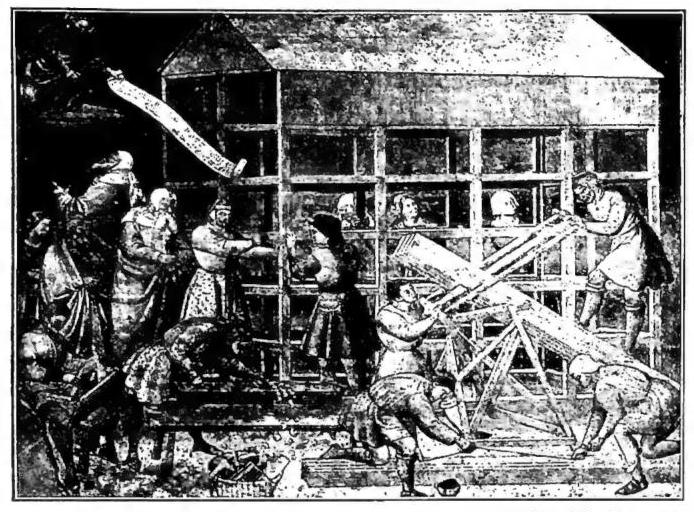
(photograph: Gab. fot. nac.) PIERO DI PUCCIO – Noah presides over the construction of the ark – Pisa, Camposanto.