
MUSEUM and MUSEOLOGY. — The term museum denotes a collection of works of art or of objects from a particular historical period and milieu, or scientific relics, whereas the second term, which is of modern coinage, refers to that special activity devoted to studying the principles governing the establishment of a good museum. The word “museum” derives from the practice, in Alexandria in Egypt during the Hellenistic period, of displaying works of art and relics in premises dedicated for this purpose to the Muses. But the origin of museums may also be traced to the practice of setting aside special spaces in temples and sanctuaries to receive the numerous gifts, often of great artistic value, offered to the divinities worshipped there—spaces that were instead called “treasuries.” A true museum, also intended for the admiration of citizens, was the one established by Attalus I at Pergamum, famous for the works of art gathered there from the various lands he had conquered.
Although the Middle Ages knew the practice of preserving ex-votos and gifts brought by the faithful in the most frequently visited cathedrals and monasteries, they were unaware of the existence of true museums intended for public enjoyment. With the Renaissance, in fifteenth-century Florence, fervent cultural and aesthetic passion spontaneously transformed private collections, previously intended solely for the enjoyment of their owners, into the first museums, where young artists in particular were admitted so that they might have before their eyes the living example of classical art: in this sense, the first museum in Europe was the one established in the “Medici Garden,” where painters freely
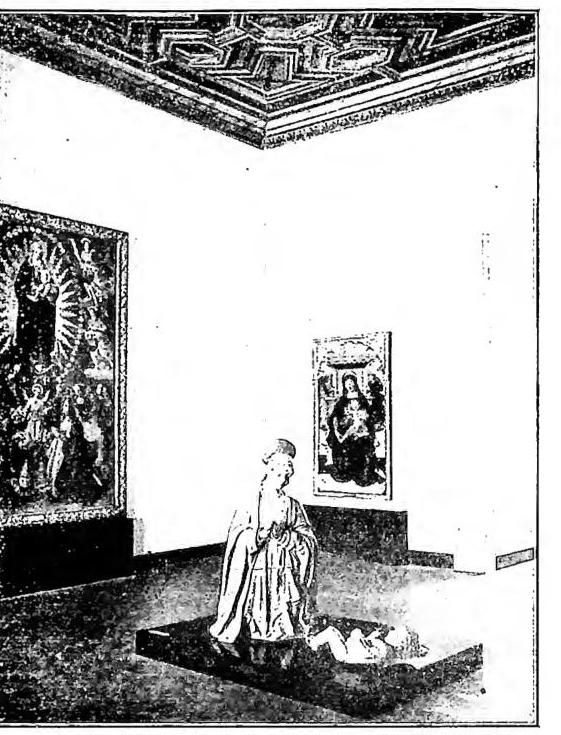
The vogue for art collections developed especially in Italy between the 15th and 16th centuries: the courts of Mantua, Modena, Milan, and Urbino were among the first to set the example. In France, under Francesco I, the celebrated «Gallery» at Fontainebleau, where so many Italian artists worked, already had the appearance of a true m. Later, Louis XIV’s new project for the Louvre, entrusted to Bernini, envisaged a large gallery of statues; and, owing to French influence, during the 18th century private individuals and princes in England began forming the important collections that would later constitute the nucleus of the present public collections.
At the center of the history of m. stands the Vatican, with its m., unique in the world in importance, formed at various times but due above all to the grand designs of Pius VI, who initiated the first construction of that m. later called the Pio-Clementino. The Vatican M. are the greatest example of the magnificent arrangement of works, especially of Greek and Roman sculpture, according to neoclassical taste.
The origin of modern m. is largely due to the State’s acquisition of ancient private collections, whereas in countries lacking a humanistic tradition, such as the United States, they were founded through the efforts of major cultural institutions or by the Governments themselves.
In the second half of the 19th century, the principal buildings intended for m. were established, and one of the most celebrated examples was the Berlin State M.; more recently, however, with the refinement of urban-planning and architectural studies, the rational enhancement of spaces was achieved in relation to the placement and study of works of art. The Brera Gallery in Milan (reorganized in 1920), the Sculpture M. in Pisa, the Floridiana M. in Naples, and the Gallery of the Banco di Napoli in the same city are some of the many examples of m. in which modern provisions have been adopted. Before the last war, which caused extremely serious damage even to the major m. of Europe (creating new and pressing problems), an «Office International des Musées» was established within Intellectual Cooperation, an emanation of the League of Nations; through congresses and publications, it greatly advanced all research relating to m. - Vedi tav. CV.