
SCULTURA. — Properly speaking, it is the art of bringing out the forms of figures and objects in any material, either in the round or in relation to a background plane (bas-relief, high relief, etc.). It is therefore the figurative art par excellence, and its origin certainly belongs among the most remote origins of all the arts.
The earliest modelers left evidence of their activity in clay figurines which, precisely because of the pliability of the material they used, are far removed from the rigidity one is accustomed to associate with the later s. in wood, the forerunner of that in stone.
The discovery of the possibility of casting images in bronze, known since the most ancient times, opened up new possibilities for the art of s., also determined by the particular strength of the metal, which makes it possible to avoid the points of support required for isolated parts (e.g., arms and legs) carved in marble.
As regards technique, in producing his work the sculptor begins with a clay model, from which a plaster cast is then made; this is translated into marble, beginning by referring to the most projecting points (capi punti).
After the preliminary work of roughing out (today generally carried out by specialist roughers), the artist proceeds to the definitive and personal work of finishing.
For bronze, on the other hand, the work is produced by casting, which may be solid (that is, massive s. obtained by pouring the metal into a hollow mold), sand casting, or lost-wax casting (the latter two being similar processes that make possible a hollow and therefore less costly s.). After casting, chasing and patination are carried out. A process analogous to that of s. in bronze is that of s. in terracotta, which likewise uses molds.
I. ANCIENT CHRISTIAN S
The richest collection of monuments illustrating the plastic activity of the first sarcophagi (v.).(Alinari photograph)
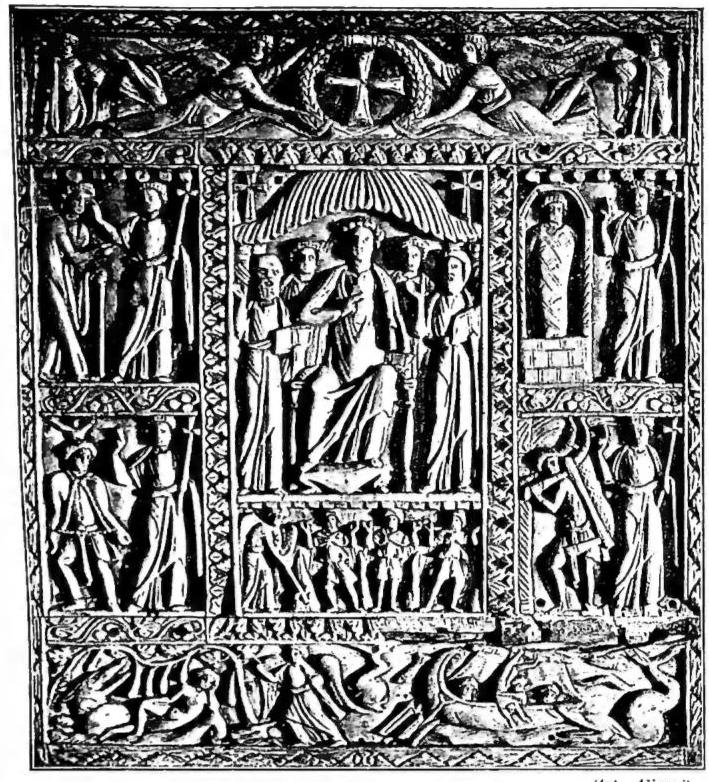
SCULTURE – Ivory diptych of the sixth century, from the monastery of S. Michele in Murano; healing of the blind man and the demoniac, Christ enthroned and the three youths in the furnace, the raising of Lazarus and the healing of the paralytic, below the cycle of Jonah – Ravenna, National Museum.
Statuary sculpture in the round, on the other hand, must have been rarer; several statuettes of the Good Shepherd have survived (the most illustrious being that of the Lateran Museum), as well as the young Christ teaching in the Roman National Museum, the statue of S. Hippolytus (only partly ancient), and perhaps the marble statue of S. Peter in the Vatican Grottoes, likewise partly remade. For the first three centuries, therefore, a prudent reserve toward such sculptural works is presumed. Nevertheless, literary accounts are not lacking that attest to the existence, after the peace of the Church, of statues both in places of worship (the Lateran Baptistery; testimonies of John Chrysostom and Gregory Nazianzen) and in public squares (the statue of Paneas; the Good Shepherd and Daniel among the lions at Constantinople; Caesarea). It is certain that the first Christian emperors did not abandon their predecessors’ practice of having themselves portrayed even in colossal statues (Constantine, the Colossus of Barletta, etc.).
Placed at the service of architecture, early Christian sculpture could be applied both to the exterior of the sacred building, especially when it was built of stone, and to the decoration and furnishing of the interior. Although at first the Hellenistic motif still predominated everywhere in ornamentation, a progressive interpenetration with local elements can subsequently be observed, especially in Syrian-Palestinian architecture, together with the increasingly frequent insertion of Christian signs and symbols: crosses, monograms, symbolic plants and birds. This applies not only to the framing of doors and windows, but also and above all to capitals.
While in the West the capital remained for a long time a piece of spolia reused, or perpetuated classical forms,
predominantly of the Corinthian or Composite type, the Eastern and Byzantine capital increasingly departed from them, creating new forms for the core, also through the insertion of the impost block, and resorting to new ornamentation, at times figurative, increasingly explicitly Christian, in which the decorative and chiaroscuro tendency, not infrequently expressed in openwork, prevailed over the plastic element. The shaft of the column could be twisted or decorated with vine tendrils; only rarely (for example, in the cemetery basilica of SS. Nereus and Achilleus) did it receive figurative ornamentation; the columns of the ciborium of S. Marco in Venice can no longer be regarded as certainly ancient.
A further ornament of the interior wall consisted of stucco reliefs, decorative, figurative, or polychrome, remains of which are preserved in S. Lorenzo in Milan, in S. Maria Maggiore in Rome, in the Baptistery of the Orthodox and in S. Vitale at Ravenna, at Poreč and elsewhere.
Precious remains of sculpture in wood are found in the original parts of the doors of S. Sabina on the Aventine, of S. Ambrogio in Milan, of the monastery of S. Caterina on Sinai, and of S. Barbara in Old Cairo; they are important both for their biblical scenes and for the ornamental motifs accompanying them.
Among the carved liturgical furnishings, first of all must be numbered the altars, often decorated on the front, on the uprights, or on the vertical faces of the mensa with motifs of a symbolic nature (Baccano, Nola, Pomposa, St-Germain in Switzerland, Marseille, Aix-en-Provence), and perhaps also with figures (S. Agnese fuori le mura); the upper surface of the mensa itself could be decorated with reliefs.
The development of early Christian sculpture could not be outlined if ivory carvings were disregarded, at least those of a certain size, even though for theoretical convenience they are usually classified under the conventional heading of “minor arts.” In part, they enable us to complete our view of sacred furnishings; in part, they reveal a new aspect of official sculpture, especially
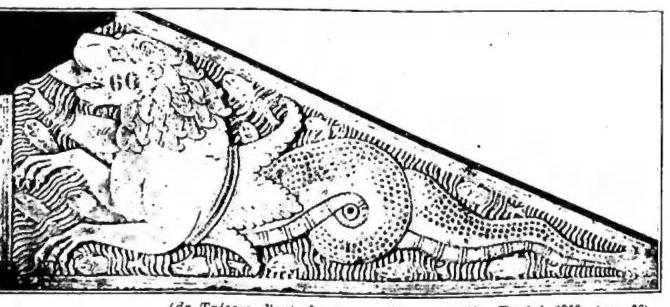
(from Tristore d'art du moyen âge en Italie, Paris 1592, pl. 20)
SCULPTURE – Fragment of an ambo from the ancient cathedral of Sorrento, depicting the Hippocampus. Campanian art of the late 12th century – Sorrento, Museo Correale.
(Alinari photograph)
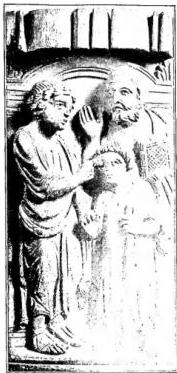
SCULTURA - The Blind Man from Birth. Ivory of the 6th century - Vatican Library, Sacred Museum.
those of the Louvre with healing scenes and that of the British Museum with scenes of the Passion should be mentioned, as well as the panels with the Ascension in Munich and with the Resurrection in the Sforza Castle of Milan. More recent or of Eastern origin are the Murano diptych preserved in Ravenna and that of the National Library of Paris (6th century). Particularly beautiful is the Byzantine valve with an archangel in the British Museum. Finally, the rich series of consular diptychs should be remembered.
A special case is constituted by Coptic art, which, both in the funerary field with its numerous stelae and in the architectural and furnishing fields, offers a very rich collection of symbolic and figurative motifs (triumphal crosses supported by the eagle, ornamentation, etc.), but above all ornamental ones, clothed in a special form of stylization in which the fusion of Hellenistic and Syrian art received a very strong local imprint.
in consular diptychs; in any case, they are invaluable for the study of post-catacomb Christian iconography. The cathedra of Massimianus in Ravenna (6th century), probably of Alexandrian origin and composed entirely of tablets adorned with biblical scenes framed by decorative bands, is a rare testimony to the richness that this part of the liturgical furnishings could attain. Among the reliquaries, the most famous are in the Lipsanotheca of Brescia and that of Samagher (Pola). A fine example of an ivory pyxis is the one in Berlin, with the sacrifice of Isaac and Christ teaching among the Apostles. Another, more recent and more Eastern, in the same city presents the Annunciation and the Nativity. Among the Christian diptychs with biblical scenes, those of the Louvre with healing scenes and that of the British Museum with scenes of the Passion should be mentioned, as well as the panels with the Ascension in Munich and with the Resurrection in the Sforza Castle of Milan. More recent or of Eastern origin are the Murano diptych preserved in Ravenna and that of the National Library of Paris (6th century). Particularly beautiful is the Byzantine valve with an archangel in the British Museum. Finally, the rich series of consular diptychs should be remembered.
II. MEDIEVAL, RENAISSANCE AND MODERN SCULPTURE
In primitive Christian sculpture, the stylistic modes that appear therein are closely connected with those of the preceding and contemporary pagan sculpture. But soon the new order of ideas that, between the 1st and 5th centuries, characterized the evolution of thought both in the East and in the West led sculptors inevitably toward new forms of expression. Indeed, whereas during the period of classical art the reproduction of the perfect harmony of the human limbs was regarded as the highest point of aesthetic perfection, other concepts now took its place, and sculpted images, like painted ones, tended rather to express the movements of the soul through forms that gradually became more pronounced, with ever greater efficacy, in an anti-academic and anti-classical direction. This continued until, around the 7th and 8th centuries, sculptors went so far as to abandon the practice of depicting human features, and the art of sculpture was reduced to engraving or perforating marble in order to represent upon it the elements of a limited decorative repertory (v. BARBARICA ARTE; BIZANTINA, ARTE; I*).It was only during the Romanesque period (v. ARTE), between the 11th and 13th centuries, that the plastic faculties of the Italians and of the other peoples participating in the culture of the Christian world manifested themselves with new and exceptional vitality; and from the multitude of stonecutters engaged in the construction and decoration of the new churches emerged the first great personalities among sculptor-artists, Viligelmo (v.), l'Antelami (v.), Nicola Pisano (v.), who expressed with perfect harmony of form the new fervor of life characteristic of that age.
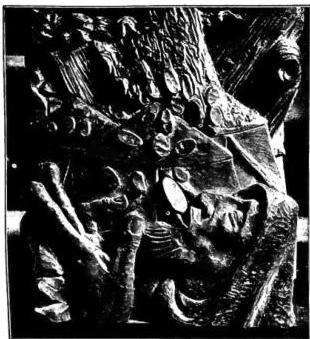
(photograph by Rossi, Trento) SCULTURA – The manna in the desert. Detail of the balustrade of the Capuchin church (20th century) – Trento.
Such technical advances continued during the Baroque age (v. ARTE), when marble succeeded in rendering with extreme lightness almost to the very rustling of silk fabrics, as well as the delicate, soft transitions between planes in the modelling of flesh. It was then that polychrome wax s. also became widespread; reviving a very ancient technique, they were especially successful in the execution of portraits and sacred images. Wax, moreover, continued to be widely used by sculptors in the modern age, and almost exclusively in wax one of the most significant sculptors of his time, Medardo Rosso, worked during the last century, producing astonishing Impressionistic effects. – See t.V. VII-IX.