
SCENOGRAPHY. — Properly speaking, it is the art of painting scenes for theatrical performances; but since it is evident that the unity of a spectacle requires the coordination of all the elements that
compose it, scenography is not something that can be conceived independently, but rather an element of greater or lesser importance in the various historical periods of theatrical representation.
It will no longer seem strange, then, that, especially in recent times, the term scenotechnics has been used in its place, as being more suitable for defining the complex scenic interplay of a performance, which ranges from scenography in the strict sense to lighting, costumes, the very form of the stage or, indeed, of the hall in which the performance takes place.
The importance of these latter elements is in fact evident; and it is precisely to their form that one must turn in order to understand the spectacle of classical antiquity: the broad semicircular tiers descending along the natural slopes of a hill, down to the level at which the orchestra is situated and in the midst of which the altar of Dionysus rises, make it clear how, even in the case of this ancient spectacle (as would later be the case with the medieval one), its origin is to be sought in religious manifestations, which implied a closer communion than can be conceived today between actors and spectators. When, at a later stage, the stage was erected at the back of the orchestra, that ideal bond was maintained by the chorus, which remained around the altar and accompanied the unfolding of the performance. But the stage also marks the emergence of other elements that may be said to constitute the birth of scenography proper: at first, a canvas limiting the back of the stage, on which, at a certain point, a perspective was painted to provide the setting for the performance (Vitruvius has transmitted the name of Agatharchus of Samos, who painted the one required for the performance of Aeschylus’ Oresteia in 458 B.C.); and then a permanent scene in marble or stone, like the pediment of a building, with three doors for the actors’ exits, while two other smaller buildings were constructed at the sides. Later, these were replaced by revolving three-sided prisms (the periacti), thus permitting the realization of the three principal scenes (tragic, comic, satyric) that composed the ancient spectacle. With the Romans, the theatre was no longer formed from the slope of a hill, but built of stone and consequently raised above the ground; the auditorium, which among the Greeks had been reserved for the chorus, instead served for the seats of the more distinguished spectators.
In the Middle Ages the theatre arose again in response to the needs of liturgical drama, this time likewise first inside the church, around the altar, and then, as a more complex dramaturgy asserted itself, in the churchyard, with the façade of the same religious building serving as a natural background setting. Characteristic of these performances, derived from the liturgical texts, and of those of the more complex Mysteries, is the simultaneous setting constituted by the so-called appointed places, that is, the very rough construction (which would also be taken up by the Elizabethan theatre) of all the places in which the scenic action would subsequently take place. A scenography that may therefore be defined as symbolic, and that can help to convey the essentially religious, choral character of this medieval spectacle.
Its evolution in a profane direction led to its prohibition by the ecclesiastical authorities, but in this evolution one also finds the origins of a form of spectacle that would continue, in more or less elaborate form, down to modern times; and it would suffice, to emphasize its importance, to recall that the oldest performance of a Mystery in an enclosed hall — that is, in a genuine theatre — perhaps dates back to 1398 (the Passion at St-Maur-Les-Fossés).
(photo Alinari)
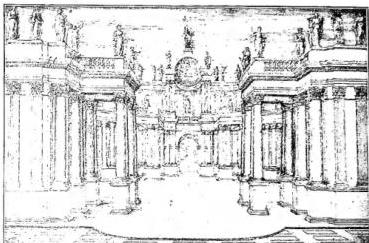
SCENOGRAFIA — Scenographic view of a portico. Drawing by G. M. Galli, called il Bibiena (1619–63) — Florence, Uffizi, Cabinet of Drawings and Prints.
the rules of this new Renaissance theatre. A theatre that could not fail, naturally, to involve a more complex constructive realization of the hall and the stage itself; it will suffice to recall the celebrated Teatro Olimpico of Vicenza, designed by Palladio and built by Scamozzi, and that of Sabbinetta (also, like the former, entirely in wood), the work of the same Scamozzi.
The Baroque period was that of the great scenic revolutions, which accompanied the evolution of spectacle from commedia dell’arte to melodrama and which, especially on account of the interludes that were increasingly coming into favor, impelled scenographers toward more complex and “marvellous” inventions, particularly for the purposes of scene changes. It was the period in which the Italians enjoyed the greatest prestige on stages throughout Europe, and the case of Torelli has remained famous: in France he amazed audiences so greatly with his mechanisms that he earned both the title and the accusation of sorcerer.
It was the century of Burnacini (1636–1707), of the Bibiena family, inventors of angular perspective, which made possible prodigious spatial illusions; of G. L. Bernini (although he was more a stage mechanist than a true scenographer); and of the Jesuit Andrea Pozzo, codifier of Baroque scenography, just as Serlio had been of Renaissance scenography. In the eighteenth century, F. Juvara (1676–1736), V. Bigari, P. Aldrovandi, S. Orlandi, M. Tesi, G. and B. Galliari are noteworthy, as is G. B. Piranesi, who, although he left no actual scenography, nevertheless became through his engravings a master to many nineteenth-century Romantic scenographers.
Nineteenth-century scenography ultimately came to reflect the taste of the dominant aesthetic theories, giving rise to a “neoclassical” scenography, slavishly historicist, and to a pictorial, “illustrative,” Romanticizing scenography. Among the most representative were the Bolognese Antonio Basoli and Francesco Cocchi, and the Milanese Carlo Ferrario.
Modern scenography emerged with the reaction against Romanticism represented by the verist, and at times excessively verist, theory of Antoine’s Théâtre libre in Paris (1887), and with the reaction against realism represented by the French symbolism of P. Fort’s Théâtre mixte (later Théâtre d’art). But at this moment there also began to appear the danger of adapting enlarged easel painting to scenography, on the part of the most renowned artists of modern art, who nevertheless failed to understand what the function of scenography was within the spectacle as a whole. Meanwhile, since its aim was precisely the spectacle as a whole, Gordon Craig would at a certain point establish himself as its master, followed by the Swiss Adolfo Appia. Also important in Italy, for the purposes of the scenic interplay of modern theatrical representation, were the Futurist theories of G. Balla and E. Prampolini, as well as A. G. Bragaglia’s theory of light. — Vedi tav. II.