
CEILING. — An architectural element intended to conceal the superstructures of the roof or, more simply, the ceiling of a room. What concerns us here is, naturally, the aesthetic function of this element, which, in the various historical periods, has undergone diverse forms of decoration, whether the beams of the floor were used for this purpose to produce the so-called coffered or lacunar ceiling, or whether the decoration of the flat surface of the ceiling was covered with paintings.
A special type of decoration, therefore, which nevertheless belongs to the history of woodcarving and stucco, particularly with regard to the first type, and to that of painting proper with regard to the second type, for which a distinction is usually made between the decorated ceiling and the vault. Works to which great importance was always attached; and it is well known, on account of the richly decorated ceiling, that
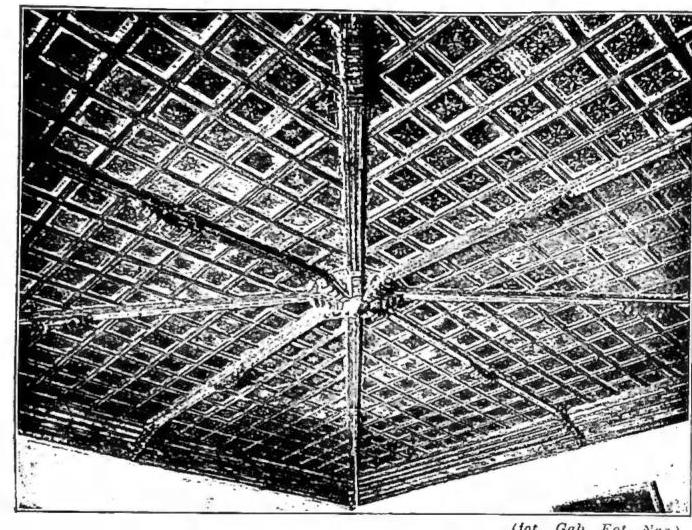
SOFFITTO — Wooden ceiling (15th century) — Fano, Seminary; it adorned it, as did the appellation “in ciel d’oro” that remained attached to the church of S. Pietro in Pavia (11th century), or that of “aurea” given for the same reason to the church of S. Giovanni in Laterano in Rome.
Among the oldest surviving works, mention should be made of the ceiling of the Cappella Palatina in Palermo (c. 1149), in which “among the Muslim ornaments are figures of profane bliss, raising their cups, seated in the Oriental manner” (Toesca); painted ceiling panels, in the Byzantine style, also remain in the Chapter of S. Niccolò in Treviso. This is a type that has never ceased to enjoy great success, especially in Sicily; for later periods, one may recall that of the Palazzo Chiaramonte in Palermo by Simone di Corleone and Cecco di Naro (1377–80), of fantastic decorative richness, with profane subjects alternating with sacred ones. It is also one of the few surviving examples of a decorated ceiling in a medieval private house, whereas examples for religious buildings are not lacking, such as the ceiling with decorated beams (dated 1334) of the church of S. Giovanni Evangelista in Ravenna. By contrast, the ceilings of the Gothic period seem to have been of limited artistic importance, owing to the very artistic spirit that produced them, during which vaulted coverings came into more frequent use.
A notable revival took place during the Renaissance, the classical period of the great carved and gilded, as well as painted, ceilings, in which artists such as the Lendinara, Giuliano da Sangallo (who, together with Domenico del Tasso, produced the richly decorated ceiling of the Sala del Dugento in the Palazzo della Signoria in Florence), his brother Benedetto, Matteo Cividali, Antonio da Sangallo (the ceiling of Palazzo Farnese in Rome), Giulio Romano (Palazzo del Te in Mantua), and Primaticcio (the apartment of Troy in Palazzo Ducale in Mantua) tried their hand. Alongside these worked a whole legion of minor artists, of whom, unfortunately, only a few names remain (Giacomo Fiorentino in Urbino; Antonio Viani in Mantua; Michelangelo Leggi in Cortona; Giovanni Sega in Carpi, and others). Seventeenth-century art left notable examples of wooden ceilings, especially in Genoa, where the work of the Lucchese Gaspare Forzani is remembered; in Florence, where one may recall the ceiling of the church of the S.ma Annunziata (1664); and in the Royal Palace of Turin, where Pietro and Bartolomeo Botto worked (in 1656 and 1660 respectively), Quirico Castelli
(1662–63), Pier Luca Bertolina (1658–59), Emanuele and Francesco Dugar, etc.
The type of flat painted ceiling is more difficult to distinguish clearly from decorated vaults, for which one must go back to earlier periods. The richly decorated ceilings of this type executed during the Renaissance are too famous to require particular mention; and in discussing them one would once again have to repeat the names of famous artists, from Mantegna to Pinturicchio, Raphael, and Giulio Romano, and then continue with the names of the leading artists of the seventeenth and eighteenth centuries. It is, however, worth recalling that in the Baroque period, alongside the daring sotto in su visions created by painters, there was a notable and natural revival of stucco decoration, as well as of wooden decoration (it will suffice to mention Serpotta), until “the tradition of solemn and powerful decorative inventions having by then been lost, that virtuosity was magnificently exercised in the infinite resources of a soft and artificial grace” (A. Colasanti) — Vedi tav. LVIII.