
SOFIA. – Bulgaria (v.), so called after the ancient Basilica dedicated to St. Sofia (Sveta Sofija), it is the most populous center of the country, situated 550 m above sea level, on a plateau between the Bragoman Pass and the Vitoscia massif, between the Balkan and Rila ranges.
Capital of the new Bulgarian State (1879), it continued to develop on account of the importance of its industries (wool mills, cotton mills, essences, oils, rubber) and the increase in its population. S. occupies an eccentric position in relation to the territory of the State, favorable to communications and international trade, being situated on the route from Belgrade to the Black Sea, also served by the railway line of the Orient Express (Belgrade – Nissa – S. – Philippopolis – Adrianople – Instanbul). At the end of the 19th century S. had approximately 50,000 inhabitants; it had approximately 290,000 in 1934 and 400,000 (including the suburbs) in 1942.
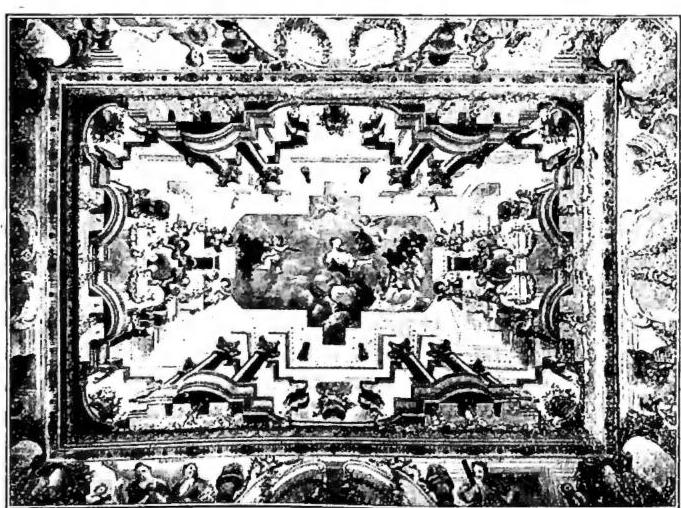
(photograph by Antonio Castelo Branco – Lisbon) CEILING – Ceiling of a room in the Biblioteca Geral, decorated in perspective (1723) – Coimbra, University.
Y. Teodorov, Le grandi strade romane in Bulgaria, Rome 1937; G. Caraci, La Bulgaria, in Geogr. univ. illustr., I, part 2, Turin 1940.
Gastone Imbrighi
I. ARCHEOLOGIA
A sud dell'antica Ulpia Serdica si trovavano le sue aree sepolcrali pagane e quelle cimiteriali cristiane all'aperto, costituite di tombe a inumazione a volta in mattoni e di cappelle, rinvenute in esplorazioni sotto l'attuale chiesa di S. Sofia. Le monete ivi trovate datano dal tempo di Galerio fino a Giustiniano II. Alcune tombe furono trovate a ca. 3 m. di profondità; una di esse conteneva 15 cadaveri. Tra le iscrizioni si notano quelle di un « vir beatissimus Theupreprius episcop(us) » (CIL, III, 14207), di un « Maxentius presby(ter) » (ibid., 14207), di un « vir religiosus Leonianus presbyter » (E. Diehl, Inscr. latin. christ. veteres, Berlino 1925-31, n. 1666 A), di un « Demetrius diaconus » (ibid., 1225 A), di un « Decius famulus sci Andreae » (ibid., 1301), di un « Iulius Dafnidius neofitus » (Revue archéol., 5° serie, 9-10 [1919], p. 350, n. 172), di un « Ioannes filius Georgi inlustris » (E. Diehl, op. cit., n. 215). Oltre queste e altre iscrizioni in latino se ne hanno poche in greco, cioè una « Μαρία πάρθενος » e un « Αμμοῦσις ἀπὸ Σεληνοῦντες » cioè da Selinunte in Cilicia (Revue archéol., 9-10 [1919], p. 317, n. 169 e p. 348, n. 3). Nel 1893 in una tomba fu trovata una cassetta in argento di cm. 7 x 8 contenente avanzi di materie organiche; all'esterno su una delle facce era il « signum Christi » Αχω tra le due lettere apocalittiche; sull'altra la croce monogrammatica &; negli altri due lati e nel coperchio decorazione geometriche (E. Le Blant, Inscriptions chrétiennes et Coffret de S., in Comptes rendus de l'Acad. des Inscr. et belles lettres, 1896, p. 291 sgg.). In una tomba si è rinvenuto un affresco con l'adorazione di Uriel (J. Mijatev, Dekorativnata živopis na sofijskija nekropol, Sofia 1925, fig. 36). Al di sopra di quest'area cimiteriale sorse nel sec. VI la chiesa di S. Sofia, a tre navi divise da pilastri con largo transetto e cupola sulla crocera; rifatta dai Bizantini (1018-1186), subì poi altri restauri; nelle pareti sono affreschi dei secc. XII e XIV (J. Ebersolt, Monum. d'archit. byz., Parigi 1934, p. 45 e fig. 38; V. Ivanova, Les anciennes bositiques de Bulgarie, in Bull. de l'Inst. arch. Bulgare, 9 [1935], pp. 211-15). La chiesa di S. Giorgio fu in origine un bagno romano poi trasformato in chiesa, la cupola romana crollò in parte e fu costruita una nuova cupola più alta. Sotto il pavimento era l'ipocausto; le quattro absidi erano in origine piscine (v. Ivanova, Godilnik du Musée nat. de S., 1921, p. 183; J. Ebersolt, op. cit., p. 20). Nella Biblioteca nazionale di S. sono con-(per cortesia del dott. R. Averini)
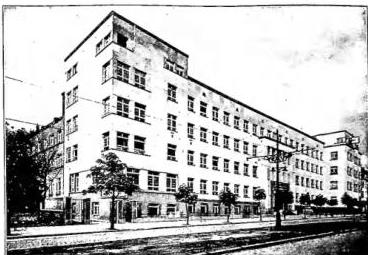
SOFIA - Institute of Public Health - Sofia.
Two notable manuscripts are preserved in the National Library of S.: the first (cod. 307), known as the “Tetravangelium of Dobrejšo,” is on parchment, written in Bulgarian and dated approximately to 1221; it comes from Macedonia (48 folios are in the National Library of Belgrade) and is decorated with three miniatures depicting the Evangelists; that of Matthew is missing (A. Grabar, Rech. sur les influences orient. dans l'art byz., Paris 1928, pp. 92–107); the second, from the 15th century (cod. 771), contains the romance of Alexander and is illustrated with 13 miniatures (A. Grabar, op. cit., pp. 108–33).
The great mosque erected by the Turks in 1474 is now used as the National Museum, which also contains the most notable collection of paintings and sculptures of ancient, medieval, and modern art.
II. INSTITUTIONS
S. has a State University and a free University; an Academy of Sciences founded as early as 1869 in Braila, Romania, and transferred to S. in 1881, with its three sections of history and philology, philosophy and sociology, and mathematical physics; the Academy of Fine Arts, founded in 1896 and reorganized in 1921; the Academy of Music, founded in 1921; and the Macedonian Scientific Institute, founded in 1925.III. APOSTOLIC VICARIATE OF S. AND PHILIPPOPOLI. – It was founded in 1758 for the Paulicians and Bogomils (v.) of the Latin rite who had been converted to Catholicism through the efforts of the Franciscans. The vicariate comprises the southern part of Bulgaria and depends on the S. Congregation for the Oriental Churches. The principal centres are, besides S.: Plovdiv (= Philippopolis), Serirovo, Nikolaevo, Jitnissa and Kaloyanovo.
In 1948 S. numbered 28,230 faithful, 13 parishes, 19 churches and 15 secular priests. In addition, there were 51 religious priests, predominantly foreigners. The Communist regime also stifled Catholic life in the vicariate of S. As early as August 1948, the closure of Catholic schools was decreed; subsequently, 3 schools in S. and two in Plovdiv were suppressed. The law on religions of 17 February 1949 sought to subjugate the Church and expelled foreign priests and religious. In the summer of 1952, a veritable persecution led to the arrest of the majority of the priests, among them the apostolic vicar, Msgr. Giovanni Romanoff. Only a few priests retain a certain degree of freedom. S. is also the seat of the Apostolic Administrator of approximately 6,000 Bulgarian Catholics of the Eastern rite.
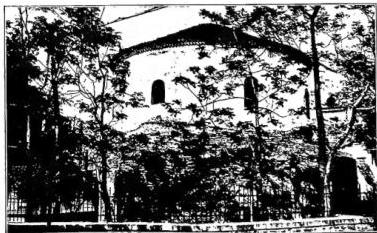
(from B. Filov, L'antica chiesa di S. Giorgio, Sofia 1933, plate facing p. 3) SOFIA – Church of S. Giorgio (4th–5th century).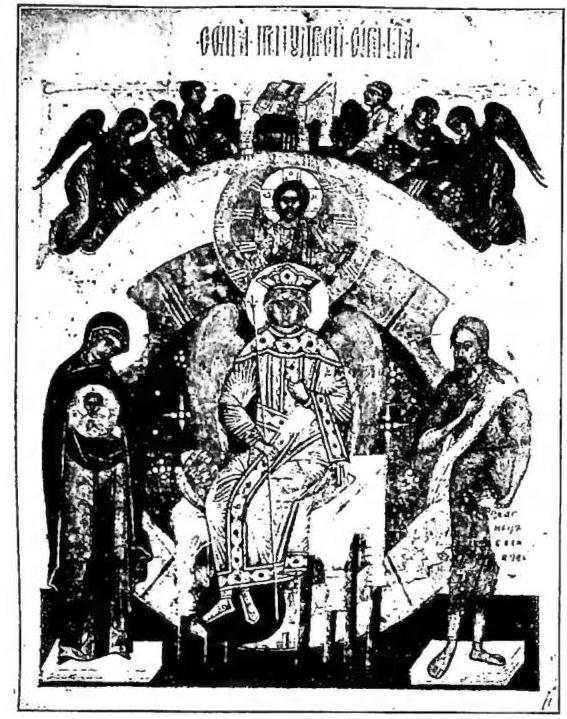
(courtesy of Fr. B. Scholtz, S.J.)
SOFIOLOGIA - Type of representation of the Sophia of Novgorod (the prototype perhaps dates from the beginning of the 15th century). Above it one reads in Slavic characters: « Sophia, Wisdom of the Divine Word ». Copy held at the Pontifical Oriental Institute—Rome.