
MATTHEW, APOSTLE, EVANGELIST, saint. — Author of the first Gospel.
I. THE APOSTLE
The New Testament provides few details about M. The name in the oldest Greek codices is Ματθαῖος, in later ones Ματθαῖος, and in the Vulgate Mattheus. The original Aramaic form seems to be Mattaj (an abbreviation of Mattanjáh), meaning “gift of Jahweh”; others, following J. Knabenbauer, suggest the root ’ēmeth, so that M. would mean “faithful.” The Synoptics relate that his call took place at Capharnaum (Mt 9:9–10). The parallel passages, Mk 2:13–14 and Lk 5:27–28, describe the tax collector at that moment as Levi, and Mark adds his paternity: Levi, son of Alpheus. The similar circumstances that precede (the healing of the paralytic) and follow (a meal in the converted man’s house, disputes with the Pharisees and with the disciples of John the Baptist) in all three Synoptics suggest that the tax collector called had two Semitic names: M. and Levi. His father Alpheus seems to be distinct from the similarly named father of James the Less. In the lists of the Apostles, Mk 3:18 and Lk 6:15 place M. in seventh place, while Mt 10:3 and Acts 1:13 place him eighth. The New Testament writings preserve nothing else special about M.From the tradition preserved by Eusebius (Hist. eccl. III, 24, 6) it appears that M. first preached to the Jews of Palestine, for whom he composed his Gospel, and then went to other peoples. Which peoples these were is uncertain. Rufinus (Hist. eccl. I, 9: PL 21, 478), St. Eucherius (Instruct. ad Salon. I, 2: PG 50, 809), Socrates (Hist. eccl. I, 19: PG 67, 126), and the Roman Breviary (Sept. 21, lectio V) suggest Ethiopia. Others point to Pontus, Persia, Syria, Macedonia, or Ireland. Although various apocryphal passiones of St. M. have been handed down, it is not certain that he died a martyr. The Gnostic Heracleon, cited without contradiction on this point by Clement of Alexandria, excludes a bloody martyrdom for M.
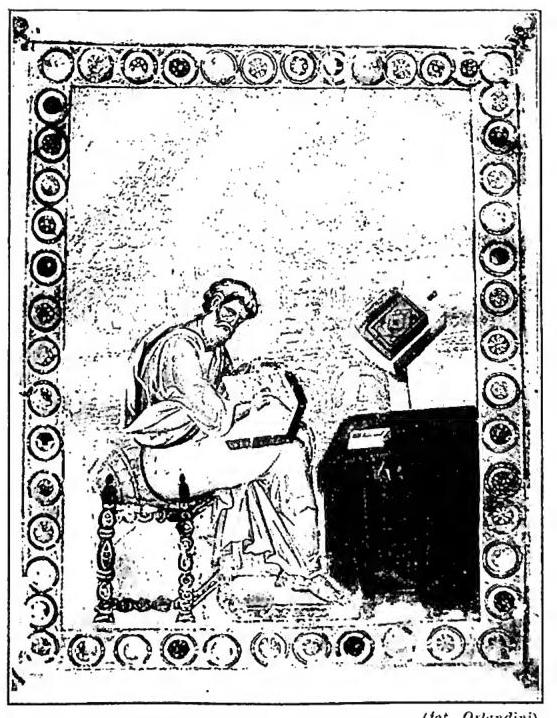
(Courtesy of Dr. B. Degenhart)
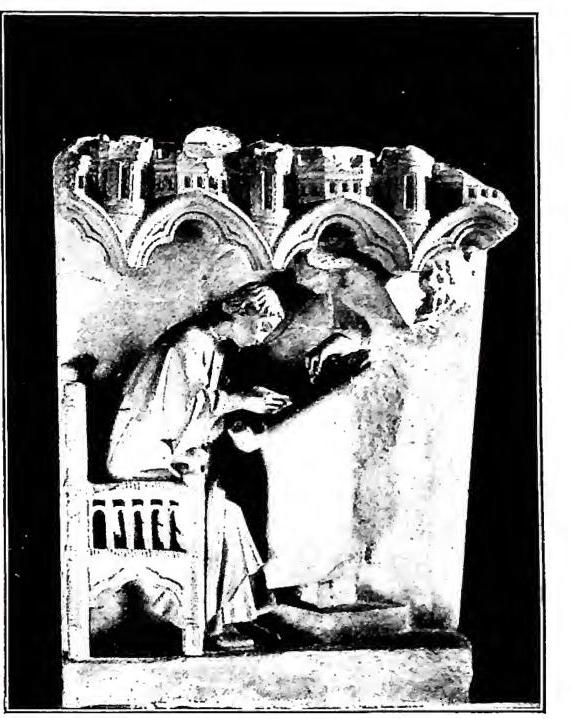
MATTEO, APOSTOLO, EVANGELISTA, santo — Relief with the Evangelist M. (13th c.) — Paris, Louvre.
II. THE FIRST GOSPEL
1. Subject and Division
The 28 chapters of the first Gospel are grouped differently by various commentators. Preferable is the division that takes into account both the dominant ideas and the changes in situation.a) Infancy and preparation for the public life of Jesus (1:1–4:11). - The genealogy (1:1–17), the conception and birth of a Virgin (1:18–25), the adoration of the Magi (2:1–12), the flight into Egypt, the massacre of the innocents, and the return to Nazareth (2:13–23) demonstrate that Jesus is the Messiah foretold by the prophets. The Baptist, the precursor foretold by the prophets, presents Him as the Messiah and baptizes Him (ch. 3). In the desert, Jesus overcomes the tempter by citing the Scriptures (4:1–11).
d) Journey to Jerusalem and ministry in Judea (chs. 19–25). - α) He continues instructing the Apostles: while crossing Perea, Jesus recommends Christian virtues, foretells His Passion for the third time, and at Jericho heals two blind men (chs. 19–20). β) He enters Jerusalem riding on an ass, fulfills the prophecies, and manifests Himself as the Messiah-King; He purifies the Temple, disputes with the Pharisees, Sadducees, and scribes, and foretells the coming and conclusion of the messianic kingdom (chs. 21–25).
e) Passion, death, and resurrection of the Messiah (chs. 26–28). - α) The Sanhedrin seeks the death of Jesus; the supper at Bethany foretells it; Judas sells the Master for thirty pieces of silver, fulfilling a prophecy (26:1–16). Other prophecies are fulfilled at the Last Supper, with the blood of the covenant, in Gethsemane with the scattering of the Apostles, with the sorrow of the Sufferer, and with His arrest (26:16–56). Before Caiaphas, Jesus recalls the oracle of Daniel, proclaiming Himself as the Messiah and Son of God, while Peter denies Him, fulfilling a prediction of the Messiah (26:57–75). β) Judas, seized by remorse, returns the thirty pieces of silver, which are used, fulfilling another prophecy, to buy the potter’s field (27:1–10). Jesus before Pilate proclaims Himself King (27:11–31). On Calvary He is crucified as King of the Jews, while the prophecies of Ps. 21 are fulfilled (Mt. 27:35–44). The death of the Redeemer is accompanied by prodigies that attest to His divinity (27:51–56). γ) The risen Jesus appears to the pious women. In vain the Sanhedrin resorts to deceit to conceal the miracle. The Risen One entrusts to the Eleven the mission to teach and baptize all nations (ch. 28).
2. Purpose and historical-literary character
From this outline it is clear what the Evangelist intended. He seeks to demonstrate through prophecies that Jesus is the Messiah promised in the Old Testament, that He is the Son of God, King, founder of the messianic kingdom (the Church, the Kingdom of Heaven), and perfecter of the ancient Law. Faith in Him is required, lest one be excluded from the messianic kingdom. For this reason, the Evangelist arranges facts and discourses in a systematic rather than chronological order: note the grouping of miracles (chs. 8–9), of parables (ch. 13), and of discourses in five sections, each concluded by the repeated formula “when Jesus had finished these discourses” (7:28; 11:1; 13:53; 19:1; 26:1—in the last case specifying: “when Jesus had finished all these discourses”). For this purpose, he uses very vague transition formulas (τῶς, tunc, without a precise temporal connection), prefers to collect the Master’s discourses while overlooking secondary details of the events, which are vividly recounted by Mark.To prove his thesis, the Evangelist selects from apostolic catechesis the facts and sayings most probative and verifiable by Jewish readers who had been direct or indirect witnesses. It is true that he adapts prophecies to the facts (sometimes using accommodations), but he does not alter the facts to fit the prophecies. Had he intended this, as certain rationalists claim, he would have invented events more conformable to the prophecies.
The author does not intend to write a complete history or biography of Jesus, but rather to gather from the history known to his readers the documents capable of proving his thesis. The historical value is confirmed by the accurate knowledge of Palestinian topography and customs that the author assumes his readers possess.
The style of the first Gospel, transmitted in Greek, strongly reflects the underlying Semitic text. Semitic tastes are evident in the parataxis or coordination of sentences (4:25–5:2; 8:14ff.), in parallelism (6:1–6, 16–18; 7:7–8, 24–27; etc.), in strophes with refrains typical of Semitic oral style (7:24–25, 26–27; 11:21–24), in the arrangement of events in groups of three, five, or seven, and in other devices used by the Hebrews.
3. Origin
Analysis of the content, the purpose intended by the author, the style, and the literary structure lead to the conclusion that this Gospel is the work of a Palestinian Jew, well informed about what he recounts, who writes especially to demonstrate to his fellow countrymen—who knew the Scriptures—the messianic and divine character of Jesus of Nazareth.The tradition, which in historical matters has predominant value, confirms and specifies these data. From the implicit citations of the Apostolic Fathers it can be deduced that the first Gospel was known at the end of the 1st century and at the beginning of the 2nd. Cf., for example, 1 Corinthians, written by St. Clement of Rome ca. 95, with Mt. in these points: “Be merciful and you will obtain mercy” (1 Corinthians 13:2 with Mt. 6:14–15; 7:1–2.12); “Woe to that man, better that he had not been born” (1 Corinthians 46:8 with Mt. 26:24; 18:6). Other interesting parallels are noted in the Didache (8:2 with Mt. 6:9 ff.; Did. 9:5 with Mt. 7:6; moreover many other passages listed by F. X. Funk, Patres Apostolici, I, Tübingen 1901, p. 640). The so-called Epistle of Barnabas cites (4:14) with the formula “it is written” the expression “many are called, few are chosen,” which is read in Mt. 20:16 and 22:14. St. Ignatius has many expressions that agree with Mt. (cf. especially Ad Polycarp. 2:2 with Mt. 10:16). St. Polycarp (Ad Philipp. 7:2) draws from Mt. 26:41. For these and other allusions to Mt. by the Apostolic Fathers cf. F. X. Funk, op. cit., pp. 640–52. St. Justin has about fifty citations of Mt., adduced without the author’s name, but as the Gospel or as the Memoirs of the Apostles. Even the heretics Cerinthus, Carpocrates, the Ebionites, the Gnostics Valentinus and Basilides, and the pagan Celsus knew the Gospel of Mt. These very ancient witnesses cite the book but not the name of the author, perhaps because in the oldest codices the title “according to Mt. (κατὰ Ματθαῖον)” was missing.
The earliest witness who explicitly attributes a work to Mt. by name is St. Papias, bishop of Hierapolis, who had been a fellow disciple of St. Polycarp at the school of John “the Presbyter” (the Apostle?). In a fragment of his five-book work, written ca. 120 and entitled Exegesis of the Lord’s Logia (preserved by Eusebius, Hist. eccl., III, 39:1), after saying that Mark had not made the coordination of the Lord’s logia, he adds: “Matthew, however, arranged the logia (of the Lord) in the Hebrew language; then he interpreted each one as he was able.”
According to Schleiermacher and several rationalists, Papias would be speaking of a work by Mt. different from the first Gospel, containing only the Lord’s discourses (logia in the strict sense), but if one observes the context well, it is seen that Papias supposes that the readers are acquainted with the Gospels of Mark and of Mt., and intends to give a reason for the fact that the Lord’s sayings in Mark are not so well coordinated, in logical order, as in Mt. The reason that Papias drew from John is this: “Mark did not write the Lord’s sayings and deeds in order... because he followed Peter, who arranged his teachings according to the usefulness of the hearers, not intending to make a coordination (σύνταξιν) of the Lord’s logia.”
Others respond to Schleiermacher’s difficulty by saying that Papias, with the term logia, intends both the sayings and the deeds; this interpretation could be confirmed by the testimony regarding Mark, where the term is explained by λαγβέντα ἡ πραξέντα (“sayings or deeds”) of the Lord. Others again think that Papias calls logia the Gospel of Mt. because it is composed prevalently of discourses. However these logia are understood, there are no serious reasons for excluding that Papias is speaking of the entire first Gospel and supposes it known to his readers.
Another important testimony, written between 175 and 189, is left by St. Irenaeus, bishop of Lyons: “Matthew, among the Hebrews in their own language, also published a writing of the Gospel, while Peter and Paul were evangelizing and founding the Church in Rome” (Adv. haer., III, 1: PG 7, 844).
An independent testimony from those of Papias and Irenaeus comes from St. Pantænus (d. ca. 200). According to Eusebius (Hist. eccl., V, 10:3), Pantænus, having gone to India (“Happy Arabia”), would have found there the Gospel of Mt. written in Hebrew characters: he would have left it there the apostle Bartholomew. Unassailable are the testimonies of Clement of Alexandria (Strom., I, 21: PG 8, 890), of Origen (in Eusebius, Hist. eccl., VI, 25:3), of Tertullian (Adv. Marc., 4:2: PL 2, 363), of Eusebius (Hist. eccl., III, 24:5–6), of St. Jerome (De viris ill., 3: PL 23, 643).
All these witnesses agree in explicitly attributing the first Gospel to the apostle Mt. Even a Priscillianist prologue from the end of the 4th century confirms this tradition (cf. F. L. Cross, The Priscillianist Prologues, in Expository Times, 48 [1939], p. 188 ff.).
There was no reason why the tradition should attribute the first Gospel to the apostle Mt. rather than to another apostle, if not the reality of the fact; a hypothetical forger would have chosen the name of a more prominent apostle. It is true that one might expect a more vivid description of events from an eyewitness, but it should be noted that Mt. deliberately excludes details not directly pertinent to his purpose.
4. The original text and the Greek version
The tradition agrees in attesting that Mt. wrote in the language of the Hebrews. This was no longer the ancient Hebrew language (as Schegg, Belser, Cladder and others think), but Aramaic, which was also commonly called “Hebrew” in the New Testament (Jn. 5:2; 19:17; Acts 21:40), in the writings of Flavius Josephus (Antiq. Iud., III, 10:6; Bell. Iud., V, 4:2; etc.) and by ancient Christian writers. Mt. intended to write for the people in the language then used by his Palestinian countrymen, not in the learned Hebrew language known only to the rabbis.The hypothesis proposed by Erasmus and repeated by Cardinal Cajetan and by many modern rationalists that Greek would be the original language of the first Gospel is not tenable.
It is true that in several points the Greek of Mt. seems better literarily than that of Mark, but a more careful analysis reveals the numerous Semitisms hidden beneath the Greek version, which nevertheless aspires to a certain elegance. It is also true that in the first Gospel several quotations from the Old Testament are taken from the Greek version of the Septuagint; but these may have been adapted by the Greek translator, who precisely used that version. It should also be noted that among the New Testament writers Mt. has the greatest number of quotations in conformity with the Hebrew text. Sometimes the quotations are paraphrased.
The original Semitic text, used by the Palestinian Christian communities, disappeared very soon with the disappearance of such communities, some of which ended in heresy. Perhaps traces of it remained in the so-called Gospels (apocryphal) of the Hebrews, the Nazarenes, or the Ebionites (q.v.).
The Greek version, according to St Papias (loc. cit.), was at first “compiled by each according to his ability.” It seems, however, that by the end of the first century there was already in circulation what may be called the official version, cited by the Didachē and the Epistle of Barnabas.
Since the Church has always unhesitatingly regarded this version as the Gospel of M., it must be said that the Greek text substantially agrees with the primitive Aramaic original. Even in the Greek version one notes that the teaching, the events and the features of Christ’s figure are presented from the standpoint of a Jewish writer addressing his fellow-countrymen in Palestine.
It may be admitted that the Greek translator introduced certain accidental modifications in rendering certain passages freely, in substituting quotations from the Septuagint, in adding some explanations, in inverting certain sections and in adapting the text of M. to that of the Gospel of Mark, which seems to have been before him. Despite these and other minor changes, the substance of the Greek version of M. corresponds to the lost original Aramaic text.
5. Destination and date. — The tradition, summarized and preserved by Eusebius (cf. Hist. eccl., III, 24, 5–6), attests that M., after preaching to the Jews of Palestine, wrote a Gospel for them in his native tongue before departing.
That M. wrote for converted Jews is attested also by Irenaeus, Origen and St Jerome (in the passages cited); some (with Cladder, Gächter, Grandmaison) think that he wrote against unbelieving Jews, interpreting in this sense the πρὸς Ἰουδαίους of Irenaeus. Others, more correctly, hold that M. had primarily in view his converted countrymen, without excluding an apologetic aim to convert those still unbelieving.
The historical-apologetic purpose and character of the Gospel, which emerge from an examination of its contents, confirm this wider destination.
Since it is uncertain when M. left Palestine to preach to the Gentiles, the date of composition of his Gospel remains uncertain. Those who maintain that his departure took place very early, basing themselves on an uncertain tradition that places it twelve years after the Ascension (AD 42–45), would date the original composition of M.’s text to that period. But this date, proposed in some apocryphal works (Kerygma Petri; Actus Petri cum Simone; Acta Iohannis), is far from being confirmed. St Jerome, in his recension of Eusebius’ Chronicon, says that M. wrote the Gospel in the third year of Caligula (AD 41: PL 27, 577–78).
It may be stated with certainty that M. wrote before the other Evangelists and before the fall of Jerusalem (AD 70). Certain rationalists, claiming that the allusion to the destruction of Jerusalem in Mt 22:7 and 24 is a prophecy post eventum, would shift the date of the Gospel to after AD 70. Yet the whole literary and historical character suggests that at the time of composition the Temple of Jerusalem still stood and the hostility of unbelieving Jews was still very much alive. After that date, which marks the dispersion of the Jews, there was no reason to write for Palestinian Jews a Gospel like that of M.
Since St Irenaeus (loc. cit.) states that M. “published also a writing of the Gospel (καὶ γραφὴν ἐξέ-νεγκεν εὐαγγελίου), while Peter and Paul were evangelizing and founding the Church in Rome” (τοῦ Πέτρου καὶ τοῦ Παύλου ἐν Ῥώμῃ εὐαγγελιζομένων καὶ θεμελιούντων τὴν ἐκκλησίαν), some exegetes, basing themselves on the absolute genitive, think that M. wrote only after Paul’s arrival in Rome, i.e. after AD 61. Others reply that the absolute genitive would not have a temporal sense but should be resolved as an adversative, thus: on the one hand, among the Jews, M. not only preached orally but also published a written Gospel; on the other, in Rome Peter and Paul were evangelizing and also founding the Church. The emphasis would not be on synchronism but on the different manner of evangelizing, whether by word or in writing.
Others, while admitting synchronism, think that Irenaeus added Paul’s name to Peter’s ad modum unius, asserting that M. wrote when Peter (later assisted by Paul) was evangelizing in Rome and founding the Church there. Whichever way this difficult and controversial passage of Irenaeus is interpreted—“of uncertain and disputed meaning” (as the Pontifical Biblical Commission asserts)—there are no serious grounds for postponing the origin of the first Gospel to after AD 60.
The most probable date, taking into account both traditional elements and a certain stage in the history of the Church presupposed by the first Gospel, would seem to fall between the years 50 and 60, better still around 55.
Cladder places the date between 50–59, at the latest up to 62; A. Merk around 50; L. Pirot at 45–50; Höpfl-Gut at 50–60; G. Ricciotti at 50–55. L. Tondelli thinks that the final redaction must be a few years before AD 70, but the primitive composition must go back much further.
6. Directives of the Pontifical Biblical Commission. — On 19 June 1911 seven responses of the Pontifical Biblical Commission were published on “the author, the time of composition and the historical truth of the Gospel according to M.” Their essential points are as follows:
a) It can and must be affirmed with certainty that M., apostle of Christ, is the author of the Gospel circulated under his name for the following reasons: the universal consensus of the early centuries of the Church, attested by explicit testimonies of the Fathers, by the titles of the codices and of the most ancient versions, by the catalogues transmitted by the Fathers, ecclesiastical writers, Supreme Pontiffs, councils, and by the liturgical use of both the Eastern and Western Church.
b) Tradition confirms that M. was the first Evangelist and that he wrote the first Gospel in the native tongue used by the Palestinian Jews to whom it was addressed.
c) Its composition cannot be postponed to after the fall of Jerusalem; the testimony of St Irenaeus does not compel rejection of the more traditional opinion that places the composition of M.’s Gospel even before Paul’s arrival in Rome.
d) It cannot be held that M. wrote only a collection of the Lord’s discourses, which then served as a source for an anonymous author.
e) It can be proved with certainty that the Greek Gospel of M. is identical in substance to that written in his native tongue by the Apostle himself; proof of this is the universal ecclesiastical usage.
f) It is not permissible to deny faith to the first Evangelist on the ground that he has primarily a dogmatic and apologetic aim—to show the Jews that Jesus is the Messiah foretold by the prophets, born of the Davidic line—and on the ground that he does not always adhere to chronological order in arranging events and sayings. Nor can it be affirmed that the narratives of Christ’s deeds and discourses have undergone a certain alteration or adaptation under the influence of Old Testament prophecies and the somewhat mature state of the Church, and are therefore not in conformity with the truth.
g) In particular, the opinions of those who doubt the historicity of the first two chapters, which speak of the genealogy and infancy (v.) of Christ, as well as of certain passages of great dogmatic importance such as those concerning the primacy of Peter (Mt 16:17–19), the form of Baptism with the universal mission to preach conferred on the Apostles (Mt 28:19–20), and the profession of faith of the Apostles in the divinity of Christ (Mt 14:33), are devoid of solid foundation. Cf. AAS, 3 (1911), pp. 294–96; Euchir. bibl., Rome 1927, nn. 401 ff.; Denz-U, nn. 2148 ff.
III. ICONOGRAPHY
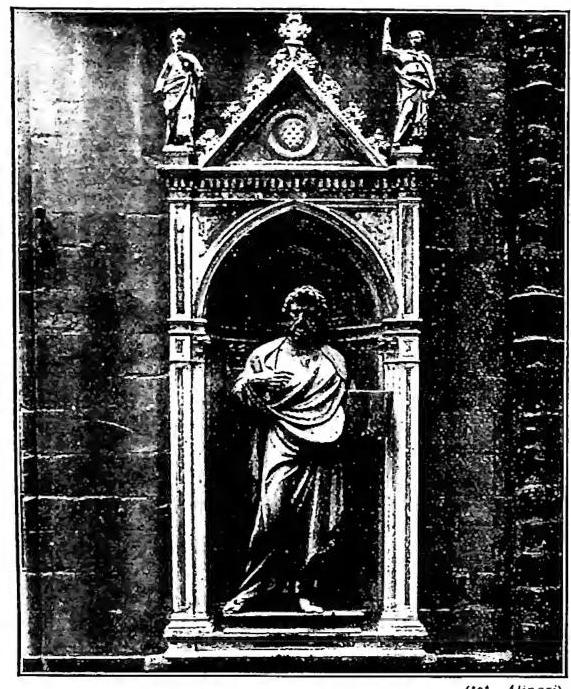
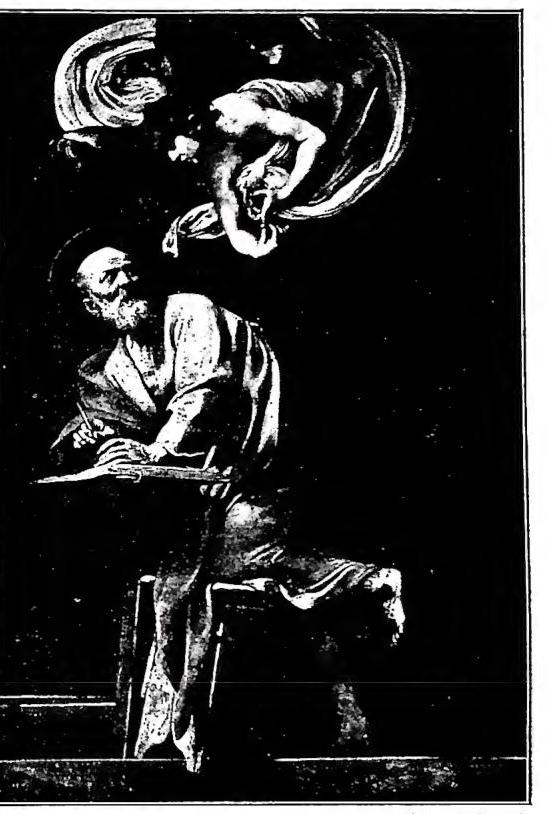
St. MATTHEW the Evangelist is depicted as a dignified old man with a beard, usually accompanied by his symbol, the angel, or inspired by it from heaven; as an apostle he has no special figurative attribute. Sometimes he holds a book in his hands. The earliest known images of the Saint are in the Ravenna mosaics of S. Vitale and S. Apollinare in Classe (6th century). Very frequent, with the now traditional attributes, is his representation in Romanesque art, while for the 1500s one may see as an example the St. Matthew painted in 1528 by B. Daddi, preserved in the Uffizi. The same typology is followed by Lorenzo Ghiberti, assisted by Michelozzo, in the statue of 1422 at Orsanmichele in Florence. On the left leaf of the Portinari Triptych by Hugo van der Goes in the Uffizi, St. Matthew is painted holding a large lance in his right hand.Among the depictions of the Baroque period of St. Matthew alone, one may first cite the canvas by Caravaggio on the altar of the Contarelli Chapel in S. Luigi dei Francesi in Rome, and that by the same master preserved in Berlin in the museum of Emperor Frederick. The Vatican Picture Gallery possesses a St. Matthew writing the Gospel, a late work by Guido Reni. A painting with the same subject by Guercino is in the Capitoline Picture Gallery in Rome. In the upper church of the basilica of Assisi, frescoes by the Roman school of the late 13th century depict five scenes of the apostolate of St. Matthew in Africa.
An entire cycle of eight scenes with the legend of St. Matthew had been frescoed in the 14th century by an unknown Rimini artist in the church of S. Maria in Porto near Ravenna, destroyed during the Second World War. The principal event of the legend of St. Matthew, namely his call to the apostolate, was also painted by Vittore Carpaccio in S. Giorgio degli Schiavoni in Venice; his martyr’s death was the subject of a mosaic of the 13th century in the basilica of S. Marco in Venice. Both these scenes found their most famous pictorial interpretation in the two large lateral canvases of the Contarelli Chapel in S. Luigi dei Francesi in Rome, masterpieces by Caravaggio, painted between 1592 and 1598. — See pl. XXVIII.
IV. GOSPEL OF M
Apocryphal, also called the book of the “Origin of the Blessed Mary and the Infancy of the Saviour.” Two spurious letters of the bishops Chromatius and Heliodorus to St Jerome, with his reply serving as an introduction, attribute it to the apostle M. St Jerome is said to have found and translated into Latin the original Hebrew text.It consists of two parts: the first (chaps. 1–24), entitled Historia de nativitate Mariae et infantia Salvatoris, is substantially James (v.), with notable amplifications and additions, though it is uncertain whether it depends on II. The second (chaps. 25–42) follows the Gospel of Thomas and is entitled De miraculis infantiae Domini Iesu Christi.
It is the only apocryphal work that recounts (chaps. 18–24) the miracles performed by Jesus during the journey and sojourn of the Holy Family in Egypt. It tends to develop the marvels that it shares with the Proto-Gospel of James. In chaps. 25–42 it narrates the prodigious life of Jesus after his return from Egypt, now on the banks of the Jordan, now in Capernaum, now in Nazareth, reworking the Gospel of Thomas in a crescendo of extravagances. Occasional less orthodox touches are noted. The Gospel of M. was composed in the West between the 5th and 6th centuries, certainly not before the 4th.
The apocryphal De nativitate Mariae, among the works of St Jerome (Epist. 50: PL 30, 307–15), is an adaptation of the first part of the Gospel of M., aiming to synthesize, moderate, and render it more orthodox through slight additions and in fairly elegant Latin. It is reproduced in the Speculum historiale of Vincent of Beauvais and in the Legenda aurea of Jacobus de Voragine. It is thought to date from the Carolingian period.
Another apocryphal work, largely coinciding with the Gospel of M. and the Gospel of Thomas, is the Gospel of the Infancy of the Saviour concerning the birth of Mary and the birth and infancy of Jesus, published by James in two markedly divergent recensions: the Hereford manuscript (13th century) and the Arundel manuscript. The former attributes it to James, the latter to M. Its origin, however—whether it depends on the Gospel of M., the Proto-Gospel of James, or the Gospel of Peter—remains unclear.
V. ACTS OF M
Apocryphal work, published under the title of Martyrium Matthaei by Lipsius-Bonnet (op. cit. in bibliography, II, II, pp. 217-62), in Greek and in a very poor Latin text. It forms a homogeneous group with the Acta Andreae et Matthiae in urbe anthropophagorum (a Catholic reworking of the Acts of Andrew in Greek, Latin, Syriac, Coptic, Ethiopic), with the Acta sanctorum apostolorum Petri et Andreae (in Greek, Slavonic, Ethiopic), with the Acta Pauli et Andreae and with the Acta Bartholomaei. Their origin is uncertain.The subject of the Acts of M. in the Latin text is most fantastic. M. is sent to preach in the land of the anthropophagi (Media). He is received by Bishop Plato, from whose staff he sees a huge tree rising up into Paradise. From the tree flows a river that waters the city of the Myrmidons. M. frees the wife and son of Emperor Bufa from a demon, whereupon Bufa resolves to kill M., to whom Jesus appears for his consolation. The devil, in the form of a soldier, incites Bufa against M., but the soldiers sent to capture or devour him are struck blind. Bufa goes to arrest M., but before him he becomes paralyzed. M. heals him. Ingratefully, Bufa has him crucified on the ground by the seashore. He orders him to be burned, but the fire is extinguished by M.’s prayer and instead burns Bufa’s idols. The fire turns into a dragon that pursues Bufa to his palace; he is freed from it by M., who dies at the sixth hour, then rises and ascends to heaven crowned... Bufa, confronted by so many marvels, converts, is baptized and receives communion. M. appears and ordains Bufa (aged 30) as a priest, his wife (aged 30) as a deaconess and his son (aged 17) as a deacon. After Plato’s death three days later, Bufa (renamed Matteo by M.) becomes bishop. The Greek text begins with the appearance of Jesus Christ to M. in the guise of one of the Holy Innocents chanting in Paradise.
There also exist a Martyrium Matthaei in Pontus, Gnostic in character; the Ethiopic Acts of M. in Kahanat; a Parthian legend of M.; the Coptic (Ethiopic) martyrdom of M.; a local legend of Hierapolis and another Ethiopic one connected with the Indian legend of Bartholomew.
VI. ANONYMOUS ON M
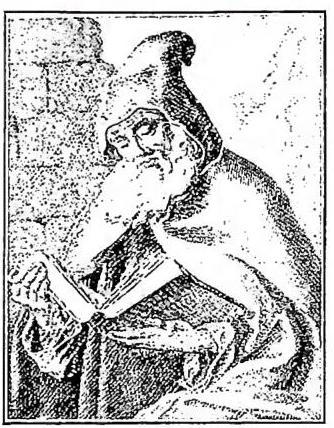
Five fragments of a Latin commentary on M. were published by MATTEO DA BASCIO - Incisione al bulino (sec. XVIII).
Ma sia A. Souter, sia Th. Zahn sono d'accordo Ambrosiaster (v.), mentre Turner è di parere contrario.
presso C. H. Turner, An exegetical fragment of the third century, in Journal of theol. stud., 5 (1904), pp. 218-41. Sull'attribuzione all'Ambrosiaster, V. A. Souter, ibid., pp. 608-21; Th. Zahn, Neue Funde aus der alten Kirche, in Neue kirchliche Zeitschrift, 16 (1905), pp. 409-27; C. Martini, Ambrosiaster. De auctore, operibus, theologia (Spicileg. P. Athenaei Antoniani, 4), Roma 1944, p. 50 sg. Erik Peterson