
BETHANIA. – Name of two localities in Palestine. 1) Village near Jerusalem on the eastern slope of the Mount of Olives, 15 stadia (approx. 2,800 m) from Jerusalem (Io. 11:18), known above all as the village of Martha, Mary, and Lazarus, in whose house Jesus loved to stay.
From there He set out for His triumphal entry into Jerusalem, and returned there that same evening (Lc. 19:29; Mc. 11:11; Mt. 21:17), and then on the evenings of the following days preceding the Passion. In its vicinity
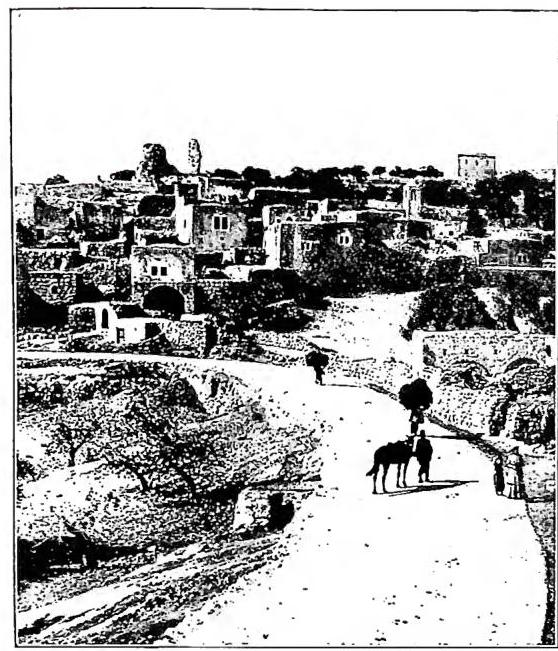
BETHANIA - View.
The Ascension took place there (Lc. 24, 50). But it is known chiefly for the resurrection of Lazarus (Io. 11, 1-44). Christians did not cease going there to venerate the tomb of Lazarus, over which a church was erected in the 4th century; from that time the name of B. began to be replaced by that of Lazarium, transformed by the Arabs into el-'Ázarijjeh. This church belonged to the Holy Sepulchre until 1738 and disappeared only in the 16th century. Queen Melisenda (12th century) had a church built not far from the tomb of Lazarus, decorated with beautiful paintings, in honour of Martha and Mary; it too has disappeared.
The present-day el-'Ázarijjeh is a cluster of houses built for the most part with material taken from ancient religious buildings; it has a population of just over 700, all Muslims, and is tending to shift eastward from the site of ancient B., where a tomb is still shown that a tradition, attested since the 4th century, identifies with that of Lazarus.
2) Locality in Transjordan where John the Baptist was baptizing when he bore witness in favour of Jesus before the envoys of the Sanhedrin. According to Io. 1, 28 (the only text that mentions it), this B. was situated beyond the Jordan. In 1908 Fr. Federlin is said to have identified it with Hirbet or Tell el-Medeš, which lies opposite Jericho, approximately 40 minutes northwest of the modern bridge over the Jordan. Although not yet confirmed by toponymy, this identification is highly probable. Io. 1, 28 does not establish that B. was the place where Jesus was baptized. Textual criticism, moreover, Bethabara (v.).