
JESUS CHRIST. - The Second Person of the Holy Trinity, that is, the Son of God made man.
SUMMARY: I. The life of J. C. according to Holy Scripture. - II. J. C., the divine bond. - III. J. C. in dogmatic theology. - IV. Worship of J. C. -
V. The divine pedagogue
VI. J. C. in historiography. - VII. J. C. in iconography. - VIII. J. C. in folklore.I. THE LIFE OF J. C. ACCORDING TO HOLY SCRIPTURE
SUMMARY:
I. Introduction
II. The life.I. INTRODUCTION
1. The Name
The Greek ‘Ιησούς (Lat. Iesus) renders the Hebrew Jēšā‘, an abbreviated form of the name Jēhōšā‘ (Joshua). This word is composed of the divine name Jāh Jēhō in its short form “Jahweh” and of šhā’, a vestige of the verb šā’ (“to be happy, unharmed”) in the hiph‘il form (from a similar verb jāšā’ = “to help,” “to free,” “to save”). The name of Jesus therefore means: “Jahweh is salvation.” Fundamentally it is the same name announced by Is. (7:14): Emmanuel (q.v.), “God with us”; (Mt 1:23 sees in the fact of the imposition of the name of Jesus, commanded to St Joseph, the fulfillment of the prophecy of the name “Emmanuel”). Jesus is “God with us.” God is with man to save him, according to the force of the expression “God with man” in the Old Testament (cf. U. Holzmeister, in Verbum Domini, 8 [1928], pp. 363-369). The title “Christ” or “Messiah” came into common use from apostolic times to complement the name of Jesus.2. Genealogy
To be with man in the most concrete way possible, “God who saves” has taken up stable abode among men in Jesus: the Word became flesh and dwelt (as in a tent) among us (Jn 1:14). “Flesh” is humanity with its frailty. Already in the genealogies that list the ancestors of Jesus, it appears that he inserted himself into human history by descending from the family of David and of Abraham, in which weaknesses are not lacking: the sinful Tamar, Rahab, and “her of Uriah.” There are two genealogies, contained in Mt 1:1-16 and Lk 3:23-38, and they seem to report conflicting data. To reconcile them it has been supposed that Luke gives the natural genealogy (of Mary), Matthew that of the legal line (of Joseph); but this hypothesis ignores that the genealogies intended to prove not natural origin but succession and legal origin (M.-J. Lagrange, St Luc, Paris 1921, p. 123). Both evangelists therefore intended to give the genealogy of St Joseph. There is no difficulty regarding the Davidic origin of Jesus: this is proven and asserted even if Jesus descended from David only through the legal line. The obvious sense of Lk 3:23 says that Luke too recounts the genealogy of St Joseph. According to many ancient and modern authors, Joseph is said by Matthew to be the son of Jacob, by Luke the son of Heli, because Jacob and Heli were sons of the same mother (Estha) and of different fathers (the first of Matthat, descendant of David through Solomon; the second of Matthat, descendant of David through Nathan), and since Heli died without children, his brother Jacob, according to the law of levirate marriage (Deut 25:5-6), married Heli’s widow and had by her a son Joseph, who was therefore the natural son of Jacob and the legal son of Heli. Matthew gives the genealogy of the natural father, Jacob; Luke that of the legal father, Heli. This second explanation runs into the difficulty that the law of levirate marriage applied only to brothers at least of the same father, if not also to brothers, sons of the same father and mother (cf. U. Holzmeister, Quaestiones biblicae de sancto Ioseph, Rome 1945, p. 11).A third hypothesis resorts to adoption: Joseph is the son of Jacob, but was adopted into the family of Heli. It does not seem that the Jews had the custom of adoption, except in the case where a father-in-law adopted as a son his son-in-law, the husband of his daughter: the son-in-law then entered into all the rights of a son. This occurred in particular when the daughter was an heir, the father having no male children. In the present case, Joseph, son of Jacob (genealogy of Matthew), marries Mary, daughter of Heli; the latter adopts as his son his son-in-law Joseph. Thus Luke gives the genealogy of Joseph (because he was adopted by Heli) and at the same time the progenitors of Mary. This solution seems the most probable, even if it cannot be proven with certainty that Mary was an heiress. Such adoption was in use among the Jews (Ex 2:61; 1 Chron 2:34-35). The effort to reconcile the two genealogies is laborious, as is evident; more useful is to understand their meaning. Matthew wished to show in Jesus the heir of the promises to Abraham and of the throne of David; Luke, going back to Adam, wished to show that he is the Savior of all humanity (M.-J. Lagrange, St Luc, p. 126).
3. The Divine Word
Jn 1:14 marks the identification of the man Jesus with the Word of God. The Johannine prologue, with its expressions about the life of the Logos with the Father, affirms that Jesus had a life and an action before coming into the world. In him was life (Jn 1:4). He pre-exists: in the beginning (before creatures were) was the Word, and the Word was with God, and the Word was God (ibid. 1:1). This life unfolds with the Father. The mystery of the life of Jesus with the Father will be placed by Jesus himself in relation to his work: what Jesus is for man has its origin in what he is before dwelling among men. The love that he receives from the Father before the creation of the world he will communicate to them (Jn 17:26). Indeed the most hidden mystery of the life of God, the being of the Father in the Son, is the cause of the life of Jesus in the faithful: “I in them, and you in me” (ibid. 17:23).If men know the Father, whom no one has ever seen, it is because the only-begotten God, who is in the bosom of the Father, has revealed him. The intimacy with the Father (being in the bosom of the Father) is the reason for the manifestation of the Father. Jesus is the light that enlightens every man, because in the bosom of the Father he is the image of the Father, of the invisible God (Col 1:15), and as the only-begotten of the Father he is entitled to the “glory,” the manifestation of divinity (Jn 1:14; correspondence between 1:14 and 1:18: to contemplate with the eyes of the body the glory of the Father in Jesus was to receive its light, to accept its revelation of the Father, to see the Father in him: “Whoever has seen me has seen the Father” Jn 14:9). All this is summarized in the word Logos. All that Jesus is for man he is because he is the Logos of the Father.
Jesus manifests in himself the glory of the Father and thus declares and explains the Father, because he is the Logos, the personal Revealer of the Father. This concept of Jesus as Revealer of the Father is what St John especially wished to express with this term, very close to the concept of Wisdom (σοφία) with which St Paul had identified in Jesus the Wisdom of the Old Testament, who goes forth from God, reveals him, and dwells among men. The word Logos was also suitable because in the language of early catechesis it had come to signify the Christian message and its content, the Person of Christ himself (cf. Col 1:25-28); he is the Word of God to humanity, a word productive of salvation for men, and supremely so, more than the words that God had spoken through his messengers in the Old Testament. God therefore sent his Son as his supreme word of salvation to man. If Jesus is Savior, it is because he is the Logos of the Father (cf. R. Kittel, Theol. Wörterbuch zum N.T., IV, pp. 100-40). In Jesus takes place the supreme revelation of the salvation of God: a concrete revelation, in the giving of salvation.
II. HIS LIFE
4. Preparation: early manifestations of the human and divine life of Jesus
a) Before birth. — α) To Mary. — Every human life must be prepared within the family. “God with man” had a family, composed of Joseph, of the house of David, and of his spouse Mary. The angel announces to Mary that the child will be the Son of the Most High, heir to the throne of David, eternal king, holy, the Son of God (Lk 1:32–35; V. ANNUNCIATION). The future Motherof God was prepared with an adornment of grace and with a special presence of God with her: “The Lord is with thee” (the phrase signifies the most extraordinary help that God would give her so that she might accomplish the difficult mission entrusted to her at that moment). The incarnation of the Divine Word would come about through a descent from on high of the Holy Spirit (the creative power of God) and through the presence of divine omnipotence, in the manner in which the cloud covered the ark and was a sign of God’s presence in the midst of the people—“For with God nothing shall be impossible” (Lk 1:37). β) At ‘Ain Kārim. — The first to whom the mystery of the
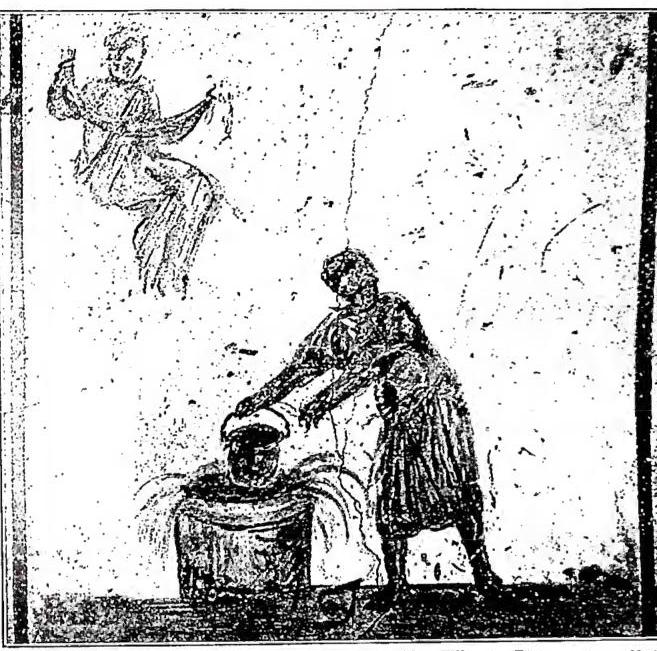
GESÙ CRISTO — G. C. and the Samaritan Woman. Fresco from the Catacomb of Callisto (late 2nd century) — Rome.
The presence of God in human flesh was first revealed to Elizabeth, who, “filled with the Holy Spirit” (Lk 1:41), recognizes in Mary the mother of her Lord and in the child in her womb the Blessed One, enriched by God with great gifts.
The divine-messianic character of G. is manifested in Mary’s canticle (v. MAGNIFICAT): God is the Savior, great, holy, and merciful. These attributes of God will be revealed in the distribution of the goods brought by G.; His salvation will consist in exalting the humble and filling the hungry with good things.
γ) To Joseph. — The just Joseph, to whom the “Gospel of Infancy” of Matthew probably goes back (cf. J. Lebreton, in DBs, IV [1950], p. 976; whereas Luke’s goes back to Mary), unaware of the mystery accomplished in Mary, thinks of sending her away so that her honor, which he does not doubt, may not be tarnished; but he is instructed by an angel. The unborn child will save His people (Israel, to whom Matthew directs his Gospel); the liberation will be spiritual: from the hostile power of sin. Joseph will have rights and the role of father, imposing the name that will indicate the mission: J. And Joseph takes Mary into his home to act as father to the Savior.
b) The visible manifestation: Bethlehem. — At the time of G.’s birth, Palestine was subject to Rome (since 63 BC, annexed to the province of Syria); King Herod had obtained power from Antony in 40 BC. He ruled over all Palestine, but with limited authority. He was not strictly a king but, strictly speaking, an ally (socius), which makes a census during his reign even more plausible. The census (not necessarily unique or simultaneous throughout the Empire) was conducted by Quirinius: whether he was twice prefect of Syria, or carried out the first census as an adjunct in the capacity of procurator to the prefect of Syria, or whether Luke’s phrase should be understood as “this census took place before the one that occurred under Quirinius, prefect of Syria” (cf. U. Holzmeister, Historia aetatis Novi Testamenti, 2nd ed., Rome 1938, pp. 38–43; and for the latest interpretation: M.-J. Lagrange, St Luc, p. 67), Luke’s note is worthy of faith and firmly grounded in historical reality. Joseph goes to Bethlehem, the ancestral home of his family; Mary accompanies him (it is obvious that, being in such a state, Joseph would not have wanted her to remain alone in Nazareth). Thus the prophecy of Micah is fulfilled. The year of G.’s birth can be fixed at 748 AUC (corresponding to 6 BC), about two years before Herod’s death (March 750 AUC).
The event, in its external circumstances and in the meaning given to it by God and the first witnesses, was transmitted by Luke (ch. 2): a Marian source, as he seems discreetly to suggest (ibid. 2:19). The place that received God in His supreme manifestation and self-giving was Bethlehem (Lk 2:6); more precisely, a region where shepherds were keeping watch over their flock (ibid. 2:8); and in this region, a manger (ibid. 2:7), thus a stable. Even if Luke’s account had not yet been written, St. Paul (2 Cor 8:9) provides its commentary: “You know the grace of our Lord Jesus Christ, that though he was rich, yet for your sake he became poor, so that by his poverty you might become rich.” The Corinthians know: in apostolic catechesis the life of G. held a central place; even if not all details were known, the first Christians must have heard about the humble origins of their Master. They were also fortunate to deepen their understanding of the Incarnation through the preaching and letters of the Apostles. St. Paul will emphasize this for the community at Philippi: “Have this mind among yourselves, which is yours in Christ Jesus, who, though he was in the form of God, did not count equality with God a thing to be grasped, but emptied himself, taking the form of a servant, being born in the likeness of men. And being found in human form he humbled himself” (Phil 2:5–8).
c) Other manifestations in humble beginnings. — Eight days after His birth, the Infant was incorporated into the people of Israel, becoming subject to the Law (Gal 4:4) and receiving the name that indicates His nature and mission (v. above). His subjection to the Law was shown in fulfilling, forty days after birth, the command to redeem the firstborn (Num 18:15–16) after consecrating them to the Lord (Ex 13:2). G. takes on the character of a victim offered to the Father (cf. the sacrificial sense of the word παραστῆσαι in Lk 2:22, Rom 12:1; M.-J. Lagrange, Épître aux Romains, Paris 1916, pp. 292–93; and the related sense of consecration to God in Rom 6:13). Here G. is revealed also as the salvation of God for all men, as the light of the nations and the glory of Israel, and, in Simeon’s prophecy, as the occasion of falling and rising for many and as a sign that will be contradicted and will be a source of suffering for Himself (Lk 2:34–35). Simeon’s predictions begin to be fulfilled; the events concretely show who the child is, taken back to Bethlehem. Magi (v.), led to Him by the star, a symbol of the Light of Christ, He is persecuted by King Herod. The intimate union with the Father, already manifested in the providence that delivers Him from Herod, is progressively revealed in Nazareth through obedience, continual manifestations of grace, and with ever greater clarity. At twelve years old in the Temple, He remains there unbeknownst to His relatives, and then explains to them the mystery with the words: “Did you not know that I must be in my Father’s house?” (Lk 2:49; even if the words are to be understood as “being in the house of the Father,” they still indicate the close union between the Son and the Father).
5. Public Life
a) Chronology of events. — chronology (v.) of events, the most recent authors are followed; here only a framework of the facts of G.’s public life is intended, with the warning that the chronology may be entirely postponed by one year.a) Up to the first Passover. — John the Baptist begins his ministry in the autumn of AD 26 (779 AUC) and continues for several months; in the winter between AD 26–27, perhaps at the beginning of January, G. comes to be baptized. Between the Baptism of G. and the first Passover of Jn 2:13 several months pass; G. spends forty days in the desert where He is tempted, returns to the banks of the Jordan (Jn 1:20), receives the testimony of John, gathers His first disciples (ibid. 1:35–51), returns to Galilee and attends the wedding at Cana (ibid. 2:11), remains for a few days in Capernaum, and near Passover sets out for Jerusalem (ibid. 2:12–13).
β) From the first Passover to the beginning of the Galilean ministry: March–May or June of the year 27. — On the occasion of the Passover, G. purifies the Temple (Jn 2:14–25), has a conversation with Nicodemus (Jn 3:1–21), and remains for some time in Judea, where he receives the final testimony of the Baptist (Jn 3:22–30). He returns to Galilee both to escape the notice of the Pharisees, who have heard that he is making disciples (Jn 4:1–3), and because John has been imprisoned (Mt 4:12; Mk 1:14; cf. also Lk 4:14, which refers to the second return to Galilee). Passing through Samaria, he converts the woman at the well; it is the time of the harvest (Jn 4:35b; 35a is a proverb: cf. F. Prat [V. BIBLICA.], I, pp. 210–12, 486–88). Arriving in Galilee, he heals the son of the royal official (Jn 4:43–54). It is early June of the year 27.
γ) The Galilean ministry. — The first part extends from June 27 to the second Passover of the year 28 and includes the events recounted by the Synoptics up to the multiplication of the loaves, at which point the Johannine account rejoins them again (Jn 6:1–13; cf. Mt 4:12–14, 36; Mk 1:14–6:56; Lk 4:14–9:17). G. begins his ministry with a sermon in Nazareth (Lk 4:16–30; some place this event later, following the chronological order of Mk 6:1–6, which would correspond to Lk 4:16–30). Going down toward the lake, he definitively calls the first four Apostles, chooses Capernaum as the central city of his ministry, and teaches in its synagogue. A typical day is described: initial miracles—the demoniac, Peter’s mother-in-law, the leper (Mk 1:16–45 and parallels). Conflicts with the Pharisees begin (Mk 2:1–3:6): the paralytic and the forgiveness of sins, the call of Matthew and eating with sinners, fasting, the plucking of grain on the Sabbath, the man with the withered hand. G. chooses the Twelve from among his disciples and the crowd that now follows him (Mk 3:7) and delivers the Sermon on the Mount (Lk 6:12–49). All this must have occurred fairly early, in the initial period of the Galilean ministry.
An indeterminate period elapsed between the Sermon on the Mount and the Sermon in Parables. Between the two, the following events are recorded by Lk 7:1–8:3: the healing of the centurion’s servant, the raising of the widow’s son, the embassy from the Baptist, and the sinful woman. During this time, G. goes from city to city and village to village preaching (Lk 8:1), assisted by certain women (ibid., 2–3); this must have occupied the summer and autumn months of 27. In the autumn (November), the Parable Discourse of Mt 13; Lk 8:4–18 harmonizes with the imagery of sowing: the sower, the tares; Mk 4:26–29: the seed that grows by itself; and the other parables, even if not all delivered on the same day.
After the Sermon in Parables, G. crosses to the other side of the lake (Lk 8:22–39): the calming of the storm, the deliverance of the demoniac. On his return, he raises Jairus’s daughter and heals the woman with the hemorrhage (Lk 8:40–56). Thus ends the first year of public life: from January 27 to January 28. The events recounted in Lk 9:1–17 can be more precisely situated in time: the mission of the Apostles must have taken place in February 28; when they return, G. multiplies the loaves for the first time, and the Passover is near: cf. Lk 9:10 with Jn 6:4. The journey of G. to Jerusalem for the Passover or Pentecost of 28, in which he heals the paralytic at the pool of Bethesda (Jn 5), marks the division between the first and second part of the Galilean ministry (many authors place here the transposition of Jn 5 and 6; cf. the discussion in F. Prat, I, pp. 567–68; cf. also N. Urichello in Biblica, 31 [1950], pp. 129–63).
The second part of the Galilean ministry extends from the summer of 28 until the Feast of Tabernacles (October 28: Mk 7:1–9:30; Lk 9:18–50; p. 51–18:30).
After healing the paralytic in Jerusalem and the consequent debate, G. returns to Galilee (Jn 7:1). The principal events of the second Galilean ministry are the journey into Phoenicia and the Decapolis; miracles of the Canaanite woman’s daughter, the deaf-mute, the second multiplication of the loaves, the blind man of Bethsaida, Peter’s confession, the Transfiguration with the healing of the demoniac, and two announcements of the Passion. Here Luke inserts the section called “the journey” (Lk 9:51–18:30), whose events must have occurred, at least in part, during G.’s journey to Jerusalem for the Feast of Tabernacles (Jn 7:2), during his stay in Perea before and after the Feast of Dedication (Jn 10:40: πᾶν), which belongs to the final period of public life (cf. below). But certainly Luke has here gathered together sayings and deeds of G. that belong to different times, even from the Galilean ministry.
δ) From the Feast of Tabernacles, October 28, to the last Passover, March 29 (April 30). — G. goes to Jerusalem for the Feast of Tabernacles (Jn 7:2–7); on the journey he sends out the seventy-two disciples, is received at Bethany by Martha and Mary (Lk 10:1–42), and teaches the Our Father (ibid., 11:1–13). Upon his arrival in Jerusalem, he teaches in the Temple and solemnly manifests himself on the last day of the feast (Jn 7:2–53), and he frees the woman taken in adultery (ibid., 8:1–11). The events that follow in John fit well between the Feast of Tabernacles and the Feast of Dedication: the dispute in the Temple (Jn 8:12–59), the healing of the man born blind (ibid., 9:1–41), and the parable of the Good Shepherd (ibid., 10:1–21). Between October, the Feast of Tabernacles, and December, the Feast of Dedication (ibid., 10:22), there was a stay of G. in Perea (cf. ibid., 10:40); in December, G. attends the Feast of Dedication (ibid., 10:22–39) and withdraws again to Perea (ibid., 10:40–42). In the first and second ministry in Perea, many events recounted by Luke in the “journey” section must have occurred, which are difficult to place in a more precise chronological order. The principal events are (after those from Lk 9:51 to 11:13) the banquet at the house of the leading Pharisee (ibid., 14:1–6), the ten lepers (ibid., 17:11–19); most of these chapters are occupied by teachings (parables of mercy, of the proper use of wealth, warnings against Pharisaic spirit, etc.). At a certain point, between the Feast of Dedication and Passover, at a less precisely defined time but certainly close to the latter (Jn 11:55), G. goes to Bethany and there performs the miracle that will decide his death: the raising of Lazarus. Afterward, to escape the plots of the Jews, he withdraws to Ephraim, remaining there for a few days (Jn 11:54–55).
2) The final journey to Jerusalem and the last week (Lk 18:30–21:38 and parallels; Jn 12). — Leaving Ephraim, G. sets out for Jerusalem, not directly, but passing through Jericho, where he heals the two blind men and stays with Zacchaeus, and then to Bethany, where he is invited to dinner and Mary, the sister of Lazarus, anoints his feet: six days before Passover (Jn 12:1), i.e., on Saturday. The next day (ibid., 12), G. enters Jerusalem triumphantly, and in the evening returns to Bethany (Mk 11:11). On Monday, returning to Jerusalem, he curses the fig tree, drives out the money-changers from the Temple, and in the evening leaves the city again (Mk 11:12–19). On Tuesday, again in Jerusalem, in the Temple (ibid., 11:27), where he disputes with the chief priests, scribes, and elders. As he leaves the Temple, he begins the eschatological discourse to his disciples (ibid., 13:1). It seems that on Wednesday G. did not go to Jerusalem but spent the entire day in Bethany with the Apostles (F. Prat, II, p. 261); this was the day on which the second meeting of the Sanhedrin was held (after that of Jn 11:46–53), of which Mt 26:2–3; Mk 14:1; Lk 22:1–2 speak. With this, the narrative of the Passion begins, which will be treated below.
b) Principal aspects of the public life. — a) The formation of the Apostles. — The revelation that J. makes of himself and of the Father requires witnesses: St. John describes the work of the Baptist from this perspective: Jn. 1:6–8, 15, 19, 32–34. Presented as the Lamb of God, as the one who baptizes in the Holy Spirit, J. seeks others who, having been with him from the beginning, may bear witness to him (Jn. 16:27; Acts 1:21–22). The principal work of J. during his public life, besides preaching to the crowds, was the formation of the Apostles. To them he reserves the explanation of the parables, for it is to them that it has been given to know the mystery of the Kingdom of God (Mk. 4:10–11). He patiently endures their slowness, their little faith, their prejudices regarding the nature of the Kingdom (cf. Mk. 4:40); he corrects them and, through a wise progression, introduces them to the mystery of his life and mission, accustoming them to the thought of the Passion (Mt. 16:21–23); he warns them against the spirit of Pharisaism (ibid., 16:6–12); he aims to form them in goodness (Lk. 9:52–56), in detachment (Mt. 10:9–10). He foretells their persecutions (Mt. 10:16–25) (against all the disciples of J.); yet at the same time he infuses them with courage and the consciousness of their dignity: it is he who sends them (ibid., 16a); in them comes J., and because J. is sent by the Father, in them the Father himself comes to men (Mt. 10:40). J. reserves for the Apostles his last hours with the supreme manifestations and gifts. But what most formed the Apostles for their office as witnesses was the concrete revelation that J. made of his nature before them for about two and a half years: what they call contemplating his glory (Jn. 1:14), the manifestation of the life that was with the Father and that now has appeared to them and which they proclaim (1 Jn. 1:1–3).
In J., the Apostles progressively discovered God. In their souls, as pious Jews accustomed to synagogue readings, were impressed the great theophanies
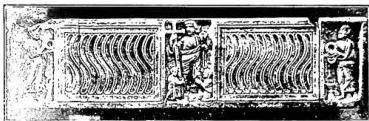
GESÙ CRISTO - G. C. between two prostrate dead, sarcophagus of the 4th century discovered in 1949 at Arles – Arles, Museum.
The biblical theophanies were not abstract but concrete, woven into the very history of the people. For them God was a holy God, who by His holiness kept the contamination of idolatry away from the people and punished them severely when they abandoned themselves to it, yet forgave with mercy when they repented. He was the one God, jealous of the love of the people whom He called His “spouse,” the Shepherd and Father of Israel; He spoke through the prophets and through the leaders, gave His laws, and the king represented Him and was the tangible sign that God was always present in the midst of the people. The Tabernacle first, and then the Temple, were the place of God’s glory, where He manifested Himself in the cloud, from which He heard prayer and communicated His will.
In the parables of the Kingdom He proclaims Himself king, foresees the future of His Kingdom, its phases and destiny in the world, its expansion despite humble beginnings, its power of penetration against which nothing can resist (mustard seed and leaven); He insists on the docility required to belong to it (sower), on its price and value (pearl and hidden treasure). These are profound words, whose explanation Jesus reserves for His disciples (Mk. 4:34); they show in Jesus the founder of the Kingdom of God on earth and the judge not only in the future (parable of the tares) but also in the present (His preaching already divides men, and the judgment of condemnation is that men have loved the darkness rather than the light: Jn. 3:18–19); the disciples marvel that He speaks to the people in parables (Mt. 13:9). All this, together with His power over demons (manifested again at Gerasa: Mk. 5:1–20), over nature, and even over death itself (the storm on the lake, the two blind men and the mute, the daughter of Jairus [Lk. 8:22–56], and shortly before the son of the widow [ibid. 7:11–17]), deeply influenced the souls of the Apostles: little by little they saw Him ever more intervening with kindness in the miseries of man, and at the same time ever more isolating Himself from the common and earthly mentality of the religious leaders of the nation, of the entire people, and even of some of the disciples: Jn. 6 (multiplication of the loaves, discourse on the bread of life, the incomprehension of the Jews and of many disciples: V. 66); then they, through Peter, proclaim their faith in Jesus: “We have come to believe and to know that you are the Holy One of God” (v. 69). The concrete manifestations of Jesus led them to place the man Jesus, whom they saw before their eyes, in the category of the divine; from now on they would see Jesus ever more in the light of God: He is the Holy One of God, who participates in a unique and incommunicable way in the holiness of God (F. Prat, I, p. 400). The events in Jerusalem during the feast (Jn. 5:1–47) and the second part of the ministry in Galilee confirmed the faith of the Apostles, which was solemnly manifested at Caesarea Philippi with Peter’s explicit acknowledgment of Jesus’ divine sonship. The final events in Galilee (the Transfiguration, with the testimony of the Law and the prophets, and the manifestation of the “glory” of God in the face of Jesus [cf. B. Zielinski, De Doxa Christi Transfigurati, in Verbum Domini, 126 (1948), pp. 291–303]) and the ministry in Judea and Perea with the cry on the last day of the Feast of Tabernacles (Jn. 7:37) and His declaration about Himself as the light of the world (ibid., 8:12); the subsequent confirmation of His word in the healing of the man born blind (ibid., 9); the parable of the Good Shepherd who lays down His life so that they may have life in abundance (ibid., 10:1–18); and the confirmation of the gift of life in the raising of Lazarus (ibid., 11:1–44) – all these reveal in Jesus ever more brilliantly the revelation and the giving of the God of the Old Testament to men, who had revealed and promised Himself as the source of living water (Jer. 2:13; Ps. 35[36]:10); as light (Is. 60:20; Ps. 26[27]:1); as the Shepherd of the people (Is. 40:11; Ps. 22[23]:1–4).
β) The Way to God’s Salvation. — The definitive “visitation of God,” promised in the Old Testament, was to consist principally in the salvation of man. Above all in Jesus is revealed and given the God-of-Salvation, the Redeeming God (v. ’ēl). The principal aspects of the salvation accomplished by Jesus are already indicated in the concise description given by Mt. 4:23 and 9:35 (cf. St. Peter in Acts 10:38), which embraces His entire ministry in Galilee: “He went around all Galilee, teaching in their synagogues, proclaiming the Gospel of the Kingdom, and curing every disease and illness.” Miracles and discourses are the means by which Jesus comes into contact with man in order to save him.
For the main lines of Jesus’ teaching, cf. J. Bonsirven, Les enseignements de Jésus-Christ, 2nd ed., Paris 1946. It suffices here to observe that Jesus shows fully realized in Himself the lines along which the idea of salvation, which permeates the doctrine and history of the Old Testament, had expressed itself and in part already been realized. In Jesus is fulfilled the “promise” made to the patriarchs (Jn 8:56; Mk 1:15); the Kingdom of God, the rule of God in the world announced by the prophets and ever and again restored in the unfaithful people, now reaches its full accomplishment: Jesus proclaims its coming (Mk 1:15), describes its characters and phases (Sermon on the Mount and parables, eschatological discourse), and inaugurates it in Himself by casting out the antagonist, the prince of this world (Jn 16:11, 33). The liberation-restoration with which Jesus gives supernatural reality to what had occurred in type in the history of the chosen people is manifested in miracles, which, even as physical facts, are a liberation from the spiritual enemies of man (the liberation of the possessed is a liberation from the demon; healing from sickness and raising the dead are a deliverance from the power of death and of sin, which is its cause). Moreover, the miracles have a symbolic or parabolic character; they signify spiritual salvation.
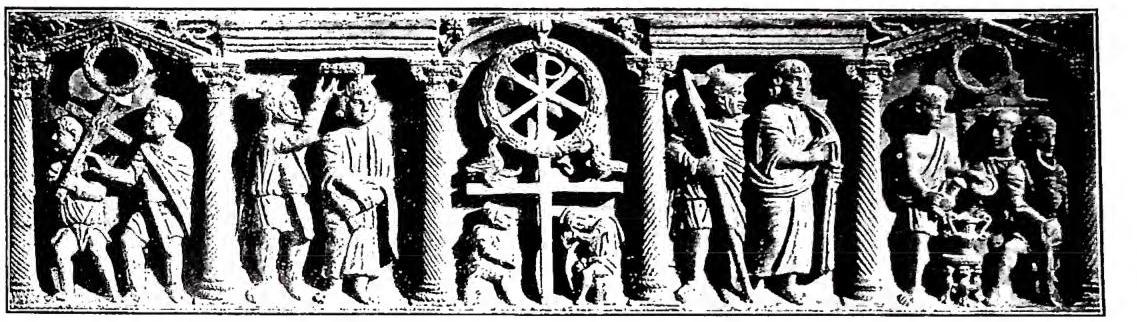
JESUS CHRIST — Sarcophagus with depictions of the Passion of J. C. At the center the Constantinian monogram and the Cross, which symbolize the Resurrection. On the sides: Simon of Cyrene carries the Cross, C. crowned and C. before Pilate (4th century). Rome, Lateran Museum.
This symbolism is expressly noted in the Fourth Gospel: the healing of the paralytic at the pool foreshadows the power of J. to give life (Jn 5:19–30); the raising of Lazarus symbolizes the fact that J. is the resurrection and the life for those who believe in him (ibid. 11:25); the healing of the man born blind shows that J. is the light of the world (ibid. 9:4–5). Even when not explicitly noted, there is in all the miracles a sense of announcements of the Kingdom, signs that the salvation of man is being accomplished, in soul and body: J. saves the whole man (cf. Mk 2:1–12; Jn 5:1–14).
The liberation and gathering of the new People of God, which J. accomplishes, reached its climax in the outpouring of his blood, already necessary in the Old Testament for establishing the covenant between God and man (cf. Ex 9:8; Heb 9:15–22). Yet already in his public life J. began to form the new People, with new laws and a new spirit (Sermon on the Mount), and in his teaching he established the conditions for participating in the salvation offered and entering the new People. He communicates salvation only to those who are reborn from above by water and the Holy Spirit (Jn 3:3–5), to those who eat the flesh of the Son of Man and drink his blood (ibid. 6:53). But beyond a sacramental life (the idea of life in Jn 3–6 is connected with sacramental rites), J. also requires moral dispositions, intimately connected with them. The first is to enter into God’s plan through faith. J. demands, as an absolute condition of salvation, faith in him and in the Father (Jn 5:24; 6:29). The faith that he demands is not merely an adherence of the intellect, but of the whole person (J. most often used the expression πιστεύω εἰς, stronger than πιστεύω τινι: one can believe in a man, but one believes in God alone (cf. J. Huby, De la connaissance de foi dans st Jean, in Recherches de sciences rel., 21 [1931], p. 408, note 439), by which man abandons his own salvation into God’s hands and accepts God’s ways, leaving his own behind. The Kingdom is received with the humility and faith of a child (cf. Mk 10:15).
One must lose oneself for him, leave everything behind, and imitate him (for an ancient Oriental, being a disciple of someone meant becoming accustomed to do everything like the master, and thus to follow him in all states and conditions of life).
γ) The Conflict with the Jews. — The conflict between J. and the religious-political environment of Judaism was inevitable; the manner in which he accomplished and offered the salvation of man clashed with the mentality of the Pharisees and of all official Judaism, provoking the conflict that was to lead to J.’s death. The causes of this conflict have been extensively studied (A. Charue, L’incredulité des Juifs dans le Nouveau Testament, Gembloux 1929; cf. J.-B. Frey, Le conflit entre le messianisme de Jésus et le messianisme des Juifs de son temps, in Biblica, 14 [1933], pp. 133–149, 269–93) and can be summarized as follows. The fundamental cause is that whenever God intervenes in human history, he places man before a supreme and definitive decision: either for him or against him. No one can remain indifferent before God’s intervention. Yet, in order to be on God’s side, one must renounce everything that is not God. Now the final and ultimate decision before which God placed the people in his supreme manifestation and gift in J. entailed the renunciation by the people and its leaders of their interpretation of the Sacred Books: J. gave the Old Testament a meaning too different from Pharisaism not to provoke a reaction. For him the Old Testament contains the history and destiny not of one people alone, but of all humanity, of which it announces salvation: the serpent represents the salvation of all believers (Jn 3:14–15); the patriarchs will welcome the pagans at their feast (Mt 8:11). Even Zacchaeus is a son of Abraham (Lk 19:9). The salvation that J. offers is for all (J.-B. Frey, op. cit., p. 273). Beyond the nationalistic spirit of Pharisaism, J. combats the Jewish interpretation of the figure of the Messiah. J. does not wish to be the magnificent king, the dominator, the liberator from foreign yoke, as many Jews expected. What in the prophets’ minds had been conditioned upon the people’s fidelity, or was a symbolic element of the spiritual goods of the future messianic kingdom, was interpreted as the principal and necessary element: in the Gospel we see the signs of the mentality of the Jews, and J. combats it (J.-B. Frey, op. cit., pp. 269–73). J. speaks of the Messiah as humble and patient, who liberates from sin, and who has a wholly spiritual mission (Lk 4:18–19); he does not wish to become king (Jn 6:15); he denies the miraculous signs that the crowd expects (Lk 11:29).
Beyond having to renounce their interpretation of Scripture, the Pharisees realize they must also renounce their spiritual predominance over the people and their role as guides. Indeed, they are alarmed from the beginning when J. enters the Temple, which is their domain, as a master (Jn 2:18); they do not accept the new interpretation of the law of the Sabbath, because it is not theirs (Mk 2:24; 3:4); to follow the new master is seduction (Jn 7:47). When they see that many others are following him, they seek to seize him (ibid. 32); and they decide to do away with him, because: “If we leave him like this, everyone will believe in him” (ibid. 11:48).
The most difficult renunciation that J. demanded with his doctrine and even with his very presence was the renunciation of their own justice. Pharisaic legalism is in contrast with the interior spirit that J. demands of his disciples (cf. Sermon on the Mount, and also Mk 7:1–23 and parallels). The burden of precepts that they impose is in contrast with the yoke of J. (Mt 11:28–30); they crush souls with their religion of external works alone, and by arrogating to themselves the monopoly of salvation they make of it an indispensable condition. J., instead, overturns this justice of observances, and accuses the Pharisees of hypocrisy (Mt 23). They, who consider themselves good and holy, cannot tolerate that this prophet makes them feel that they are far from true salvation, and that in order to find it they need him. This is the blindness or hardening of which J. (Jn 9:39–41) and his Evangelist speak (ibid. 12:37–43): the failure to recognize that they need him. Thus the mission of J., which aims to enlighten, has the effect—due to their bad disposition—of blinding and hardening them even more. Yet the epilogue of the drama that leads J. to death will still be a victory of God, as already in the ancient unfaithfulness of Israel. God always has the last word in history, and it is a word of salvation.
c) The Passion, Supreme Manifestation and Self-Giving. The Third Passover: A.U.C. 782. - a) General Consideration. - Jesus himself interpreted his Passion as the necessary death of the grain of wheat, which, having fallen to the earth, bears much fruit (Jn. 12:24); as his supreme glorification (together with the Resurrection) by the Father (ibid. 13:31-32; 17:5; cf. 7:39); as the hour of his enemies and the power of darkness (Lk. 22:53); as giving his life as a ransom for many (Mt. 20:28); as the fulfillment of prophecies, necessary for Christ to enter into his glory (Lk. 24:25-27). The first apostolic catechesis also saw in the Passion an event that occurred because and as God had foreseen and decreed (Acts 2:23), a rejection by the Jews of the stone that later became the cornerstone (Acts 4:11); a gathering together of Herod and Pilate, of Gentiles and Israelites against the holy servant of God, Jesus, anointed by God to do all that God’s hand and counsel had predestined (ibid. 4:26-27: in the mouths of the disciples, already well instructed on the meaning of Jesus’ Passion).
Later theological reflection would further emphasize the sanctifying justice of the Father in the Blood of Christ (Rom. 3:25-26); the Father who did not spare his own Son but delivered him up for us all (ibid. 8:32); who, through suffering, perfected the pioneer and leader of our salvation (Heb. 2:10), making him in all things like his brothers, tempted and tested as they are, and thus merciful, able to sympathize with our weaknesses (ibid. 2:17-18; 4:15): he learned obedience through what he suffered, offered prayers and supplications with loud cries and tears in the days of his flesh, and was heard because of his reverence, and, having been made perfect, became the source of eternal salvation for all who obey him, having been designated by God a high priest according to the order of Melchizedek (ibid. 5:7-10). He offered himself (spontaneously) to God as a spotless victim (ibid. 9:14).
The theological themes that explain and coordinate the events of the Passion are therefore: the power of darkness,
the spontaneous self-giving of Jesus, the command of the Father and Jesus’ obedience, the priestly character of his sufferings, Jesus’ passage through all human trials to perfect his priestly office, filial prayer, the fruit of the seed that falls to the earth, the redemption that is accomplished.
β) The Power of Darkness Enters into Action. - The drama that was Jesus’ entire public life, in the struggle between the unbelief of the Jews and his preaching, reaches its climax in the Sanhedrin’s decision to put Jesus to death, taken after the raising of Lazarus (Jn. 11:46-53). A second meeting of the Sanhedrin two days before Passover deliberates on how to seize Jesus (Mt. 26:3-5). On the same day or at the same time, Judas offers to betray Jesus; it is Satan who has entered into him (Lk. 22:3; Jn. 13:2). The price is thirty shekels, equivalent to approximately 116 gold lire, less than the price of a slave.
γ) The Gifts of the 13th of Nisan. - The Passover meal, which Jesus anticipated to the 13th of Nisan with other Jews (this solution is considered the most probable by exegetes; it thus reconciles the apparent discrepancies between the Synoptics and John), is marked by his gifts and his obedience to the Father. Jn. 13:1 sees in the events of the Cenacle the supreme proof of Jesus’ love (not excluding the rest of the Passion). The highest testimonies of love are due to the fact that Jesus knows that his hour has come to pass to the Father. Jesus, who throughout his public life and now in a special way has been as one who serves (Lk. 22:27), teaches humility first with words (ibid. 24-30), then by example (Jn. 13:1-17), washing the feet of the Twelve. He then shows his disciples that he goes to his death neither constrained nor unaware; thus, he reveals the traitor, who immediately afterward, possessed by Satan, prince of darkness, leaves the Cenacle at night (Jn. 13:18-30). Once the traitor has departed, Jesus gives the Apostles his Body and Blood, thus leaving them the Sacrifice of the New Covenant. Just as the covenant made by God with the people was sealed with the blood of the victims, so the covenant that God renews with all humanity through Jesus must be sealed with Jesus’ own Blood. The Blood will be shed for all for the remission of sins, the Body will soon be given in sacrifice. The Supper, renewed through the centuries by Jesus’ command, will be the memorial and apply the fruits of the sacrifice of the Cross, from which the first Supper already derives its value.
Having instituted the Sacrifice, Jesus addresses the Apostles and their successors with the gift of his final words of consolation and warning. The main lines of the discourse (which certainly reflects much of John’s redactional work) are as follows: Jesus assures the disciples of his imminent glorification, which brings with it the glory of the Father (Jn. 13:31-33); he gives them the commandment of love, a new commandment (ibid. 13:34), the distinctive mark of his disciples (ibid. 13:35) according to the norm of his love, cf. ibid. 13:34 and 15:12-13; he exhorts them to faith with abandonment to God and to himself (ibid. 14:1). The reasons he gives are: 1) the work of the Father and the Son for their salvation: the Father has prepared a place in heaven for each of them; the Son begins a journey, the final phase of which will be the common life with the Father (ibid. 14:2-5); 2) Jesus is the way, the truth, and the life, the only way to the Father; whoever knows him knows the Father, because of the communion of essence and life between Jesus and the Father, manifested in his words and works (Jn. 14:6-11); 3) the benefit of Jesus’ departure: the efficacy of prayer in Jesus’ name (ibid. 14:12-14); 4) Jesus promises the Holy Spirit and describes his action: he will be an advocate, will remain with them forever as the Spirit of truth (ibid. 14:15-17); 5) Jesus will return at his Resurrection and will be a life-giving spirit: the communion of life that exists between Jesus and the Father will be shared with them (ibid. 14:18-20); 6) the Most Holy Trinity dwells in those who keep the commandments (ibid. 14:21-24); 7) final reasons for joy are again the illuminating action of the Holy Spirit, the gift of peace, his going to the Father, and the victory over the prince of this world (ibid. 14:25-31).
The continuation of the discourse (Jn. 15-16) is a collection of sayings of Jesus, perhaps pronounced on different occasions (M.-J. Lagrange, St Jean, pp. 398-400). Here Jesus reveals first the mystery of our union with him (ibid. 15:1-17): he sees himself as perfectly realizing (ἀληθινή) elements of organic unity and vital influence with the branches; a necessary union, which brings about the efficacy of prayer and the glory of the Father; its condition is the observance of the commandments, especially that of love, of which Christ’s love is the example. Jesus then foretells the hatred of the world and persecutions for the Apostles, promises the Holy Spirit as his witness, as the accuser of the world, and as the illuminator of the Church (ibid. 15:26; 16:8; 16:13-15). Concluding, Jesus once more comforts his disciples, speaking of his return (ibid. 16:16-22), of the Father’s love for the disciples (ibid. 16:27), of his union with the Father and his victory over the world (ibid. 16:28-33).
The third part of the outpouring of Christ’s Heart in the Cenacle is the priestly prayer, in which he asks for himself (1-5) glorification; for the Apostles (6-19) preservation in the faith in what the Father has manifested through Jesus and in Jesus (ἐν τῷ ὀνόματί σου), that they may be one, that they may be sanctified, for whom Jesus offers himself as a victim (meaning of ἁγιάζω, “I sanctify”); finally, for future disciples (Jn. 17:20-26), that they may be one and may be where Jesus is.
BIBL.:
M.-J. Lagrange, Évangile selon Saint Jean, Paris 1925; A. Durand, La Passion de N.-S. Jésus-Christ, Paris 1926; F. Prat, Jésus-Christ, I-II, Paris 1933; L. de Grandmaison, Jésus-Christ, I-II, Paris 1928; J. Bonsirven, Le judaïsme palestinien au temps de Jésus-Christ, Paris 1934; A. Wikenhauser, Die Christusmystik des Apostels Paulus, Freiburg 1928; J. Rivière, Le dogme de la Rédemption, Paris 1931; H. Dieckmann, De Ecclesia, I-II, Freiburg 1925; P. Galtier, De Incarnatione et Redemptione, Paris 1939; J. Rivière, Le problème de l’Église, Paris 1932; J. Lebreton, Histoire du dogme de la Trinité, I-II, Paris 1927-1928; A. Lemonnyer, La Révélation primitive et les données actuelles de la science, Paris 1931; A. Michel, V. Passione di Gesù Cristo, in DThC, XI, coll. 2255-2336.
A. MÉDEBIELLE
The discourses of Jesus after the Supper, together with His prayer, are among the richest pages of the Gospel for the revelations Jesus makes therein regarding the mystery of His Person and His life: His life in the bosom of the Father and in communion with the Spirit of the Father, His union with the disciples. For further study, see J.-M. Vosté, Studia Ioannea, Rome 1930, pp. 251-301; A. Durand, Le Discours de la Cène (in Rech. sc. rel., 1 [1910], pp. 97-131, 513-39; 2 [1911], pp. 321-49, 521-49); J. Huby, Le discours de Jésus après la Cène (Verbum Salutis), Paris 1932). For the texts on the Holy Spirit: J. Musger, Dicta Christi de Paracleto (Rome 1938).
8) The agony in the garden. - After singing the hymn, Jesus leaves the Cenacle and goes to the garden of olives. The sentiments to which Jesus gives way in His heart are sorrow (λυπεῖσθαι: Mt. 26, 37) for a present evil, weariness (ἀδημονεῖν), horror, and astonishment (ἐκθαμβεῖσθαι). These are sentiments through which men pass and which Jesus had to share (Hebr. 2, 17-18). Sorrow drives Jesus to ask the Father that the cup (in the sense of the fate destined for Him) might pass, yet at the same time He conforms to the will of the Father (cf. Phil. 2, 8, factus oboediens usque ad mortem, mortem autem crucis). Jesus, fearing death, falls into such anguish that He sweats blood (the phenomenon does not seem foreign to natural causes [cf. U. Holzmeister, Exempla sudoris sanguinei, in Verbum Domini, 23 (1943), pp. 71-76]).
9) The religious trial. - The sequence of events appears to be as follows: Jesus is interrogated privately by the former high priest Annas, who might more easily find grounds for a condemnation (Io. 18, 13-24); He is then led to Caiaphas, the high priest, and to the Sanhedrin, assembled in his house (Mt. 26, 57-66),
where He is questioned whether He is the Christ and the Son of God. The two interrogations are distinct, and the meaning Caiaphas attaches to the second is whether He is the natural Son of God, in the sense understood by the Psalms (2, 7) and by Jesus Himself (Io. 5, 18). With the expression, "You will see the Son of Man seated at the right hand of Power and coming on the clouds of heaven" (Mt. 26, 64), Jesus answers affirmatively to both questions: the allusion to Dan. 7, 13-14 proves His messianic status; "seated at the right hand of God" is equivalent to possessing divine honors and thus divine nature (cf. A. Médebielle in La Ste Bible, ed. L. Pirot, XII, Paris 1938, pp. 293-94). The condemnation of Jesus, pronounced by Caiaphas and ratified by the Sanhedrin, was therefore inflicted because He declared Himself the Son of God (cf. Io. 19, 7). Claiming to be like God was considered blasphemy (cf. Mc. 2, 7 and Io. 10, 33) and thus punishable by death (Lev. 24, 16). The Sanhedrin therefore pronounces the death sentence, since the right had been left to it, but unable to execute the sentence, it was necessary to refer the case and have the sentence ratified by the Roman magistrate (Io. 18, 31; cf. U. Holzmeister, Historia aetatis Novi Testamenti, 2nd ed., Rome 1938, pp. 99-100).
With the condemnation of Jesus to death, the religious trial concludes, conducted—according to competent scholars—against Jewish procedural practice and thus irregular (H. L. Strack-P. Billerbeck, Kommentar zum N. T. aus Talmud und Midrasch, I, Das Evangelium nach Mat., Munich 1922, p. 1024). Even setting aside procedural irregularities, the sentence was unjust, as the judges should have known from the Old Testament preparation and the proofs adduced by Jesus that in declaring Himself the Son of God, He did not derogate from the holiness of the one God. The unjust condemnation, preceded by the blow with a rod to the face (ἀσπύσμα Io. 18, 22), by Peter’s triple denial (on the harmony of the accounts cf. F. Prat, II, pp. 355-56), and followed by the insults of the Sanhedrin members and servants (Mt. 26, 67-68) and the second condemnation in the morning (Lc. 22, 66-70), was the power of darkness in action; and at the same time, the progressive annihilation of Christ to the extreme of pain and humiliation. On the entire religious trial, cf. Giacinto del S.mo Crocifisso in La Redenzione. Conferenze bibliche tenute al P. Istituto Biblico nel 1933 (Rome 1934, pp. 55-88).
10) The civil trial. - In bringing Jesus before Pilate, the Jews accuse Him of political crimes, the only ones that would have wrested a death sentence from the Roman Procurator. They accuse Him first in general as an evildoer (Io. 18, 30), then as a political agitator who made Himself king and forbade paying tribute (Lc. 23, 2-5). Pilate recognizes Jesus’ innocence six times:
Then were fulfilled the words of Ps. 2:1-2 regarding the conspiracy of princes and kings against the C., as the early Christians recalled (Acts 4:25-28). J. also suffered therein the afflictions already foretold by Is. 50:6; 52:13-53:12. J. is the “servant of Yahweh” who did not turn his face from ignominies and spitting, who presented his back to those who struck him and his cheeks to those who tore out his beard; a man of sorrows and acquainted with suffering, mistreated, he was resigned, and did not open his mouth, like a lamb led to slaughter.
J. shows throughout the Passion the special protection that God grants him (Is. 50:7); he reveals himself in his responses as king of a spiritual kingdom; he reaffirms his mission and his superhuman origin (Jn. 18:36-37); he asserts that he is in Pilate’s hands by the Father’s will (ibid. 19:11). The fulfillment of the prophecies and the manifestations of his nature, as the struggle of the power of darkness against the light draws to a close, prepare for the supreme glorification of J. C. and of the Father in Death and Resurrection.
Following Jesus’ cry and His lament « I thirst », vinegar was offered to Him; cf. Ps. 21 (22):16 and 68 (69):22. Thus all the Scriptures were fulfilled (Jn. 19:30), and the perfect mercy of the High Priest was also accomplished, already demonstrated on the Cross through the forgiveness of His executioners, the promise of reward to the thief, and the filial act toward His Mother. Through this, according to an increasingly accepted opinion, He proclaimed His spiritual maternity over all men, and the High Priest’s entry into heaven was also realized—His unique oblation, by which « He has perfected for all time those who are being sanctified » (Heb. 10:14). With the death of the testator, the New Covenant in His blood came into force (ibid. 9:16-17).
θ) The « clarificatio » begins. – St. John presents the Death together with the Resurrection as the glorification of Jesus (13:31-32; 12:28; 7:39): the tearing of the Temple veil, the earthquake, and above all the piercing of His side are the first signs of Jesus’ glorification. The last event signifies that from the heart of Jesus Christ the Church was born (cf. S. Tromp, De Nativitate Ecclesiae ex Corde Iesu in Cruce, in Greg., 13 [1932], pp. 489-527), and in it was symbolically expressed the fact that from the Body of Christ flowed rivers of living water (Jn. 7:39).
ξ) The manifestations of the new life. – The Apostles in their preaching present themselves as witnesses to Jesus’ new life and consistently connect their apostolate with the risen Christ: cf. Acts 4:33; 2:32; 3:15; 13:31; I Cor. 9:1. The Apostles also feel that they owe the gift of the Holy Spirit to the influence of the Risen One, whom they call « the life-giving spirit » (I Cor. 15:45; cf. Acts 2:33). The Christology of the earliest apostolic preaching calls Jesus the Christ and Son of God (Acts 2:36; 13:33; for its entire content in relation to the Resur-