
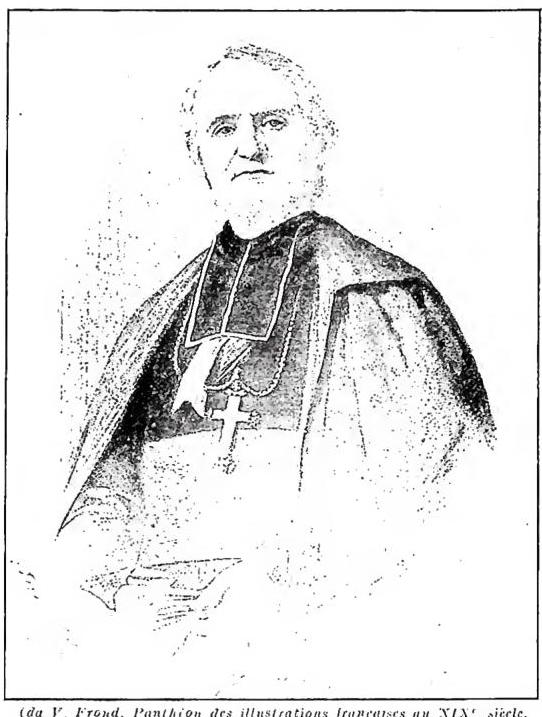
DUPANLOUP, FÉLIX-ANTOINE-PHILIBERT. – Bishop of Orléans, born at St-Félix in Savoy on 3 January 1802, died at Lacombe (Savoy) on 11 October 1878. Educated at the minor seminary of St-Nicolas du Chardonnet and then at St-Sulpice, he left the latter as a priest on 18 December 1825. He began his activity as curate at the Assumption, where he immediately distinguished himself through his exceptional gifts as a catechist, so much so that he was entrusted with the religious instruction of the royal princes. There he founded the Academy of St. Hyacinth, deserving of great credit for the education of the young. He then moved, likewise as curate, to the Madeleine and subsequently, in 1836, to St. Roch. As early as 1833 he had inaugurated at Notre-Dame those celebrated conferences which were later to be continued by so many illustrious speakers. In 1838 he received Talleyrand’s recantation and final confession. From 1837 to 1845 he was rector of Chardonnet, acquiring there and lavishing upon it a wealth of pedagogical experience. E. Renan, his pupil—who unfortunately degenerated—bears witness to this: “Only those who knew St-Nicolas du Chardonnet during the brilliant years from 1838 to 1844 can form an idea of the intense life that unfolded there. And this life had only one source, one principle: Monsignor D. ... He was an unrivalled stimulator. No one equalled him in the art of drawing from each of his pupils the sum
He later gathered his experiences as an educator in a great work, in two parts: De l'éducation en général (3 vols., Paris 1850–62) and De la haute éducation intellectuelle (3 vols., ibid. 1855–57). As versatile as he was, he also found time to devote himself to the external apostolate as an effective writer on all the major questions of the day: De la pacification religieuse (ibid. 1845); La situation intellectuelle et religieuse du clergé; Les petits séminaires. Etat de la question (ibid. 1847), on freedom of education, etc. In 1841 he became professor of sacred eloquence at the Sorbonne, and in 1845 vicar general of mons. Affre, canon of Notre-Dame and director of L'Ami de la religion. In 1849, as a member of the commission appointed by Minister Falloux to prepare the law on freedom of education, he exercised a decisive influence.
In April of that same year he was elected to the episcopal see of Orléans. He distinguished himself through his intelligent and indefatigable zeal in the formation of the clergy, in the education of youth, and in the teaching of catechism. In 1852, in a letter to the professors of his minor seminary, he defended the study of the pagan classics against Gaume’s misgivings. On 9 November 1854 he was admitted to the French Academy. The following year he delivered in the cathedral the panegyric of Joan of Arc; he delivered another in 1869, the year in which he took the first steps in Rome toward the introduction of the cause for the heroine’s beatification, and in 1876 he transmitted to Rome the results of the diocesan informative process.
From 1859 to 1870, through his speeches and writings, he was the indomitable champion of the Pope’s temporal power. He was not, however, an ultramontanist. In 1862, at the château of La Roche-en-Brény, he pledged with Montalembert and Falloux to fight “pro libera Ecclesia in libera patria.” It was the programmatic motto of French Catholic liberalism. Desiring to reconcile the imprescriptible rights of the Church with the modern spirit, he wrote La convention du 15 septembre et l'encyclique du 8 septembre 1864, in which he comments on the Syllabus with mitigating glosses that ex-
DUPANLOUP FÉLIX-ANTOINE-PHILIBERT - DUPHOT LÉONARD
He received praise from no fewer than 630 bishops and from Pius IX himself (4 February 1865). Always in the forefront, he rejected Minister Duruy’s attacks on Christian education; opposed the admission of Littré to the Academy; took part in the Congresses of Malines in 1864 and 1867; attended the episcopal meetings in Rome in 1862 and 1867; and continued to be present, through pamphlets and pastoral letters, in every religious and social debate of his time. It is unfortunate that certain Gallican tendencies led him, for reasons of expediency, to adopt a hostile attitude toward the definition of papal infallibility, whereas he had not failed to support and defend it precisely in his doctoral theses in Rome in 1842. He feared that this definition might hinder the conversion of Protestants and compromise the faith, still too weak, of so many Catholics. He therefore published in November 1869 the Observations sur la controverse soulevée relativement à la définition de l'infallibilité au futur concile. He thus maintained the inopportuneness of that definition to the very end and, on the eve of the definitive session, rather than repeat the non placet in the Pope’s presence, preferred to return to his diocese. Yet as soon as the dogma had been defined, he hastened to perform an act of submission.
During the German occupation of Orléans he was the true defensor civitatis: grateful Catholics elected him as their representative in the National Assembly, where he spoke whenever a religious interest had to be defended, especially with regard to the freedom of higher education (July 1875). He refused the see of Lyon (1875) and instead agreed to become a member of the Senate (1876). Despite his advanced age, he continued to fight with youthful energy against the spreading forces of unbelief and Freemasonry. Through his vigorous protests, he obtained the government’s disapproval of the celebrations organized in 1878 by the Municipal Council of Paris for the centenary of Voltaire’s death. Leo XIII wished to grant him the cardinalate; but the government raised difficulties, and meanwhile D. died suddenly. He was certainly not a great theologian, but in compensation he was a great shepherd of souls. In light of this, certain of his attitudes become understandable, even though not all of them can be justified.
The list of D.’s works is found in Herluisson, Liste bibliographique des écrits de mgr D. (Orléans 1878; in Polybiblium, 2 [1888], pp. 463 ff.), as well as in F. Lagrange, Vie de mgr D. (III, Paris 1894, pp. 486 ff.). Subsequently, the Journal intime, edited by L. Branchereau (2nd ed., Paris 1910), and a selection of the best pages, edited by H. E. Dutoit, D. (Choisir collection, I, ibid. 1933), were published.