
ORLÉANS, DIOCESE of. - Diocese and prefecture city in the department of Loiret, on the right bank of the Loire, at the confluence of the O. canal.
(phot. A. Ferri, Cagliari)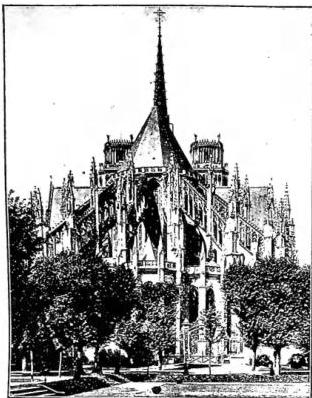
"Cenabum", conquered by Julius Caesar in 52 B.C., was a very ancient religious, commercial, and road center; after having been part of the civitas Carnutum, at the end of the 3rd century or the beginning of the 4th century A.D. it became the civitas Aurelianorum.
The list of the bishops of O. is handed down by the first collection of St. Alban of Angers (cod. Vat. Reg. 465); it ends with Rainier (ca. 1066-82). L. Duchesne believed that the list originally went as far as Odalric. The first bishop was Diclopitus who signed the act of absolution of St. Athanasius in 346: he was followed by Alitus and Desianus; then came Enurtius or Fortius who was at the Council of Valence in 374 (he is listed on Sept. 7 in the Martyrologium Hieronymianum; but his biography dates from the first half of the 9th century); his successor Anianus saved O. from Attila (the Hieronymianum records his deposition on Nov. 17 and a translation on June 14; the Bern manuscript adds: "et liberatio civitatis ipsius a Chunis"); then Prosper and Flavulus who are also found in the Hieronymianum on June 2 and Feb. 2; Eusebius, Leontius, Antoninus, and Marcus attended respectively the Councils of O. of the years 511, 533, 538, and 541; in the one of 549 the innocence of Marcus was recognized. Ricomer was at the Council of Paris in 573; Namatius at those of Mâcon in 581 and 585; Ando at those of Clichy in 627 and Chalon-sur-Saône in 650; Eucherius died in exile at St-Frond in 739. At the time of Charlemagne, Theodulf, who was also a poet, was bishop, then Jonas from 818 to 843 (J. Reviron, Les idées politico-religieuses d'un évêque du IXe siècle, Jonas d'O. et son De institutione regia, Paris 1930); then Agius (843-67) and Valterius (868-891); St. Theodoric ca. 1016-22; later the cardinals Regnault of Chartres (1439-49) and John of O. (1521-1533); A. Sanguin (1535-50), later archbishop of Toulouse; P. du Cambout de Coislin (1666-1706); Merlot (1839-43), later archbishop of Tours and Paris; P.-H. Coullie (1878-1893) later archbishop of Lyon, and A.-St. Touchet (1894-1926) propagator of the cult of St. Joan of Arc. Clovis occupied O. in 498, then followed the Kingdoms of Chlodomer and Guntram; in 612 Clothar II united the Kingdom of O. to that of Neustria. From then on the city flourished increasingly, where kings were often consecrated and resided. In 1344 Philip of Valois created the Duchy of O. for his son Philip, and Charles VI gave it to his brother Louis, killed in 1407; then O. suffered the siege of the English in which the heroic St. Joan of Arc shone (v.). Louis XII in 1499 united O. to the crown of France. In 1562 O. became the headquarters of the Huguenots and submitted in 1594 to Henry IV. Louis XIII created his brother Gaston duke of O., and later the duke of O. was Philip, brother of Louis Philippe, who became king of France in 1830.
During the Revolution, O. was the seat of the National High Court which judged political trials; Collot d'Herbois and Barère raged there. O. was occupied by Germany in 1815 and in 1870 until March 1871. It suffered greatly from the bombardments of June 1940 and in the years 1943-44.
The Cathedral of the Holy Cross rises above two earlier buildings, the first from the 4th century, enlarged by a Carolingian rotunda, burned in 989; the second Romanesque building between the end of the 10th century and the 11th century transformed into Gothic in 1287 by Bishop Gilles Gasté, unfinished and set on fire by the Huguenots in 1562. The nine chapels of the choir (end of the 13th century) and other elements from the 14th century remain. Henry IV in 1601 laid the foundation stone of the present Basilica; work continued until 1829 and various architects collaborated, among whom was the Jesuit father S. Martillange; the façade is the work of Trouard; the interior, with five naves, measures 13 x 41 m.; the transept 53 x 27 m. and the vaults are 32 m. high. There are the funerary monuments of the bishops of O., Cardinals De Coislin (1666-1706) and Touchet (1926) and of Monsignor Dupanloup. Beneath the choir is the large crypt explored in 1937-38, bringing to light the Romanesque basilica of the end of the 10th century with 11th-century alterations; it had an ambulatory; at a lower level are the remains of the primitive rectangular basilica and fragments of a rotunda with a large mosaic from the Carolingian age with relative inscriptions. Three tombs of bishops were found, two from the 13th century and one from the beginning of the 14th century, with artistic objects now preserved in the Cathedral treasury (G. Chenesseau, Les fouilles de la cathédrale d'O., in Bulletin monumental, 97 [1938], pp. 73-94; id., Fouilles faites dans la cathédrale d'O. en juillet et octobre 1942, in Bulletin des antiquaires de France, 1942, pp. 218-25). Councils were held in O. in the years 511 (July 10); 533 (June 23); 538 (May 7); 541 (May 14); 549 (Oct. 28); between 639 and 641, and in 1022.
The old bishop's palace (17th cent.) is now occupied by the Municipal Library founded in 1714; it possesses a series of precious manuscripts from the 7th to the 15th century, partly coming from the abbey of St-Benoît-sur-Loire, and many incunabula; furthermore, the Desnoyers collection which includes over 10,000 volumes relating to O.
St-Aignan, a Benedictine abbey founded in 617 near the tomb of the holy bishop, restored several times after fires and destructions (865, 999, 1370, 1428, 1562), profaned during the French Revolution; of the ancient building remain the transept and the choir; the chapter house and the sacristy are from the 15th century; three chapels on the left from the 16th century. The crypt dates from the 11th century.
St-Euverte, a church erected between the 9th and 12th centuries, pulled down during the Hundred Years' War, rebuilt in 1445; devastated by the Huguenots in 1562, repaired until 1655, closed and abandoned with the Revolution, then reopened to worship and today the chapel of a boarding school (C. Berrois, Histoire de l'abbaye de St-Euverte, Orléans 1919). Where the parish of St. Mark is located, the Benedictine priory of St-Gervais was founded in 817, later dedicated at the end of the 15th century by Charlotte of Savoy to St. Faretrius (Phallier), demolished by the Huguenots in 1562 (Cottineau, II, col. 2140).
N.-Dame de Bonne Nouvelle (de bono nuntio) was founded in 1026 for Benedictine nuns; in 1126 it became a Benedictine priory, passing to the Maurists in 1653. The monastery, situated on the site of a Roman monument, is now occupied by the prefecture (ibid., II, col. 2142). Notre-Dame de Recouvrance was consecrated on April 14, 1519, on the site of an 11th-century chapel dedicated to Notre-Dame de Bon Secours. The church of St-Pierre-le-Pueller preserves architectural remains from the 12th and 13th centuries and a Romanesque apse. The church of St. Paul, with three naves, dating from the late Gothic period (16th century), with a cloister and bell tower from 1629, was burned down in 1940. On the right nave is the sanctuary chapel of Notre-Dame des Miracles, which dates back to the 9th century; in front of the ancient statue, burned in 1562 by the Huguenots, Joan of Arc prostrated herself in gratitude on May 8, 1429, after the liberation of Orléans. The church of St-Pierre-du-Martroi, formerly St-Pierre Ensentele, erected in the time of Francis I, was devastated by the Huguenots and restored at the end of the 16th century. The church of St. Paterne was rebuilt in 1876; St-Loup ("S. Lupus ad Ligerim"), originally "Vinea B. Mariae," was a priory of Benedictine nuns founded in 1235 at St-Jean-de-Bray by St. Louis; in 1639 it was transferred to France and Urban VIII erected it into an abbey, which was suppressed in 1792 (ibid., col. 2141). La Madeleine, belonging to the Order of Fontevrault, was founded in 1113 by Robert of Arbrissel, destroyed by the English in 1428, rebuilt in 1466, and suppressed by the French Revolution (it was located in the present-day suburb of La Madeleine [ibid., col. 2141]). About 3 km from Orléans was the abbey of Micy, today St-Mesmin, founded by St. Euspice, priest of Verdun (d. 510), and by his nephew St. Maximinus (Mesmin, d. 520) on land donated in 508 by Clovis, and initially dedicated to St. Stephen. It held great cultural importance. It was plundered several times in the years 732, 856, 897, and 1562, and restored on several occasions starting from the time of Theodulf and St. Benedict of Aniane; around 1830, Abbot de la Rochefoucauld invited the Feuillants there. It was suppressed in 1790 by the French Revolution; the last abbot, Chapt de Rastignac, was one of the victims in Paris at the Abbaye prison in September 1792 (E. Jarossay, Histoire de l'abbaye de Micy-St-Mesmin-lez-Orléans, son influence religieuse et sociale, d'après les archives et les documents originaux, pièces justificatives et gravures, Orléans 1902; Cottineau, II, cols. 1845-46). The house where St. Joan of Arc stayed from April 29 to May 9, 1429, was damaged by bombing in 1940.
The schools of Orléans, where King Guntram of Burgundy and his son Childebert were educated, held notable importance; they flourished in the Carolingian era under Bishop Theodulf and even more so from the 11th to the 14th century. Teachers from Orléans wrote treatises on rhetoric entitled Ars or Summa dictaminis; in 1230, not a few students from the University of Paris moved to Orléans; in 1298 Boniface VIII also commissioned the doctors of Orléans to comment on the Decretals. Clement V was a student at Orléans and, by a bull of January 27, 1306, conferred upon it the title and privileges of a university. Of the great university buildings, nothing remains except the so-called "Salle des Thèses" from the end of the 15th century, which housed the city's first public library; today it is the seat of the "Société archéologique et historique de l'Orléanais." St. Lifardus, abbot of Meung-sur-Loire, is commemorated on June 3 in the Hieronymian Martyrology. There are many saints of the diocese; among them are St. Baudilius, Nîmes (v.); St. Lucanus, patron of Loigny; St. Donatus, abbot of May; St. Mesma, sister of St. Maximinus; St. Fenicula, patroness of Gien; the Burgundian king, St. Sigismund, and St. Guntram; St. Lupus, bishop of Sens; St. William, abbot of Fontainjean and later archbishop of Bourges; Bl. Odo, bishop of Cambrai, and Reginald, dean of the collegiate church of St-Aignan. Goyau (v.) was also from Orléans. In 1130, St. Bernard and Innocent II were in Orléans.