Machine translation of the 1948–1954 Italian original. The original text is authoritative.
ORISTANO, DIOCESE of. – City and diocese in the province of Cagliari, with 38 municipalities in the province of Cagliari and 18 in that of Nuoro.
It has an area of 4,000 sq km and a population of 130,000 inhabitants, all Catholics; it comprises 77 parishes served by 116 diocesan and 26 regular priests; it has one seminary, 3 male and 36 female religious communities (Ann. Pont., 1952, p. 302).
The diocese was created in the 11th century. Boniface VIII raised it to metropolitan status on 24 April 1296. Bishop G. Serra, created a cardinal in 1500, retained the diocese until 1510. On 15 July 1515, the diocese of S. Giusto was united with it; its last bishop had been Mgr. G. Toreglias. The archbishop bears the titles of bishop of S. Giusto and abbot of S. Michele in Thomis. The Cathedral is dedicated to the Assumption; the protector of the diocese is S. Archelaus.
O. was the seat of the judges of Arborea, one of the four giudicati of Sardinia in the 11th century. O. included the curatorie of Simaghis, Milis, Barbagia, Ololai, and Gileiber. Under the rule of the lordship of Aragon, the influence of Tuscan art, especially that of Pisa, continued there.
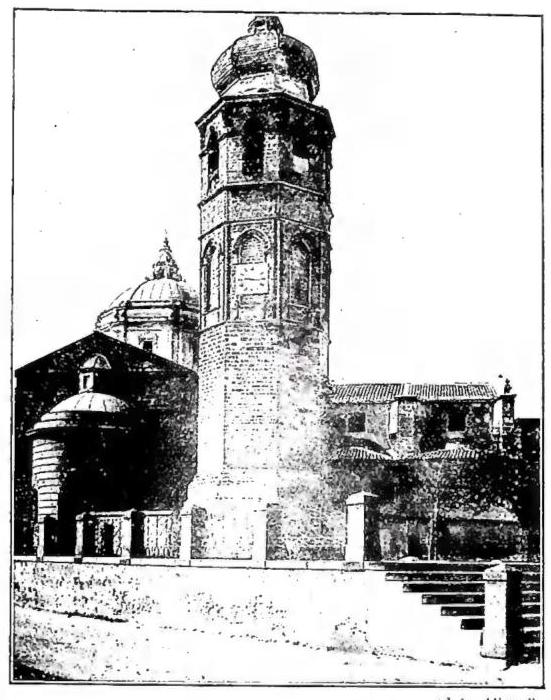
The Cathedral was erected by Archbishop Torgotorio and Mariano, judge of Arborea, in 1228. It then had a basilica-shaped plan, and Roman columns and capitals taken from nearby Tarros were used in it; inscriptions documenting this construction remain. D. Scano identified two slabs with bas-reliefs from the 8th–9th century, perhaps eviden-
(phot. Fotobel)
ORIONE, LUIGI - Ritratto.
ORISTANO, DIOCESI di - Fianco e campanile della Cattedrale (sec. XVII).nienti dalla cattedrale di Tarros; in una è Daniele nimbato tra i leoni, nell'altra due leoni azzannanti due cerbiatti: al rovescio esse presentano lo scudo del Giudicato di Arborea e le scene di Gesù in trono, l'annunciazione e l'incoronazione della s.ma Vergine, s. Antonio e s. Giovanni, opera forse di Andrea Pisano per ornare l'altare o il coro; inoltre le statuine della Madonna e di un apostolo, probabili sostegni dei due pulpiti (D. Scano, Sco-parte artistiche nel duomo di O., in L'arte, 4 [1901], pp. 358-360). Di grande pregio è il crocifisso ligneo detto di Nicodemo, datato al 1350 ca., di probabile provenienza pisana (R. Branca, Il crocifisso di Nicodemo, Milano 1935). Alla chiesa di S. Francesco fu prima annesso un monastero benedettino al quale subentrarono nel sec. XIV i Francescani. La chiesa venne trasformata nel sec. XVIII dall'architetto Cunia, ma conserva opere d'arte anteriori, tra cui una statuetta di vescovo, forse s. Biagio, con tracce di policromia e l'iscrizione «Ninus magistri Andree de Pisis me fecit» (figlio di Andrea Pisano). Presso O. sorge la chiesa della Maddalena, di architettura pisana; l'incavallatura del tetto è sorretta da mensole in cui sono scolpiti i simboli degli Evangelisti a decorazione policroma (D. Scano, Notizie di Sardegna, in L'arte, 6 [1903], pp. 327-28).
BIBL.: Eubel, I, pp. 101-102; II, p. 92; III, p. 115; IV, p. 91; per S. Giusto: Eubel, I, pp. 287-88; II, p. 169; III, p. 216; Sulle carte di Arborea: W. Foerster, Sulla questione della autenticità dei Codici di Arborea, in Memorie della Accaa, reale delle scienze di Torino, 2ª serie, 55 (1905); A. Solmi, Studi storici sulle istituzioni della Sardegna nel medioevo, Cagliari 1917; Cottineau, II, col. 2138; P. Sella, Rationes decimarum Italiae nei sec. XIII e XIV (Studi e testi, 113), Città del Vaticano 1945, n. 339 e passim. Enrico Josi
Cite this article
“ORISTANO, DIOCESI DI.” Enciclopedia Cattolica, vol. IX (1952), p. 232. Azione Romana digital edition, https://azioneromana.com/article/oristano-diocesi-di.