
BIAGIO, saint and martyr. — The details of his life and martyrdom are uncertain and obscure.
According to the Passio, widely circulated though highly fabulous, he was a physician before being elected to the episcopal see of Sebaste in Armenia, his native city. When the persecution of Licinius broke out (307–323), he hid in a cave where he healed beasts that came to him; discovered by some hunters and brought before the prefect Agricolaus, he was subjected to horrible torments. Condemned to capital punishment, as he was being led to execution he performed other miracles, including healing a boy who was choking on a fishbone. Thanks to this prodigy, BIAGIO is invoked especially for throat ailments, and on his feast day (February 3) it is customary to bless throats with two blessed candles. He was widely venerated in the West and was numbered among the Holy Helpers (v.).
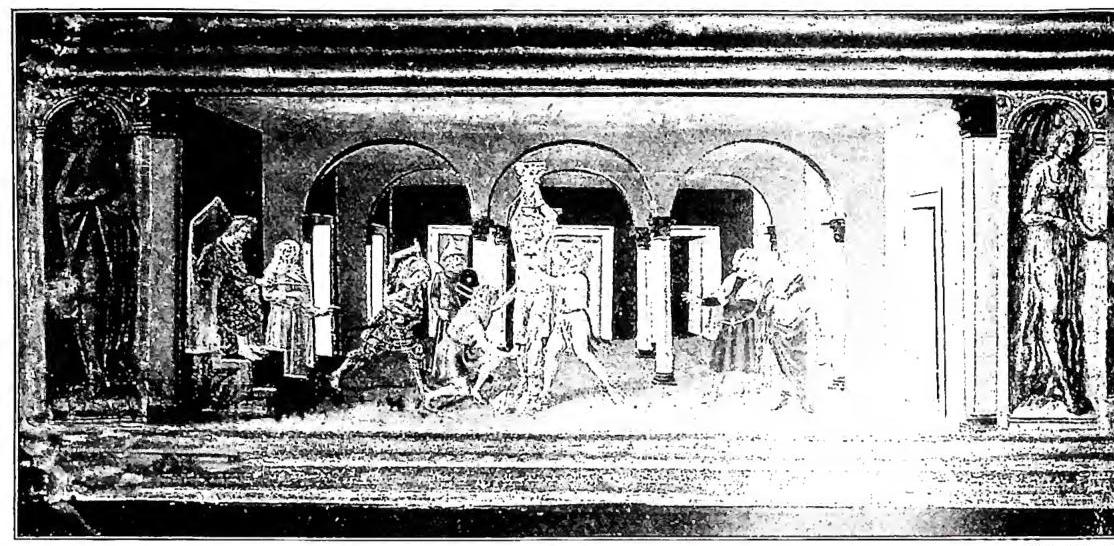
(photo Alinari)
BIAGIO, saint — Martyrdom of the Saint. Predella panel attributed to Vecchietta (c. 1412–80) — Pienza, museum.
Since the instruments of torture mentioned in the legend include iron combs, and this is one of his distinctive attributes in iconography—as seen, for example, in the painting by Domenico Ghirlandaio (Galleria Mazzarosa, Lucca)—the Saint has been chosen as the patron of wool carders. He is also venerated as the protector of farmers, who in some places (for example, in France) celebrate him with a procession featuring decorated carts and costumed groups. Some ethnographers see in this the substitution of a previous pagan cult of some rural deity whose feast coincided with the same date. The Saint is also invoked by working-class girls to find a husband.