
LUCCA, ARCHDIOCESE of. — Archdiocese and capital city of the eponymous province in Tuscany. It has an area of 950 sq. km. and a population of 259,270 inhabitants, of whom 259,227 are Catholics. It comprises 253 parishes, served by 415 diocesan priests and 123 religious priests, one seminary, 19 male and 42 female religious communities (Annuario Pontificio, 1951, p. 255).
A Ligurian settlement, later occupied by the Etruscans, L. became a Latin colony in 180 B.C. and then a municipium (90–89 B.C.); under Augustus it formed part of Etruria and subsequently of Tuscia Annonaria. It then became a Lombard duchy around 570; later it formed part of the Marchesato of Tuscany and was included in the dominions of the House of Canossa. The Commune, already governed by consuls from 1107, soon succeeded in definitively freeing itself from imperial and feudal constraints (1197) and reached the height of its political and economic power in the thirteenth century. The premature end of the lordship which Castruccio had established (1314–28) opened the way to foreign dominations (1328–69), brought to an end by Charles IV, who restored the ancient liberty (15 April 1369). But the Republic, after the brief interlude of the lordship of P. Guinigi (1400–30), gradually changed from its democratic origins into a closed aristocratic and then oligarchic constitution (1556). Constituted as a principality in favor of Elisa Bonaparte, wife of Felice Baciocchi (1805–14), it became a duchy (1817) under Maria Luisa and Carlo Lodovico di Borbone, until in 1847 it passed under the rule of Leopoldo II of Tuscany, subsequently becoming part of the Kingdom of Italy.
For L. too, a very late tradition connects its Christian origins with a Paolino sent by St. Peter, together with three companions, to evangelize the city and establish the episcopal see there. According to an approximate calculation, the diocese, like those of Pisa, Florence, Siena, and Arezzo, would have appeared in the first decades of the fourth century; the first certain bishop, Massimo, was present at the Council of Sardica in 343. The first fifteen bishops in the authentic episcopal catalogue descend, though not according to the original order, to around the end of the sixth century; the most venerated among them, St. Frediano, prior to the Lombard invasion, is mentioned by St. Gregory the Great (Dialog., III, 9). The bishops Leto and Eleuterio appear respectively at the Roman Councils of 649 and 680; and the documents of the exceptionally rich capitular archive record the activity of their successors. They also attest to the division of the very extensive diocesan territory into pievi as early as the sixth century, if not earlier, as well as to the existence, by the eighth century, within the boundaries of these pievi, of minor churches subordinate to them, which would become full-fledged parishes in the communal period (twelfth–thirteenth centuries), together with charitable works and pious foundations. Toward the end of the eleventh century and during the twelfth, the pievi were transformed into collegiate churches, so that some of them later became true monasteries, such as S. Frediano and S. Michele in Foro in the city, S. Pietro di Pozzeveri and S. Pantaleone on the Mons Heremitae in the countryside; while others, toward the end of the fourteenth century, were transformed into secular collegiate churches, such as S. Donato (transferred to S. Paolino in 1513), S. Alessandro Maggiore, and S. Maria di Camaiore. Some of these still survive, while others were suppressed under the rule of the Baciocchi.
In antiquity the diocese evidently extended over the entire territory belonging to the city, occupying the Val di Nievole as far as beyond S. Miniato al Tedesco. It then proceeded into the lower Valdarno and the Val d’Era, and in its farthest southern part included the Tuscan Maremmas, bordering the dioceses of Volterra, Populonia, and Rosselle. It also possessed, in the territory of Pisa, the monastery of Sesto, Bientina, S. Michele di Verruca, S. Frediano di Vecchiano, and S. Maurizio di Filettole. To the north it reached the Modenese territory at the Giogo dell’Alpe, where the sanctuary and hospital of SS. Pellegrino e Bianco arose as early as 1110; it then extended into the Garfagnana to include the lands of Piazza and Sala, the ancient fief of the bishops of Lucca, and finally reached Versilia with S. Martino di Pietrasanta and the ancient pieve of S. Felicita. But the need to remove from the spiritual jurisdiction of the bishops of L. lands which politically belonged to other states considerably reduced this extent, and it is estimated that from 1519 to 1853 the diocese lost approximately 200 parishes, together with the monasteries and charitable institutions that existed in those territories.
Leo X, in fact, raised the ancient pieve of Pescia to a provostship (15 April 1519) and made it immediately subject to the Holy See, placing under it the churches of the Val di Nievole and the Valleriana that had remained outside the political dominion of L.; following the bull of Benedict XIII (17 March 1726), these formed the diocese of Pescia. At the request of the grand duchess Maria Maddalena d’Austria, Gregory XV erected the new diocese of S. Miniato on 9 December 1622. By this measure, 118 churches, convents, charitable institutions, etc., were removed from the jurisdiction of the bishop of L., among them the collegiate churches of Fucecchio, S. Croce, Castelfranco, and S. Maria a Monte. At the request of Grand Duke Pietro Leopoldo, the two vicariates of Barga and Pietrasanta (17 parishes), together with the pieve of Ripafratta, were united to the primatial see of Pisa by Pius VI (18 July 1789). In the same document, however, the Pope ordered that several parishes of the coast and of the adjoining hills of Lucca should pass from the diocese of Pisa to that of L. With the erection of the diocese of Massa (3 July 1822), Leo XII assigned to the new bishopric the 48 churches included in the vicariate of Garfagnana and the priory of Castiglione (41 parishes, 7 cures). Pius IX (17 December 1853) ordered the fifth and final dismemberment, by which all the churches situated in the territory of Gallicano (9 parishes) passed to the diocese of Massa.
(total Eva)
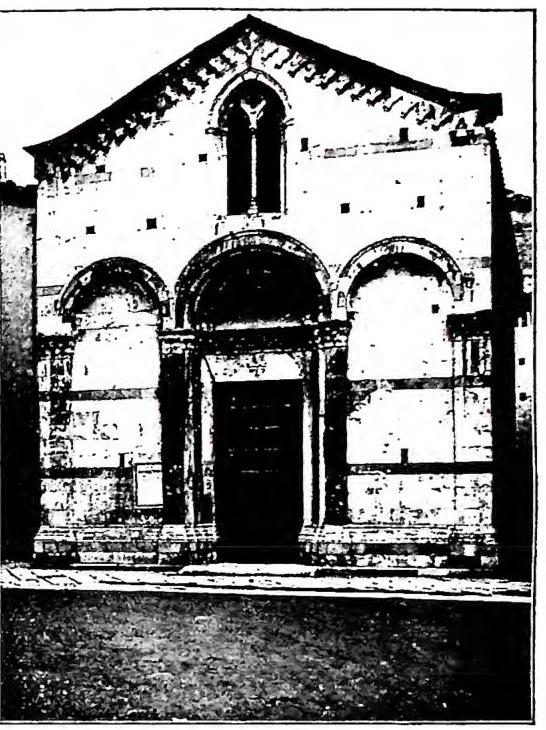
LUCCA, ARCIBIOCESI di — Oratory of S. Giulia (thirteenth–fourteenth century). Lucca.
diocese (1742), and a few years later granted the government the right to present four names, later three, for the appointment of the bishop.
Shrines. — There are no widely renowned shrines in the diocese, except for the one established in the city in 1940, near the monastery of the Passionist nuns, in honor of s. Gemma Galgani (d. in 1903), and the other located at the boundaries of the three towns of Capannori, Antraccoli, and Lunata, where since 1665 a fresco depicting Our Lady of Carmel between s. Roch and s. Sebastian has been venerated; it was entrusted (1940) to the Discalced Carmelites of the Tuscan province. But since the Middle Ages the effigy of the Volto Santo was famous at L.; that is, the wooden Crucifix which, during the iconoclastic period, is said to have reached the shore of Luni and from there to have been transported to L. (742), and then placed in its Cathedral. According to the legend of Leobinus, the cult dates from the 8th century, and there is no reason for doubt; but in that case the present Volto Santo is not the ancient one, and all the documents are silent concerning a replacement in the 12th century.
Also remembered is s. Zita (d. in 1278), whose incorrupt body rests near the basilica of S. Frediano, in the chapel erected in 1321 by the Fatinelli, the fortunate masters of the poor and holy maidservant.
there 1943. Organization of the diocese: M. Giusti, Le canoniche della città e diocesi di L. al tempo della riforma gregoriana, in Studi gregoriani, III, Rome 1948, p. 321 ff.; L. Nanni, La parrocchia studiata nei documenti lucchesi del secc. VIII-XIII, in Analectia Gregoriana, 1948. On the Volto Santo: P. Guidi, La Luminara di S. Croce nel medio evo, Lucca 1920; id., La data nella leggenda di Leobino, in Archivio storico italiano, 7° serie, 18 (1932), p. 153 ff.; A. Guerra-P. Guidi, Storia del Volto Santo, I, Sora 1926; F. P. Luiso, La leggenda del Volto Santo, I, Storia di un cimelio, Pescia 1928; F. Baroni, Il Volto Santo di L. e le sue gloriose origini, Lucca 1932; G. Schnürer-J. Rits, Sankt Kümmernis und «Volto Santo», Düsseldorf 1933; A. Pedemonte, Quando venne il Volto Santo a L., Lucca 1936.
Domenico Corsi
ARTE. —
1937. Architecture
From the outset, the forms of Lucchese architecture reveal an adaptation of those of Pisa—not only in the city, but also in its territory (the parish churches of Segromigno, S. Andrea in Gattaiola, and S. Maria del Giudici, and that of S. Giovanni near Pietrasanta, from the thirteenth century); and Pisan architects worked in L., although a particular taste for a profusion of ornament reveals a direct influence of Lombard craftsmen (S. Frediano, consecrated in 1147; S. Maria Forisportam, S. Michele, and S. Giovanni, all three from the end of the twelfth century; and the façade of the cathedral of S. Martino, dated 1204 and signed by maestro Guidetto, animated by its recesses of shadow and by the richness of its inlaid and carved ornamentation). These tendencies toward lightening the Romanesque mass are also found in the façades of S. Michele in Foro and S. Pietro Somaldi (thirteenth century), and become more pronounced with the arrival of Gothic influence, which was especially decisive, toward the end of the fourteenth century, in the work of reconstructing the interior of the Duomo.In the territory of the diocese, Pisan characteristics, still mingled with Lombard forms, are found in the façade of the cathedral of Barga, and in the parish churches of S. Cassiano di Controne, Castelvecchio at Vellano, S. Gennaro at Capannori, Villabasilica, and Brancoli; while Gothic art is present in the upper part of the façade of S. Agostino at Pietrasanta and in S. Michele di Castiglione Garfagnana. During the Renaissance, Florentine influences predominated, strengthened by the activity of artists who came from Florence, such as Baccio da Montelupo, to whom the architecture of S. Paolino (1522) is owed, and Bartolomeo Ammannati, who began the Palazzo della Signoria (1578) and built the Palazzi Bernardino and Orsetti. Local glories, however, were Matteo Civitali (1435–1501), who built the Palazzo Pretorio, followed by his son Nicolao (b. 1482) and the latter’s son, Vincenzo (1523–97). For the Baroque period, the Villa Garzoni at Collodi and the enlargement of the Palazzo della Signoria by Juvara and the Lucchese Francesco Pini may be mentioned; Lucchesi also included Fr. Buonamici (who later moved to Malta) and D. Martinelli (who went to Austria). For the nineteenth century, L. Nottolini (1787–1851) should be recalled.
1938. Sculpture
Lombard influence was also predominant in the sculpture of the twelfth and thirteenth centuries: in the scenes from the life of Moses on the basin of the baptismal font of S. Frediano (end of the twelfth century), the work of a Maestro Roberto; in the decoration of church façades, for the most part connected with the manner of Guidetto; in the work of Biduino, who inscribed his name on the side portal of the church of S. Salvatore (end of the twelfth century); and in that of the anonymous sculptor, probably Pisan, who left the beautiful group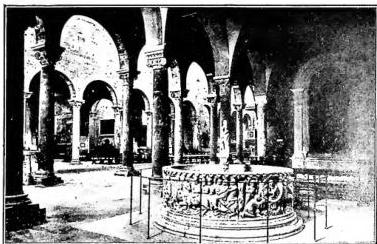
3. Painting. — Painting, which in L. too first manifested itself in the decoration of church façades (see, for example, the Byzantine-style mosaics in the upper part of the façade of S. Frediano), saw the Berlinghieri and Deodato Orlandi at work in the thirteenth century. The former are recorded in L. as early as 1228, and the Cross (signed) in the Pinacoteca is by Berlinghiero the elder, while Bonaventura signed in 1235 the panel depicting s. Francesco and scenes from his life in the church of S. Francesco at Pescia. Deodato Orlandi left his name on the Cross of 1288 (Pinacoteca), and the fresco on the tomb of Bonaiuta (1274) in the cloister of S. Francesco may also be attributed to him. In the fourteenth century, the local school left works of some merit by Angelo Puccinelli, active until the first decade of the following century, influenced by Siena (Triptych of 1350 in the Museum) and subsequently by Traini and A. Gaddi (Passing of the Virgin of 1386 in S. Maria Forisportam); and by Francesco Anguilla (1386–1440), likewise a follower of the Orcagna and Traini. In the fifteenth and sixteenth centuries, however, the influx of Florentine works was decisive for the development of local painting. Among the Florentine-influenced artists, Paolo Zacchia should be recalled (Ascension, dated 1561, in the choir of S. Salvatore; Assumption, in the Pinacoteca), as well as his grandson Lorenzo Zacchia (works in the churches, dated from 1550 to 1587), and Agostino Marti (lunette of 1516 in S. Paolino; Marriage of the Virgin of 1520 in S. Michele). In the seventeenth century, the Lucchese school of painting was subject to the influence of that of Bologna; and from G. Reni derive the works of Paolo Biancucci (Purgatory in the church of the Suffragio; panel with various saints in S. Francesco) and Pietro Ricchi (two paintings in S. Francesco). Pietro Paolini, on the other hand, drew inspiration from Domenichino and the Venetians (Martyrdom of s. Andrea in S. Michele; S. Gregorio Feeding the Pilgrims in the Library of S. Frediano). Pietro Testa, called il Lucchesino, perhaps learned the first rudiments of his art from Paolini; his paintings are in S. Romano and S. Paolino, and a fresco with Liberty is in the Palazzo pubblico. In the eighteenth century, Pompeo Batoni acquired great renown as one of the most gifted Italian artists of the early Neoclassical period. — Vedi tavv. CXIII-CXIV.