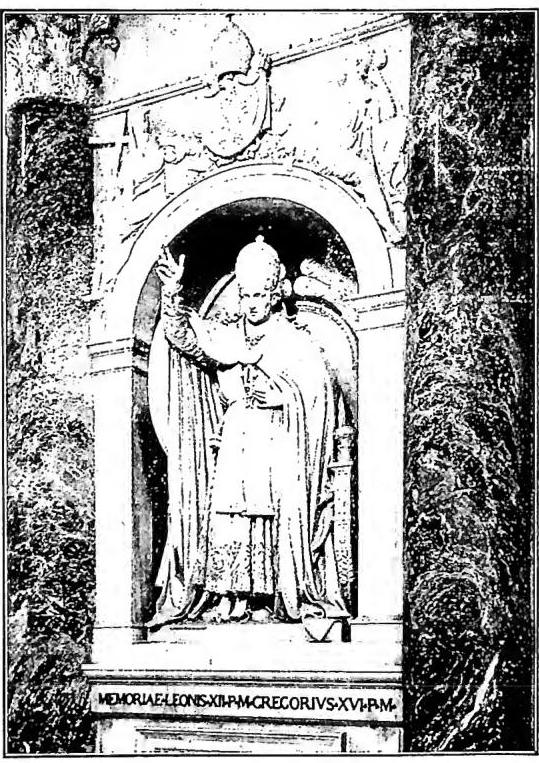
LEONE X, PAPA. – Born in Florence on 11 December 1475, died in Rome on 1 December 1521.
I. BEFORE THE PONTIFICATE
Giovanni de' Medici, second son of the magnificent Lorenzo, had Poliziano as his tutor at the age of three, but after a few months was entrusted to the education of others, and was above all spiritually formed by the learned, joyous, multifaceted life of Medici Florence. A cleric and protonotary before the age of eight, provided by his father with numerous benefices, and abbot of Montecassino and Morimondo at eleven, at little more than thirteen he was secretly created cardinal by Innocent VIII, as a seal of his friendship with Lorenzo (9 March 1489). Having graduated in canon law at Pisa, three years after his creation he received the cardinal’s hat and was given the title, rather than the authority, of legate in the Patrimony and the Florentine dominion. In the Conclave of 1492, after a shrewd attempt to reconcile the Sforza and Aragonese factions, he yielded to the former and, not without simoniacal agreements, gave his vote to Rodrigo Borgia, Alexander VI. Not a friend of the new pope, and on none-too-cordial terms with his brother Piero, he lived in the shadows until the catastrophe of Medici rule, which he had vainly tried to avert (9 November 1494), forced him to wander through Italy, Germany, the Netherlands, and France, where he acquired maturity and experience.Returning to Rome before September 1497, he gathered in the palace he had had built near S. Eustachio (Palazzo Madama) books, men of letters, and artists, and distinguished himself by his munificence in restoring the diaconal church of S. Maria in Domnica and in giving Bolsena the splendid façade of S. Cristina. Legate of Bologna for Julius II (1 October 1511), he was taken prisoner by the French at Ravenna (11 April 1512) and, brought to Milan, skillfully restored the prestige of the pontificate and his own.
Freed by relatives and peasants, he was legate with the Hispano-Papal army that was to restore the Medici to Florence, and, after the sack of Prato, reentered the city (September 1512) and governed it with moderation.
II. THE PRINCE
In the Conclave that followed the death of Julius II, he swore, together with the others, an electoral capitulation that greatly restricted the authority of the Pontiff; but, as was customary, he did not subsequently observe II. He was elected pope (11 March 1513), without simony, as an act intended «to calm poor Italy and set the Church in order». Indeed, after the storm of the pontificate of Julius, he announced a programme of peace. At the same time, he wished to defend the «liberty of Italy», by preventing either the French or the Spaniards from predominating alone, or, having reached an agreement, from dominating together, and above all by preventing Milan and Naples from falling into the same hands. But, short of means and variously advised by his most trusted counselors—the cardinal of Bibbiena first, and then Cardinal Giulio de' Medici—and naturally inclined toward diplomatic intrigues, while overly concerned with the interests of his family, he pursued a policy that was perhaps subtle, but certainly ambiguous and tortuous. He did, in fact, succeed in securing Florence for the Medici family, entrusting its government first to his brother Giuliano, then to his nephew Lorenzo with an Instructione that marked the limits of a moderate lordship. Though he could not procure for Giuliano, who died prematurely (1516), the great dominions he had dreamed of, he gave Lorenzo the duchy of Urbino, taken from the unreliable Francesco Maria della Rovere (1516); and, when the latter recovered it, he restored it to his nephew through a most costly war (1517). He also strengthened the Papal State, incorporating Urbino after Lorenzo’s death (1519), subduing petty tyrants in the Marches and Umbria, and bringing Perugia back into obedience (1520).But his perpetual wavering kindled the conflagration in Italy and Europe and diminished the prestige of the Church. During the first months he followed Julius II’s anti-French policy, while avoiding any clear commitment and, as «father of Christendom», making attempts at peace. Then, out of fear of the Spaniards, he appeared pro-French; when the designs of Francis I against Milan began to emerge, he joined Spain, the Swiss, and the Emperor against him. Discouraged by the king’s spectacular victories, he concluded a treaty with the king at Viterbo (13 October 1515) and met him at Bologna (11–14 December), renouncing Parma and Piacenza and promising the king the investiture of Naples upon the death of the Catholic King; he obtained from him protection for Medici rule in Florence and laid the foundations for the concordat with France. He could not prevent the Treaty of Noyon between the kings of France and Spain (13 August 1516), nor the Treaty of Cambrai (11 March 1517), by which the two powerful monarchs and the Emperor Maximilian divided Italy among themselves. In the new conflict between Francis I and Charles of Habsburg over the imperial succession, since he desired the election of neither of them, and still less that of the latter, who united the crown of Naples with that of Spain, after attempting (6 March 1518) to obtain a five-year truce for all Christendom and papal arbitration for every dispute, he led both kings to hope for his support, negotiating compensation, and simultaneously formed a separate alliance with each of them, while also promoting the election of a third, less powerful candidate. As Charles’s election appeared probable, he seemed determined to support Francis; when it became certain, he gave it his consent; but he secured himself through a secret agreement with France (October 1519). Finally, because he needed Charles V’s help against the Lutheran movement, he allied himself with him through the secret Treaty of 8 May 1521, published on 29 June, which brought together the two «Heads of Christendom». After the imperial victory in Lombardy, he received a triumphal welcome in Rome (25 November 1521); a few days later, already near death, he learned that Parma, like Piacenza before it, had been recovered for the Church. His death prevented him from seeing the Church and Italy at the mercy of his ally.
As ruler of the Papal State, he maintained security and peace; he promoted agriculture and considered the draining of the Pontine Marshes. Generally mild and benevolent even toward the Jews, to whom he granted permission to establish a printing press in Rome, he lured Gian Paolo Baglioni, lord of Perugia, to the court with «good words» and sent him to a death that was, in any case, well deserved. A conspiracy, probably deliberately exaggerated, against the person of the Pope was punished harshly with the death of Cardinal Alfonso Petrucci and the imprisonment of four other cardinals, who obtained pardon only by paying enormous sums (1517); perhaps the need for money was one of the principal causes of this intrigue. For his imprudent generosity and the enormous expenses of the war of Urbino not only led L. to squander the treasury of Julius II, but also drove him to raise money through increased taxes, loans, pledges, the sale of even the highest offices, tithes, jubilees, and indulgences, whose proceeds were not always directed toward the lofty ends announced. The Romans were displeased by the influx of swarms of Florentines, who took up positions in many offices, particularly the most lucrative ones.
III. THE PATRON
Literary men and artists exalted L. with enthusiastic praise. And indeed patronage is a title to glory for him. He had Bibbiena as his counsellor, and Bembo, Sadoleto, and Colocci as secretaries; he held Castiglione, Alberto Pio da Carpi, Gianfrancesco Pico, Molza, and Bernardo Accoliti dear; he urged Vida to compose the Cristiade, Sannazzaro to publish the De parta Virginia, and Zaccaria Ferreri to reform the Breviary linguistically. He gave Machiavelli nothing, apart from his pardon after the Boscoli conspiracy; but he gave Guicciardini the offices of consistorial advocate and governor of Modena and Reggio, Trissino diplomatic missions, and Giovio a chair at the University of Rome. Although he showed himself cold towards Ariosto, he granted him privileges for the publication of theLEONE X, pope — Monument to L. X. Work of Baccio Bandinelli (ca. 1525) — Rome, church of S. Maria sopra Minerva.
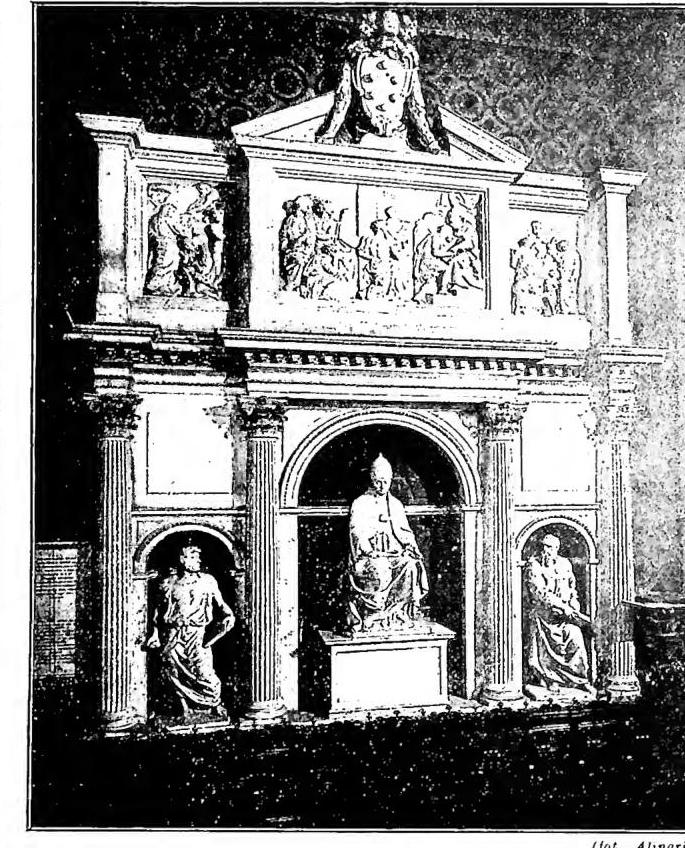
He wished to make Rome, whose population had greatly increased, the intellectual center of the world as well. He gathered literary men and artists there; he reformed the University (5 Nov. 1515), which enjoyed a brief flourishing, with as many as eighty-eight men of distinction teaching there alongside many others, among them Nifo, Luca Paciolo, Giovio, and Fedra Inghirami. He enlarged the private library and the Vatican Library, taking care to collect books from throughout Europe, with results not commensurate with the effort. He established in Rome, as in Florence, a Greek college, directed by Giano Lascaris and with a printing press attached; he granted Mazzocchi a privilege for the collection of Roman topographical inscriptions; he encouraged Raffaello to prepare an archaeological plan of Rome. Most of these undertakings lacked continuity; some did not even begin.
In the field of construction, he rebuilt the Via Alessandrina and began the Leonina (Ripetta) and the redevelopment of Piazza del Popolo; he completed the Logge of the courtyard of S. Damaso. In matters of art, with a brief (27 Aug. 1515) he saved the treasures of antiquity from destruction, and collected many of them in the Belvedere. Raffaello, assisted by his pupils, while completing the Room of Heliodorus, represented the features of L. X in the figure of Leo the Great; in the Room of the Fire he symbolized, in the deeds of Leo III and Leo IV, the exploits and intentions of the distant successor; for the Room of Constantine he designed the triumph of the Church; while in the cartoons for the tapestries, the Parthenic sculptures of the modern age, he glorified its more ancient history, and in the Logge (1513–19) he harmonized his Bible with the inspired pagan creations of Giovanni da Udine; Giovanni himself and Perin del Vaga decorated the ceiling of the papal hall in the Borgia apartment. But the grandiose works begun by Julius II came to a halt, or proceeded with difficulty; foremost among them was the Fabric of S. Pietro, for which fra' Giocondo, Raffaello, and Antonio da Sangallo could accomplish little, having been successively entrusted with its direction after the death of Bramante (1514). Michelangelo first received the commission for the façade of S. Lorenzo in Florence, and then that for the New Sacristy; but he did not even begin the work. The obscurity of the period that followed L.’s death made his age appear more luminous, so that the century took its name from him; but even in patronage he remained inferior to the great Julius.
IV. THE PONTIFF
L.’s more strictly religious activity was certainly not negligible, but it was inadequate to the needs and dangers of that extremely grave moment for the Church. From the beginning of his pontificate, he set out to defend Christendom against the threats of the infidels; he gave aid to Hungary, urged the Christian powers to undertake a Crusade, and had a memorandum drawn up (Nov. 1517) by a commission of cardinals, ambassadors, and experts, which examined the problem of holy war in depth. But distrust, especially on the part of Germany, concerning an enterprise that many suspected of being a pretext for raising money, the war of Urbino, and political manoeuvring obstructed the plan.L. was, however, able to continue from the sixth session (27 Apr. 1513) and conclude with the twelfth (16 March 1517) the Fifth Lateran Council, opened by Julius II, proposing for it as its purpose the restoration of peace, the condemnation of errors, and the reform of the Church.
The Gallican schism was brought to an end through the submission of Carvajal and Sanseverino, who, after humbling themselves, received forgiveness (27 June 1513); through the declaration by the French representatives that they were abandoning the Council of Pisa and adhering to the Lateran Council (19 Dec. 1513); and through the approval of the French Concordat (19 Dec. 1516). The doctrines concerning the mortality of the individual soul and the collective soul, as well as the theory of the twofold truth, rational and revealed, were condemned (19 Dec. 1513); and priests who wished to pursue humanistic studies were required first to study theology and canon law for five years. Decrees were issued that eliminated certain abuses in the Curia, sought to improve the selection of bishops and abbots, to restrain commendatory appointments and the accumulation of benefices, and to raise the religious and moral standard of life among the clergy and laity (5 May 1514). The disagreement between bishops and religious was mitigated, though not eliminated, by reducing the exemptions of the latter and increasing the authority of the former (4 May 1515); and boundaries were established between the rights of the secular and regular clergy (19 Dec. 1516). Laws were laid down for the exercise of preaching; a long-standing question was resolved by approving the charitable pawnshops and allowing compensation to lenders; and the printing of books without the license of the bishop and inquisitor, or, in Rome, of the vicar and the master of the Sacred Palace, was prohibited (4 May 1515). These were measures of pacification, defence of the faith, and reform, largely advantageous and seeds of greater things; but they neither went as deeply as was necessary nor, above all, received effective implementation.
Even outside the activity carried out in the Council, L. did not prove insensitive to various needs of the government of the Church. He favored the religious Orders, and in particular that of the Minims, whose founder, Francesco di Paola, he canonized (1 May 1519); after attempting to reunite the entire Franciscan Order, he sanctioned the division between Conventuals and Observants (1517); he published bulls against magic, divination, and dueling; and he approved the “Compagnia del Divino Amore,” one of the most notable manifestations of the Catholic pre-Reformation. He established cordial relations with the Maronites and the united Greeks, whom he defended against the hostility of the Latin clergy; he also attempted to bring the Ethiopians and Russians closer to the Roman See. He raised his voice against the enslavement of the Indians and sought to protect them from the violence of the conquerors.
But he tolerated too many scandals among prelates and courtiers around him; he was too fond of hunts, secular festivities, and spectacles, even attending performances of the Calandria and the Suppositi and wishing or permitting Mandragola to be performed in Rome.
In the very creation of cardinals, and especially in that of no fewer than 31 at one time (1 July 1517), to which the Sacred College consented, terrified by the harsh vengeance taken against Petrucci and his real or alleged accomplices, although worthy men were included, too many others were admitted who owed the purple to kinship or friendship with the Pope, to political considerations, or to the payment of enormous sums. This conduct of his undermined his intentions and attempts at reform.
And L. appeared far too weak in the face of tendencies dangerous to the authority of the pontiff and the unity of the Church, even if his compliance can be partly excused by the gravity of the circumstances. The Concordat with Francesco I (18 Aug. 1516) abolished the Prammatica, rejected the doctrine of the superiority of the council, and secured the support of the Crown for the French Church; but it abandoned that Church to the hands of the King, to whom almost unlimited powers were granted to appoint bishops and abbots and, indirectly, to settle the vast majority of cases, including ecclesiastical or mixed cases, even on appeal. L. confirmed to the King of Spain the grant of the Cruzada; and he unsuccessfully attempted to deprive him of the right of retención de bulas and to subject the Spanish Inquisition to the common law. To the King of Portugal he granted the right of patronage over all benefices in the overseas countries; to the King of Poland, privileges; and to the Polish archbishop of Gnesen, the office of legatus natus. To Henry VIII of England he gave (26 Oct. 1521) the title of defensor fidei, which he had earned through his Aserio septem Sacramentorum; but to the most powerful chancellor Wolsey he had granted not only the purple (10 Sept. 1515), but also the office of legate, allowing him to combine political and religious authority.
In the face of the new doctrines spreading in Germany (v. LUTERO, MARTIN), he displayed excessive tolerance. He hesitated for a long time to pronounce himself in the battle between theologians and humanists concerning the works of Reuchlin, and only on 23 June 1520 did he condemn the Augenspiegel.
V. LA FIGURA
Era nella persona di L. un singolare contrasto. Alla figura enorme ed obesa, col volto floscio e i miopi occhi sporgenti, idealizzata da Raffaello, ma ritratta con brutale realismo da Sebastiano del Piombo e dal Varignana, si contrapponevano la voce armoniosa, la parola eloquente, il tratto amichevole e talora affascinante. E lo stesso contrasto, proprio, d'altronde, di quell'età, era nel suo carattere spirituale. Sinceramente credente, pio, onesto nel costume, largamente benefico, era insieme bramoso di «vivere e godere la vita», aveva «in orrore ogni fatica» e non voleva «fastidi»; era prudente sì, ma dubbioso, timido, coperto nei disegni, non schivo di doppiezza e di falsità, troppo amante dei suoi. La sua stessa cultura, ricca e varia, aveva alcun che di superficialità e dilettantismo. Morì, dopo rapidissima malattia, con segni di schietta pietà. Ma non fu compianto, anzi fatto segno ad accuse atroci ed ingiuste; sepolto prima in S. Pietro, solo più tardi le sue ossa riposarono nel pomposo monu-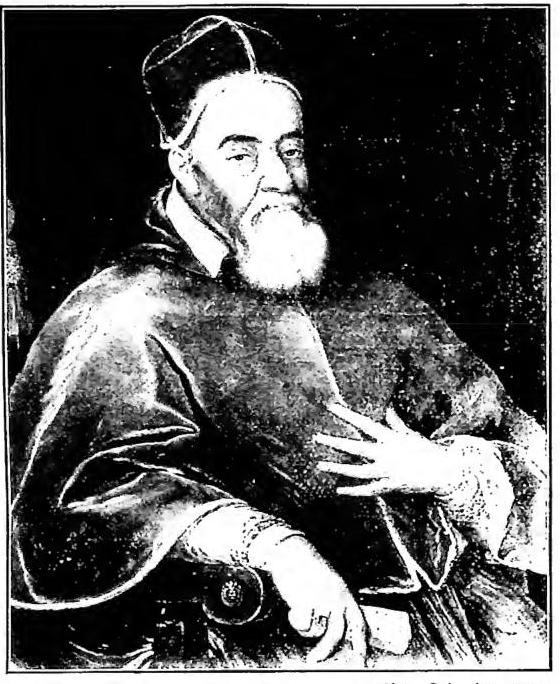
Bandinelli, nel coro di S. Maria sopra Minerva. -
Vedi tav. LXXV.