
RIDOLFI, NICCOLÒ. — Cardinal, born in Florence on 16 July 1501, to Piero and Contessina de’ Medici, daughter of Lorenzo il Magnifico, he was directed toward an ecclesiastical career as soon as Cardinal Giovanni de’ Medici, his uncle, was raised to the papacy under the name of Leo X.
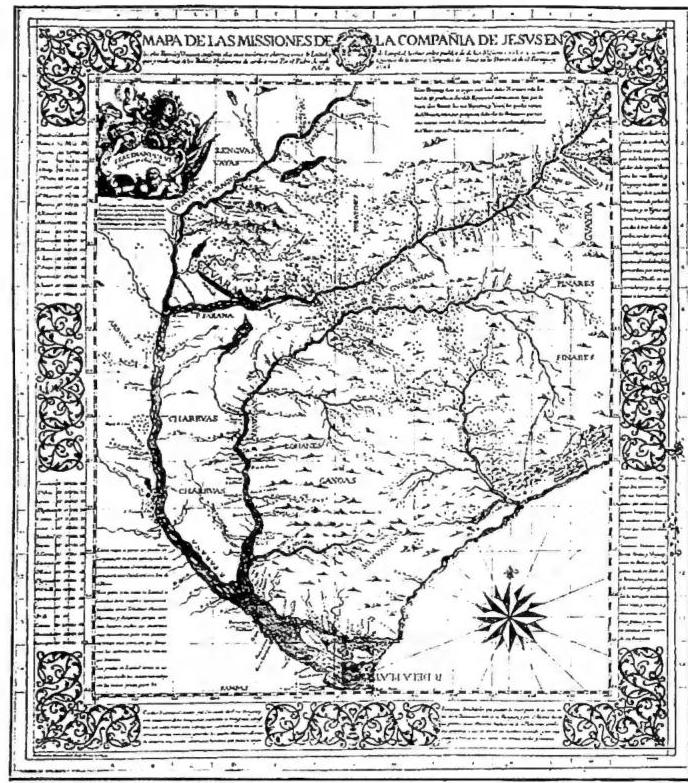
(from Fr. Guillermo Furlong Cardiff, Cartografia Jesuítica del Rio de la Plata, Buenos Aires 1858, vol. 63-II, plate 18)
REDUCTIONS – Map of the missions of the Society of Jesus in Paraguay with the r., compiled by I. Quiroga (1749).
After Alessandro was killed and Cosimo succeeded him, together with Cardinals Salviati and Gaddi he marched with an army toward Florence to oppose this election, asserting, with the Salviati and the Strozzi, his rights as the last legitimate descendant of that branch of the Medici which had ruled the homeland. But while he, because of family traditions and the republican ideas he had acquired from his humanistic studies, sincerely wished to restore liberty and the Great Council to Florence, Salviati was thinking of the advantages that could derive from his kinship with Cosimo. Thus, since the cardinals were divided, the expedition failed. The R. did not for this reason surrender, and from Rome, under the benevolent eyes of Paul III, he continued to plot against Cosimo’s principate. After the death of Paul III, the R. was among the papabili, despite imperial opposition. Favored by the cardinals of the French party, he would easily have been elected had the Farnese, the arbiters of the conclave, followed the recommendations of the deceased Pontiff. Instead, they seemed to turn toward the R. only after he had left the conclave because of an indisposition. Recalled with firm promises, he was preparing to return when a sudden death overtook him on 31 January 1550, «at the moment closest to his elevation» (Galluzzi, Storia, I, 7). Naturally, there was talk of poison, given to him by Cosimo or «by one who had no other means of preventing him from attaining the papacy» (B. Segni, Storia, XII). But this is at least doubtful, even though the famous physician Realdo publicly asserted, after dissecting the body, that if he had given him the poison himself he could not have been more certain of II.
The R. was great of spirit and good-natured; in generosity, the worthiest nephew of Lorenzo il Magnifico and Leone X. A disciple of Lascaria, he was extremely learned, especially in Greek literature; he assembled a library of ancient Greek and Latin codices, the most extensive and renowned collection put together in his time. His household, filled with artists and men of letters whom he supported, among them Donato Giannotti, who dedicated to him the treatise Della Repubblica fiorentina, was called the house of wisdom. Molza, Flaminio, Bonfadio, Tolomei, and Berni sang his praises. Trissino, who was his friend, as were the poet Gambara and Michelangiolo, addressed to him the volume of his Rime; Michelangiolo sculpted for him, not without significance, his bust of Bruto. The autographs of Machiavelli used for Blado’s celebrated editio princeps came from his library. Valerio Belli engraved gems for him, and Cellini, who remembered him in the Vita, fashioned silverwork for him. In a court that was by no means austere, his morals were exceptionally pure. Such a splendor of virtues appears blemished by certain transfers, not all disinterested, that he made of some of his numerous and rich benefices; but it seems that he, who knew how to remain free of so many vices and abuses of the age, was unable entirely to liberate himself from this one.
He opposed private life (1629), promoted religious reform, and established a national training novitiate in Paris (1631). Because of his pro-Spanish sympathies, for having favoured the marriage of Princess Olimpia Aldobrandini to Paolo Borghese, and for having sided with Cardinal R. Ubaldini, who was opposed to the Barberini, he fell into disfavour with Urban VIII, who, on unspecified charges, suspended him from office (brief Alias a nobis), confined him in S. Pietro in Vincoli (1542), and subjected him to an interminable trial. He was defended by Anna of Austria, Mazzarino, the Duke of Orléans, and Philip IV of Spain. Rehabilitated by Innocent X, he died a few days before the probable re-election to the office of General could take place. He wrote many encyclical letters to his Order, notably the one beginning Videte vocationem vestram (1 January 1631), which was printed; Breve modo di far l'orazione mentale, Rome 1642.