
SAVONAROLA, GIROLAMO. – Born in Ferrara on 21 September 1452, to Niccolò di Michele Savonarola and Elena Bonacossi, perhaps descended from the Bonacolsi, lords of Mantua. The Savonarola family originated in Padua, whence this branch of the family had moved to Ferrara in 1440, when Michele, a physician highly celebrated in his own time, was summoned there by Niccolò III. It was this Michele who took charge of G.’s education; and there is no doubt that the old scholar, formed in the fourteenth century and thus a participant in the Middle Ages, a man of exemplary piety and strict morals, exercised a great influence on the formation and life of his grandson. As for S.’s studies, it is known that, having pursued humanistic studies until the age of 17
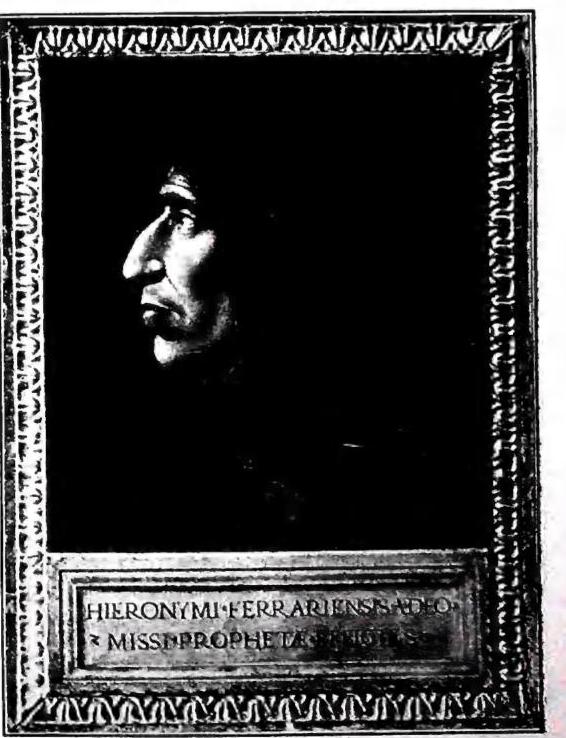
Having received his doctorate in the liberal arts and begun medical studies, he persevered in them only briefly. In the adolescent S. we find already whole and perfect the sentiments and thoughts that would make him “vir rixae et discordiae in universa terra.” Humanistic paganism, which contaminated life, art, and religion itself, was intolerable to him, as was the corruption spreading through every class of men; and he saw its primary cause in the Church’s bad shepherds. This idea at once prostrated and exalted him inexpressibly; in his youthful writings, in prose and verse, the future reformer already appears fully armed: the song De ruina mundi (1472) might be thought to have come from the pen of the S. of twenty-five years later. And since he “could not endure the great wickedness of Italy’s blinded peoples” (as he would write to his father), “he continually said a little prayer, saying to God: Notam fac mihi viam in qua ambulem quia ad te levavi animam meam.” The path was the one he took on 24 April 1475, when, leaving his father’s house without saying farewell, he went to don the woolen habit of Guzmán at S. Domenico in Bologna. On entering the cloister he would not have wished to be ordained a priest, but rather to devote himself to the humblest tasks of the convent; nevertheless, he submitted to the will of his superiors, who did not wish to leave his intellect idle. He pursued theological studies, first in Bologna and then in Ferrara, having returned to his native city in ’79. He was still there in ’82, when at the Chapter of Reggio he was entrusted with the office of lecturer at S. Marco in Florence. Here he soon won the hearts of his fellow religious and disciples, both through his marvelous expositions of Scripture and through the perfection of his life. Whoever had him as a companion bore witness to his more-than-human virtues and to the great fruit he produced by word and example. Blessed Sebastiano Maggi recounted that he had heard his confession countless times without finding in him a venial sin. His first attempts at preaching, in ’82 and ’83 at the Murate and in ’84 at S. Lorenzo, met with less success, although the unhappy nature of these beginnings was magnified by the early apologists in order to make his later triumphs appear more miraculous.
Meanwhile his secret anxieties were growing, an echo of which can be found in the song Oratio pro Ecclesia. It was a sudden revelation of the scourge and renewal impending over the Church, received at the convent of S. Giorgio (1484), that once again showed him the way and gave rise to his prophetic preaching, begun at S. Gimignano during the Lents of 1485 and ’86. In ’87 he preached in Florence at S. Verdiana, but had to interrupt the Lenten series, having been elected Master of Studies at the Studium generale of S. Domenico in Bologna. After completing the year of his mastership, he was sent to Ferrara, and from there to preach “in many places of Lombardy.”
His preaching during Advent of 1489 at Brescia remained famous, where he prophesied the sack that the city would suffer in 1512. He preached Lent of 1490 in Genoa; then he was sent once more to Florence, at the request of Lorenzo de' Medici himself, in order to please Giovanni Pico, who had fallen in love with S.’s soul and intellect ever since the Chapter of Reggio, and even more during his first stay in Florence.
Having returned to his fateful city, S. was shortly afterward elected prior of S. Marco. While attending to the duties of his new office and to preaching, he published several ascetical booklets, such as the treatises Della vita viduale, Della umiltà, Dell'amore di Gesù Cristo, as well as works of philosophical popularization. But his preferred battlefield was the pulpit. A cycle of lectures begun for the friars in the garden immediately after his return to Florence drew such a large attendance, including laypeople, that he had to continue it in the church, where he began to expound the Apocalypse. During the Lenten series of
During Lent of 1493 he preached in Bologna, where it is reputed that he dared to rebuke the Bentivoglio family harshly from the pulpit, and during Lent of ’94 in Florence, where, Lorenzo having died, the greatest obstacle to the grand work he had envisioned had been removed: to make S. Marco a model of religious life in which the fervor of the primitive Church would bloom again, so that a great fire of faith and charity might blaze in Florence, “the heart of Italy,” and then spread throughout all Christendom. To gain independence from the Lombard Congregation was the first step to be taken on this road, and toward this they directed their efforts
(courtesy of Prof. M. Ferrara)
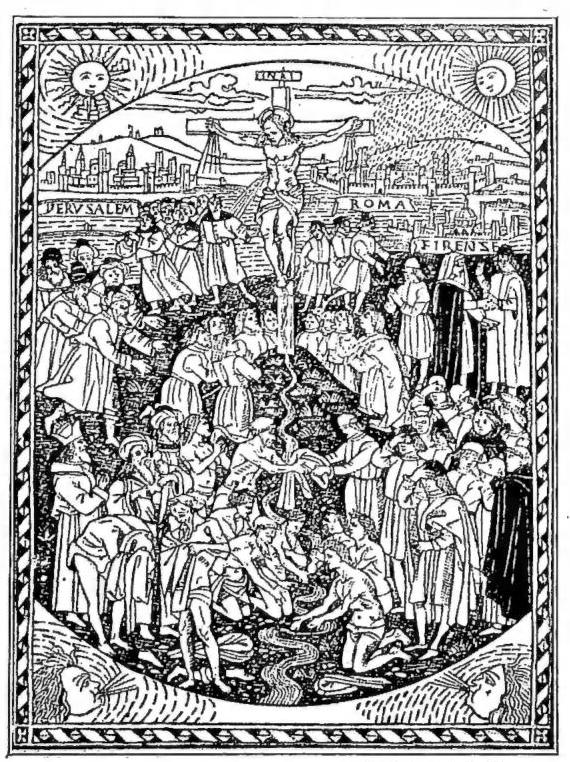
SAVONAROLA, GIROLAMO - Illustration of the 48th sermon On Amos and Zechariah by G. S.: unbelievers and Christians who cover their cross-marked foreheads hasten to regenerate themselves in the river flowing down from the Cross. The sky is clear over Jerusalem, while it hails over Rome and Florence. Drawing by S. Botticelli. Woodcut from the Treatise by Domenico Benivieni - Florence, Bonaccorsi, 28 May 1496.
The efforts of S. succeeded. Once he had thus become certain that his work could neither be prevented nor interrupted, he advanced along the path of reform, applying himself, according to a chronicler, “to introducing an almost divine order into study and life.” When Charles VIII entered Italy, the Medici were expelled, while S. was in Pisa, having been sent by the Republic as ambassador to Charles, to whom he spoke loudly and frankly. He did the same in Florence, after the King had entered it with evil intentions; hence it is probable that the city owed its salvation to him no less than to the generous impulses of Pier Capponi.
With the separation of S. Marco (22 May ’93), subsequently constituted as a congregation together with other convents, the liberation of the city from Medici rule thus came to coincide; and so (it seemed miraculous) all the doors suddenly opened wide to the work conceived by S. He did not like to involve himself in affairs of state, and if he labored to establish in Florence not a hierocracy or a theocracy, but a Christianly and civically well-ordered republic, it was in order to make it the “city of God,” so that from it, as he said, “the reformation of all Italy” might proceed. Preaching Advent on Haggai, he not only succeeded in quieting factional hatred and checking the outbreaks of civil discord, but, while the city seemed about to fall once more under an oligarchy, in bringing about the predominance of a wise democratic order that bore much resemblance to the Venetian government. Once the new popular state had been founded, S. proposed in a sermon that Christ be elected King. Continuing his apostolate, through the sermons on the Psalms (the feasts of 1493), and especially those on Job (Lent of ’95), he devoted himself to promoting the religious and moral renewal of the city, which proved even greater than the civil renewal he had brought about. The skeptical and pleasure-loving city of the Magnifico soon appeared transformed; everywhere there were manifestations of piety and simplicity of life: noble citizens and men distinguished for their learning flocked to S. Marco to request the Dominican habit. But the suddenness and magnitude of the success, while on the one hand increasing faith in S., on the other aroused hatred and suspicion against him; and those who feared his power formed the sect appropriately called the Arrabbiati, while the Friar’s followers were called the Piagnoni. Even outside Florence, S.’s large following was disliked by those potentates who, having joined forces against Charles VIII in the Holy League, saw in him the most formidable instrument for keeping the Florentines steadfast in their traditional friendship with the King. Thus the Arrabbiati from within, and princes such as Sforza from without, soon began to incite the Pope against him. Under these influences, and following appeals made to him by Alberto da Orvieto, who had been sent to Florence to obtain its entry into the League, Alexander VI wrote that remarkable brief of 21 July 1495, in which, after showering S. with the rarest praises, he ordered him to appear before him, wishing to hear his prophecies from his own lips and profit from them. The trap was too obvious for S. to fall into II. Had he set out, he might perhaps never have reached Rome; certainly he would not have returned to Florence. He cared little for his own life, but greatly for the work he had cherished in his adolescent dreams and now saw miraculously flourishing. Warned by physicians to abstain from preaching and even from study, and harassed by his enemies, he replied that, because of the infirmity of his body, the manifest danger to his life, and the harm that would come to his work, he asked permission to defer his coming.
(courtesy of the Marchese Ridafè)
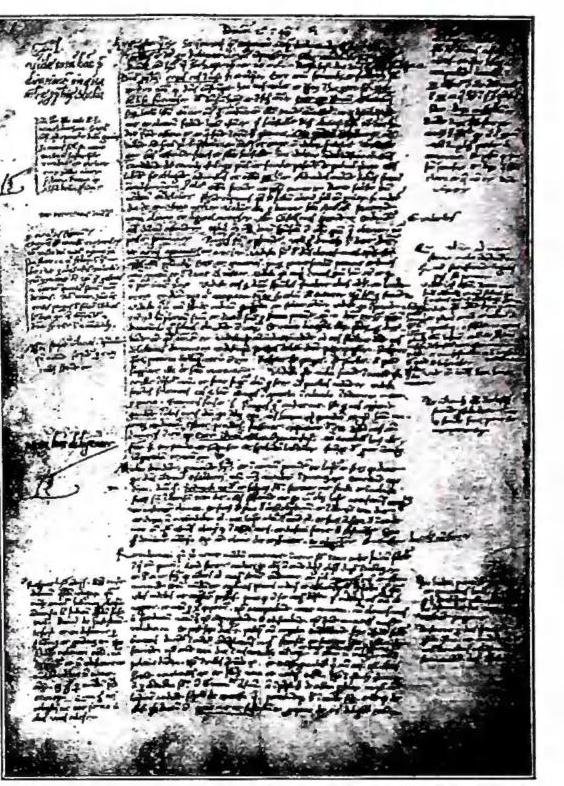
SAVONAROLA, GIROLAMO - Autograph outline of the terrifica praedicatio of Lent 1491 - Florence. Museum of S. Marco.
this time also the soundness of the reasons put before him; so much so that the brief of 8 September was promptly annulled by another of 16 October, considerably softened, which nevertheless reaffirmed that S. was to abstain from preaching until further notice. Before the brief arrived, however, he had time to revive the city with three sermons. When the brief arrived, he obeyed, withdrawing into silence and prayer.
This silence, however, opened the way to his opponents, who perhaps had sought precisely this through the papal briefs; nor is it therefore surprising that his supporters worked to ensure that his voice might be heard freely, just as his enemies worked to silence II. The Signoria petitioned that S. be permitted to preach during Advent, and the efforts were redoubled as Lent approached. Alexander VI, pressed by political considerations, resisted; nor did he hesitate to say candidly to the Florentine ambassador: the league did not want him to permit the Friar to preach. Finally, however, while denying a formal revocation of the brief of 16 October, he verbally allowed S. to ascend the pulpit again. Thus, on 17 February 1496, he began the sermons on Amos, which are among his finest and most forceful. If some had hoped for more cautious language from him, he had given them no grounds for such hope; he was not a man to compromise or fail in his duty, nor did he do so. At times he seemed to allude to the scandalous life of the Pope himself. The latter began to make vehement complaints against him; but once again he was moved above all by political considerations. Thunderbolts were threatened. A council of theologians expressly convened could reach no conclusion against S. For this reason, but even more because of fear of another invasion by the king, the curial anger subsided. The fruits of these sermons were abundant beyond measure; it is enough to mention the reform of the children: according to a contemporary testimony, Florence seemed to have become « an earnest of paradise ». On 8 May he began the sermons on Micah, without any complaint coming from Rome. By now the curve of S.’s
fame had reached its peak, and not only in Florence. From this period date some of his letters to the princes of Italy, who turned to him for advice, or to whom he freely addressed himself in order to exhort and correct them. At that time the Pope too sought to win him over, having the cardinal’s hat offered to him on certain conditions. He replied in the sermon of 20 August: « I do not want hats, neither large nor small mitres; I want nothing except what you gave to your saints: death. A red hat, a hat of blood, this is what I desire ».
In those days his treatise De simplicitate christianae vitae was being printed, while he was working on the Triumphus Crucis. To attend to these works and to rest, he had left the pulpit; but on 28 October he had to ascend it again, since the Florentines were terrified by the arrival of Maximilian, King of the Romans, who was besieging Livorno by land and sea. S. promised the people that God would deliver them, and the city’s enthusiasm was immense when, after a storm had broken up his fleet, Maximilian abandoned the undertaking. But the political fortunes of Italy were turning against S. Alexander VI was constantly pressed by the League and the Arrabbiati, who urged him to finish with the Friar. The best course still seemed to be to deprive him of the independence he had acquired through separation from the Lombards; and the Pope was induced to do this by the brief of 7 November, by which many convents were united with those of S. Marco in a new congregation, in which S. would lose all authority. It was claimed that the aim was to spread the observance introduced by S., whereas the effect would have been entirely the opposite. The concealed purpose, moreover revealed in later briefs, was that S., by obeying, should lose himself and his work; while by refusing to obey he would incur the excommunication threatened in the brief against anyone who opposed it, and would thus likewise be brought to certain ruin. Although he did not remain silent in his Apologia della Congregazione di S. Marco, which would have been contrary to charity, it cannot be said that he disobeyed or opposed that brief; for no superior came forward to him to carry out the papal orders, and none came to remove him from his office as Vicar.
S. therefore continued on his path, the path of charity. During Advent he began the sermons on Ezekiel, continued during Lent 1497: as the choice of so terrible a prophet led one to expect, it was a terrible preaching. The machinations of his enemies, rather than making him cautious, inflamed his indignation and moved him to cry out ever more loudly, until Lazarus, the corrupted body of the Church, should rise again. But his fortunes, which until then, despite alternating vicissitudes, had continued to grow and had enjoyed a symbolic triumph on 7 February 1497 in the first « burning of the vanities », began to decline. The famine, the prolongation of the war against Pisa, the truce between Charles VIII and the League, and the gathering papal anger were so many causes of estrangement from him among the fickle Florentines. Among the unfavorable circumstances must be added the decline of his health, reduced to such a state that it forced him to shorten and at times interrupt his sermons. But the worst came to him from two Signorie hostile to him. The first had Bernardo del Nero, head of the Medicean faction, as gonfalonier; under him came Piero de’ Medici’s expedition against the city, made dangerous by the gonfalonier’s position, but miserably unsuccessful, as S. had predicted. The second was led by Piero degli Alberti, the principal man among the Arrabbiati; under him they lorded it over the city for two months, indulging in every kind of excess. On Ascension Day they provoked a tumult during the sermon in order to cause a scandal and, if they succeeded, to kill the preacher. When the plot failed, they set about inciting the Pope so that the excommunication, repeatedly urged, might finally be promulgated. The principal argument in this work of agitation was still, more than the alleged contempt for the Supreme Keys, the Florentines’ refusal to enter the League, which was attributed to S. Two wealthy Florentines gave force to these arguments with their money, persuading certain prelates, through the worst kind of insinuations, to overcome the final resistance. Thus Alexander VI, although against his will, as he himself later confessed,
was induced to sign the fatal brief dated 13 May. Drawn up in an unusual form and, apart from its surreptitious origin, defective in substance, it reached Florence only on 17 June, because the courier did not dare enter Florentine territory and eventually entrusted it to someone else. The brief was read in only five churches, the others having refused to do so because the required formalities were lacking.
Though urged by the people to preach, the Friar persevered in his painful silence, in obedience to the papal commands. Finally, when it became clear that he would not regain the right to preach even through powerful intercession, and that his work was therefore condemned to certain ruin, he decided to follow that voice which had so often shown him the way. He reaffirmed his resolve and his indignation at the bargain proposed to the Signoria, namely, that absolution should be made conditional upon the Florentines’ entering the League. Thus he returned to the pulpit of the Duomo on 11 February 1498, to begin those sermons on Exodus that were to mark his exodus from the pulpit, from his great work, and from life. From the very first sermon it was clear that S. was determined either to achieve a difficult victory over the evil forces opposing him or to receive that crown of blood which he had so often requested and which that morning he again invoked, offering himself in sacrifice. He continued in the same manner in the subsequent sermons, repeatedly asserting that the Pope had been circumvented, that the brief had been improperly drafted, and that the excommunication was therefore invalid. And, while continuing to preach, he composed, at the request of the gonfalonier Salviati, the Trattato del reggimento e governo della città di Firenze. On Carnival Day the second burning of the vanities was held. But from Rome the city was threatened with an interdict unless it handed over S. or at least silenced him. And so the Signoria, which, although predominantly opposed to S., had firmly replied to the papal briefs, ordered the Friar—who had meanwhile withdrawn to preach in S. Marco—to cease preaching. He did so immediately, after a sorrowful farewell to his people. Having thus lost his most powerful weapon, he had no other means of defending himself and his work than a Council, where his voice would once again have been raised, more solemnly, to denounce and admonish. But although the conditions for a convocation were not lacking, and although the idea of a Council was already widely diffused among princes and worthy prelates, in the end his great Christian heart could not bear to disturb the Church, even for a holy purpose; and he burned the letters he had already begun to write. This renunciation closed his final path; nothing remained to him but the path of martyrdom. The untimely fervor of his most faithful disciple, fra’ Domenico da Pescia, caused events to hasten.
(Alinari photograph)
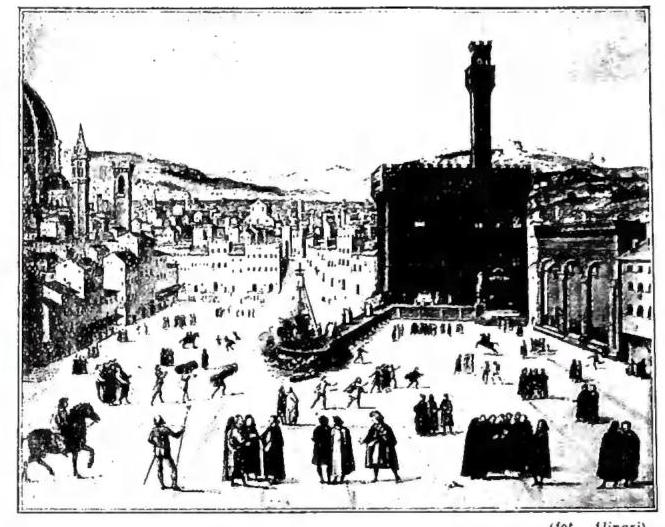
SAVONAROLA, GIROLAMO — The execution of S. in the Piazza della Signoria (23 May 1498), painted by an unknown contemporary artist — Florence, Galleria Corsini.
On 25 March the Minorite Francesco da Puglia, preaching, challenged anyone who maintained that S.’s excommunication was not valid to trial by fire. Fra’ Domenico was ready to take up the challenge, and the Signoria itself, in which the Arrabbiati now held sway and to whom this seemed an excellent opportunity to rid themselves of S., ensured that the parties could no longer withdraw, inviting them on the 29th to sign the propositions to be tested by fire. These concerned, in essence, the flagellation and renewal of the Church and of Florence, and the invalidity of S.’s excommunication. Once the definitive agreement had been drawn up on 6 April in the presence of the Signoria and the archbishop’s vicar—establishing that the party that refused or merely delayed would be deemed to have lost—the trial took place on the morning of the 7th. But no test was made other than an endless exchange of words and arguments. Although victorious according to the terms of the signed agreement, since the refusals and delays had come from the opposing party, S. nevertheless seemed to much of the populace to have lost, solely because, against everything and everyone, he had not performed the miracle expected of him. The multitude did not forgive him for this; and the Arrabbiati took advantage of it to deal him the final blow. The following day, Palm Sunday, S. delivered a brief sermon in which, foreseeing his imminent end, he declared himself content that the Lord, during the days of His Passion, should make him like unto Himself. That afternoon, as one of his friars was preparing to preach in the Duomo, a tumult broke out there. Suddenly, as had been prearranged, the place was filled with a rabble and armed citizens, directed by the Arrabbiati and rushing toward S. Marco. S. wished to prevent any defense and attempted to surrender himself to the attendants; but his followers blocked his way. He went to pray in the choir, where he remained for six hours, while some citizens and a few friars defended the convent and church against the besiegers. Rising from prayer, and having been informed of the order to appear at the Palazzo, he surrendered, together with fra’ Domenico, into the hands of his enemies.
Interrogated in the following days and cruelly tortured, he answered with steadfast courage until, in the end, his delicate constitution gave way under the torments, causing a limb to be dislocated and his flesh to be laid open; afterward, the torture was continued. Thus, in two consecutive trials, it was possible, if not to make him say what they wanted, at least to make him renounce his prophetic mission. This not being enough, after the document had been signed they interpolated certain clauses at the ends of the paragraphs and inserted several marginal notes that poisoned the context. These trials were read in public, but they did not dare to have the accused present, as was customary, for fear that, before his people, he might proclaim the truth. The gonfaloniere himself said in a council that S. should not be allowed to leave Florence, lest he repeat what he had said, “the trials having been conducted as they were, for the peace of the city.” Left in peace for several days, he was able to compose the marvelous meditation on the Miserere, in which, through Peter’s example, he consoled his sorrow over the forced denial he had made under torture; then he began the one on the psalm In te Domine speravi. But on 20 May a third trial, conducted by the apostolic commissioners, began. Tortured anew, at times his great spirit overcame his weakened flesh, and he retracted the forced retractions and reaffirmed in moving words his prophetic mission.
Even historians hostile to S. agree on the iniquity and falsity of this trial, no less than of the preceding ones. On its basis the commissioners pronounced the sentence condemning S. and his companions, fra’ Domenico and fra’ Silvestro Maruffi, as “heretics and schismatics,” to be handed over to the secular arm, which, as had been decided some time earlier, would hang them and then burn them. The infamous sentence, communicated to the condemned men on 22 May, the final day of the trial, was carried out the following morning. S.’s words and actions during the mournful vigil were exemplary, and cannot be read without profound emotion. His death was a marvelous example of Christian virtues, just as his life had been; nor could it have received a more worthy seal. Receiving Communion before the execution, he pronounced aloud a brief prayer that constitutes a beautiful profession of Catholic faith. He uttered other moving words when his Dominican habit was taken from him. Having received plenary indulgence from the apostolic commissioners, he mounted the scaffold reciting the Credo piccolo. When the pyre was lit beneath the bodies of the hanged men and the corpses had been consumed, their ashes were gathered up to prevent popular veneration and thrown into the Arno. Thus was verified the prophecy that S. had pronounced as early as 1491: “The wicked shall go to the sanctuary, with axes and fire they shall break and burn the doors, and they shall seize the just men and burn them in the principal place of the city; and what the fire does not consume and the wind does not carry away, they shall cast into the water.”
After the initial bewilderment that the false trials, the persecutions of his adversaries, and the understandable severity of his superiors had caused in the souls of many devotees, not only did S. begin to be rehabilitated, but his cult also began, soon entering the liturgy of certain Tuscan convents, which as early as 1499 celebrated his solemn feast. It is even said that Alexander VI regretted his death, excusing himself by claiming that he had been badly informed. Julius II declared that he would gladly have canonized him. At the beginning of the sixteenth century, three distinct collections of miracles attributed to him were compiled, and the blessed Maria Bagnesi took part in the preparation of one of them. St. Caterina de’ Ricci, who twice acknowledged that he had cured her, recited the Office for him and celebrated his annual feast in her convent at Prato: these practices were the subject of discussion but did not impede the beatification process. St. Filippo Neri, the blessed Colomba da Rieti, the blessed Caterina da Racconigi, and the blessed Maddalena del Paradiso were no less devoted to him. Canonization of S. was discussed under Clement VIII, who was himself greatly devoted to him; so much so that the master general of the Order, Sisto Fabbri, had three different proper Offices composed for him. In the Acta Sanctorum his name is included among the praetermissi of 23 May.
The dramatic events of his life, the very injustice he suffered, the character of the times, and the salutary rigors of the Counter-Reformation necessarily prolonged the conflict surrounding S. beyond the pyre. His doctrine, rigorously examined at the Florentine Synod of 1516, at the Fifth Lateran Council, and in the Congregation of the Index (1558), always emerged unshaken. At the last of these bodies, a few things were indeed suspended, not because they contained error, but because, in order to be commonly understood, they required some explanation. In truth, this doctrine, steeped in Thomism, could not be more immaculately Catholic; and today this is recognized without dispute even by those Protestants who, with manifest distortion, had initially attempted to appropriate S.’s great name. Nor could a greater injustice have been done to one who lived actively for the Catholic faith and died exemplarily in II. If there were conflicts between S. and the Borgia, his attitude toward the Roman Pontiff was always devoted and reverent; nor did he ever cease to profess that devotion and reverence until his final moments.
This is borne witness to not only by his life, but also by his preaching and his works. The principal one of these is the Triumphus Crucis, which he wrote in Latin and immediately rewrote in the vernacular: a lucid and closely argued apologetic treatise on the Christian faith, which remained in use until the end of the seventeenth century in the schools of Propaganda Fide, by whose initiative it was reprinted in execution of the testament of Cardinal Antonio Barberini, brother of Urban VIII. Nor may the De simplicitate christianae vitae be overlooked, in five books, the first of which deals with Catholic doctrine, the others with simplicity of heart and outward simplicity. Of the other works, some are exegetical in character, others ascetical in subject: a clear mirror, within the framework of a candid style, of that spiritual perfection which he had succeeded in building up within himself. His youthful songs have been mentioned; his other poems are for the most part laude, which in strength of feeling and originality rank among the finest of the period. Stale humanistic prejudices branded S. as an enemy of poetry; perhaps, on the contrary, it is true that, feeling himself too strongly drawn to it and deeming it useless, if not harmful, to the attainment of the ultimate end, as he explained in his Apologeticae de ratione poeticae artis, he sought to repress it in his heart, just as he had earlier sternly repressed his family affections there. Clarity, simplicity, and effectiveness were the principal qualities of S. the writer; and the same may be said of his qualities as a preacher. His sermons contain passages of great force and beauty, even in the text that has come down to us, which is certainly very imperfect (cf. R. Ridolfi, Studi savonaroliani, Florence 1935), even stripped of the fascination of his voice and person, which was undoubtedly very great. Prejudices of the same kind as those that portrayed him as an enemy of poetry sought to make him appear an enemy of art, whose nobility he appreciated; but neither the overly rhetorically vilified “burnings of vanities,” nor the things he said against certain pagan deviations, can erase the debt that art owes to the man who inspired a Michelangiolo, a Botticelli, and a Simone del Pollaiolo.
Editions. — Of S.’s works, many times reprinted in the fifteenth and sixteenth centuries, but always separately (many ascetical pamphlets were collected in the Additiones of Quétif to G. F. Pico, Vita... H. Savonarolae, Paris 1674), there is no comprehensive modern edition; the National Edition seeks to remedy this deficiency, and its first two volumes (Prediche sopra Ezechiele, edited by R. Ridolfi) are in press. Nor are there modern critical editions of the individual works, except for the Epistolary (Le Lettere di G. S., edited by R. Ridolfi, Florence 1933). In the rather unsuccessfully conceived collection Prediche italiane ai Fiorentini, Florence 1930–35, the sermons sopra Aggeo (vol. I) and sopra i Salmi (vol. II) were published, edited by Cognasso (with many errors); the sermons sopra Amos were edited by Palmarocchi (vols. III–IV). Of all the other sermons and works there exist only old editions, or modern ones that are entirely negligible.
bibliography). — Historical and documentary sources: A. Gherardi, op. cit.; I. Del Lungo, Fra G. S., in Arch. stor. ital., new series, 18 (1863, 1), pp. 3–18; 19 (1863, 1), pp. 3–41; C. Lupi, Fra G. S., ibid., 3rd series, 3 (1866, 1), pp. 3–77; J. Schnitzer, Quellen und Forschungen zur Gesch. Savonarolae, 4 vols., Munich and Leipzig 1902–10. — Biographies: P. Villari, La storia di G. S. e de' suoi tempi, 4th ed., Florence 1926; G. Schnitzer, S., Milan 1931 (this is the definitive edition: the original German edition: 2 vols., Munich 1924); R. Ridolfi, Vita di G. S., 2 vols., Rome 1952; 2nd ed., ibid. 1952.