
EZECHIELE (Hebr. Jēḥezqēl, “God is strong” or “God strengthens”). — The third great writing prophet, who lived among the exiles in Babylon during the troubled period in which the new Israel was being prepared.
SUMMARY:
I. Time and setting
II. Prophetic activity and doctrine
III. The book
IV. Archaeology
V. Iconography
VI. Apocryphon of E.I. TIME AND ENVIRONMENT
Nabuchodonosor forced Jerusalem, which had rebelled against him, to surrender; he deported to Babylon King Ioachim, the queen mother, the court, 7000 of the most influential persons, 1000 craftsmen, and several other people; he stripped the temple of its most precious furnishings (II Reg. 24, 14.16). E. was among the deportees (Ex. 1, 1-3).They were settled, at least for the most part, along the great canal (nar-kabari), which, leaving the Euphrates near Babel, ran toward the southeast and, after passing through Nippur, rejoined the same river. They were employed in agricultural work (cf. the names Tel 'Abhibh, “hill of ears of grain,” in Ez. 3, 15; Tel 'Harid, “hill of the plough,” in Eid. 2, 59, etc.), but enjoyed broad autonomy. They formed colonies in which the elders retained a certain authority (Ez. 8, 1; 14, 1; 20, 1). Jeremiah’s advice to build houses and plant gardens (Ier. 29), and the great prosperity of the exiles at the time of their return, demonstrate that the exiles were permitted to improve their conditions and become property owners and prosperous people. E. had a house of his own (3, 24 ff.; 8, 1). But the greater disturbance of their minds corresponded to the tranquillity of their surroundings. The deportees hoped for Jerusalem’s revenge against Babel and for their immediate return. The overestimation of Egypt as an ally played an important part in this dream, but they were chiefly animated by erroneous ideas about God and worship. Jahweh could not permit Jerusalem to suffer the fate of Samaria (721) and Nineveh (612), because with it his worship and his very “name” would also perish. Hence their superstitious trust in the Temple: Jahweh might permit a temporary punishment, but could never allow his dominion to be conquered by Marduk! For the sake of his prestige, he had to punish the Chaldeans who had laid their sacrilegious hands upon the furnishings of the sanctuary; otherwise, the destruction of Jerusalem would mean the breaking of the Sinai covenant: all the promises sworn by God to Abraham, the patriarchs, and David would prove vain. Moreover, according to the law of solidarity, the merits of the righteous had to save the nation from punishment; divine justice could not destroy it, since from Abraham onward and down to their generation (Ez. 9, 4), so many Jews had loved the Lord and venerated him as could occur among no other people. False prophets and chauvinistic priests fostered these erroneous conceptions (Ier. 29, 31-32; Ez. 13). Thus the deportees made no effort at all to reform their grave moral conduct; indeed, they believed that they had sufficiently atoned by undergoing that deportation and awaited from Jahweh the reward of an immediate, triumphant return. They expected salvation from Judea.
When, in 587, Jerusalem, after a siege of approximately eighteen months, during which Pharaoh, having come to its aid, was defeated (Ez. 30, 21 ff.), was captured, plundered, and burned, harsh reality exposed their foolish illusions and, shaking their religious ideas, would have induced them to adhere to the worship of Marduk and Bel, which appeared more powerful than their God. This temptation was already strong far from Judea and the Temple, and near the great Chaldean cities, in which the saqqurat, with their varied and sumptuous worship, flourished. God’s merciful plan of purifying Israel from idolatry and other grave sins through the sufferings and humiliations of exile (Lev. 26; Deut. 28) would thus have foundered. To avert this danger, to prepare the exiles for the grave disaster of 587, to prevent them—just as had happened to the deportees of the kingdom of Samaria (721)—from being absorbed into the sea of the nations and disappearing forever, to prepare them for conversion and make them the new Israel, guardian of the promises, the Lord chose E. from among the deportees themselves as his spokesman. In a sublime vision recalling that of Ir. 6, this priest, son of Buzi (1, 3), in 593, along the banks of the great canal, received from God the mission of being a “watchman for the people of Israel” (3, 17). He would exercise his lengthy ministry (approximately twenty-two years) at Tel 'Abhibh. The final date of his prophecies (29, 17) brings us to April 571. It is unlikely that he lived until 561, the year of Joachia’s release, of which he makes no mention. Unlike Jeremiah, E. had a wife, whom he lost in the sixth year of the exile (24, 1, 16 ff.). According to an ancient tradition, E. was killed by a leader of the people whom he had reproved for his idolatry (PG 25, 160; 43, 401; PL 83, 143).
II. PROPHETIC ACTIVITY AND DOCTRINE
Since Jahweh is omnipresent, he is not bound to the Temple or to the worship of Jerusalem, and reveals himself as the absolute sovereign of heaven and earth, as well as mighty in Ba-EZECHIELE - The vision of E. Painting by Raffaello.
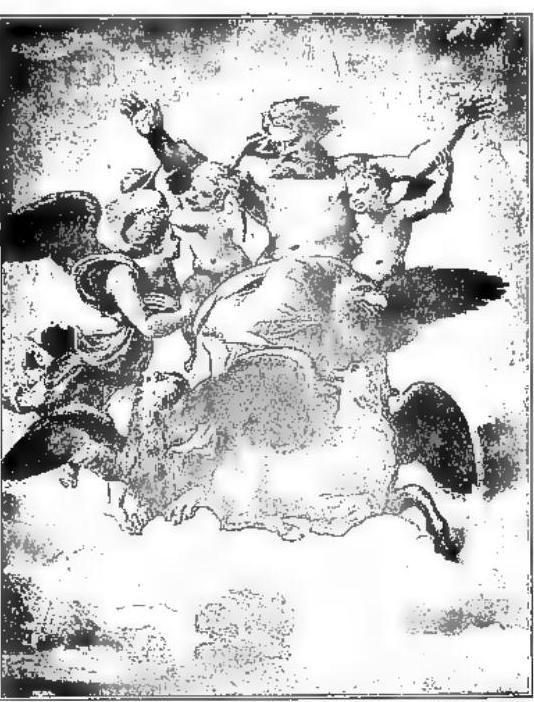
It was necessary to shake the torpor of those rebels; words would have been futile. To strike their minds forcefully, E. performs a series of symbolic actions depicting the siege of Jerusalem, the torments of the besieged, and the destruction or exile of the few survivors. Among other things, he allows himself to be seen lying motionless on his left side, the more uncomfortable position, for a longer period of time, and then on his right. He will explain to them that the Lord has fixed 390 days—the duration of the siege—because Jerusalem had to expiate the sins of the past, and that the expiation then continued for 40 years in exile (chaps. 4–5). Two prophecies of the same tenor follow (chaps. 6–7): punishment is imminent, for the sins of idolatry, murders, and injustices are too numerous. Faced with these precise predictions, the community of exiles began to grow concerned: about 11 months after the initial vision, several elders gathered in the prophet’s little house and asked why such punishment was to occur. E., in an interior vision, is transported to Jerusalem and sees the idolatry practiced there in the Temple (8:5–16), as throughout Palestine (8:17); therefore Jahweh has the Temple and the city destroyed (chap. 9). Only the few righteous will be saved. Thinking, together with the exiles, that the “remnant” must be among the Jews then in their homeland, E. prays to Jahweh not to destroy Israel completely; Jahweh replies that the remnant whom he will bless and who will form the Israel of tomorrow are precisely the exiles of 507. Judah and Jerusalem are doomed to ruin; salvation will come only to the exiles who convert. Jahweh therefore abandons Jerusalem; E. recounts everything to those present (chaps. 8–11). But the restoration promised for the future does not please the rebels, who dream of a material, immediate revenge; thus they mock the announcements of misfortune that will fade with time and the promises made for distant ages (12:21–26). E. insists on the imminence of the punishment and on the certain fulfillment of God’s word. He announces in vivid form the fate that will befall Sedecias—his flight, capture, blinding, and deportation to Babel (12:1–16)—and later describes the advance of Nabuchodonosor and the attack on Jerusalem (chap. 21). To the false prophets and pseudo-prophetesses who venally encourage the exiles’ illusions, he announces death and exclusion from the new theocracy (chap. 13). Nor can the merits of the righteous be invoked; it would be convenient to use them as a lightning rod in order to persist tranquilly in wickedness. There is indeed solidarity in reward, but the same principle also applies to punishment. Now iniquity in Jerusalem is at its height; Jahweh, by his justice, can no longer defer the punishment. His very holiness is at stake in the eyes of the nations. This time the righteous will be able to save only themselves (chap. 14).
A dominant concept in E. is the crisis of the Sinai covenant (chaps. 15, 16, 20, 22, 23). The Mosaic covenant was God’s free choice of the people of Israel as his special portion, based on divine mercy on the one hand and observance of moral precepts on the other. Consequently, Jahweh defends Israel and grants it every good, provided that Israel remains faithful to him, flees idolatry, and practices justice. Since Israel, instead, has always acted against the covenant, God, because of his dignity as an offended and betrayed spouse and because of his very holiness, must punish II. Since Israel is more guilty than Samaria and Sodom, Jahweh must punish it at least as he punished those two cities (chap. 23). Israel was chosen to keep alive among the nations the idea of the true God; having failed in its mission, it no longer has any reason to exist (chap. 15). The rupture, at least externally, of the covenant will nevertheless be only temporary. God punishes Israel so that it may repent (16:35–63; 20:1–38). E. thus illustrates better than any other prophet the central idea of the economy of the Old Testament: collective solidarity. The house of David, too, is punished; it will be eclipsed (chaps. 17, 19). Yet, mindful of his promises, Jahweh will cause the Messiah to arise from II. Nor should it be said (chap. 18) that, since collective punishment is inevitable, conversion is useless. Why—asked the exiles—should they do penance when they must remain in exile all the same and helplessly witness the definitive triumph of the accursed Chaldeans? Having already expiated, through deportation, those approximately 6 years of exile, it appears that God is making us atone, in addition, for the sins of our fathers. And they cry out against injustice. It is not the principle of solidarity that they oppose, but its partial application. E.’s response condemns this blasphemy against the justice of God. The collective punishment does not concern them; therefore, whether or not they convert, it will take place in any event. But this does not mean that they may continue with impunity in wickedness and sin. Alongside collective justice, with reward and punishment for the entire nation, there is an individual justice that it suits them to forget. There is strictly personal responsibility, which places them face to face with God, who strikes each wicked person with an equally terrible punishment: temporal and everlasting death; just as he rewards each righteous person. Nothing escapes the Lord, who has absolute dominion over every mortal.
The exiles are therefore wrong to call the principle of solidarity into question while overlooking the state of their consciences. E. recalls them, against their will, to the right moral path; they must settle their accounts directly with God, each separately and personally. And it is precisely these accounts that do not balance: they are wicked, as is also shown by their opposition to his voice. Jahweh is already showing them great mercy by waiting for them to convert. They believe they have atoned sufficiently, while they still persist in rebellion and vice; but whoever does not convert will be struck by divine justice and annihilated. Conversion is the sole means offered them to escape death and share in the future restoration.
E. would then continue to speak of the principle of collective solidarity, as in ch. 16 and in chs. 20, 22, 23, 36, and 37. On the very day when Nabuchodonosor begins the siege of Jerusalem (588), E. announces it to the exiles; thereafter he is silent: events will speak for him (ch. 24). Here the first part of his mission ends. In it he combats the errors and illusions of his fellow exiles. He moves against the current; he encounters contempt and hostility. His preaching is often limited to those who come to visit him at home (3, 24 ff.; 8, 1; 14, 1); nevertheless, it reaches and spreads among all the others. All must indeed hear the words of Jahweh, whether hesitating or openly hostile, so that, when they come to pass, they may come to their senses and finally recognize that they were true, and therefore repent and begin a new life (2, 5; 12, 2); cf. the frequently used formula: «Then they shall know that I am the Lord» (6, 7, 13; etc.). The miracle of prophecy must awaken these dazed people. Only one who forgets this purpose of E.’s prophecies will be surprised that until 587 he speaks so much of the Jews who remained in their homeland, of their sins, and of the destruction of Jerusalem (Tondelli), or, worse still, will dream of a Palestinian ministry of our prophet (Bertholet). Five months after the destruction of Jerusalem, a survivor brings E. the news (33, 21), and he begins the second part of his mission. He now preaches openly (33, 21 ff.), consoles, preventing the despondency of the people, and works profoundly toward their conversion. In general, their dispositions have changed. The prophecies, fulfilled even in their details, make the exiles recognize their illusions and their wrongs. E. now appears to them as a true prophet. The details of E.’s long activity (587–571) are unknown, because the book offers only a selection of the most significant prophecies of this second period. Having reaffirmed the necessity of conversion (ch. 33), E. announces the new theocracy, which will then continue, absorbed into the Kingdom of the Messiah (ch. 34). The restoration is certain because Jahweh will accomplish it for his own glory, to demonstrate his power to the nations; he will sanctify the exiles, in order to demonstrate his holiness to the world (36, 16–38). The symbolic vision of the bones which, at God’s command, become clothed with flesh and return to being human beings (ch. 37), vividly confirms this certainty. The theocracy is now foretold as living in peace on the hills of Palestine: powerful enemies will arise and, in a supreme effort, seek to destroy it, but Jahweh will annihilate them (chs. 38–39). The organization of reconstituted Israel is described, in an ideal and symbolic manner, in chs. 40–48. These chapters insist on the spirit that will animate the new theocracy: the full and filial observance of the essence of the Sinai covenant; veneration of the one God, which must permeate worship and all the manifestations of social and individual life. Those who have wished to find in these chapters not the prophet but the architect and legislator have encountered insurmountable difficulties.
Perhaps in Baruch (1–3, 8), the fruits of E.’s prophetic work can already be seen.
In terms of form, characteristics of E. are the visions described in their minutest details, and the frequent symbolic actions, sometimes complicated and strange. The visions are presented as real, objective events, and there is no reason to understand them otherwise; they correspond to the features of the Babylonian milieu, while repeating and developing the traditional elements of the sacred books; they take place in the prophet’s internal senses and are joined to intellectual revelations. The symbolic actions were actually performed, as is generally admitted today. Jeremiah approaches E. in visions (1, 11 ff.; 13–16; etc.) and symbolic actions (13, 1–11; 18, 1–12; etc.). Certain symbolic actions—the voluntary confinement (3, 25), mutism (3, 26 ff.), immobility (4, 4–8), and certain expressions («I fell face downward»: 1, 28; etc.)—served Klostermann to launch the thesis that E. suffered from epilepsy, a thesis adopted by several critics (Kraetschmar, Bertholet, etc.). The incongruity of the arguments advanced makes any refutation unnecessary.
III. THE BOOK
There is general agreement in recognizing it as possessing a perfectly systematic order. Two parts are clearly distinguishable: in the first (chs. 1–24), the exiles are prepared for the shock of 587, through the announcement of the disaster and its justification against the false arguments of the exiles. In the second (chs. 33–48), the reconstruction is foretold, together with the new Israel rising from the ruins, and hearts are prepared to enter II. Between the two, at the center of the book, are gathered the oracles against the nations (chs. 25–32): the governing idea is the universal dominion of Jahweh, who regulates all human events. He uses the pagans to punish his people, but then punishes them also for their pride and cruelty, especially for the baneful influence they exercised upon the chosen people. And whereas the punishment of Israel is only temporary and medicinal, for them it is definitive.The book, almost always, unlike that of Jeremiah, follows the course of E.’s activity and is entirely his work. The sole exception to the chronological order is constituted by the oracles against the nations. To this unity of design and composition must be added unity of style: the same stereotyped phrases and expressions recur throughout the book. Nevertheless, it would be exaggerated to maintain, with Cornill and Lajčiak, that everything is in order, both as a whole and in its details, “from the first to the last syllables.”
The book of E., although so homogeneous, here and there reveals some correction and addition, extending only to details or brief pericopes (Rothstein, Heinisch, Herrman, and Cooke). Hence Hölscher’s thesis may be disregarded, since it is based on a subjective aesthetic criterion and assigns to E. only the passages of high poetry (about 170 verses in all), as Duhm does for Jeremiah; and so may Torrey’s (1936), which attributes everything to an unknown author of 230 B.C., on the basis of the Talmudic statement that “the men of the Great Synagogue wrote the book of E.” (Bābha' Bāthra'). But this assertion, which brings E. together with all the Minor Prophets, must either be rejected or corrected by understanding it as referring merely to transcription. More widely followed was the hypothesis of two recensions, launched by Kraetschmar and especially emphasized by Bertholet (1936), based on the so-called duplicates: often in E., similar thoughts are repeated in slightly different forms, and it was consequently inferred that these were parallel texts deriving from different forms and brought together by a third party. But the inference is arbitrary: the repetitions, recognized by all critics, from Cornill to Cooke, must be attributed to the prophet’s characteristic style, or at times to a corrupt text. E. dwells at length on an idea and returns to it, illustrating it under its various aspects; allowing no detail to escape him, he first expresses an idea in general terms, then analyzes its aspects one by one, defining it ever more precisely, and finally synthesizes what he has analyzed. This manner of composition is evident where no recourse has been taken to variant recensions (cf. 1, 4–2, 1; 4–5; etc.). The repetitions were therefore inevitable, especially since our book lacks the work of stylistic polishing; hence s. Jerome rightly observed: «Sermo libri Ezechiele nec satis disertus, nec admodum rusticus est, sed ex utroque modo temperatus». But given the progression of the ideas, they cannot properly be called repetitions either. It is sufficient to admit that E. himself gave his book its definitive form toward the end of his life (about 570), making use of earlier writings or collections reflecting the activity of many years, to explain adequately these frequent returns to the same ideas.
The book of E., written almost exclusively in prose, is predominantly didactic in character: it seeks to convince. The insistence with which it returns to the same subject produces a certain monotony. Yet it contains pages of sublime poetry, with splendid images (chs. 15, 17, 19, 21, 26–28): the allegory of the ship (ch. 27) may be compared with the finest pages of Isaiah. Unfortunately, it is difficult to determine its rhythm because of the corruption and uncertainty of the text.
The language strongly reflects Aramaic influence; Akkadian influence is also notable in its vocabulary. The Masoretic Hebrew text is particularly corrupt, and the Septuagint is commonly used for its critical reconstruction. But from Cornill onward the Masoretic text has been excessively depreciated in favor of the Greek version, as Rothstein does in R. Kittel’s Biblio Haebraica (2nd ed.). Beuer was the first to oppose this depreciation; and in the same Biblio Haebraica (3rd ed.) he restored to the Masoretic text the place due to II. The Septuagint version is in fact mediocre: it omits passages it does not understand, when it does not paraphrase them in a manner discordant with the context. The papyri from the Steheide collection, published by Johnson, have confirmed this position of the more recent criticism; they also demonstrate the existence of a single Greek translator.
V. below)
For the text: non-Catholic: C. H. Cornill, Das Buch des Proph. E., Leipzig 1896; A. B. Ehrlich. Tradizionen zur hebritischen Bibel, V. there 1912; F. G. Kengen. The Chester Beatty biblical papyry, fasc. vii, London 1936; A. C. Johnson, H. S. Gehman, E. H. Kase. The John Slende biblical papyri E., Princeton 1938. — For the historical setting: non-Catholic: E. Klamroth, Die jüdischen Exulanten in Babilonien, Leipzig 1912; R. Kittel, Geschichte des Volkes Israel, III, 1, Sroccola 1927. — Principal commentaries: Catholic: Theodore of Cyrus (PG 81), s. Jerome (PL 25, 13–400); J. Knabenbauer, in Curran S. Srv., Paris 1800; P. Heinisch, in Beume Bibel, Bonn 1923; L. Tondelli, Le profezie di E., Reggio Emilia 1930; F. Spadafora, E., Turin 1948. Non-Catholic: A. B. Davidson, in Cambridge Bible, London 1892; R. Kraetschmar, in Handbummenten zum A. T., by W. Novack, Gottlinga 1900; C. M. Toy, in The Sacred Books by P. Haupt, XII, Leipzig 1901; J. W. Rothstein, in Die heil. Schrift des A. T. by A. Bertholet, Tübingen 1924; J. Herrmann, in Kommentar zum A. T. by E. Sellin, Leipzig 1924; A. Noordtaly, De Profeet Ezechiel, Kampen 1932; A. Bertholet, in Handbuch zum A. T. by O. Eissfeldt, Tübingen 1939; A. Cooke, in International Crit. Commentary, London 1937; L. G. Matthews, Ezechiel, Philadelphia 1939; H. Veldkamp, De profeet E., Kampen 1940; H. Bardike, Hezehiel, Hamburg 1941. — More notable special studies: Catholic: J. Lajčiak. E., sa persone et son enseignement, Paris 1905; P. Cheminant. Les prophéties d'E. contre Tyr, there 1912; J. Pleasia, Les prophéties d'E. contre l'Egypte, there 1912; L. Dürr, E's Vision des bunde, Münster in W. 1917; id., Die Stellung des Propheten E. in der israelitisch-jüdischen Apokalyptin, there 1923; D. Bury, Les symboles de l'A. T., Paris 1923, pp. 157–264; P. Herzog, Die ethischen Anschauungen des Proph. E., Münster in W. 1923; W. Gronkowski, Le messinature d'E., Paris 1930; E. Ornafah, Die Offenbarung Gottes in der Fremde: Die Botschaft des Buches Ezechiel, Munich 1930. Non-Catholic: K. Beurich, Das Blessensbild des E., Tübingen 1904; G. Hölscher, Hezehiel der Dichter und das Buch, Giessen 1924; W. Kessler, Die unsere Einheitlicheheit des Buches E., Herrmut 1926; C. C. Torrey, Pseudo-E. and the original Prophecy, New Haven 1930.Francesco Spadafora
IV. ARCHAEOLOGY
The figure of the prophet E. appears only rarely in early Christian art and exclusively in the scene representing his famous vision of the field covered with bones that is repopulated by living beings. This vision, so frequently recalled by the ancient Christians that s. Girolamo (in Ezech., 37) could write Famosa est visio et omnium Ecclesiarum lectione celebrata, was already recognized by Tertulliano (De resurrectione carnis, 29) as a symbol of the resurrection of the bodies: nostrum futurum verticinium clore demonstrat. The scene was never reproduced in cemetery painting, nor in basilical mosaics. In the fourth century it is found only on a very limited number of sarcophagi and on a gold glass. On the sarcophagi, the artists represented the moment when the prophet, with the thaumaturgical staff, calls the dead back to life: beside a body lying on the ground, another is generally seen already standing, while a third, thanks to the life-giving spirit, is about to rise; of other corpses, only the head is visible, seeming to emerge from the earth. This scene is seen, for example, on a sarcophagus in the cathedral of Gerona and on four now preserved in the Lateran Museum. More realistic is the scene depicted, together with many others drawn from the Old and New Testaments, on a gold glass discovered in Cologne in 1866: E. is beside a tree, with the wand directed toward a place where two hands, two legs, two feet, and a head are scattered: le ossa aridia, which are about to come to life again.A miniature in Greek manuscript no. 210 of the National Library of Paris, dating from the end of the ninth century, is likewise informed by a realistic spirit. It shows the prophet, led by the angel Gabriele into a field covered with bones, speaking with God, represented above by means of a luminous hand scattering from the clouds, beneath which are written the words εἴπε εἰ ψάσσεται τὰ δέντα.
von Dobschütz also recognized the representation of the vision of E. in a Byzantine ivory plaque of the ninth century, now preserved in the British Museum.
V. ICONOGRAPHY
Although the earliest depictions of E. known today date from early Christian art (4th century), his individual typology was nevertheless established slowly and with little precision. Almost always, however, he appears as an old man of dignified appearance and with a beard. He is depicted in the same manner in the 13th century, when, especially among sculptors, a scroll bearing his name or a passage from his prophecies was placed in his hands in order to identify him, as can still be seen in his most famous depiction, painted by Michelangelo on the vault of the Sistine Chapel (1368 and 1512). Iconographic representations of E.’s visions appear in the Middle Ages in the miniatures of very diverse Bibles, without the prophet himself being depicted in them. A rich development of such representations appears in various Spanish illuminated manuscripts. Nor does the image of the prophet appear in the small panel with the vision of E. preserved in the Pitti Gallery in Florence and painted by Raphael (ca. 1518), in which the Eternal Father is seen being carried through the heavens by the four symbols of the Evangelists and by little angels.Witold Wehr
VI. APOCRYPHA OF E
Jewish apocryphal work composed between 50 B.C. and A.D. 50.Nicotero’s stichometric list mentions an apocryphal work of E., of which early Christian literature has preserved several fragments. S. Epifanio (Haer, 64, 70 [ed. Holl, 64, 71]; PG 41, 1196 ff.) gives the longest one, concerning the particular judgment. It is the apologue of the blind man who carries the paralytic on his shoulders in order to ravage the king’s garden, and therefore they are punished together; so the soul will be judged together with the body, hence the necessity of the resurrection. Clemente Alessandrino (Quis dives salvatur, 40, 2; PG 9, 645) quotes another passage from it: “I will judge you according to the state in which I find you.” There is another quotation in Clemente Romano (Ad Corinth, 8, 3); Tertulliano, De carne Christi, 23; (PL 2, 700) attributes to it the phrase: “The cow that gave birth and did not give birth,” understood as referring to the Virgin Mother of Jesus, which other Fathers refer to different sources. – Vedi tav. LXIII.