
BYZANTINE, ART. - Of the civilization that developed in the Eastern Roman Empire, with Constantinople as its center, between the 6th and 15th centuries, artistic expression was undoubtedly the highest and most refined. It was the figurative language of a courtly society that inherited and transmitted uninterrupted, alongside the forms of late-Roman monarchical ceremonial, the formal and iconographic heritage of early Christianity.
The problem of the origins of Byzantine art is one of the most debated and controversial in the entire history of art; yet the reasons for such critical unease may lie in a misunderstanding, stemming from the very formulation of the problem, which appears largely illegitimate. Indeed, Byzantine artistic culture did not, properly speaking, have origins: its specific character was, from the very beginning, that of a full, refined maturity, almost senility. It fixed in a secular tradition the most cultured and courtly aspect of late-Roman and early Christian art: that is, not of Hellenistic art, as some scholars maintain (Ainalov, Morey, the Princeton school), since this had long since been absorbed into the ars una of the Roman Empire; nor, as others would have it (Strzygowski, Duthuit, the French school), of Eastern art, which, in the sense relevant here, was nothing but a provincial aspect of Greco-Roman art; nor even of Roman art proper, as the archaeology of the last century opined. Rather, it was of late-antique art, which, while embracing—inevitably—all the strands of the weary Greco-Roman tradition, with its orientalist veins, was something profoundly different from these. It was precisely within this cosmopolitan culture of the vast Empire unified by Rome that, especially from the 3rd century onward, the "principles" of early Christian art—so different from both the plastic vision of the Greeks and the illusionistic vision of the middle-Roman period—were affirmed. And it was these principles, adopted by Constantinople, that remained the foundation of the Byzantine vision throughout its history, while the barbarian West diverged from them and developed the art of the Middle Ages (Wickhoff, Riegl, Schlosser, Sas-Zaloziecky, Bettini). Proof of this lies in the very millennial history of Byzantine art, which, over the centuries, seemed not so much to concretize a renewing creative capacity in variable forms, but rather to dedicate itself to the exploitation and refinement of a formal heritage already fully gathered at the outset.
I. ARCHITECTURE. – From the foundation of Constantinople (330) to the age of Justinian (6th century), Byzantine architecture does not yet distinguish itself by truly original characteristics from that of other major cities in the eastern part of the Empire.
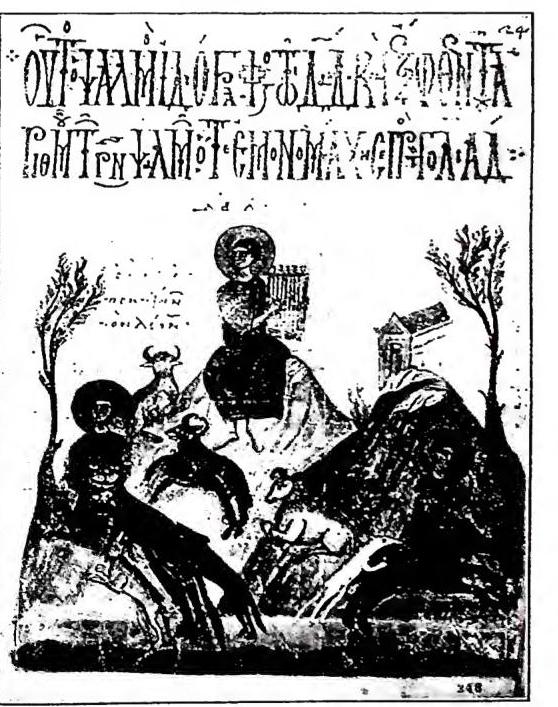
BYZANTINE ART - David playing the lyre.
Illuminated Psalter for a Byzantine emperor of the 12th century.
Vatican Library, cod. Barb. gr. 372.
in the architecture of the eastern provinces compared to those of the West throughout the Middle Ages. While in the West, which had nonetheless created and developed domed central-plan buildings, the dominant "type" of church for liturgical synaxis remained the ancient Early Christian basilica with a longitudinal plan, the Christian East, due to the aforementioned precise symbolic intention, adopted, made its own, and transmitted across the centuries the central-plan and domed architectural module, which was not originally its own.
The masterpiece of this new Byzantine basilican architecture is Hagia Sophia in Constantinople, built for Justinian in five years (532-37) by Anthemius of Tralles and Isidore of Mileto.
The great church, even in its dedication (Divine Wisdom), attests to the "Pseudo-Dionysian" concept it seeks to embody. Architecturally, it stands, alongside San Vitale in Ravenna, as the highest achievement of Late Roman building art.
Unlike all other ancient architectures, particularly Greek and Hellenistic, Roman architecture had founded its expression on the internal space of the building: the typical Roman monument is the Pantheon, formed by a block of internal space defined by a continuous and unitary cylindrical wall, crowned in elevation by a dome. This internal spatial form persists even in Late Roman architecture, in which, however, the central space block is no longer defined by a solid wall but by a perforated wall, surrounded in turn by smaller spaces (niches, ambulatories) and thus transformed into an "optical," chiaroscuro wall ("Temple of Minerva Medica," Santa Costanza, San Lorenzo in Milan, San Vitale in Ravenna). On such a wall, dissolved into color, a coherent decoration can only be chromatic: hence, in these Late Roman buildings, sculpture (capitals, friezes, transennas, etc.) becomes a kind of marble lacework devoid of any plasticity, and painting a decoration of purely chromatic significance (mosaics).
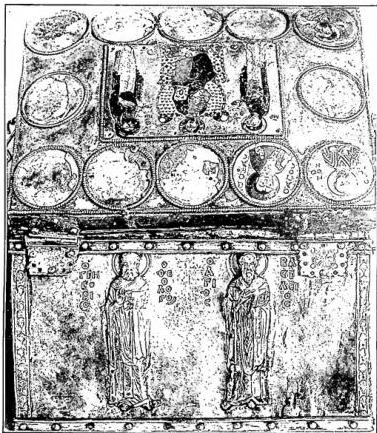
BIZANTINA, ARTE - Reliquary casket of St. Praxedes from the Sancta Sanctorum (11th century) - Vatican Library, Sacred Museum.
In the history of civilization, particularly artistic, the art that re-emerges in Byzantium under the Macedonian dynasty appears by now detached from its late-Roman and paleo-Christian roots, assuming more "national" forms, less grandly Roman and pervaded by a nostalgic aspiration toward the impossible resurrection of the great Hellenic past. This is not, of course, a true neo-Hellenism: a hasty reflection on the fact that classical Greek art was the most fully plastic of all, while Byzantine art was, with nearly equal absoluteness, a chromatic art, would suffice to expunge such a notion from the vocabulary of any concrete history or criticism. And if in the sculpture and painting of the Macedonian, Comnenian, and finally Paleologan dynasties certain figures of Greek art resurface—albeit reduced to bodiless shadows of color—the architecture of Byzantium remains, even throughout the period from the restoration of images to the fall of Constantinople (842-1453), always tied to the Roman constructive syntax. Yet its spaces undergo a sort of contraction: the spirit withdraws, losing creative vigor. The creation of this period is the typical Byzantine church, with an inscribed cross, derived from one of the many modules of proto-Christian cruciform martyria. Generally of much smaller dimensions than Hagia Sophia and the other great Justinianic temples, this type of church restricts and articulates the still-Roman expansive spatiality of those structures. The dome, over the center of the nave crossing, is no longer the vast and aerial calotte of Hagia Sophia: reduced in size and raised upon an ever taller and more slender drum, it has become an almost detached globosity, where the figure of space tends to assume, in Hellenic fashion, an almost plastic value. The thrust of the dome is transmitted to the side walls through barrel vaults that extend the four arches supporting it, outlining the Greek cross externally. This external discharge, of late-Roman origin, allows the piers that previously received the fall of the great arches at the crossing to be thinned to an extreme or replaced with slender, graceful columns. The result is a composite spatial form, in which each bay is sharply defined and coordinated around the central domed block, with the same pseudo-plastic sense with which a mosaic figure, for example from Dafni, stands out against its golden background. To this arrangement correspond, with secondary variations, in Constantinople the Budrum Camii (Myrelaion of Romanos Lecapenos, 920-44), the Kilise Camii, the Kariye Camii (Church of the Holy Saviour in Chora, 10th-11th century), the Pantokrator (1126-36), etc.; the first and most famous example of this type of church had been the Nea of Basil I, now lost. The Constantinopolitan model is followed especially in Thessaloniki, which at this time is the "second capital of the Empire": it can be recognized, despite local decorative variations, in the Church of the Virgin of the Blacksmiths (1028), St. Panteleimon (12th century), the Holy Apostles (13th century), etc. The period of the Paleologan restoration, which follows the Latin conquest (1261) and lasts until the fall of the capital to the Turks (1453), brings nothing substantially new to the art of Constantinople, except an accentuation of those decorative preciosities and that exoticizing restlessness already announced in the Comnenian era. In architecture, the module of the "inscribed cross" still dominates, its space moving even further away from the vast Roman expansiveness of its origins. The domes narrow their diameter and rise: reduced almost to lanterns, they withdraw from the image of the church's internal space to assume a purely, sometimes capriciously ornamental value: e.g., Fethiye Camii (Virgin Pammakaristos), etc. It is customary to contrast the Constantinopolitan school, in medieval Byzantine architecture, with a "Greek school" (Millet), where the "inscribed cross" has a more compact module (churches of Attica) and where longitudinal vaulted basilicas also appear, bearing some resemblance to the Romanesque basilicas of the West (Macedonia, Thessaly, Epirus, Crete, Cyprus). Especially in the last period, and in the post-Byzantine era, provincial subgroups can be recognized, in which Constantinopolitan derivation combines with diverse influences, producing varieties interesting from a decorative standpoint but architecturally and constructively less organic (Serbia, Romania, Russia, etc.). A group of particular interest is constituted by the churches of the monasteries of Mount Athos (Great Lavra, founded in 963; Vatopedi, 11th century; Chilandar, 1197, etc.) and the Meteora in Thessaly: always with an "inscribed cross," but with the addition of two apses at the ends of the lateral arms, thus outlining a trefoil plan.
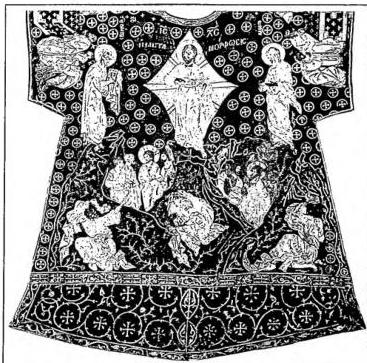
II. SCULPTURE AND MINOR ARTS
The process of progressive decline in sculpture, particularly statuary—understood by classical Greece as a fully plastic expression—which had begun in late Roman and early Christian art, is further advanced by Byzantine art: so it is no surprise, as some (Duthuit) have noted, that statuary almost completely disappears, and sculpture is reduced to architectural decoration or the delicate modeling of precious marble, ivory, and metal reliefs. This is a perfectly coherent process; to understand its meaning, however, it is not helpful to invoke the myth of influences from a romanticized Orient, but rather to consider the particular form that architectural spaces had already assumed in the late Roman and proto-Christian periods. As mentioned earlier, these spaces are no longer defined by solid walls of pronounced materiality, but by thin diaphragms that, transformed into continuous crowns of exedrae, reduce themselves to an alternation of solids and voids, that is, of lights and shadows: thus, to a definition no longer of plastic but of chromatic value. Sculptural decoration, therefore, to remain coherent with this dematerialized spatial form, must abandon all plastic relief and translate itself into a flat chiaroscuro rendering, often achieving results of extreme preciousness.In Hagia Sophia, the vast interior space is a dense, colored fluid, tinted not only by the light or polychrome marbles of the columns, the floor, and the panels covering the lower zone of the church, but also by the shimmering chiaroscuro of the capitals, cornices, transennae, and plutei: carved in low relief with crosses, monograms, or vegetal ornaments, but more often pierced through. A splendid marble lacework, with continuous palm racemes or minute acanthus leaves, covers the capitals shaped like ancient craters (elsewhere resembling baskets of various forms), the parapets of the galleries, and the cornices marking the springing of the arches. This manner of sculpting, flat and chiaroscuro-based, remains constant throughout the millennium of Byzantine art: it not only continues to decorate the churches of the second and third golden periods but also extends to reliefs of anthropomorphic and more generally iconographic subjects that adorn various objects of worship and luxury. This occurs because in Byzantium, as a Roman inheritance, the leading art remains architecture with its particular sense, as described: that is, it is always the structural framework of the object—building or chapel—that prevails and predetermines the plane that sculpture must decorate. Sculpture does not achieve isolated and autonomous forms, as in the "spatial" arts of Greece or the Italian Renaissance. Whether it is a capital or a transenna—that is, architecturally decorated members—or an episcopal throne or an ivory casket—that is, autonomous objects not tied to the structure of a particular building—the relief that unfolds upon them behaves in the same way: it is always kept within the limits of a very delicate modeling, entirely chromatic, so as not to break the unity of the surface it embellishes and decorates, whether this be the wall of a church adorned with marble panels depicting Madonnas or saints, or the front of a sarcophagus, the side of a casket or pyxis, the valve of a diptych, the face of a coin or a seal. And it is understandable, especially considering the great importance that sumptuary arts assume in such a refined civilization, that the highest expressions of Byzantine sculpture are realized in ivory objects. In the time of Justinian, this class of precious small sculptures is represented by the large five-compartment diptychs of religious or secular subjects, continuing the tradition of consular and imperial diptychs (e.g., perhaps the greatest example, the "Barberini Ivory" in the Louvre, depicting an emperor, perhaps Anastasius, on horseback); by pyxides (e.g., among many, the pyxis in Berlin with the depiction of Christ among the Apostles), by boxes for eulogiae, by panels for caskets, furniture, and furnishings. The masterpiece of ivory sculpture of the 6th century is the great throne of Maximian in Ravenna (Museo dell'Arcivescovado), which many scholars consider of Alexandrian origin, especially due to the iconographic character of the panels with the Stories of Joseph the Hebrew; but it is more likely to have been executed, if not in Constantinople itself, in Antioch: both because of the form of the throne, which presupposes visibility from all sides—and thus suggests a use more compatible with the particular dispositions and liturgy of the Syrian church—and also because of the style of the carvings, which approaches that of five-compartment ivory leaves of precisely Antiochene origin (panels of
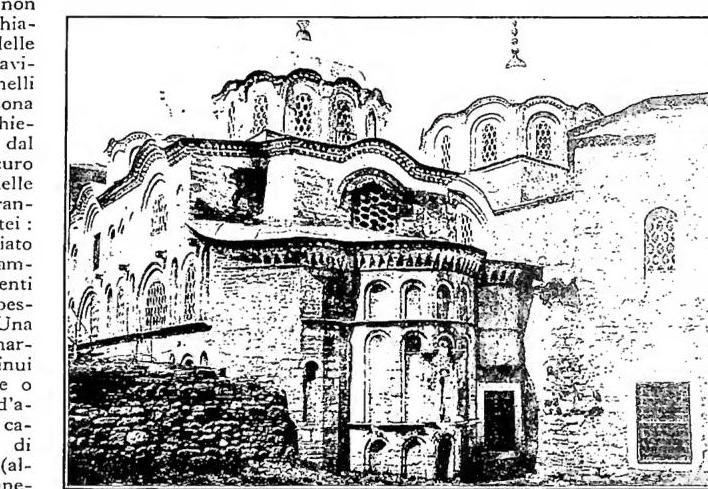
BIZANTINE ART - Funerary chapel near the church of the Panimacristos (mid-14th century) - Constantinople.
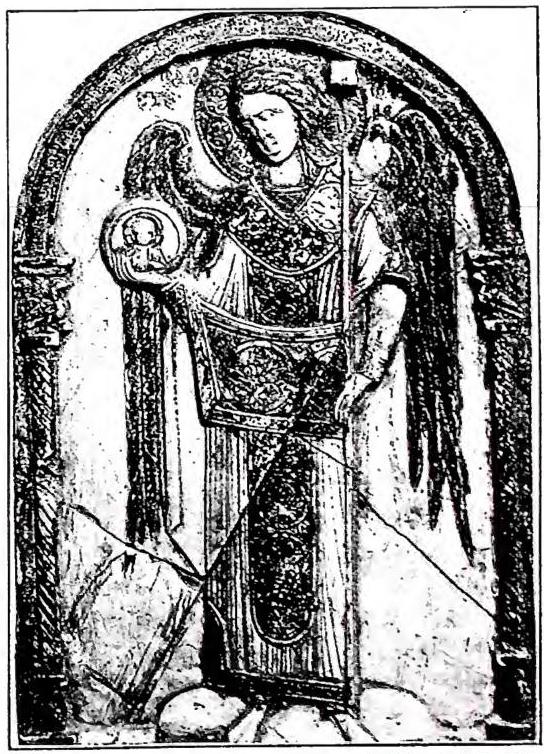
Murano at the Ravenna museum, the British Museum, the Vatican, Etchmiadzin, and the Cabinet des Médailles. In the "second golden period," the production of caskets and ivory reliefs must have been quite intense in Constantinople, judging by the very high number of surviving examples, now scattered across museums in Europe and America, church treasuries, and private collections. Among the most famous caskets are the Veroli casket at the South Kensington Museum and the one at the Bargello in Florence (10th century); among the reliefs—often true ivory icons or triptychs for domestic worship—the most refined are those created by court artists working for the emperors and their circle in the 10th century: notable, also for its chronological value, is the relief in the Cabinet des Médailles depicting Christ crowning Romanos II and Eudokia (Berta of Provence: the ivory thus dates to shortly after 944); particularly fine—perhaps the masterpiece of the series—is the panel with the Virgin and Child at the Archiepiscopal Museum of Utrecht (10th century). It should be noted that several large marble panels from this period resemble ivories both in their sculptural subjects and in the character of their modeling; thus, if in the 6th century the sculpture of small objects in Byzantine art still drew inspiration from monumental sculpture, from the 10th century onward the reverse seems to occur. In any case, even in the large panels we recognize the same broadly spatial and simplified compositions, the same elongated, elegant figures, barely detached from the smooth background by means of a light relief defined by contours of extreme delicacy, varied internally by sharp lines that create the faintest shadows on the surface of the modeling. Many of these panels are found reused outside Byzantium (e.g., in St. Mark’s in Venice); the finest example, though mutilated, is the one with the Orant Virgin, from the Mangana Monastery, now in the Constantinople Museum (mid-10th century). The same style of the ivories is evident in the less common reliefs on steatite (a particularly fine example: the Archangel Gabriel, assignable to the 14th century, in the Bandini Museum in Fiesole) and on other minerals with the most delicate colors; and on silver and goldsmith works. These are rather rare in the first period: most often associated with enamels, they constitute those "cloisonné" or alveolate enamels, whose technique likely derives, perhaps through nomadic intermediaries, from the East, particularly Persia. Famous is the
Nothing remains in Constantinople of the mosaics commissioned by the emperors between Constantine and Justinian; very little even from the "first golden period." In Hagia Sophia, a restoration of the decoration was ordered immediately after the disaster of 558 by Justin II: and it seems, from passages in Theophanes and Corippus, to have included a cycle of scenes from the New Testament. The cleaning currently underway has revealed, especially in the narthex, mosaics of ornamental character (large crosses, rosettes, garlands) of extremely careful execution, most likely dating to the 6th century.
What remains outside Constantinople (St. Catherine’s on Sinai, Cyprus, etc.) has the character of provincial art; except, however, for the admirable Justinian additions to the mosaics of Ravenna (imperial panels in San Vitale; processions of Virgins and Martyrs in Sant’Apollinare Nuovo) and the panels, about a century later, of Thessaloniki (especially in St. Demetrius), which, with their high quality, attest to the work of court artists. During the Iconoclastic period, the production of mosaics did not cease, though it was limited to non-anthropomorphic subjects: an idea of what the decorations of this time in Constantinople (especially in the Palace) must have been like is preserved in the splendid mosaics, commissioned by Islamic patrons but executed by Byzantine artists, of the Dome of the Rock in Jerusalem (691–92) and the Umayyad Mosque in Damascus (ca. 715).
Painting, of course, was not limited to mosaics: fresco decoration must have been quite widespread, although today, from this early period, only provincial reflections remain, particularly in Rome (Santa Maria Antiqua). The late frescoes of Syria and those—equally numerous and most interesting—of Coptic art in Egypt cannot be considered properly Byzantine art. In Constantinople, some traces remain in the crypt of the Odalar Camii (7th century). As for religious manuscripts adorned with miniatures, determining their provenance is highly difficult due to the great stylistic mingling of the time. It is easier to recognize those that follow a rather Roman (or, as others define it, "Alexandrian") pictorial tradition, such as the Vienna Genesis or the Joshua Roll in the Vatican, as distinct from those still tied to the persistent Syrian "neo-Atticism" (the Gospels of Rossano and Sinope). Almost all portable icons from the early period were destroyed during the iconoclastic struggle; a few extremely rare examples, taken from the monasteries of Sinai, are preserved in the Kiev Museum.
In the "second golden period," just as in architecture, so too in the pictorial decoration of Byzantine art, the concept takes precise form that the church must symbolize the divine work of creation and redemption. In the New Church, the Nea of Basil I (867–86), the decorative arrangement was present for the first time in its connected entirety, which was later to become canonical over the centuries in all Greek-schismatic churches. In the dome (the celestial church), one saw Christ the Pantocrator and Demiurge, surrounded by the angelic hierarchies; in the pendentives, the four Evangelists; in the apse (the passage from the celestial to the terrestrial church),
Byzantine bas-relief (stratite) with the Archangel (14th century) - Fiesole, Museo Bandini.
naves (earthly church) the "Great Feasts": representations
of the Gospel narrative from the Annunciation to Pentecost
— with topographical prominence in the body of the church
given to the two most important: the Crucifixion and the Resurrection —;
in the remaining spaces, figures of patriarchs, prophets, martyrs, and saints.
This dogmatic and liturgical arrangement, whose schematism
is also reflected in the interior of individual iconographic panels,
has no surviving example in the capital today; but it can be seen
reflected in the mosaic decorations of two Greek churches:
that of Hossios Lukas in Phocis (c. 998-1050) and that of Daphni in Attica (c. 1080).
The properly Constantinopolitan pictorial style is attested by
two lunettes recently discovered in the great Hagia Sophia:
one from the time of Leo VI (886-912), the other slightly later.
To the various currents into which the art of mosaic in the Byzantine Middle Ages branches,
other great provincial decorations can be assigned: at Hagia Sophia in Kiev (c. 1037),
at the Church of the Dormition in Nicaea (1025-28), now destroyed;
at the Nea Moni on Chios (1042-56), etc.; to one or another of these currents,
still not well defined, can also be linked large portions of execution or direct Byzantine influence
in the great Italian mosaic decorations: especially in Venice (St. Mark's) and elsewhere along the Adriatic coast,
and in Sicily. In the "third golden period," the art of mosaic experiences a final splendid revival in Byzantium:
its masterpiece is the decoration, fortunately almost entirely preserved,
of the two narthexes and part of the naos of the Kahrie Djami (from 1303):
a work of unparalleled chromatic refinement; the ultimate, most mature result of a figurative civilization
entirely devoted to color, already on the verge of decline, which has left us here its true swan song.
A more popular and narrative character is generally preserved by frescoes, of which,
if we except those of the parekklesion (an annex to the church) in the same Kahrie Djami,
almost contemporary with the mosaics, only examples from the provinces have survived,
and thus reveal, to a greater or lesser extent, provincial accents: from those of the rock-cut churches of Cappadocia,
to those of Russian churches (e.g., Nereditsa near Novgorod, 1199) or Macedonian churches (e.g., Nerez, 1164),
or Serbian churches, or those of the island of Crete. Here, at the end of the Middle Ages,
a highly prolific pictorial school developed, which then spread works and artists throughout Greece
(especially in the numerous churches of Mistra and, after the fall of the Empire,
in the monasteries of Mount Athos, Meteora, and elsewhere in the Balkans:
where it stood alongside the "Macedonian school"). The Cretan painters,
who were the most direct and faithful heirs of the properly Constantinopolitan tradition,
also moved in large numbers to Venice and the Ionian Islands: gradually absorbing
ever greater influences from Venetian art, they constituted that school of painting,
especially of icons, known as the Cretan-Venetian school, which, permeating all of Christian
Oriental art with its images, slowly transformed its tenaciously Byzantinizing artistic culture
into a properly European one. For, especially in the last period,
and in the post-Byzantine era, it is the painting of icons that undergoes predominant development:
and these panels, the work of painters almost exclusively Cretan or Ionian, active in Venice
or in lands remaining under Venetian rule, spread as isolated objects of worship,
or grouped in the great iconostases of churches, throughout the Greek-Orthodox world;
alongside the precious, and far rarer, portable mosaics (e.g., panels in the Museo dell'Opera del Duomo in Florence).
Among illuminated manuscripts — which in the
"second golden period" reach an exceptionally high artistic quality —
Gospel Books continue to be in vogue, as well as, from the Old Testament,
the Octateuchs (containing the first eight books of the Bible); but the preference
of medieval Byzantines goes to the Psalter, which can be illuminated
following two systems: that of marginal miniatures (e.g., the Chludov Psalter in Moscow, 9th century),
and that (e.g., the famous Paris gr. 139) with full-page plates illustrating the life of David
and the canticles that follow the Psalms. Other books widely circulated in the
Byzantine Middle Ages, often splendidly illuminated,
are the Menologia, which illustrate the lives of the saints
according to the calendar (e.g., the Menologion of Basil II in the Vatican).
In the third period, there are still splendidly illuminated "frontispieces" even in
books of secular subjects, such as the Chronicle of Skylitzes in Madrid (14th century);
and the works of John Cantacuzenus (1341-54), with two beautiful full-page portraits of the author:
depicted in one in imperial costume, in the other in the black habit of monks (Paris, Bibliothèque Nationale, gr. 1242); etc.
Byzantine art was not confined to the geographical and chronological limits of the Empire.
Throughout the Middle Ages, its works served as models (its civilizing historical function was precisely this)
both for the barbaric and post-barbaric West (to whose art it yielded, more than its style, fundamental iconographic modules),
and especially for the barbaric and Slavic East, to which it provided the very foundations of a figurative culture
that long outlived the fall of Byzantium; and it constituted the basis of the "national" arts
of those peoples: we may say until no more than two centuries ago, that is, until the moment of their laborious adherence
to the post-Renaissance art of Western Europe.
Vedi Tav. XCIX-C.
BIBLIOTHE: O. Wulff, Altschristliche u. byz. Kunst, Berlino 1914;
L. Bréhier, Art byz., Parigi 1924; Dalton, *Byz. art and archaeo-
logy, Oxford 1925; C. Diehl, Manuel d'art byz.*, ivi 1925-26;
id., Choses et Gens de Byzance, ivi 1926; id., *L'art chrétien pri-
natif et l'art byz., ivi 1928; G. Millet, Orient et Byzance*, ivi
1930; A. Goldschmidt e Wietsmann, *Byz. Elfenbeinshaupt des X.-
XIII. Jahrb., 1931; S. Gasson, Bizantinium, in The Burlington
Magazin for Connoisseurs, 59 (1931), pp. 208-13; Creswell, Early
Muslim Architecture, I, Oxford 1932; H. Peirce e R. Tyler, Art
byz., Parigi 1932; C. Diehl, La peinture byz.*, ivi 1933; J. Arnott
Hamilton, B. Architecture and decoration, Londra 1933; J. Ebers-
olt, Manuments d'architecture byz., Parigi 1934; J. Szczypowski,
Die Wandlungen der byz. Studien seit ihrer Begründung, in *Boll.
Inst. Arch. Bulgare, 6 (1935), pp. 69-80; D. Talbot Rice, Byz.
art, Oxford 1935; W. J. Wolbach, L'a. b. nel medioevo*, Roma
1935; A. Grabar, L'empereur dans l'art byz., Parigi 1936; L. Bré-
hier, La sculpture et les arts mineurs byz., ivi 1936; J. D. Ste-
tinescu, L'illustration des Liturgies dans l'art de Byz. et l'Orient,
Bruxelles 1936; S. Bettini, L'architettura b., Firenze 1937; id.,
La pittura b., I, ivi 1937; W. Zaloziecky, *Die Sophienbische
in Konstantinopel, Città del Vaticano 1937; C. Cecchelli, Studi
d'archeologia e di st. dell'arte del tardo Impero e del periodo b.*, in
Felix Ravenna, 1 (1938), pp. 40-56 (con bibl. dal 1925 al 1938);
A. Grabar, L'art byz., Parigi 1938; S. Bettini, I massici b., I e
II, Firenze 1939; D. T. Rice, The aesthetic basis of Byzantine art,
in Lich., 2 (1939), pp. 1-6; O. Wulff, *Altschristliche und byzantin-
ische Kunst (bibliogr. critica), Potsdam 1939; G. Millet, Les études
byzantines au Congrès d'Alger, in C. R. Accad. Incrp.* 1940,
pp. 137-56; G. de Jerphaniou, *Bulletin d'archéologie chrétienne
et byz., in Orient. christ. per.*, 6 (1940), pp. 140-97; S. Bettini,
Scultura b., I e II, Firenze 1944; id., Architettura di S. Marco, Padova
1946; A. Grabar, Martyrion, Parigi 1946; A. Muñoz, *Alcune
fonte letterarie per la st. dell'a. byz., s. n. t.; R. Dussaud, Ré-
flexion sur l'a. byz., in Orientalia christiana periodica*, 13 (1947),
pp. 1-2; Th. Whittemore, The Mosaics of A., Sophia at Istanbul,
rap., I (1933); II (1936); III (1947). Sergio Bettini