
DAFNI. - The monastery and church of D. are located 10 km from Athens, on the road that led to Eleusis. The complex, dedicated to the Dormitio of the Blessed Virgin, occupied a quadrangular enclosure of approximately 100 sq. m and was built at the end of the 11th century above a more spacious early basilica and an earlier monastery. The church was preceded by a portico and a narthex. Inside, the dome covers the entire square, onto which three apses open; it rests on four double arches and four pillars.
The iconostasis was richly decorated with marble (fragments are in the Athens museum). But D.’s splendour consists in its mosaics, rich in pictorial effects despite the restraint of their colours. At the summit of the dome, on a gold ground, is the Pantocrator at the centre, surrounded by 16 prophets arranged between the windows of the drum: Mosè, David, Isaia, Salomone, Elia, Eliseo, Giona, Habacuc, Sofonia, Malachia, Daniele, Michea, Gioele, Zaccaria, Ezechiele, Geremia.
At the four corners are the Annunciazione, the Natività di Gesù Cristo, the Battesimo, and the Transfigurazione. In the central apse is the Most Holy Virgin, between the archangels Michele and Gabriele. In the apse of the prothesis is the Prodromo with the priests of the ancient covenant, Aronne and Zaccaria. In the diaconicon are the three bishops Nicola, Gregorio il Taumaturgo, and Gregorio d'Agrigento.
Under the arches, standing beside the niches, are four bishops: Silvestro, Antimo, Eleuterio, Abercio; beside the central square are four deacons: Stefano, Rufino, Lorenzo, Euplo. Above, in the medallions over the trefoil windows, are the saints Probo, Taraco, Andronico, Samonas, Gourias, and Abido. Above the side doors leading to the narthex are the busts of Sergio and Baeco; beneath the four arches, to the north, Acindino, Pegaso, Aftemio, Elpideforo, Anempodisto; to the south, Eustrazio, Aussenzio, Eugenio, Mardario, and Oreste.
In the second zone are the Natività della Vergine, the Annunciazione, the Natività di Cristo, the Adorazione dei Magi, the Presentazione al tempio, the Battesimo, the Trasfigurazione, and the Resurrezione di Lazzaro.
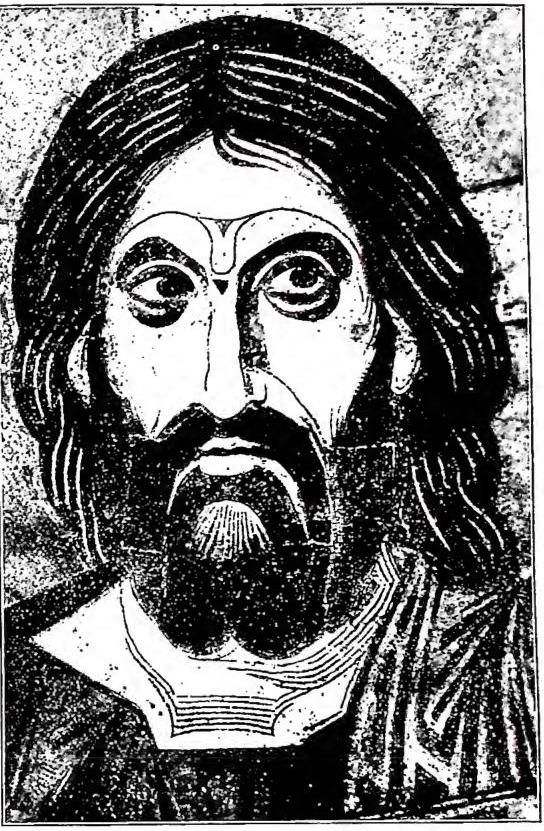
(courtesy of mons. A. P. Frutaz)
DAFNI - Detail of the Pantocrator. Mosaic from the end of the 11th century.
In the narthex, to the north, the Betrayal of Judas, the Washing of the Feet, the Last Supper; to the south, the Prayer of Joachim and Anna, the Purification, the Presentation in the Temple.
Approximately 100 m. southeast of the enclosure there is a vaulted chapel with an ossuary. In 1211 the monastery was occupied by a Cistercian community. In 1217 Pope Honorius III entrusted the abbot of D. with an investigation into abuses in the archdiocese of Thebes (J. B. Pitra, Analecta novissima, I, Frascati 1885, p. 558). The duke of Athens was buried at D. in 1263.
The abbots of D. were Stephen in 1237, Giovanni in 1250, Pietro in 1283, Giacomo in 1308, and Pietro Strasberch in 1412. The Cistercians left D. in 1450; thus the Latin church disappeared, and in the 16th century the Orthodox took possession of it, as attested by two inscriptions, one from 1532 and the other from 1548. It subsequently served as a garrison and even as an asylum from 1885 to 1885.
The buildings were damaged by earthquakes in 1889 and 1894. The Society of Christian Archaeology of Athens explored the monastery and began the restoration work, directed by the architect Troump of the French School at Athens; the mosaics were restored by Venetian artists.
The Christian inscription of a Callopis was found at D. (v. V. Chapot, Inscription chrétienne à Daphne, in Bulletin de la Société nationale des antiquaires de France, 64 [1903], pp. 200-201). - Vedi tav. LXXIV.