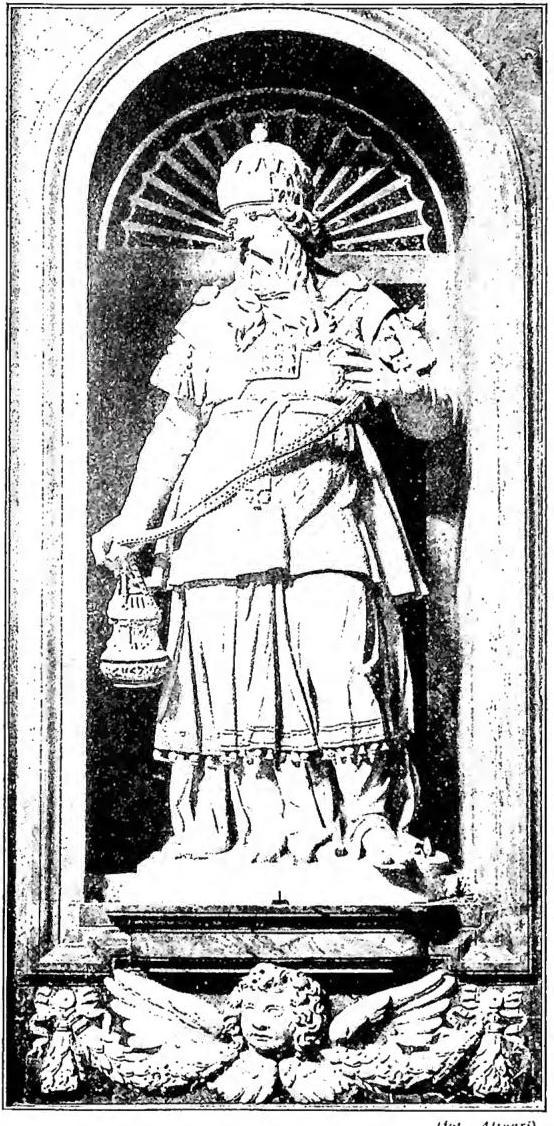
ARONNE (Heb. 'Ahārān, of uncertain etymology). — First high priest and founder of the priesthood of Israel. The firstborn of Amram, son of Caath and Iochabed, both of the tribe of Levi, brother of Moses and Maria (Mirjām), he was born in Egypt three years before Moses (Ex. 7:7), with whom he remained closely associated. At the beginning of his mission with Moses he was 83 years old.
In the theophany at Horeb, Jahweh assigned him to Moses, who had objected on account of his difficulty in speaking, as an interpreter (“prophet”) before Pharaoh (Ex. 4:10, 16; 7:1). He communicated to the elders what Jahweh had revealed to Moses, and by means of miracles gained the people’s confidence. He accompanied Moses before Pharaoh to obtain permission for the Hebrews to go out into the desert (Ex. 4:27-31); but the negative outcome of this undertaking worsened the servile condition of the Hebrews, who became indignant against the two brothers. A. performed with his rod (or Moses’ rod, Ex. 4:2) the miracles of the serpent devouring the rods of the magicians, and of the first three plagues: the waters of the Nile changed into blood, the invasion of frogs and of gnats (Ex. 7:10-8:19). Moses’ constant assistant, he received Jahweh’s commands together with him (Ex. 9:8; 12:1, 28, 43, 50). The people associated them equally in their trust and in their murmuring and rebellions (Ex. 16:2). Ps. 76:21 regards both of them as liberators of Israel.
In the desert of Sin A. collected an omer of manna to preserve it in the Tabernacle (Ex. 16:32-34), thus beginning his office as minister and guardian of sacred things. At Raphidim, with Hur, he supported Moses’ arms in prayer until the complete defeat of the Amalecites (Ex. 17:8-16); on Çebel Mûsâ he had the majestic vision of God (Ex. 24:10). As Moses ascended Sinai, he entrusted A. and Hur with resolving whatever difficulties might arise among the people (Ex. 24:9-14). But when Moses prolonged his absence, he yielded to the people’s request and, with the jewels they offered, made a golden calf, before which he erected an altar and sacrificed burnt offerings and peace offerings, declaring that day a “solemn feast of Jahweh” (Ex. 32:1-6):
a grave sin, though it does not appear to have been idolatry (it was not a question of the Apis bull worshipped at Memphis), but rather a violation of the strict prohibition against materially representing God (Ex. 20:4 ff.). Rebuked by Moses, A. was unable to justify himself; 3000 men (the Vulgate has 23,000) were put to death by the swords of the Levites (Ex. 32:21-28). A. obtained forgiveness from the Lord through Moses’ prayer (Deut. 9:20), since he had been destined for the high priesthood (Heb. 4:4).
The election of A. and his sons to the priesthood is already mentioned in Ex. 28-29 (cf. Num. 8 and 18). A. was consecrated high priest (and his four sons priests) with the solemn ritual set forth in Ex. 29, on the plain of er-Rahab, where the transgression had occurred. For seven days Moses offered sacrifices, while A. and his sons remained secluded from the people. Then A. himself sacrificed victims, blessed the people, and entered the Tabernacle with Moses: the “glory of the Lord” appeared over it, and a fire from heaven consumed the burnt offerings (Lev. 8-9). But ABIA (v.) were struck down for profaning the altar. The “blessing” in God’s name (Num. 6:23-27) is reserved to A. and his sons as a priestly prerogative (Gen. 14:18 ff.; Deut. 10:8; 21:5).
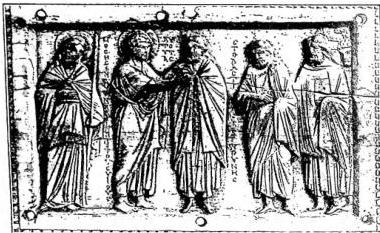
(phot. Enc. Cutt.)
ARONNE – Moses consecrates A. as high priest.
Ivory plaque (11th century) – Bologna, Museo Civico.
causing his staff (almond tree) to blossom and bear fruit among those of the leaders of the 12 tribes deposited in the Tabernacle; by divine command, A.’s staff was preserved there as a perpetual memorial (Num. 17, 1–11 [Heb. 16, 16 ff.]; cf. Hebr. 9, 4).
Thirty-seven years later, in the desert of Kades, A. hesitated, together with Moses, in his trust in God, when the latter struck the rock twice with his staff, from which water gushed forth to quench the thirst of the murmuring people; therefore God punished them by denying them entry into the Promised Land (Num. 20, 1–12). Four months after this condemnation, in the 5th month of the 40th year after the exodus, while the Hebrews were encamped at the foot of Mount Hor, God
ordered Moses to lead his brother up the mountain, because the end of his life had come. There Moses stripped A. of the garments of the high priest and clothed his son Eleazar in them. A. died at the age of 123 and was buried in a cave on the mountain.
The people mourned for 30 days (Num. 20, 22–30). Num. 33, 38 and Deut. 32, 50 place his death at Hor, Deut. 10, 6 at Mosera; the discrepancy is only apparent, since Hor coincides at least in part with Mosera (the present-day Çebel el-Madérah, near Kades, seems to correspond to it). On the highest summit of Çebel Nebi Hârûn (near Petra), identified by an ancient tradition with Mount Hor, a building (not earlier than the 13th century A.D.) is venerated by the Arabs as the “tomb of A.”
A. had married Elisabeth, daughter of Aminadab of the tribe of Judah (Ex. 6, 23; Num. 1, 7), by whom he had four sons: Nadab, Abiu, Eleazar, IOATHAM (v.). The descendants of the last two perpetuated the priesthood.
A. was “very great and like Moses” (Eccli. 45, 7): less zealous and energetic than his brother, like him he devoted himself to his people; he was patient and pious; with Moses he was obedient and faithful (except at Haseroth, where, together with his sister, he disparaged Moses on account of his “Cushite” wife, Num. 12). John the Baptist descended from his lineage. In the Byzantine liturgical books he is commemorated on 20 July, whereas in the Western Martyrologies he is noted on the first of the same month (cf. Martyr. romanum, p. 264).
With the inauguration of his priesthood, Jesus Christ abrogated that of A., a figure lacking efficacy in itself, like the Mosaic law into which it was incorporated (Hebr. 7, 11–23).